
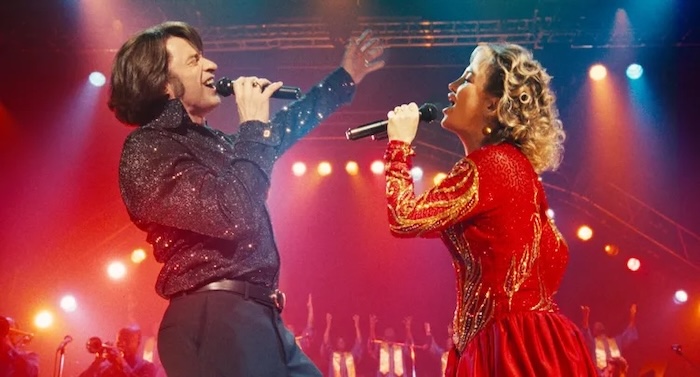
As a producer-director, Craig Brewer has made a lot of music-related narrative works, including the florid hip-hop industry dramas Hustle & Flow and Empire, which address the business side of major label music more than the creative side. He’s never done a standard music biopic until Song Sung Blue, which isn’t about the real-life Neil Diamond, the composer of the title song, but rather a real-life Neil Diamond cover act, and it fits Brewer’s usual rationale by deriving most of its drama from the money angle, or, more precisely, the lack-of-money angle.
As a portrait of a subculture, the movie starts strong with a jaded take on the nostalgia-act trade that has flourished since the 1980s, introducing recovering alcoholic Mike Sardina (Hugh Jackman), a full-time freelance car mechanic, Vietnam veteran, and part-time musician who plays guitar with a Milwaukee R&B outfit when he isn’t impersonating singers like Don Ho for a friend (Michael Imperioli) who stages occasional variety shows for “the blue-haired crowd.” Mike’s dream, however, is to sell his own rock act as a character called Lightning, and his enthusiasm sparks a fire underneath hairdresser and fellow impersonator Claire Stengl (Kate Hudson), whose specialty is Patsy Cline. She persuades him to narrow his act down to his admiration of Neil Diamond. With Claire playing keyboards and providing harmonies and Mike on guitar and appropriately stentorian lead vocals, the pair peddle themselves as Lightning and Thunder, not so much a Diamond tribute act as a Diamond “interpretive” act, since Mike’s stage persona is even more outlandish than Diamond’s. And while Brewer, with the invaluable help of Jackman—certainly Hollywood’s most shameless showman—and Hudson, delivers mightily with a series of full-length Diamond stage productions, the movie is mainly about Mike’s and Claire’s eventual marriage and financial difficulties, since they put everything into their act at the expense of their children (from previous marriages) and their own well-being. When Claire is laid up after a horrific accident, their dream of fame, which the movie posits as within the realm of possibility, is waylaid, rendering the comeback road long and painful. Brewer appropriates the music biopic arc of success-downfall-resurrection for a couple who are always poor in terms of material comforts, a great idea he can’t quite pull off since the melodrama is laid on too thick owing to the lower middle class milieu, which, despite the spot-on production design, demands as much corn as heart.
The predictability of the dramatic beats also undermines the movie’s “based on a true story” conceit, since the highs and the lows feel so schematized. Even the elements that make it seem stranger than fiction—the pair’s unlikely opening slot for Pearl Jam, for instance—have a canned quality that fortifies the sentimentality while smoothing out the working class grit that gives so much of the performance—whether musical or thespian—its power.
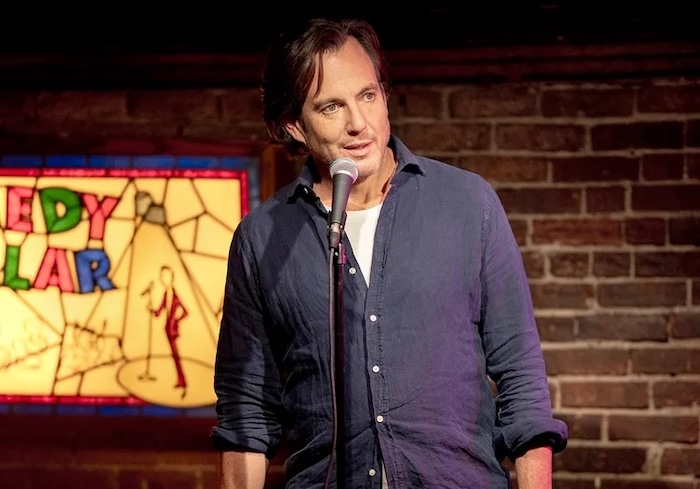
Performance is even more of a psychic salve in the comedy Is This Thing On?, which is also supposed be based on a true story, though liberties were obviously taken with it; not because it’s melodramatic the way Song Sung Blue is but rather because it’s sometimes too brainy for its own good. Will Arnett plays Alex Novak, a “man in finance” raising a family in a posh Long Island suburb who, as the movie opens, is getting set for his first night away from his family as he and his wife, Tess (Laura Dern), prepare to separate after 12 years of marriage, wondering desperately how to break the news to their two young sons. For Alex the split is already proving to be traumatic, despite the jokey tone of the script, and when, high on edibles, he’s confronted with spending his first night alone in his newly rented Brooklyn apartment he opts to instead get a drink, but the nearest bar is having standup night and there’s a $15 cover, a charge Alex refuses to pay so he signs up as a performer without actually thinking he’ll be called, but, of course, he is. Alone on stage with no material and ten minutes to kill, he does the only thing he can, and explains the end of his marriage. It would be tempting to say a star is born, but director Bradley Cooper knows that the audience would never buy such an assertion. Suffice to say that the crowd’s positive reaction makes Alex feel better than he has for a long time.
Though the movie is more about Alex’s attempts at saving his marriage than it is about his burgeoning comedy career, the stage routines are carefully curated not only for their relevance to Alex’s attempts at self-therapy but as actual effusions of creativity, and while I found them less than hilarious, their organic integrity presents Alex as a sympathetic soul, one who may not have been as effective a husband and father as he wanted to be, but nevertheless someone who thought profoundly about such matters. Cooper and his co-scenarists, Arnett and Mark Chappell, make a major error by downplaying Alex’s real job—we only see him once on his way to work in a suit and tie—since it isn’t clear how he can afford a huge house in the suburbs and a fairly big apartment in Brooklyn without taking out a second mortgage, especially given the fact that Tess is only now thinking of getting back into the job market (as a volleyball coach—she was once on the US Olympic team). The one point you had to concede to Song Sung Blue is that the economics of the Sardina household figures centrally in the movie’s dramatic effectiveness. In Is This Thing On? it feels more like an inconvenient detail, especially when we compare Alex and Tess’s circumstances to those of their friends Balls (Cooper) and Christine (Andra Day), a much more bohemian couple who are also thinking of divorce.
The movie’s gravy is its insider look at the rookie standup scene in New York. Key to Alex’s enlightenment with regard to his self-worth is the acceptance by this scene of his native talent. But there’s no indication that Alex is going to be able to give up his day job for a comedy career (another reason why it would have been more interesting if we saw what that day job entailed), an admission that grounds the movie in a more believable reality than the one we get in Song Sung Blue; but it’s supposed to be a comedy, and it succeeds on that level.
Song Sung Blue now playing in Tokyo at Toho Cinemas Hibiya (050-6868-5068), Toho Cinemas Shinjuku (050-6868-5063), Kino Cinema Shinjuku (03-5315-0978), Shibuya Cine Quinto (03-3477-5905), Toho Cinemas Roppongi Hills (050-6868-5024).
Is This Thing On? now playing in Tokyo at Toho Cinemas Hibiya (050-6868-5068), Toho Cinemas Shinjuku (050-6868-5063), Bunkamura Le Cinema Shibuya Miyashita (050-6875-5280).
Song Sung Blue home page in Japanese
Is This Thing On? home page in Japanese
Song Sung Blue photo (c) 2025 Focus Features LLC
Is This Thing On? photo (c) 2025 Searchlight Pictures

