
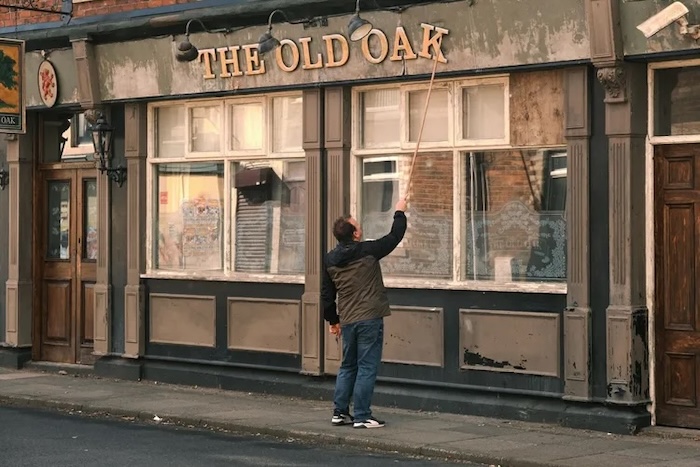
The Old Oak, the title of what is reported to be Ken Loach’s last film, refers to a superannuated pub in Durham, a small town in northern England that was once sustained by a local coal mine, which closed some time ago, thus leaving the residents in an almost perpetual state of economic uncertainty. So far, so Loachian. But, as usual, the director’s long-time scenarist, Paul Laverty, has injected a topical element that makes the movie more relevant than almost anything else you’ll see in a theater this year. The town’s population is now being supplemented by carloads of Syrian refugees whom the British government through an NGO is transplanting to vacant properties there without any input from the natives, and the latter aren’t very thrilled. The exception is TJ (Dave Turner), the owner and operator of the Old Oak, which is the community’s de facto town hall, where all grievances and gossip are aired openly and often loudly in the region’s colorful and often impenetrable vernacular. TJ, a soft-spoken, middle aged salt-of-the-earth type, seems to be the only resident who welcomes the newcomers as he is assisting the NGO in helping them settle in, and in time becomes not only their principal champion, but the moral conscience of the community.
As always in a Loach/Laverty production, worst-case scenarios rule, and the refugees’ loss of homeland and family are exacerbated by the unhinged prejudice they confront in their new, strange surroundings; which isn’t to say Laverty is unsympathetic to the locals’ own troubles, but rather that he can’t ignore the huge gap in their level of suffering. The first affront cuts deep. One of the young refugees, Yara (Ebla Mari), is an amateur photojournalist, and she starts taking pictures of her new home as soon as she arrives, attracting a bunch of hooligans, one of whom snatches her camera. She eventually recruits TJ, the only kind face she encounters, to get it back for her and he agrees, humiliated by the boorishness of his compatriots. In the meantime he gives her an old working camera that’s been gathering dust in his back room, and the gesture offers him the opportunity to show Yara his own collection of historical photos of the town as well as regale her with a capsule history of the mine and its subsequent closure. In turn, Yara talks about her family’s escape from ISIS terror and the fact that her father remains in Syria, his whereabouts and situation unknown. Though the conversation is emotional and expository in equal measure, a device that Laverty and Loach always use to put across their socialist-working class-world citizen proclivities, it’s so plainly presented and passionately acted that you can’t help but fall under its intended spell.
Subsequently, the actions of TJ’s neighbors can come off as unspeakably cruel, especially when their resentments of these Arabic-speaking, hijab-wearing interlopers spill over and result in the death of TJ’s canine companion. Laverty almost pummels us with wonkish factoids, like the attendant crash in property values and the paucity of social welfare for retirees, in order to strike a balance, but since the Syrians are at such an obvious disadvantage—even the NGO that brought them here is hard-pressed to do anything more—all empathy leans toward them. In the end, the dramatic components can overwhelm the social reality, which holds that the town is a victim of capitalist exploitation rather than bureaucratic neglect. Fans of Loach can of course expect a final act reckoning, and at risk of revealing spoilers, this time he extends some hope, not only for the refugees but for the town, if only because the residents finally recognize their better angels through the community-minded agency of TJ, one of the best characters Laverty and Loach have ever created. If this is their last film, it’s a beautiful way to go out.
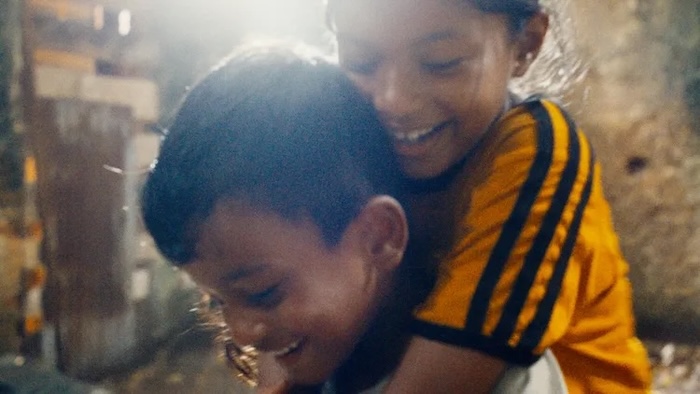
The refugee story in Lost Land describes the journey rather than the destination, and it’s a harrowing one. Writer-director Akio Fujimoto has made the plight of displaced Asians his preferred topic in his work—he has lived and worked in Myanmar—and here he focuses on Rohingya siblings who are fleeing a refugee camp in Bangladesh for what they hope is a better life in Malaysia, where some Rohingya have formed their own community. Fujimoto’s presentation is documentary-like but it’s clear from the beginning that he will use whatever dramatic tools at his disposal to make you feel what these individuals are going through, and while some of it may feel contrived or inappropriately staged, overall it makes the necessary impression.
Since the siblings, Shafi and Somira, are, respectively, 4 and 9 years old, an atmosphere of imminent peril is never absent from the movie, which shows them losing their initial guardians—a grandfather and an aunt—and falling under the care of a series of shady characters. Inevitably they and their fellow travelers lose their way due to unforeseen circumstances, including bad weather, unscrupulous traffickers, and illness, which continually upset whatever flimsy plans have been formulated on the fly. Fujimoto keeps the viewer clued in on how the trip keeps getting sidelined. When the group ends up in Thailand by mistake, it’s pretty much every refugee for themself, and the possibility of the two children actually reaching their destination feels more and more remote.
Fujimoto contrasts the realistic unpleasantries with dreamlike passages meant to recreate the kind of wonder that a child might feel when confronted by raw nature, and the elliptical narrative can be confusing in terms of navigating the story’s temporal and geographical contours. Unlike The Old Oak, it’s a movie that doesn’t inspire much in the way of hope, which is perfectly understandable because the actual Rohingya situation remains dire. It’s unlikely this kind of movie can affect that situation in any meaningful way, but it makes for an emotionally jarring experience.
The Old Oak, in Engish and Arabic, opens April 24 in Tokyo at Human Trust Cinema Yurakucho (03-6259-8608), Shinjuku Musashinokan (03-3354-5670), Human Trust Cinema Shibuya (03-5468-5551).
Lost Land, in Rohingya and Malay, opens April 24 in Tokyo at Human Trust Cinema Yurakucho (03-6259-8608), Kino Cinema Shinjuku (03-5315-0978).
The Old Oak home page in Japanese
Lost Land home page in Japanese
The Old Oak photo (c) Sixteen Oak Limited, Why Not Productions, Goodfellas, Les Films du Fleuve, British Broadcasting Corporation, France 2 Cinema and the British Film Institute 2023
Lost Land photo (c) 2025 E.x.N K.K.
 philipbrasor.com