
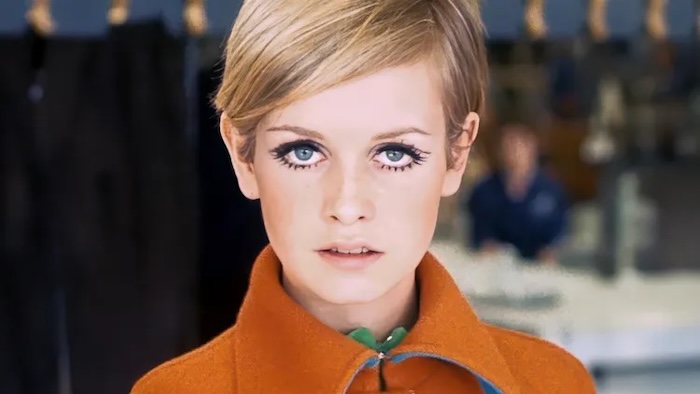
The moral of the story that comes through in Sadie Frost’s fawning documentary about 60s fashion icon Twiggy—born Lesley Hornby to working class parents in Cockney London in 1949—is that good character will always hold sway even during the most difficult personal travails—not that Twiggy ever suffered any truly catastrophic setbacks. It’s more that her no-nonsense attitude, coupled with a disarming candor and a modest native talent for every vocation she tackled, went far to make her the star that she has remained throughout her life. I mean, at 77 years old she’s still quite the celebrity item, as this movie takes great pains to point out.
It helps that she started out in iconoclastic mode. As a fashion model who never aspired to be one, she arrived at 16 as an anomaly—rail-thin, childlike, with a short, boyish hairstyle and eyes whose elfin purity was enhanced by her own makeup choices inspired by her stuffed toys. Given Twiggy’s preternaturally blase take on the business, it required others to provide the initiative that would send her fame soaring, mainly her much older boyfriend/manager Nigel Davies, who assumed the posh moniker Justin de Villeneuve in order to promote his own brand, and therein lies the difference. De Villeneuve was an obvious phony, while what you saw with Twiggy was exactly what you got: a real girl with hopes, dreams, and enthusiasms rather than a broody chick or a highfalutin’ poser, the image that fashion models manifested at the time. The most delicious sequence is an interview by Woody Allen, who attempts to punch through Twiggy’s celebrity by asking her so-called intellectual questions that will prove her lack of brains, and she effectively turns the tables on his sexist designs. But while Frost makes much out of de Villeneuve’s put-on BBC accent and flair for flashy clothes, she also points out that Twiggy’s success would have been less feasible without his careful direction, which extended to protecting her from predatory photographers and editors (it was previously unthinkable that models be chaperoned to photo sessions by their managers). When de Villeneuve eventually proves to be inconstant and disposable, he leaves the picture, and the movie is a diminished thing for not having any input about him as a private person or, for that matter, even pursuing what happened to him later. He just vanishes from her life, and the movie.
Consequently, the rest of the narrative loses anything that could be called intriguing, since Twiggy goes from one career success to another without the slightest drop-off in popularity or critical favor. Whether she’s tackling acting on screen or stage, singing (country music, no less), product promotion, or even a return to modeling in middle age, Twiggy is nothing if not a smash, and Frost provides a hall-of-fame’s worth of celebrities to testify to her charms and smarts. Most of them are from the British fashion world, which I know nothing about, but there’s also Paul and Stella McCartney, Joanna Lumley, Sienna Miller, Tommy Tune, Brooke Shields, and…Dustin Hoffman? Since Frost doesn’t bother to explain the actor’s relationship to Twiggy his effusive comments feel merely gratuitous, as if he just happened to be in the studio when they were doing interviews. It’s filler, and while the doc does generate a bit of drama with the end of Twiggy’s tragic marriage to American actor Michael Witney, for the most part once de Villeneuve is out of the picture the documentary is a flat bore. Success will sometimes come across that way, no matter how deserving.
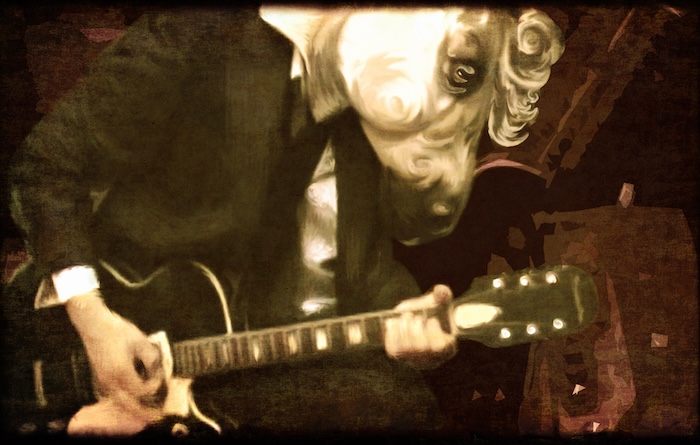
Celebrities of an entirely different stripe comprise the talking heads in the biographical documentary This Is Sparklehorse, about the life of indie singer-songwriter Mark Linkous, who took his own life in 2010. Linkous’s project, Sparklehorse, was an extremely influential alternative rock band in the 90s, at least among the scene’s cognescenti, and many show up here to sing Linkous’s praises, including Gemma Hayes, Tom Waits, Jason Lytle, Adrian Utley, John Parish, Jonathan Donahue, and even David Lynch. Linkous’s music was difficult to describe, but, coming from a rural background in Virginia, he tended toward dark Americana that often layered over into hard rock textures. But it was his voice, thin and frail, that made the starkest impression, not to mention his cracked lyrics that alternated doom with hope, and which made him a difficult artist to not only market but like unconditionally.
The directors Alex Crowton and Bobby Dass fashion a movie that’s equally impressionistic, thus blurring a lot of the factual material, much of which is provided through interviews with those closest to Linkous. It’s obvious from an early age that he suffered from mental illness that was difficult to diagnose due to his low-energy behavior. Though his background as a musician was in thrash metal, he never presented as a headbanger, and once he created the Sparklehorse persona he donned a cowboy hat and effected the air of an Appalachian hermit who read Southern Gothic literature. He was never an urban person, and as the years accumulated and his notoriety blew up in certain indie circles—especially in the UK, where bands like Portishead and Radiohead anticipated every new release—he grew more reclusive while the music became denser and less bothered by things like overt melodies. Many admirers, including Lynch, found these developments “beautiful” (the most common adjective used in the doc), though, of course, they never made Linkous a rich man or even a financially solvent one.
Crowton and Dass concentrate as much on Linkous’s health situation as on his music, and while such attention can seem ghoulish given the stylistic decisions—low lighting, purposely scratchy visuals—they do an admirable job of presenting the artist as a real identifable human being with genuine emotional problems. As Lynch says at one point, Linkous conveyed “vulnerability and not a lot of self-worth.” The tragedy This Is Sparklehorse explicates so well is that Linkous never saw the value of his work in the same way others did, and while that’s true of many artists in his case it was especially damaging to the view he had of himself.
Twiggy opens April 24 in Tokyo at Shinjuku Musashinokan (03-3354-5670), Cine Switch Ginza (03-3561-0707), Shibuya White Cine Quinto (03-6712-7225).
This Is Sparklehorse opens April 24 in Tokyo at K’s Cinema Shinjuku (03-3352-2471), Human Trust Cinema Shibuya (03-5468-5551).
Twiggy home page in Japanese
This Is Sparklehorse home page in Japanese
Twiggy photo (c) Soho Talent Limited 2024

