Review: The Old Man & the Gun

David Lowery’s career so far has produced one of the weirdest bodies of work of any young director: the 70s pastiche Ain’t Them Bodies Saints, the surprisingly affecting family-friendly fantasy Pete’s Dragon, and the ambitious occult-psychological study A Ghost Story. His latest, clearly a vehicle for Robert Redford to leave the acting profession on his own terms, has almost nothing in common with those three previous films except casting: Redford appeared in Pete, and Casey Affleck, who plays a police detective here, was in both Saints and Ghost (the latter, however, mostly under a sheet).

Though based on a true story, The Old Man & the Gun takes such full advantage of Redford’s image that the viewer probably assumes that the man he plays, Forrest Tucker, wasn’t at all like the affable old gentleman on the screen. Tucker was a bank robber who spent a good deal of his adult life in prisons, and didn’t quit in his old age. Reportedly, his m.o. was courtesy and a non-threatening demeanor, despite the gun he carried on his jobs. Nobody was ever hurt as a result, and in the opening scene, which takes place in the early 80s, Tucker escapes from a job with police in pursuit and loses them by stopping on the side of the road to help a stranded motorist, the idea being that the cops would never expect someone on the lam to do that. Lowery cagily makes the reason for Tucker’s Good Samaritan act ambiguous, but in the end he charms the motorist, an older woman named Jewel (Sissy Spacek), and they embark on a relationship that seems more informed by some production decision to pair these two 70s icons in their dotage (though Spacek is about 15 years younger) than by the facts of the case. What the movie gains from this relationship is a sense of heretofore untapped possibility in that Jewel doesn’t seem particularly bothered when she finds out that Tucker is a career criminal who has yet to mend his ways. The plot point where Tucker offers to take over her mortgage seems credible enough, in fact.

Too much of the movie, however, is as low energy as its stars’ romance. Affleck’s detective, John Hunt, connects a series of robberies to Tucker in rather short time, but seems as charmed by the genteel robber as Jewel is, and while it doesn’t dampen his determination, it adds a bittersweet tone to their interactions that’s more sentimental than realistic. Less effective is the use of Danny Glover and Tom Waits as Tucker’s equally over-the-hill accomplices. Even when one of them is shot, there’s a fraternal feeling of well-being, as if they all know they’ll be repairing to the nearby bar and grill after the day’s shooting. There’s nothing here with the intensity of Saints, the heartfulness of Pete, or the ambition (no matter how ill directed) of Ghost. It’s a capable but underwhelming work of myth maintenance—not for Tucker, but for Redford.

Now playing in Tokyo at Toho Cinemas Chanter Hibiya (050-6868-5001).

The Old Man & the Gun home page in Japanese.

photo (c) 2018 Twentieth Century Fox Film Corporation
Posted in Movies | Tagged , , | Leave a comment

Review: The Guardians

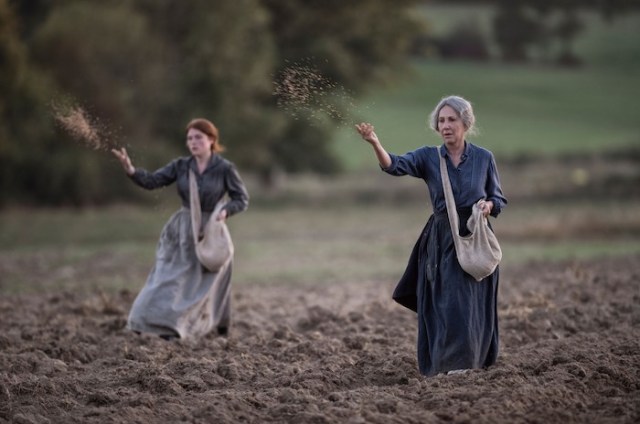
Xavier Beauvois takes an unusual approach to a war movie. Though he opens on a battlefield strewn with corpses during World War I, his film very rarely addresses the brute terror of warfare. Like Satyajit Ray’s memorable Distant Thunder, it mostly looks at the effect war has on those who are not at war, in this case the French farmers who continued to till the land during and after World War I. Not surprisingly, these farmers tended to be women, since the men were either fighting or already killed, and the special attention that women bring to agriculture is emphasized through action, word, and sensibility.
Hortense (Nathalie Baye) sees her two sons, Georges (Cyril Descours) and Constant (Nicolas Giraud) off to battle, leaving her to manage their farm with only her daughter, Solange (Laura Smet). Though the two women are healthy and able, there is only so much they can do by themselves, and so she takes on another young woman, Francine (Iris Bry), who is stoical and sturdy. Though there are tensions between the three women owing to personality differences and the like, Beauvois is more interested in the mechanics of running an enterprise, and how women approach it. Though he doesn’t explicitly find ways to compare the egalitarian, almost collective spirit these three women call forth to how a man would do it, the fact that men are fighting a useless war (the movie, it should be pointed out, is apolitical) while women are making food makes the difference plain. For most of the movie there is little dialogue, but rather scenes of painstaking labor photographed in detail. Still, this is not documentary filmmaking. It’s more like Beauvois wants to recreate the great tradition of French pastoral painting: his model is Millet, not Resnais. But there’s nothing romantic about the treatment. The Guardians is not a paean to the past, but rather a tribute to a timeless impulse and how that impulse governs human behavior for survival.

But there is drama, even melodrama, as Francine eventually falls in love with Georges when he is on leave. Hortense isn’t thrilled because, even though she is a farmer, she is also a landowner, and she views Francine’s station as being lower than her son’s. As the plot wavers between Lawrencian sexual intrigue and Zolan social naturalism the action remains fixated on the workaday world, as if human emotional life cannot compare to the staid splendor of the soil. Even as the “plot” enters the realm of tragedy, the world goes on. France, after all, survived the carnage (only to be plunged into it again a short time later), so we shouldn’t expect Francine and Georges to be ruined when their love cannot survive Hortense’s scrutiny. That’s a story for another, much more conventional film, where the world stops as the end credits roll. In The Guardians, the future is always in sight.

In French. Now playing in Tokyo at Iwanami Hall, Suidobashi (03-3262-5252).

The Guardians home page in Japanese.

photo (c) 2017 Les films du Worso – Rita Productions – KNM – Pathe Production – Orange Studio – France 3 Cinema – Versus production – RTS Radio Television Suisse

Posted in Movies | Tagged | Leave a comment

Review: The Sisters Brothers

The Sisters Brothers. Day 26.

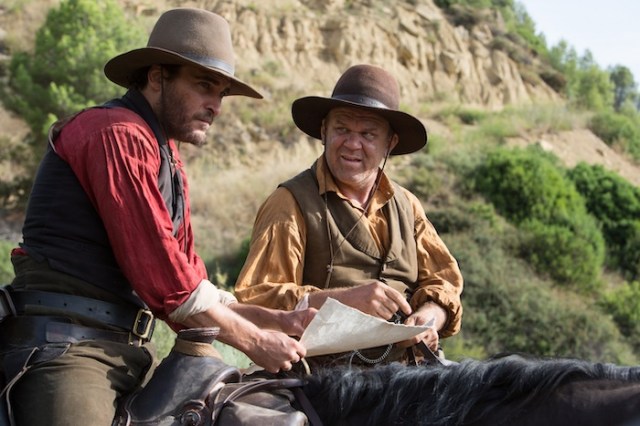
The hitman movie hit a wall years ago, maybe as far back as Pulp Fiction, which billed itself as the last word on the sub-genre. Since then, it’s been variations on a theme, and the variations haven’t been varied enough to make a distinction. Nevertheless, Jacques Audiard’s English language debut (based on a novel) may be one of the first hitman Westerns ever made, so the French director gets points for at least trying to change the conversation, even if his movie doesn’t feel that original. Hitmen, of course, have to be in the employ of someone, even if they’re freelancers, but Eli and Charlie Sisters (John C. Reilly, Joaquin Phoenix) work for the mysterious and little seen Commodore (Rutger Hauer, though he appears so briefly that I wouldn’t have known it was him if I hadn’t seen the name in the credits), who seems to practically rule the Oregon Territory in 1851. Given the moral parameters of the Wild West, the Sisters brothers (the joke is only invoked once, thank God) are almost comic in their brutality. In the opening scene they kill not only their target, but massacre everyone in the house with him, while at the same time burning down a nearby barn filled with horses. They laugh off their seeming ineptitude, given that they fulfilled their mission.

As if often the case in this kind of movie, the brothers are not exactly equals in terms of responsibility and character. Though Eli is older, he’s not in the good graces of the Commodore, who works strictly through Charlie and trusts him to work out whatever plans need to be worked out. Eli, in fact, is hoping to get out of the killing game and settle down with a nice girl he met, but as in any comparable mob movie, Charlie says it’s not something you can just walk away from, though he tries to frame the argument within a sentimental paean to fraternity. Audiard thus creates a mood of potential tension between the brothers that requires something to make it snap.

That something is a job to meet up with a private detective, John Morris (Jake Gylenhaal), who is supposed to capture a gold prospector named Kermit Warm (Riz Ahmed). The reasons for this odd configuration of task assignment puzzles the audience as much as it does Eli, and Audiard extends the conundrum by dividing scenes between those of Eli and Charlie on their way to the rendezvous, and those of Morris stalking and eventually catching his prey. Up until this point, the movie seems fairly standard, but it suddenly takes on a kind of dual urgency, as we learn of Warm’s plans and start to understand why the Commodore wants him, not to mention why the Sisters brothers have been dispatched to join in the project. The ringer is Morris, who, once he learns of Warm’s plan decides not to hand him over but, instead, join him in his quest, which is as much politically idealistic as it is economically rewarding. The conversations between Morris and Warm are erudite and stimulating (and because it is Gyllenhaal, who is playing basically a cowboy, the homoerotic resonance is keen), while those between Eli and Charlie are mostly marked by crudeness and a simplistic understanding of human nature. It’s thus surprising when these four finally meet. The results are unexpected and highly compelling, though the plotting is so dense you start to wonder how much disbelief you’re expected to suspend. After all, this is still supposed to be a Western.

But in the end it’s mainly a hitman movie, and in that regard it’s one of the better ones I’ve seen in the last decade or so. You even forget you’re watching a Western in that you eventually stop expecting the usual cowpoke tropes. Enjoy that while you can, because there’s a lot here to ponder.

Now playing in Tokyo at Toho Cinemas Chanter Hibiya (050-6868-5001).

The Sisters Brothers home page in Japanese.

photo (c) 2018 Annapurna Productions LLC and Why Not Productions

Posted in Movies | Tagged , , | Leave a comment

Review: Wildlife

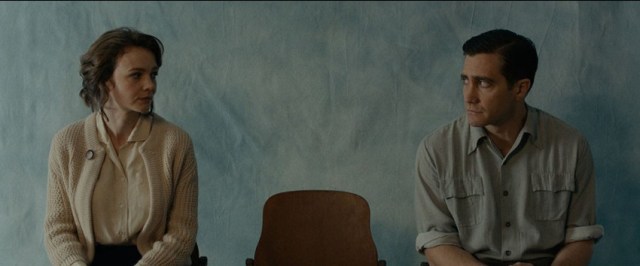
Actor Paul Dano took on a lot when he decided to adapt Richard Ford’s 1990 novel as his directorial debut. Dano does not appear in the movie, and neither does his significant other and co-scenarist Zoe Kazan, but there’s something of the pair’s storied flair for the quirky and unexpected in both the story and the way they pull it off. Ford’s book takes place in the 1960s, in a backward backwater in Montana, where a family of three has relocated. The father, Jerry (Jake Gyllenhaal), is a golf pro who has given up competition to take a job at a local country club. The town is overshadowed by a mountain that seems to be constantly on fire, a situation that’s the source of a lot of local black humor. The mother, Jeanette (Carey Mulligan), is a housewife who, at first, seems resigned to her fate of constant motion for the sake of her husband’s ambitions, which only go as far as his pride. The teenage son, Joe (Ed Oxenbould), is, according to Jerry, destined to be a distinguished football player, though Joe is so unassuming that you can’t imagine him giving or receiving a tackle.
The character of this family is mostly expressed through innuendo, and thus requires a crisis to make apparent the weak structure holding it together. Jerry is fired for a serious infraction, but when the country club realizes its mistake it offers him his job back. He can’t get over the slight and turns it down. “I won’t work for people like that.” Jerry is principled to a fault. It’s his abiding trait, and absolutely destructive for the family he feels is his greatest accomplishment. He takes a job as a firefighter on that mountain, and promptly leaves the story and the lives of his wife and son.

Jerry’s absence sets Jeanette free, both socioeconomically and emotionally, and it’s difficult to decide if her transformation from a domestic helpmate into a raging force of nature is a function of the story or an inevitable turn of events. Dano and, I assume, Ford don’t give us much backstory to make that determination, so the dramatic effect is immediate and powerful. She gets a job and starts seeing an older man (Bill Camp) who has money and is set in his ways. He lacks Jerry’s sense of righteousness but she justifies the affair by telling herself, and her son, that she deserves affluence and stability. Joe, who still respects his father, has trouble forgiving her.

Dano honors the story without exercising his ego, and perhaps because he’s spent enough time on the other side of the camera, he allows his actors to explore their characters fully, so much so that Gyllenhaal, who is basically a supporting player here, maintains Jerry’s existence in his family’s thoughts even if he isn’t present physically. He embodies the quality of Jerry’s particular generation that honored integrity without giving an inch to sentimentality, a quality that haunts his son and enrages his wife, who end up at each other’s throats because they can’t escape his spell.

Now playing in Tokyo at Yebisu Garden Cinema (0570-783-715), Shinjuku Musashinokan (03-3354-5670).

Wildlife home page in Japanese.

photo (c) 2018 Wildlife 2016, LLC

Posted in Movies | Tagged , , | Leave a comment

Review: Girl

The movies are still conflicted when it comes to portraying LGBTQ individuals, not because the portraits are necessarily difficult to convey with sensitivity and honesty, but because the very act of representation is fraught. Heterosexual cisgender actors and actresses still mostly play the parts of gay, bi, and transgender individuals, and gay, bi, and transgender actors are justifiably upset, to say the least. The titular character in Lukas Dhont’s Girl, a young transgender woman trying to make it as a ballerina, is played by Victor Polster, a cisgender male, and while it’s not central to our appreciation of the movie’s merits to wonder if it might not have been better to have hired a nonbinary actor for the role, it’s difficult these days to dismiss the notion as you’re watching the movie, and that’s an unwanted and, for all intents and purposes, avoidable distraction.

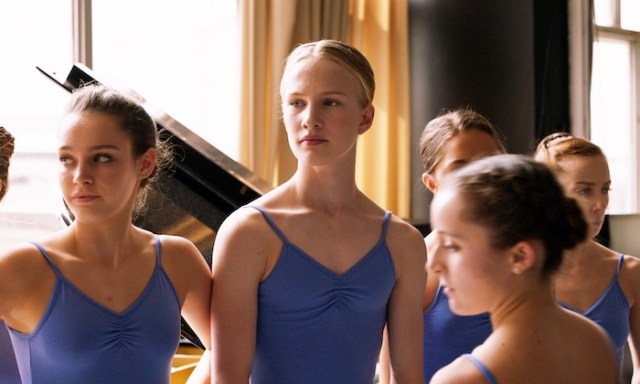
Lara has just been accepted at one of Belgium’s most celebrated ballet schools, and thus the movie is full of scenes of her suffering for her art. Mention is made that Lara, having been born with a male body, has not trained enough en pointe, and therefore is way behind the learning curve compared to her cisgender female classmates. She’s also undergoing hormone treatments (paid for by Belgium’s national health insurance, it seems, a point that I, as an American, think should be stressed more), thus making her daily routine that much more stressful in her runup to sex reassignment surgery. She has yet to develop breasts and tapes her penis between her legs, which is painful and embarrassing.

Dhont is not squeamish about Lara’s body, and often films the 15-year-old Polster naked. The purpose is to show Lara’s uneasiness with her body as it is now, but as with the actor-character matchup, this directorial decision can’t help but draw attention to things that we don’t need to think about, namely, Polster’s willingness to let is all hang out, so to speak. The only time this device is used to real dramatic advantage is during a party when some bullies force Lara to show her genitals. That said, most of the other characters support Lara’s transition, including her father (Arieh Worthalter), her psychiatrist (Valentijn Dhaenens), and her physician (Katelijne Damen), all of whom go out of their way to accommodate her emotional and physical needs. The problem is Lara herself, who has yet to fully accept her decision even if she feels transitioning is inevitable. In essence, Dhont tells a story that is all too familiar to LGBTQ people—that sexual minorities invariably pay a high price for their orientation, and so their lives are interesting simply because of their inherent “drama.” That, of course, is why we watch movies, but too much of Girl trades in drama for drama’s sake. We never get a sense of Lara as person, only as a victim, and it’s not really clear what she’s a victim “of,” except maybe her own insecurities, which all teens have. This isn’t to say there aren’t existential threats to her well-being as a trans person; but Dhont takes them for granted. Girl is certainly a sensitive and honest film, but it raises more questions than it answers.

In French and Flemish. Opens July 5 in Tokyo at Shinuku Musashinokan (03-3354-5670), Human Trust Cinema Yurakucho (03-6259-8608), Bunkamura Le Cinema Shibuya (03-3477-9264).

Girl home page in Japanese.

photo (c) Menuet 2018

Posted in Movies | Leave a comment

Review: Cold War

According to Thomas Wolfe, you can’t go home again, but that doesn’t mean you can’t learn something in the attempt. I don’t know which country the 62-year-old Polish director Pawel Pawlikowski currently calls home—he left his native land for England when he was 14—but since returning to Poland to make films earlier this decade he has come into his own as a filmmaker with a cinematic style and narrative voice that are so distinctive he will soon have graduate seminars dedicated to his output. The movies he directed in the UK were accomplished and unremarkable, and it’s likely he started making movies in Poland—black-and-white “art films” in the old boxy aspect ratio—to rejigger his mojo in late middle age. Ida (2013), his first genuinely Polish film, won the Academy Award for Best Foreign Language Film, and Cold War, his second, was nominated for the same award and probably would have won if Roma hadn’t been released the same year. Though Poland has produced some great directors and inspiring films, this pair by Pawlikowski already feel like the last word on the postwar cultural situation in Eastern Europe.

It’s not just hindsight. Films like Ashes and Diamonds, produced temporally closer to the events they depict, have an immediacy that actually obscures the filmmakers’ message. Both Ida and Cold War are partly inspired by Pawlikowski’s family history, so there is an emotional connection that is real but measured. In Ida, the director struggled with the tension between his Catholic upbringing and his Jewish heritage, and Cold War equally struggles with his parents’ separation when he was young, a separation set in motion by the political circumstances of the time. If it’s less dramatically fraught than Ida, it may be because Pawlikowski doesn’t have the psychological wherewithal to confront directly the horrible choices his parents had to make.

Wiktor (Tomasz Kot) is an accomplished musician who, in 1949, travels the countryside with his professional partner, an older woman named Irena (Agata Kulesza), and a kind of government-certified impresario named Kaczmarek (Borys Szyc), in search of Poland’s folk music heritage. They record songs and singers and then form a choral group called Mazurek to teach them the songs and dances they have recorded. The auditions bring forth a cheeky young woman named Zula (Joanna Kulig), who after performing a duet with a friend of an old folk song is asked by Wiktor to sing something solo. She belts out a brassy show tune she once saw in a Soviet musical. Wiktor is smitten.

Cold War is their love story, and it’s a stormy one. Though Wiktor seems almost resigned when it’s revealed that Mazurek will mainly be a propaganda vehicle for the Soviet-controlled Polish Communist party apparatus (Irena, disgusted, quickly disappears from the movie), Zula, who is clearly the ensemble’s most vibrant member, becomes increasingly annoyed at the strictures placed on her artistry, if not her personality. It is she who suggests they escape to the West while the group is performing in East Berlin (1952, the wall won’t be built for at least 8 years), and while Wiktor agrees in a seeming half-hearted manner, he shows up for the rendezvous and ends up leaving on his own, because the mercurial Zula gets cold feet at the last minute.

The story jumps to 1954, Paris, where Wiktor plays jazz piano in a nightclub and lives in bohemian splendor with his free-loving French paramour. Zula visits him when Mazurek comes to town, and though it’s as if they were never apart, they don’t stay together. Zula cannot quite make the break, even if her dismay with the kind of kitsch she has to perform is palpable.

The movie continues in this elliptical manner, jumping years and locations—Yugoslavia, back to Paris, back to Poland—and Wiktor and Zula’s love for each other never tempers. If anything, the vicissitudes of holding on to your values, not to mention sanity, in the face of such nationalist self-annihilation, forces them to admit that they only have each other in this world. Their journey is not a happy one, even during an unusually prolonged period when both seem to be achieving the professional success they always wanted. What they don’t have is a place to call their own, because it’s been highjacked by brutes.

Much has been said of Cold War‘s look, its pristine monochrome textures and uncanny ability to isolate individuals in crowded settings (the change in expression on Zula’s face when she notices Wiktor sitting in the audience while she performs with Mazurek is one of the most startling things you will ever see in a movie), but these aspects are mostly gravy. It’s Wiktor and Zula, as both characters and physical objects, who hold you spellbound, and if the movie feels as if it needs to go deeper to do justice to their story, it may simply be that Pawlikowski couldn’t go that far. Some stories are just too painful to tell.

In Polish and French. Now playing in Tokyo at Human Trust Cinema Yurakucho (03-6259-8608), Humann Trust Cinema Shibuya (03-5468-5551).

Cold War home page in Japanese.

photo (c) Opus Films Sp. z o.o./Apocalypso Pictures Cold War Ltd./MK Productions/Arte France Cinema/The British Film Institute/Channel Four Television Corp./Canal+ Poland/EC1 Lodz/MazoweickiInstytutKultury/InstytucjaFilmowaSilesia Film/Kino Swiat/Wojewodzki Dom Kultury w Rzeszowie

Posted in Movies | Tagged | Leave a comment

Media Mix, June 23, 2019

Gochipo, the mascot of the American pork exporters association

Here’s this week’s Media Mix about animal welfare, a topic we’ve written about before but usually in the context of cultural perception. What makes the subject particularly perplexing in Japan is the cognitive dissonance created when the cavalier and often cruel treatment of livestock is contrasted with the image of farm animals, especially those raised for meat, as being almost giddy about their own fate. Japanese advertisers have no problem with portraying these animals as being simultaneously delicious and cute. But it gets weirder. The other day I saw a tweet, by a non-Japanese person, I believe, about an advertisement the person saw on a Tokyo subway. The advertiser was American pork exporters and the ad was a drawing of cartoon pigs enjoying a barbecue of pork products. It was essentially a kind of cartoony Hieronymous Bosch pastisch of cannibalism. Regardless of the exporters association determination to penetrate the Japanese market, I am positive they didn’t come up with the idea of the ad. It was surely the work of the Japanese advertising company they hired, beause I’ve seen these kinds of ads before in Japan, though never as horrifically blatant. One smiling pig in the panorama was even wearing what looked like a sausage necklace.

The disconnect is not limited to advertising and the public arts. The column mentions the NHK drama “Natsu-zora,” about a dairy farm in Hokkaido in the 1940s and 50s. The milk cows are not just resources; they’re portrayed as part of the family. This happens on dairy farms in many countries, but in Japan this sort of communion with livestock extends to animals fated to be butchered at a young age. After the Fukushima nuclear meltdown in 2011, there were many stories about cattle ranchers abandoning their animals, with tearful farmers expressing bottomless remorse about how they had to leave the animals they’d grown so attached to to fend for themselves. Most Japanese people took this remorse at face value, and the media got a lot of sentimental, melodramatic mileage out of it, but I just felt confusion. Even if these cows were dosed with radiation, they’d live longer on their own. Had the accident not occurred, they’d be on their way to the slaughterhouse as soon as they were big enough. The emotional outpouring doesn’t make any sense. When I’ve expressed this confusion to others, some have replied that it’s a kind of Buddhist thing: You appreciate the sacrifice that an animal makes for you, so there’s no real paradox here. Whales are a fairly good example. Japan kills whales for food and sets up memorials in whaling towns to the sea mammals themselves. The sailors pray for their souls at temples and such. Then they go out and harpoon them in the most brutal ways. Sorry if I sound culturally indifferent, but it seems to me that these sailors and farmers just want their capitalist cake and eat it too.

Posted in Media | Tagged | 1 Comment

Review: Dark Phoenix

The flaw in the X-Men saga that outsiders can’t quite get past is the mutant pretense that is its whole reason for being. Though the idea of mutants being social outcasts despite their super powers and tendency to use them for good is a powerful one, the kind of poetic license exerted in describing those powers becomes strictly arbitrary after you sample a few characters. It’s as if the creators simply make up an ability that fits whatever story they wanted to tell, and after a while you have so many super powers that there seems little point in extrapolating on them.

But it is a saga, and in this supposed final chapter (though there are rumors there’s at least one more) the viewer is bombarded not only with more super powers than you can throw a chunk of kryptonite at, but complex interrelationships between protagonists of equal narrative weight and references to past (and future) events in the saga that are left unexplained for those of us who may not have seen them (or may have simply forgotten).

With Wolverine MIA and all the original X-Men replaced by their younger incarnations (the story is set in the early 90s), the protagonist is the iconic Jean Grey (Sophie Turner), whose telekinetic and telepathic abilities make her the ultimate X-person, so to speak, in that she can pretty much make anything possible. She’s thus sent out into space to rescue a group of stranded astronauts and while doing so is blasted with a particularly potent dose of radiation that heightens her powers immeasurably. Unable to control these new powers, partly because her mental state is shaky in the first place (childhood trauma that’s taken for granted), the other X-Men, including their leader, Dr. Xavier (James McAvoy), grow to fear and mistrust her, thus deepening her paranoia. As it turns out, she is being manipulated by an exterrestrial group of evildoers led by a shapeshifter played with icy nonchalance by Jessica Chastain. Their plan is to use Grey’s powers for their own ends, which necessitate the end of the earth.

Needless to say, the action scenes are thrilling without really getting us anywhere in terms of plot development, since everything is dialed up to 11 from the start. Those who have been following the saga raptly from the start may find it all cathartic, but the rest of us will regret having missed (or, again, forgotten) an earlier chapter that might have made sense of it all. Or maybe we don’t care in the first place.

Now playing in Tokyo at Toho Cinemas Hibiya (050-6868-5068), Toho Cinemas Shinjuku (050-6868-5063), Toho Cinemas Shibuya (050-6868-5002), Toho Cinemas Roppongi Hills (050-6868-5024), Shinjuku Wald 9 (03-5369-4955), Shinjuku Picadilly (050-6861-3011).

Dark Phoenix home page in Japanese.

photo (c) 2019 Twentieth Century Fox Film

Posted in Movies | Tagged | Leave a comment

Media Mix, June 16, 2019

Here’s this week’s Media Mix about the widespread anxiety surrounding social recluses. The column is mainly about the unfounded belief that hikikomori are potentially dangerous to themselves and others, and while experts do think that some hikikomori present with symptoms of mental illness, they very rarely manifest as violence. After all, the definition of a social recluse is someone who does almost everything in their power to avoid contact with others. And this obvious but strangely overlooked aspect of the issue points to another common feature of hikikomori that is rarely mentioned, namely, the socioeconomic situation of the families involved.

In almost all the hikikomori cases reported by the media, the subjects live in relative middle class comfort. They reside with parents or relatives who, for the most part, support them financially, often for years and even decades. Though there is no reason to think the poorer classes are immune to hikikomori tendencies, by definition it would be very difficult for someone to live completely off of a family that already exists on the economic margins. Most likely, individuals who are virulently antisocial and from poorer households will simply end up living by themselves in cheap apartments and never going out except to work, and so they can’t really be called hikikomori.

In other words, hikikomori live the way they do because they can. This may sound dismissive of their particular emotional and psychological situation, but, as mentioned at the end of the column, the kind of pathologies now being associated with hikikomori are more the result of the imposition of mandatory intramural responsibility. Families are expected, by society and the authorities through the legal system, to take care of their own. Hikikomori know this and so do their guardians. One of the main complaints from people who constitutionally resent hikikomori for what they see as outright laziness is that they’re simply taking advantage of their parents’ obligation toward them without owning up to their own obligations, but in a sense they are since eventually they will have to take care of their parents. In fact, they very well may be counting on it, because they will have to rely on whatever assets they inherit from their parents once those parents die. This is another social aspect that limits hikikomori to more well-off families. One of the conditions for receiving welfare in Japan is that the applicant first exhaust all possible assistance from family members. Those applicants’ children, parents, or siblings are thus obligated by law to help them, so if they don’t want to then they will be compelled to stay as far away from their families as possible. The best cure for hikikomori is probably poverty.

Posted in Media | Tagged | Leave a comment

Review: We Are Little Zombies

Young people in Japanese and Korean indies often evince a distinct cognitive dissonance, purposely rubbing against the stereotype of the good son or daughter in the Confucian tradition. Those of us who are not Japanese or Korean may feel cut off: Adolescent disaffection is universal and perhaps more acute in a social milieu that distinctly places greater value on family cohesion, but there’s usually the feeling that the filmmaker is trying to make their point by exaggerating certain attributes. Hikari, the narrator of Makoto Nagahisa’s debut feature, is a 13-year old video game addict who has just lost both parents in a bus accident and feels nothing. Actually, scratch that. He betrays some relief, because he obviously didn’t love his parents, and the sentiment may have been mutual—to call Hikari an unreliable narrator would be an understatement.

Hikari isn’t being cynical. He’s still too young to have cultivated a sense of the world, but he knows his feelings or lack thereof, which is credible in its own way. However, Nagahisa compounds the disaffection by bringing Hikari together with three other 13-year-olds who have also lost both parents, and at the same funeral parlor on the same day. Again, all seem underwhelmed by their loss, and recognize that there is perhaps something wrong with that, but since they’re still kids they are now free to do whatever they want. The fantastical elements of Nagahisa’s narrative go beyond this unbelievable coincidence. There seems to be no serious guardianship issues at play, and the four flit freely from one home to another indulging their childish whims and philosophizing about the total moral bankruptcy of adulthood. There’s nothing malicious in their attitude, and if Nagahisa gets anything precisely right about their youthful lark it’s that they understand how their peculiar situation allows them to put off responsibility for as long as possible.

The kicker comes when they visit a refuse facility and encounter a group of homeless individuals who inspire them to form a rock band, which becomes a viral hit. Now you can chalk the movie’s sensibility up to cynicism, though it’s Nagahisa’s rather than the kids’. It helps to understand that the director used to work for advertising behemoth Dentsu, so he certainly knows the ins and outs of the BIG CON. Inevitably, the Little Zombies’ relative success indirectly helps them achieve an emotional maturity that provides the movie with the kind of sentimental closure we normally expect from Japanese indies.

All of this would be fairly conventional if not for the structure and the production design, which references computer game visuals and logic (it seems to be the only way Hikari could tell a story), not to mention the manic pacing, propelled by editing on steroids. We Are Little Zombies makes its point effectively enough, but its exhaustive insistence on being emotionally dry until the point when it isn’t still feels manipulative.

In Japanese. Now playing in Tokyo at Toho Cinemas Chanter (050-6868-5001), Toho Cinemas Shinjuku (050-6868-5063), Shibuya Cine Quinto (03-3477-5905).

We Are Little Zombies home page in Japanese.

photo (c) 2019 “We Are Little Zombies” Film Partners

Posted in Movies | Leave a comment