
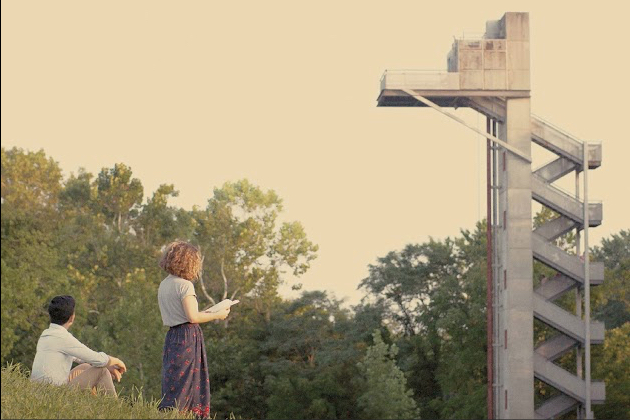
 The title city, a leafy Midwestern exurb that is located in Indiana, not Ohio, is an interesting choice for a place where the two main characters find themselves stuck. The town’s main attraction is its full line of modernist architecture, much of it designed by the Finnish master Eero Saarinen, and first-time feature director Kogonada apparently built his whole script around this feature. The fact that it works so well in illustrating the difficulties of two people overcoming their circumstances is a tribute not only to the Korean-American director’s imagination, but to his acute insight into the way we project onto our surroundings.
If you need a genre check, Columbus is a coming-of-age story. Casey (Haley Lu Richardson) is a young woman who, despite encouragement from her betters and a sharply honed intelligence, has put off university, mainly because she is afraid of leaving her single mother (Michelle Forbes), a recovering meth addict who may or may not be lapsing. However, her excuse to everyone is that she doesn’t want to leave. As she tells an old high school classmate who has moved on to Los Angeles, “I like it here,” much to the classmate’s arrogant chagrin. And it’s easy to understand at first because Kogonada and his cinematographer, Elisha Christian, are obsessed with the physical beauty of the town as much as Casey is, taking every opportunity, both within and without the parameters of the story, to explore these marvelous buildings.
The ringer is Jin (John Cho), the estranged son of an architecture professor who was slated to give a lecture in Columbus but suffers a stroke that puts him into a coma. Jin flies in from Seoul, where he works as a book translator, and is forced to hang around “until he either dies or recovers,” he tells his father’s long-time assistant, Eleanor (Parker Posey), and since the father simply lingers, Jin has to kill time. During an awkward but effectively staged meet-cute, he bums a cigarette off of Casey and a bond is formed. The younger woman had planned to attend the lecture, so she’s surprised to learn that Jin essentially hates architecture, and decides she will turn him on to her hometown’s charms. Puzzled and yet intrigued, Jin gives her a hard time. “Just tell me how you feel about it,” he demands impatiently when Casey launches into her tour guide shtick. To her credit, she’s up to the challenge.
The beauty of the dialogue is that it never shortchanges either the viewer’s or the characters’ intelligence. Casey often has spirited conversations with Gabe (Rory Culkin), her colleague at the local library who is working on a doctorate and is secretly in love with Casey. When Jin starts interrogating Casey’s reasons for having abandoned an opportunity to study architecture on the east coast, he compels her to talk about those feelings in a more practical way, thus revealing her insecurity about her mother, as well as her lack of self-confidence. In the process, Casey compels Jin to question his feelings toward his father and how those feelings have prodded him into a life he doesn’t really feel comfortable with. Both eventually become unstuck, but not in a way you would imagine. As resolutions go, the ones described in Columbus are surprisingly realistic considering how openly hopeful they are designed to be. Just like a great building.
In English and Korean. Opens March 14 in Tokyo at Theater Image Forum Shibuya (03-5766-0114).
Columbus home page in Japanese.
photo (c) 2016 Jin and Casey LLC
 It was only a matter of time before Kenneth Branagh, the still-living film actor most popularly identified with Shakespeare, portrayed the Bard himself on screen, and for what it’s worth and despite the stupid schnozz, there’s something heartening and even a bit surprising in his impersonation, namely an effort to confound any sort of expectations. Branagh’s Shakespeare, caught at the end of his life, after he’s retired from writing and managing his theater company, is a man who not only knows his worth, but likely understands his place in history, and Branagh plays this aspect without the kind of hindsight navel-gazing one usually gets in the biopics of “great men in their twilight,” but rather with a wistfully sad acknowledgment that it means very little if you’re not around to enjoy it. And that’s something we all have to address, even if we aren’t famous and world-changing. On the other hand, the movie itself feels like a greatest hits collection of rumored moments that never quite deliver the pleasures promised.
 Here’s
  Usually, I don’t comment on acting when I review a film, mainly because I expect professionalism from everyone involved and good acting should be a given. Normally the acting is good, so there’s no point in talking about it unless it’s extraordinary in some way. With this movie about Judy Garland, however, I feel it’s necessary to discuss Renee Zellweger’s performance, and not just because it earned her an Oscar, but rather because of what it says about imitation and how we tend to judge quality by measuring verisimilitude. Zellweger doesn’t look much like Garland and she makes up for this shortfall by focusing on physical and vocal tics. She’s not entirely successful on this front, but, inadvertenly perhaps, a compelling character comes through, and whether or not it’s Garland isn’t really important, though I imagine to some people it is. In any case, the movie, which isn’t particularly well made, could be much worse if this character were done differently.
 Critics have at long last realized that the development of Chinese art house cinema over the last decade has been deeply influenced by American and European film noir. The influence probably goes back further, and, for what it’s worth, film noir as an aesthetic idea is so deeply imprinted on film theory that it seems hardly worth mentioning. Bi Gan’s Long Day’s Journey Into Night, which has nothing to do with the O’Neill play, is drenched in both the mood and the attitude prevalent in classic film noir, and thus comes across as a kind of primer for what Chinese art cinema has turned into. The fact that it was something of a hit in China shouldn’t really be surprising.
 As has already been pointed out, the title of Ladj Ly’s debut feature is a kind of piss-take on the classic Victor Hugo opus, a move that both provokes curiosity and confounds expectations. It is about “poor people” in the sense that a put-upon population is pitted against their so-called betters, but Hugo’s story was classist to the core, while Ly’s is more about conflict born of authoritarianism. The “betters” in his case are represented solely by the local police contingency in the Paris banlieu of Montfermeil, where immigrant cultures live in various states of near-destitution. Crime is not exactly rampant here, but it is a mode of survival and thus the tension between the residents and the cops is ever-present and prone to eruptions of emotional if not physical violence.
 Though it’s not vital to appreciating her achievement, Waad al-Kateab was not a trained filmmaker when she started recording her day-to-day existence in the besieged Syrian city of Aleppo in 2012. At the time she was studying for a business degree, and while protests against the regime of the dictator Bashar as-Assad were growing, the civil war that eventually overran the country and destroyed Aleppo had yet to reach its deadliest phase. The beginning of this remarkable documentary contains the kind of casual everyday videos you’d expect from a 26-year-old woman who is pursuing her dream of a better life. They are hopeful and even playful at times. Al-Kateab is clearly on the sides of the rebels, longing for the day when Assad is gone, but as the national army and its proxies start bombarding the town, first to destroy rebel forces and then the IS contingents that move in to take advantage of the chaos, loyalties fade from the picture because survival is the first priority.
 Tongue-in-cheek title aside, there’s not a whole lot in Jay Roach’s takedown of Fox News that’s farcical. If anything, the movie is earnest, even sincere in the way it unloads on male toxicity in the media, but Roger Ailes is dead and Megyn Kelly, though somewhat chastened by her failure at NBC, still willfully spouts ignorant horseshit. In a word, Bombshell is burdened with too much ongoing context.
 I’ll give hot horror director Ari Aster this much: He really knows how to set the stage for his twisty mischief. Like his earlier potboiler, Hereditary, Midsommar opens with a deceptively bleak slice of melodrama. Dani (Frances Pugh), a grad student, has to cope with the tragedy of a bipolar sister in a set piece that would have made an exceptionally interesting film by itself. The trauma eats away at her already disintegrating relationship with her boyfriend, Christian (Jack Reynor), who seems more beholden to his chums, a toxic crew of privileged maleness. The one exception is Swedish softie Pelle, (Vilhelm Blomgren), an exchange student who invites Christian and his pals to his home village in Scandanavia, a kind of primitive hippie commune. Since two in this crew are studying anthropology, they are eager to go to experience the village midsummer festival. Dani’s part in this is not really clear, though Christian seems to want to patch up their relationship, and she really could use a change of scene.
