
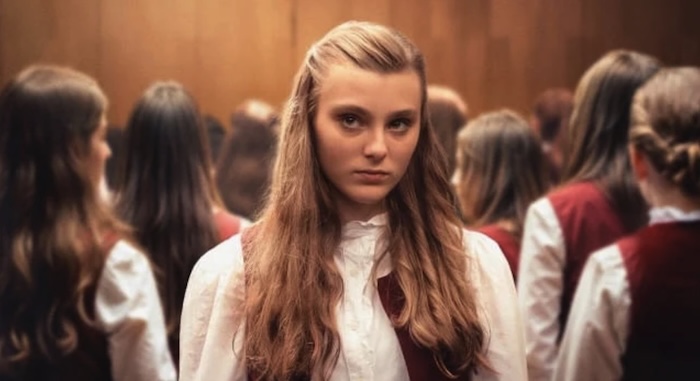
Ondřej Provazník’s Broken Voices was inspired by a real life scandal surrounding the Prague-based children’s choir Bambini di Praga. In 2008, the choir’s leader, Bohumil Kulínský, was arrested for having sexually abused two dozen girls in the ensemble over the previous two decades, almost all of them underage. He was later convicted and sentenced to five years in prison, and then released on parole after about two-and-a-half years. Not long after his release he died of kidney failure. Provazník’s film fictionalizes the principals and the story, limiting its time frame to several months in the early 1990s, not long after the Czech Republic emerged from communism and Czechoslovakia. The choir, here called Canticella, is a prestigious organization and the adolescent members are constantly in competition to rise up to and remain in the “A” choir, which is the main public face of the group, performing throughout the country and in Europe. The choir master, Vitek Mácha (Juraj Loj), is an imperious but not altogether cruel taskmaster, and the girls use their youthful feminine wiles to get on his good side. The protagonist of the story is 13-year-old Karolína (Kateřina Falbrová), a member of the “B” choir whose older sister, Lucie (Maya Kintera), is in the “A” group.
I know the woman who was the Japanese-English interpreter/road manager for Bambini di Praga during the 90s, when they came to Japan almost every year to tour the country, and I asked her to watch a screener of the film and give me her opinion. She said the actor who portrays Mácha looks a lot like Kulínský, though despite what he ends up doing in the movie, he comes off as more likable than the man she worked with. Kulínský, she said, was a drunk and a bully, a man who lorded over the girls (and two boys—in Japan the choir toured as the Praha Shonen Shojo Gasshodan) with almost comical bravado. He terrorized the Japanese staff with his demands and while the interpreter got along with him to a certain extent, she didn’t like him at all, but he always insisted she tour with them as they went from small town to small town, and since the choir was a money maker for the Japanese organizer he got his way. Kulínský spoke English but the girls mostly did not, so the interpreter’s relationship with them wasn’t very deep; and while she found the maestro’s behavior around them creepy (if they stayed at a hot spring he would sometimes bathe with them, behavior duplicated in the movie when Mácha shares a sauna with Karolína) she never suspected him of sexual abuse, though when she eventually learned of his arrest, some years after she stopped working with the choir, she wasn’t really surprised. Kulínský was a seasoned showman, which is why the choir was so popular in Japan. He knew exactly how to present the girls to Japanese audiences—he even taught them popular Japanese songs—and at the inevitable post-performance parties with local bigwigs he knew how to show them off to middle aged men who thought they were cute. The interpreter felt he was just doing what he was supposed to be doing, promoting the choir for the sake of the Japanese organizer, as well as Czech culture and, most importantly, himself. He was very ambitious, and had inherited the choir from his late father, the previous choir master. It was a family business, and his mother toured with them as assistant choir mistress. What he really wanted to do was move beyond children’s choirs and become a legitimate orchestra conductor, a goal he was on his way to achieving when he was arrested. In that regard, Japan was always central to his aims since his many years of touring here had given him a certain professional cachet he could take advantage of. His first orchestral gigs were in Japan.
In the movie, Mácha initially comes across as the urbane sophisticate, less a big brother figure than an unattainable hip uncle with his acoustic guitar, long hair, and colorful couture. He immediately singles Karolína out from her “B” choir peers and promotes her to the “A” choir, based on what he says is her native talent. As she gains his favor, we see Lucie grow more nervous and even jealous, thus leading to a cruel bullying incident that has dire health consequences for Karolína. She survives the ordeal and is selected as one of 20 girls who will embark on the choir’s first tour of the U.S. Along the way, she has to navigate the catty conflicts at play among the girls, some of whom we suspect have already been the victims of Mácha’s untoward attentions, though the extent of those attentions isn’t made clear until they get to their hotel in New York.
Despite one shocking scene, Broken Voices is almost too tasteful in its approach to its unsavory subject. It’s mostly concerned with how a monster like Mácha gets away with what he gets away with, since those who followed the real situation with Kulínský know he continued taking advantage of his charges for at least another decade. There are hints in the movie that Mácha’s mother, the choir’s “professor,” knows what’s going on, but like the Japanese interpreter with Kulínský, the general feeling among people familiar with the situation surrounding the choir is that sexual abuse was beyond the pale and thus unimaginable. Power dynamics between mentor and mentees in the art world is such a cliche that men like Mácha/Kulínský can confidently believe they will never get caught until, of course, they are.
In Czech and English. Now playing in Tokyo at Theater Image Forum Aoyama (03-5766-0114).
Broken Voices home page in Japanese
photo (c) endorfilm s.r.o. Punkchart Films s.r.o. Ceska televize innogy Ceska republika a.s. Barrandov Studio a.s. 2025

