
Few national cinemas have looked at their troubled histories with as much candor as South Korea’s. For sure, in many of the historical movies the country has released since throwing off their long dictatorship in the late 80s the Korean people have come off as victims, but most of the perpetrators of human rights crimes in the country were Koreans too, albeit those in positions of authority. It’s notable that Korean filmmakers have made dozens of films about the brutality of their Japanese overlords during the colonial period, but even in those movies the worst villains tend to be Korean collaborators rather than Japanese occupiers. And movies that cover Korean postwar history have addressed the atrocities carried out by the Rhee, Park, and Chung regimes, such as the Gwangju Massacre of 1980, in various modes of detail. However, there is one atrocity that has not been talked about until very recently, and that is the wholesale killing of civilians on Jeju Island in the late 1940s, which is often referred to as the 4.3 Incident. Tensions had been increasing between native inhabitants of the island and forces both official and unofficial that came there from the peninsula to quell labor unrest starting in the spring of 1947. On April 3, 1948, members of the Workers Party of South Korea erupted in an insurgency against these interlopers, attacking police stations and ad hoc right-wing elements. Retribution was swift and unmerciful, with at least 14,000 residents slaughtered, and some 40,000 clandestinely forced to flee to Japan.
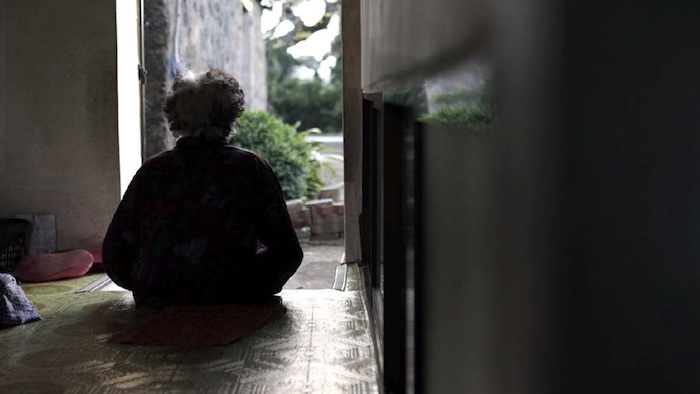
Because both survivors of this massacre and families of those who perpetrated it still remain on Jeju, the incident is almost never mentioned, but several years ago a memorial to the victims was erected on a park on the island and earlier this year a fiction film, Hallan, which depicted some of these atrocities, was released theatrically. Now comes a full-on documentary, Voices, that attempts to present some of the last living witnesses to the horrors of the period. Central to the story is the testimony of four women, or, in actuality, three of them, since the fourth woman, who witnessed the worst of the worst, can’t bring herself to remember out loud, and so her son talks in her place. The other three speak about wholesale rape and murder, about how their parents, anticipating the bloodshed to come as right-wing paramilitary troops landed on the island, forced their daughters to marry as teens because they thought these troops and police would not rape married women. Of course they were wrong. In fact, one woman, who was 7 at the time, recalls seeing a young bride, eight months pregnant, hung from a tree naked and bayoneted to death by these right-wing soldiers.
Labor activists who fought this incursion also committed atrocities, often against their own people in order to prevent them from falling into the clutches of the enemy and informing on them. The trigger for all this terror was the election in 1948 sponsored by the U.S. military that would eventually divide the country in half, a choice the residents of Jeju opposed, but not because they were communists as their persecutors insisted. Rather, it was because they believed the Korean people could not survive in a divided country. Another contributing factor that comes to light in the documentary is that, like Okinawans vis-a-vis “Yamato” (the rest of Japan), Jeju Islanders have a precarious relationship with the rest of Korea, and thus have always been scapegoated by those with axes to grind. Labor unions after the war were considered crucibles of “reds” that had to be eradicated at all costs. Though Voices still seems to leave a lot out, it pays tributes to the survivors in the only way it can, by listening to what they have to say as well as what they can’t bring themselves to say.
In Korean. Now playing in Tokyo at PolePole Higashi Nakano (03-3371-0088).
Voices home page in Japanese
photo (c) 2024 Storyon Co., Ltd.

