
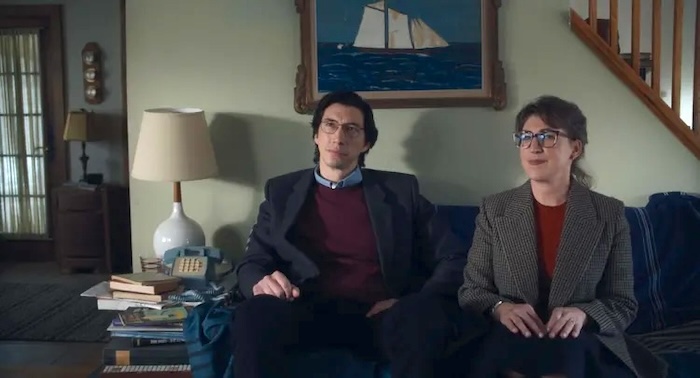
Jim Jarmusch’s latest movie follows the omnibus structure he’s used previously in movies like Night on Earth and Mystery Train, except that Father Mother Sister Brother has a stronger thematic thread running through its three unrelated stories. Jarmusch’s thesis is that children invariably never really know their parents, and vice versa. In fact, in two of the stories it’s easy to get the feeling that the parents involved have intentionally mislead their offspring about themselves for what can only be taken as selfish reasons.
This idea is strongest in the opening tale, wherein two adult siblings, Jeff (Adam Driver) and Emily (Mayim Bialik), are depicted driving along rural roads to visit their father (Tom Waits), who lives in a remote part of New Jersey in an old house that is supposedly falling down around him. The brother and sister rarely see him, we soon learn. This visit, in fact, will be their first meeting since their mother died some years ago. During the drive, we learn that Jeff is divorced and that the split was engendered at least in part by his ex’s objections to Jeff occasionally sending money to his father. Emily, who is happily married with children, has never done such a thing and never will, and when they both mention that they have no idea how their father gets by financially, you have to wonder. The wondering gets even more wide-ranging when we get a glimpse into the father’s preparations for his guests, actions whose aim is to make the house look cluttered. In the second story, the theme is reversed. Charlotte Rampling plays a very proper British lady, a successful novelist, living on a beautiful estate in Dublin awaiting the annual visit of her two grown daughters for tea. Tomothea (Cate Blanchett) is a stereotypically prim and plain spinster, while Lily (Vicky Krieps) is a punky ne’er-do-well with a female lover she hides from her mother, who seems to know nothing about her daughters, either because they don’t want to tell her (Timothea), or they simply make everything up (Lily). The last tale involves twins Skye (Indya Moore) and Billy (Luka Sabbat) revisiting the Paris apartment where they once lived with their Bohemian parents, who recently died in an air crash. Based on their banter, it’s clear that the two never quite understood their parents, and, for that matter, neither does the audience, which comes away from these conversations with a lot of questions: Why was this family in Paris (the parents were American, as are the twins)? Where did they get their money (it seems they were flying the crashed plane themselves)? That Jarmusch doesn’t have Skye and Billy interrogate these matters for our benefit seems a bit mean.
All three stories share leitmotifs—Rolex watches, conversations in cars, skateboarding, hot beverages—that seem to have little meaning except to make the movie cohere in some way. Jarmusch successfully puts across his theme and the relationships feel natural and credible, but there isn’t much in the way of action and some of the conversations are purposefully dull for the sake of verisimilitude—this is how families talk. It’s an extremely well put together movie, but don’t expect anything compelling.
In English and French. Opens Nov. 20 in Tokyo at Human Trust Cinema Yurakucho (03-6259-8608), Human Trust Cinema Shibuya (03-5468-5551), Shinjuku Piccadilly (050-6861-3011).
Father Mother Sister Brother home page in Japanese
photo (c) 2024 Vague Notion Inc.

