
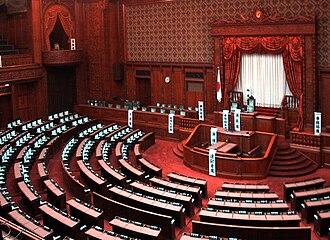
Last week, the ruling Liberal Democratic Party (LDP), its ally the Innovation Party (Ishin no kai), and the opposition Democratic Party for the People (Kokumin Minshuto) compiled a long-discussed bill to reduce the number of members in the lower house of the Diet. The three parties hope to enact the bill during the current Diet session.
The proposed law would cut a total of 31 seats, all from the proportional representation side of the chamber. Representatives are elected to office from two types of candidates: constituency representatives, which residents of specific areas vote for directly, and proportional representatives, which are determined by votes for parties. In proportional voting, the parties submit rosters of candidates and, depending on the portion of votes a party receives nationwide, a proportional number of candidates on its list may advance to the Diet.
A forum on the matter of seat reduction that appeared in the Asahi Shimbun Oct. 29 pointed out that in earlier talks about the issue, both constituent seats and proportional seats were targeted. However, over the years, the discussion has shifted, and now only proportional seats are being subjected to reduction.
One of the three commentators in the forum, Momoko Nojo, a member of a group called No Youth No Japan, which is suing the government in order to lower age limits for Diet members, writes that the proposed bill to cut seats, if passed, would greatly diminish the diversity of the lower house, in particular with regards to women. The portion of constituency Diet seats occupied by women is 9.7 percent, while the portion of proportional Diet seats occupied by women is 22.7 percent.
The reason, she says, is that the constituency system tends to benefit political dynasties and incumbents, which are mostly men. In fact, one of the purposes for implementing the proportional system was to guarantee at least some measure of diversity, since parties could place women, members of minority groups, and young people in the roster of candidates so that they would have a better chance of advancing to Parliament.
Japan lags behind the rest of the world when it comes to female representation in politics, and the main reason is political dynasties and old-boy funding networks that have strangleholds on constituencies. It is almost impossible for newcomers to have any kind of impact on electorates that have been controlled for decades by political machines.
Nojo is careful to point out that the current prime minister, a woman, is the glaring exception that proves the point, since she got to where she is by essentially playing by the old boys’ rules. Nojo writes that for Sanae Takaichi’s “generation” of women it has always been difficult to survive in an environment controlled by men, so she had to make a special effort to fit in. “I want to believe she desires that women will follow her lead,” Nojo writes, “so for that reason I want her to state whether she really thinks this [reduction] bill is needed.”
Takaichi’s support for the bill is purely for political purposes, a notion that naturally brings up the question of what the ostensible reason is for reducing Diet seats.
The idea is Ishin no Kai’s, and, in fact, it is the cornerstone of its national strategy. Ishin, which is powerful in Osaka but less so nationwide, successfully reduced the number of seats in Osaka prefecture so that it could more easily pass the laws it wanted.
Ishin claims that such reductions would save money, an assertion that 50 percent of the public supports according to surveys, though, relatively speaking, very little money would be saved—a little more than ¥2 billion, according to the Asahi. By exploiting the public’s ingrained distrust of politics Ishin can eliminate seats and thus reduce opposition to its national policies, though the only policy that seems to have any traction other than reducing MPs is establishing supplementary capitals.
Since Takaichi is part of the ruling party, it wouldn’t seem to be in her interest to reduce seats, and reports say that there is a considerable portion of the LDP that doesn’t like the bill, but Takaichi needs Ishin’s help in passing LDP legislation and, more significantly, resisting the movement to reform campaign financing in the face of so many LDP money scandals, so she has gone along with the plan. However, during negotiations over the bill, the LDP insisted that reductions be limited to the proportional seats, since they don’t affect the LDP’s fortunes as much. The LDP also needs Kokumin Minshuto, though what exactly it has to offer isn’t entirely clear, since Kokumin Minshuto is putatively an opposition party. Obviously, it thinks it can bargain better with the LDP to get its own policies accepted.
The other opposition parties naturally object to seat reduction since it would significantly affect their election chances. A recent Sankei Shimbun article quoted the leader of Inochi no To, Joji Yamamoto, as saying that one of the purposes of the proportional system is to “promote women’s participation in politics.” Miho Fukushima, the veteran head of the Social Democratic Party, said the bill benefits incumbents because they already have constituents and money. The head of the Japanese Communist Party, Tomoko Tamura, said at a press conference on Oct. 30 that the LDP wants to protect the positions of its incumbent lawmakers, which are mostly men. The proportional system, she said, “offers oppurtunities for women who don’t have base constituencies.”
In her Asahi essay, Nojo says there are many administrative matters that need to be addressed before reducing MPs, such as regaining public trust in the political system, reducing age eligibility for public office, and reforming campaign funding. And as long at the public believes it has no real connection to politics, they will never really care how the government operates, only what it achieves. In essence, the very existence of the reduction bill acknowledges this dissatisfaction.
Ishin’s slogan for the bill is “mi wo kiru,” which translates directly as “cut the body.” “When you hear this slogan,” she writes, “you might imagine that it is the body of politics that is being cut, but a reduction in proportional seats means less powerful citizens become marginalized even more, since those who occupy positions of power prefer not to listen to the voices of the less powerful.”

