
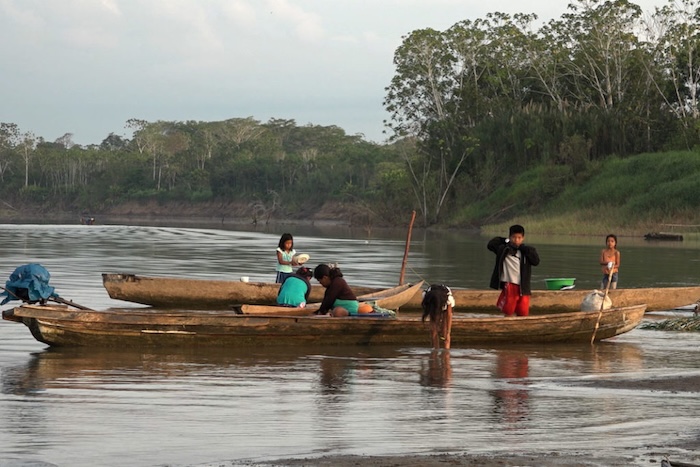
In 2021, a group of women who belonged to the Kukama ethnic group sued the government of Peru to declare that the Marañón River, which has provided the Kukama people with a livelihood for centuries, was a legal person with human rights. For more than a decade, the government had allowed corporations to drill for oil along the river, causing spills that greatly affected the Kukama. In 2024, a district court found in the women’s favor, a ruling a subsequent court upheld. Since then the group has worked to ensure that the government is held to the ruling.
Karuara, People of the River, a documentary by Miguel Araoz Cartagena and Stephanie Boyd, is mostly background for this story. Though the directors interview the leader of the women’s group, Mari Luz Canaquiri Murayari, she mostly talks about her life on the river, relating personal anecdotes about how modern life has encroached on the people of her village, Shapajilla, and the environmental destruction that has come with it. For their part, Cartagena and Boyd seem more interested in the ethnographic dimensions of the story, and even open the film with an animated recreation of the Kukamas’ origin story for not only the Marañón, but the entire Amazon River, of which the Marañón is the source tributary. From there, the documentary skips between further animated myth reenactments that explicate the unique world view of the Kukama, interviews with fishermen and farmers regarding the economy of the village, and pastoral interludes showing how the villagers interact with the river on a daily basis. It isn’t really until the last third of the film that the outside world enters the picture, first with Murayari’s story about how her first pregnancy forced her to visit the nearest city, Iquitos, a three-hour canoe journey away (she didn’t make it and gave birth in the canoe, but the baby was fine); then with stories of various Kukama people who tried to live in Iquitos and were met with discrimination and disillusion; and finally a precis about the oil spills and subsequent lawsuit.
Central to the documentary’s overall impact is its treatment of the titular Karuara, which are essentially souls of Kukama people that have entered the river to find happiness as marine life. Not so much a myth as it is an idealistic metaphor, the Karuara story is given an extra measure of attention because it describes the relationship between a body of water and the humans who rely on it with more emphasis on the spiritual side of the latter’s dependence than the sustenance side, thus showing how the two cannot be separated. If, like me, you have to go to the internet to find out more about the outcome of the lawsuit and its political ramifications, which have been international, it seems that that may be the intention of the filmmakers, whose basic purpose is to show how a certain group of people can live happily with nature on nature’s own terms.
In Spanish and the Kukama language. Now playing in Tokyo at Theater Image Forum Shibuya (03-5766-0114).
Karuara, People of the River home page in Japanese
photo (c) Miguel Araoz Cartagena y Stephanie Boyd

