
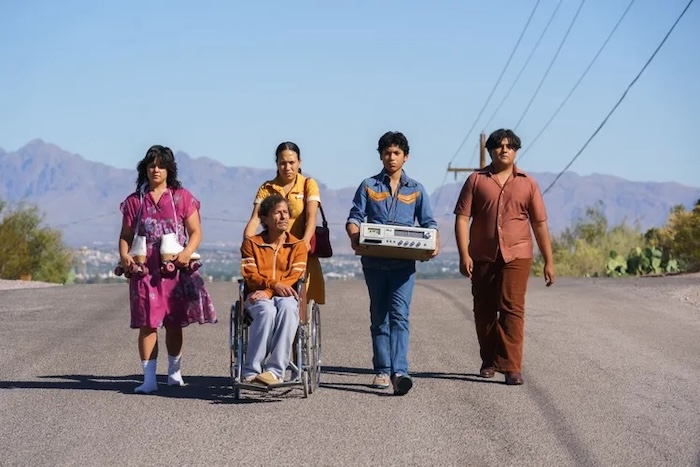
Ideally, a coming-of-age film sets up obstacles that make the adolescent protagonist work harder to learn the life lessons they need to get by in the world, and in Fernando Eimbcke’s Olmo the titular teen lives in a household where the father is bedridden with multiple sclerosis. This is New Mexico in 1979, in a community made up primarily of Mexican immigrants and their US-born children, so the dialogue is by definition bilingual in the strictest way: the adults speak to their kids almost exclusively in Spanish and the kids reply almost exclusively in English, thus setting up a linguistically based generational divide. Secondly, Olmo (Aivan Uttapa) is constantly at odds with his older sister, Ana (Rosa Armendariz), since they share the task of caring for their father, Nestor (Gustavo Sanchez Parra), while their mother (Andrea Suarez Paz) works overtime as a waitress trying to make the rent, which we quickly learn is three months overdue. How is a boy with a normal libido and desire to fit in going to find his place in the world if he’s expected to give sponge baths and empty bedpans all the time?
Eimbcke provides something of a plot on which to hang Olmo’s tribulations. The girl next door, Nina (Melanie Frometa), on whom Olmo has a crush, invites him and his best friend Miguel (Diego Olmedo) to a party across town if they can provide a stereo. As it happens, Olmo’s father has a stereo, though it’s broken, so Olmo has to talk him into fixing it (he’s an electrician by trade), which means he has to explain to Olmo how to fix it since he can’t use his hands. In this scene, we quickly understand how Nestor still takes his responsibilities as a father seriously, since he insists that learning such skills is important for Olmo, who simply wants to fix the stereo and bristles at his father’s edifying instructions. Over the course of the movie, Olmo’s naive but pointed resistance to parental control snowballs into a self-punishing imperative. And when he and Miguel finally get the stereo to the party and become heroes not only for providing the tunes but schooling the fine young ladies in attendance in the niceties of post-Travolta booty-shaking, you might feel he’s accomplished something, but actually his emotional conflicts are just starting.
Tonally, Olmo is a comedy, though the outwardly funny scenes feel as if Olmo himself thought them up, meaning they might only be funny to someone his age. Eimbcke’s strong suit is how his characters interact in continually surprising ways. I’m not sure if the clinch between Olmo and Nina that climaxes the dance scene could really have been that easy, but the subsequent coitus interruptus is worth the price of admission.
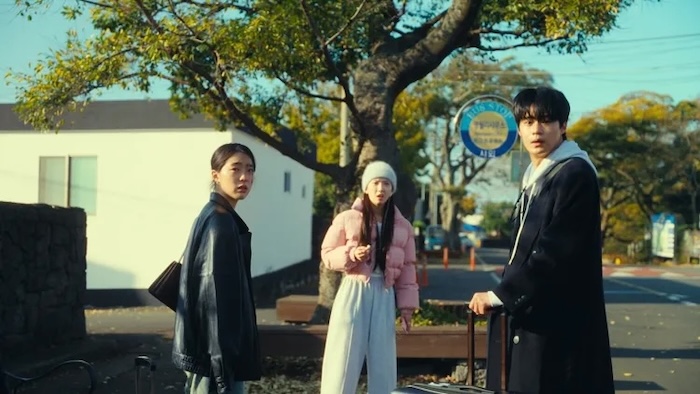
The central trio in the Korean film Time to Be Strong are all 26, so they should be well past their marks when it comes to coming-of-age themes, but they grew up under unique psychologically stunting circumstances. They were K-pop idols when they were adolescents. Now they are washed up and taking that “school trip” they never could because of work, and decide to tour Jeju Island, a popular school excursion destination. Things do not go well right from the get-go. One of the two women, Sa-rang (Ha Seo-yoon) leaves her big suitcase on the bus, thus forcing Soo-min (Choi Sung-eun), the other female in the group and the most responsible member, to spend an inordinate amount of time on her cell phone trying to locate it. No luck. Then after checking into their rental house they go out to eat and Sa-rang, paranoically thinking that the party at the next table is talking shit about them, savagely attacks the party, incurring a compensatory demand from the aggrieved individuals that relieves the trio of their discretionary cash.
We soon learn that Sa-rang is off her meds, and that her delicate mental state was as least partially brought on by the suicide of her friend in the same idol girl group where she and the bulimic Soo-min toiled. The third member of our troupe is Tae-hee (Kan Chae-yun), who was the “funny guy” in a boy band (“I was never a good singer”) that announced its dissolution while he was fulfilling his mandatory military service, even though he still has two years left on a punishing contract that has rendered him 30 million won in debt. Suffice to say that all three ex-idols are at loose ends because they have no viable future, having squandered their most formative years for the sake of entertainment companies that bled them dry and then callously discarded them. During their sojourn, they discuss these matters and others with candor, but only Soo-min seems capable of self-awareness and the viewer is constantly waiting for the other shoe to drop with regards to Sa-rang. An extended night of drinking and carrying on with a young woman who appears to be their only fan on the island allows plenty of opportunities for the worst to happen. It does and it doesn’t.
Writer-director Sun Nam-koong is herself self-aware enough to know that while the trio will learn bitter truths about themselves and their situations on this trip, they won’t get any closer to solving their problems, which leaves the movie sort of up in the air, but there’s a bracing honesty in the acting and characterizations that shine a light into the world of K-pop that’s quite convincing. Interestingly, Time to Be Strong is produced by South Korea’s National Human Rights Commission, which means even the country is aware that K-pop is a severely exploitative industry that preys on young people’s hopes and dreams. I’m not sure if the movie qualifies as a cautionary tale given that it’s obviously aimed at adult sensibilities, but maybe it should be made mandatory viewing for 7th graders.
Olmo, in English and Spanish, now playing in Tokyo at Human Trust Cinema Shibuya (03-5468-5551).
Time to Be Strong, in Korean, now playing in Tokyo at White Cine Quinto Shibuya (03-6712-7225).
Olmo home page in Japanese
Time to Be Strong home page in Japanese
Olmo photo (c) 2025 Olmo 2023, LLC
Time to Be Strong photo (c) 2023 National Human Rights Commission of Korea, Before We Die

