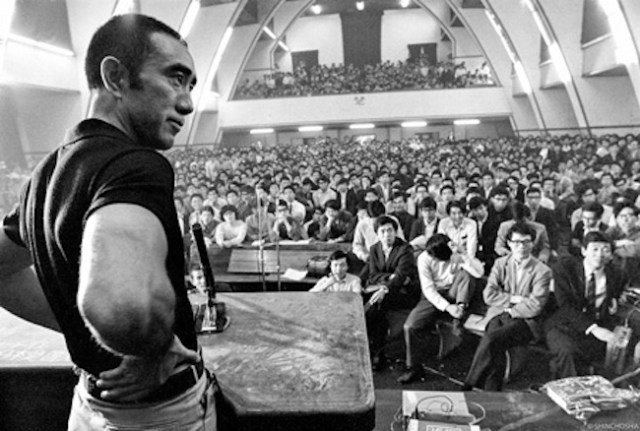
 Almost 50 years after he committed ritual suicide at the self-defense agency headquarters in Tokyo at the age of 45, Yukio Mishima wedges his way back into Japan’s consciousness in the form of a documentary based on “lost footage” of a public debate he had with a left-wing student organization at the Komaba campus of the University of Tokyo in May 1969. In terms of quality and content, the footage is certainly impressive and worthy of scholarly and even general scrutiny, though there’s a certain dated predictability to the exchanges depicted and, later, analyzed. Director Keisuke Toyoshima lines up as many surviving participants in the debate, as well as people with academic skin in the game, in order to show us how momentous this event was, but in the end it feels more like a historical curiosity than a revelatory document.
For sure, it was a momentous time. The radical student organization, Todai Zenkyoto (All Campus Joint Struggle Committee), had essentially been defeated by the police and school authorities in its quests, first to stop the Vietnam War and Japan’s security alliance with the U.S., and secondly to assure greater student autonomy within the university structure. Mishima, probably the most acclaimed novelist of his generation, was already well into his poetic nationalist phase, buff from bodybuilding, effortlessly cosmopolitan regardless of parochial pronouncements, and brimming with confidence. He could well afford to take on these punks single-handedly in a school auditorium holding hundreds and accepted their challenge to argue his case for restoring the emperor to the head of the state and reviving militarism. But another reason he took the challenge, according to the various talking heads who appear throughout the movie, is that he sincerely admired these young men (and the vast majority were men; no women appear in the footage chosen and only one is a talking head, fellow novelist and epicurean Jakucho Setouchi), because they had proven they were men of action. In fact, one of their beefs with Mishima was that he showed off his intellectualism, and like Richard Hofstadter’s famous theory about people who identify as being practical-minded, the students wanted to trip him up by proving his intelligence was used for frivolous things. As one student says during the debate, “This is all philosophical nonsense! I’m here to see Mishima get beaten up.”
And in a sense that’s the problem with the film, because too much of the debate is spent talking about the meaning of language rather than the primacy of action, which is the real subject of Mishima’s literature. The centerpiece confrontation is between the author, chain smoking and cracking jokes at the expense of his hosts, and a student named Masahiko Akuta, who, with his baby daughter strapped to his chest, brings the debate down to the ground in ways that are startlingly direct. Akuta does not defer to Mishima, and, in fact, seems impatient with his constant extemporizing, and for a second, at least, you can sense the writer realizing that someone is calling his bluff.
Though it would take a great deal of intellectual gymnastics to claim that one side or the other “won” the debate, there’s another sense that Mishima didn’t feel entirely satisfied with his performance. As several talking heads say in hindsight, he actually “loved” young people, regardless of their political position, because he knew they were not yet ground underfoot by Japanese conventions. He may have worshipped the idea of the emperor, but he seemed to resent the man himself, which was exactly the point. When the emperor was a god, he could be revered. As a man, he was barely capable of holding a conversation of any interest. Even Mishima’s militaristic turns were more theatrical than political (though he probably hated U.S. bases just as much as the leftists did), and the film gives the impression that his famous suicide more than a year later was carried out to own the libs, if not these particular students. He wasn’t humiliated in the debate by any means, but he knew he had failed to persuade them that his was the path they should be following, not that of left-wing dreamers (Akuta would go on to become an avant garde theater director) or corporate/government factotums, but rather citizens who saw the greatness in their native sensibility, even if Mishima himself had yet to figure out a way to transform that ideal into something that was really great for everybody on anything but a spiritual level. By killing himself so spectacularly, he at least was able to get in the last word.
In Japanese. Opens March 20 in Tokyo at Toho Cinemas Chanter Hibiya (050-6868-5001), Toho Cinemas Shinjuku (050-6868-5063), White Cine Quinto (03-6712-7225).
Mishima, the Last Debate home page in Japanese.
photo (c) 2020 eiga “Mishima Yukio vs Todai Zenkyoto 50nen me no shinjitsu” seisaku iinkai/(c) Shinchosha

 Here’s this week’s Media Mix, which is about the main reason behind the Japanese government’s improvisational response to the COVID-19 crisis. We’ve been covering this general topic for years now. The gist of our interest is that Japan has a national health insurance program that provides excellent, affordable care to every resident, but the government’s obsession with market dynamics combined with the medical industry’s profit-making impulses, can undermine the fundamental purpose of health care, which is to improve lives. In this column we explain how ongoing cost-cutting measures first implemented in the 1980s created a situation in which Japan was unprepared for the pandemic. For anyone who is interested, here are links to some other articles we have written on the same general theme.
 Here’s
  Here’s
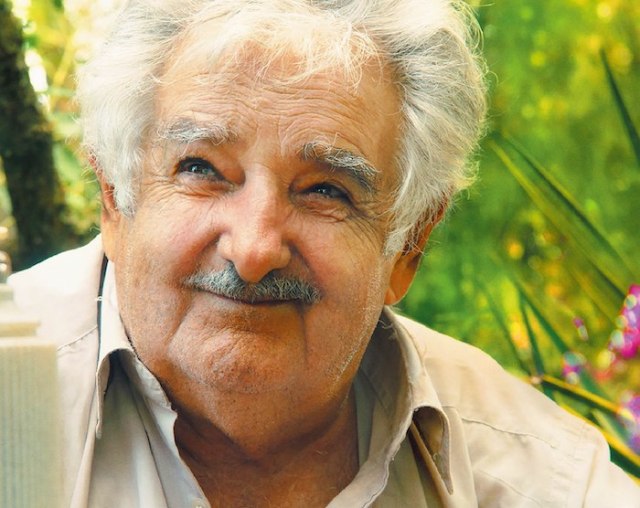 There’s something wonderfully encouraging about Emir Kusturica’s filmic fascination with Latin America. The Serbian director’s reputation as a polymath who makes a decent if not outstanding living as a filmmaker, writer, and musician is enhanced enormously by his tendency to work well outside his wheelhouse on subjects that simply fascinate him. His documentary on the soccer god Maradona was so personal that he titled it Maradona by Kusturica, and while that personal angle sometimes made the narrative impenetrable, it held up as a kind of primer for how to watch South American football, which is like no other pastime in the world. The cigar-chomping director brings this same element of indescribable love for his subject to his portrait of Jose “Pepe” Mujica, the former president of Uruguay who is now comfortably retired on a farm he runs with his forever partner Lucia Topolansky. Now in his 80s, Mujica has lost none of his left-wing fervor (since Topolansky was, at least at the time of the shooting, Uruguay’s vice president, he still has skin in the game) nor his biting, clear-headed intelligence, and though most of the movie involves Kusturica in conversation with him, it’s basically a monologue, because once Pepe starts a story you don’t want him to stop.
 Though I was initially interested in reading Thomas Piketty’s big bestseller about income inequality as a permanently expanding fixture of economic life, I eventually concluded that the book would probably teach me little. Anyone with a decent grounding in social history who follows the news with any kind of regularity already understands most of Piketty’s most salient points: the growth of the middle class, as well as its doom, was predicted by Marx, stockholders eventually eclipsed stakeholders as the drivers of capitalism, late 20th century deregulation meant the end of upward mobility regardless of what the ruling classes told you, the financial industry would dominate all others, and China’s rise was just another victory for the oligarchy. The movie version of Piketty’s tome lays all of these elements out in a convenient timeline spiced up with eye-catching graphics and animation, peppered with tasty sound bites by some of the most charismatic economists presently pontificating, and presented at a crisp pace that will keep you riveted without breaking your brain.
