
 The unwieldy title of this feature film from Kazakhstan that was trotted out for film festivals is The Horse Thieves, The Road of Time, which is far too much information and points to a loss of clarity as to what the purpose of the movie is as a piece of art or entertainment. For sure, the basic narrative idea, which mixes romantic intrigue with action and danger, is dramatically absorbing, but the whole exotic component of the setting and the culture as emphasized by the cinematography and production design points to its promotion as some kind of precious artifact. Then there’s the subtext of having a Japanese actor play the romantic male lead opposite a Kazakh actor who won a Best Actress prize at Cannes, as well as the directing credit being shared by a young Japanese director, even though the story and overall aesthetic is obviously the product of the award-winning Kazakh director.
Thankfully, the end result is nowhere near the kind of mish-mash of cross purposes this description could indicate, though it may have had something to do with the film’s lack of originality and ambition. The principals have described the story as a Western on the steppes, which is a useful reduction. The head of a family (Dulyga Akmolda) living in a remote area of Kazakhstan leaves his wife and children alone for a number of days as he goes to the regional market to sell some horses, and during his journey he is set upon by thieves who steal the horses and kill the man. After being informed of her husband’s murder, Aigal (Samal Yesyamova) holds a village funeral and struggles to raise her three children on her own. Coincidentally, on the day of the funeral, a mysterious Shane-like figure arrives in the village. Kairat (Mirai Moriyama), a freelance horse trainer passing through, calls on Aigal, and the relationship between the two, as well as between Kairat and Aigal’s 10-year-old son, Olzhas (Madi Minaidarov), is revealed in subtle ways.
Most of what transpires is predictable to anyone familiar with Westerns or even this kind of rural, former-Soviet-bloc cinema, which takes nothing away from the way directors Yerlan Nurmukhambetov and Lisa Takeba stage the climax for maximum suspense and excitement without betraying the naturalistic tone of the production. If the rest of the movie had been approached with this open sense of risk, it might have made more of a distinct impression, not so much as a faithful pastiche of certain tried-and-true narrative patterns but as something that tried to reach beyond such patterns to something sublime. For sure, the horse work and the cinematography by Aziz Zhambakiev is especially strong, so maybe it was just a case of too many cooks.
In Kazakh. Now playing in Tokyo at Shinjuku Cinema Qualite (03-3352-5645).
Horse Thieves home page in Japanese.
photo (c) Olzhas no Shiroi Uma Seisaku Iinkai

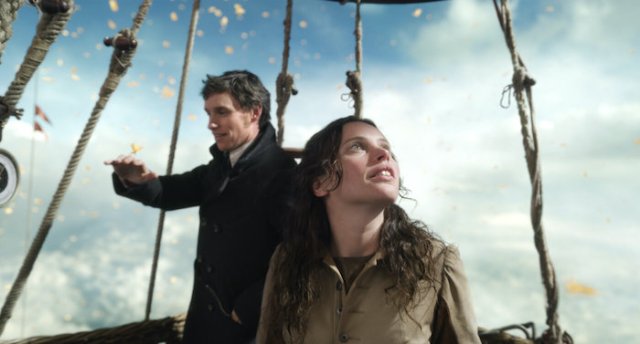 About the only way to approach Tom Harper’s two-handed adventure film is as a problem in search of a solution. Though based thinly on a true story (or, more exactly, elements from several true stories), the film’s adventure component is so limited in scope that in order to remain relevant for 100 minutes a number of hurdles must be overcome, the first of which is that there are only two characters, and the second of which is that the entire adventure takes place in the basket of a hot air balloon.
 Though Clint Eastwood’s oft-discussed tendency to inject his personal cultural prejudices into his movies seems to become more pronounced with age, he is more likely to get away with that proclivity in films where he also stars, probably because the director’s work as an actor, particularly in the Dirty Harry series, provided his entire public persona with an acceptable facade of conservative independence that comes with its own integrity. Whether you appreciate or abhor his politics, Eastwood is a known entity, and a comfortably familiar one, so wherein presentations such as American Sniper and 15:17 to Paris can come across as reactionary statements, equally skewed movies like The Mule and El Torino feel more like films thanks to Eastwood’s curmudgeonly lead characters. You take them at face value as entertainment rather than as veiled attempts at libertarian persuasion.
 Director Taika Waititi sincerely tries to hedge his bets with his Oscar-nominated Nazi comedy by labeling it right off the bat as an “anti-hate satire,” which, of course, gives the impression that the New Zealand director, not-so-fresh off the success of his MCU Thor blockbuster, has only the best intentions when he depicts Hitler as a goof-ball and anti-Semitic propaganda as akin to MAGA-inspired cultural laziness or immaturity or both. And for sure, the movie’s relentlessly inventive stream of jokes that tap directly into our collective sense of how ridiculous that whole regime was, with its uniform fetishes and obsession with whiteness for the sake of whiteness, works a certain magic until you catch yourself wondering what you should make of a group of people hanged in a town square after summary trials for anti-Nazi activities. You’re obviously supposed to be appalled, but then you’re also supposed to fall right back into laughing at the silliness of it all.
 Here’s
 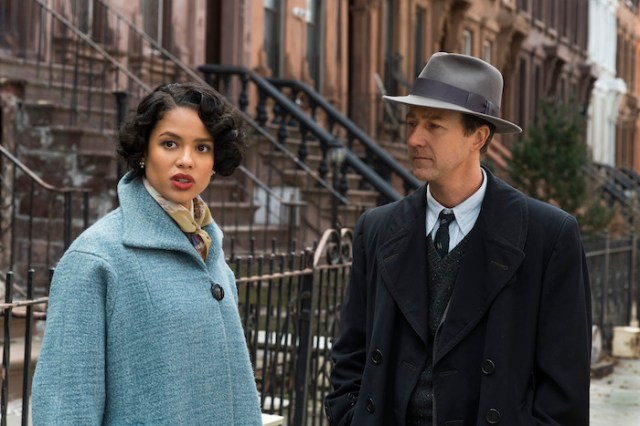 Edward Norton is arguably Hollywood’s most idiosyncratic movie star, a description that will find pushback in some circles for two reasons: Norton doesn’t present as a “star” and his idiosyncrasies aren’t apparent in all the work he’s done. Motherless Brooklyn, a kind of vanity project that Norton has been trying to launch for many years, makes good on this description for various reasons but also points up the problems that the actor-director-screenwriter has trouble seeing through the haze of his ambitions. Since I haven’t read Jonathan Lethem’s source novel I have no opinion about Norton’s decision to change the setting from 1999 to 1957, though given the central plot point of a grasping, corrupt New York city planner modeled after Robert Moses (Alec Baldwin), it at least makes logical sense. However, all the attendant noir elements feel a little too on-the-nose when they are located in an era when film noir was at its historical apex as a form of expression.
 The initial reflexive response to James Mangold’s wannabe epic about the Ford Motor Company’s ambitious entry into the world of auto racing is that it’s late to the 60s nostalgia orgy. As could be predicted with such a high budget Hollywood project the production design is immaculately retrograde, though as is also often the case with high budget Hollywood projects the verisimilitude is sometimes off-putting: the colors a bit too period-bright, the haircuts creepily perfect. What made Mad Men (and, to a lesser extent, Once Upon a Time in…Hollywood) transcend this aesthetic was the way the scripts buried beneath the surface gleam for something that felt real about the time, especially if you lived through it. Ford vs Ferrari, however, simply wants you to bathe in the promise of American exceptionalism, even if one of the main characters is a spiky Brit.
 After it opened last January, this crime-comedy became South Korea’s second biggest box office success in history, prompting all sorts of speculation as to what exactly it represented to the country’s very large movie-adoring population. Though a few of the actors have wide appeal, no one had ever been considered responsible for a comparable hit, so it mostly came down to a happy combination of factors, including central plot points focused on food, a fairly open-ended approach to violent slapstick, and the normal January doldrums, when studios, even in Korea, I suppose, mostly release detritus.
 Whether due to the ravages of age or encroaching apathy (itself a ravage of age), I found it more difficult this year to retain much familiarity with music I listened to. When I started reviewing the year in mid-November in order to compile this list, except for a half dozen albums that had made an exceptionally strong impression during our initial encounter, I seriously questioned if I had really listened to many of the other albums that were in my devices, though I was almost sure I did. One hypothesis is that I don’t listen to any new music on CD any more, only older music, because I stopped buying physical product several years ago, having reached the conclusion that I didn’t want to accumulate any more things in what is left of my life. Whatever else they offer, CDs provide more of an emotional anchor for the music they contain, something MP3s can’t provide. And now that iTunes, as much as I hated it, is gone, the music files on my computer seem that much more ephemeral. In the end, however, a guitar lick here, a particularly clever lyric there did penetrate the fog of my short-term memory, but basically I had to reboot, which explains why I’m late with the list. And it’s not as if I didn’t care about the music I was hearing. If anything, the short list I came up with ended up being pretty long. One aspect that often boosted a record’s appeal in my estimation was whether I’d seen the artist in question play live this year. I don’t attend half the number of shows I did twenty years ago, so maybe I appreciate concerts more than I used to, but one of the reasons I stopped going was that live shows increasingly held less interest for me (ravage of age, check), so if I do go out of my way to see someone, it’s almost always because I like their latest record a lot, so, in a sense, the concert is like a double reinforcement of their appeal. Yeah, I know most people see artists they already like, but for so long, because of my work, I was invited to almost every concert in town, and I took advantage of that. Not so much any more, but that’s not a ravage of age. More of a realignment of priorities. P.S., No decade-best from me. Since the dawn of the millennium, time has been a continual blur.
