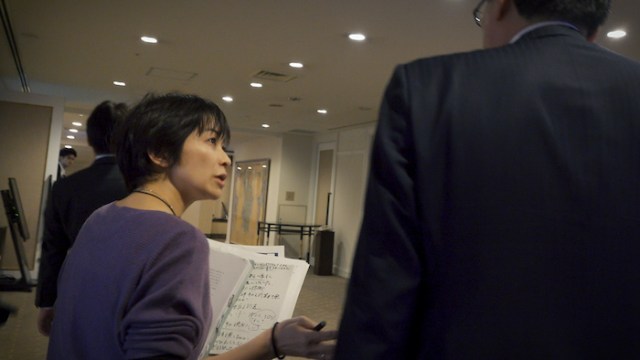
 Writer and documentary filmmaker Tatsuya Mori obviously likes titles limited to one letter of the alphabet. The two movies that made him famous, the ones about the Aum Shinrikyo cult, were titled A and A2. The title of his latest, i is a bit of a mystery until it’s explained at the end, so someone, perhaps producer Mitsunobu Kawamura, suggested the secondary title that pointed out it was a film about journalism, or, actually, one journalist in particular, Isoko Mochizuki, who writes for Tokyo Shimbun. Though Mori teaches about media in Japan and is a common pundit on TV for media-related issues, i, apparently, was not his idea, but rather Kawamura’s. The producer also made that fiction film, Shimbun Kisha, that was released several months ago and which was also based on Mochizuki. It was a hit. This is a kind of companion piece and Kawamura thought Mori was just the guy to do it, and he is, except as with all his documentaries, i is more about him than it is about its nominal subject.
Mochizuki has made a name for herself as one of the few reporters who asks tough questions of those in authority, and there is plenty of footage in the movie showing her confronting Chief Cabinet Secretary Yoshihide Suga during regular news conferences at the cabinet office. Mochizuki has been derided by the government for being too insistent, implying that she’s wasting everybody’s time, and for premising her questions on false information. What she’s doing, though, is trying to pin Suga down. Most of the questions depicted in the film have to do with Okinawa, specifically the new U.S. marine base being built at Henoko, and Mochizuki can’t rightly ask a question about things like feasability and whether the government’s construction plans are legal without explaining the background, but since Suga never gives more than a one word answer, which resolves nothing, the exercise really does seem like a waste of time. Mochizuki knows he will answer in such a way, so what she is mainly trying to do is show what a reporter is supposed to do in such circumstances.
Though these news conference snippets are a very small part of the movie in terms of running time, they are the most significant because the whole point is to reveal how toothless the media is due to their complicity in government stonewalling. Unfortunately, we don’t get much of a sense of Mochizuki as a reporter, meaning someone who writes stories. Her interview style is dogged and pointed, and it’s exhilirating to watch her tail her interlocutor down a hallway or ambush him outside his office. But perhaps because he doesn’t see any point in it, Mori never gives us any of the results of these interviews. Is Mochizuki’s reporting making a difference, or just her pugnacious style? In any case, she pursues three topics during the course of the movie: Henoko, the rape case of fellow journalist Shiori Ito, and the Moritomo Gakuen school scandal. Certainly the most telling sequence in the movie is when Mori essentially highjacks Mochizuki’s interview with Moritomo’s owners, Yasunori and Junko Kagoike. It’s as if he were investigating the scandal, not Mochizuki.
Similarly, there are a number of scenes showing Mori trying to gain press credential to cabinet office new conferences, so he can record Mochizuki doing her thing in the flesh, and, of course, he’s constantly turned down because he’s a freelancer. Another freelancer, Tetsuo Jimbo, explains to Mori that it took him 15 years to finally get a seat at the pressers, so it’s hardly necessary to show Mori getting turned down on the phone, but suffice to say that Mori isn’t going to lose to Mochizuki in the persistence department. In the end, i is less about Mochizuki than it is about Mori’s pronouncements about the sad state of news reporting in Japan, which is where the one-letter title comes in. It’s “I” as in first person singular pronoun in English, which Mori thinks is important since the news media addresses its responsibility more as a “we.” To drive home this point, he occasionally flashes an image of a dense school of fish, implying that all Japanese reporters work cohesively to follow and disseminate the government line. It’s a specious analysis, though, because in order for the media to fulfill their responsibility as watchdog they have to confront the powers that be as a group. They have to be as monolithic as the government even if each outlet and writer is pursuing their own agenda. Mochizuki is admirable in her iconoclasm, but that’s the problem, as she points out: She’s only doing what a normal reporter should do. It shouldn’t be extraordinary. Of course, i should be seen by as many people as possible so as to bring home how impotent the mass media is in Japan, but Mochizuki’s quixotic efforts should be seen for what they are: meaningless if they don’t produce news that people can use. Mori doesn’t show that she’s doing that; only that she’s trying.
In Japanese. (Prints with English subtitles may be screened at a future date) Now playing in Tokyo at Marunouchi Picadilly (050-6875-0075), Shinjuku Picadilly (050-6861-3011), Shibuya Eurospace (03-3461-0211).
i home page in Japanese.
photo (c) 2019 i shimbunsha document seisaku iinkai


 Though This Is Spinal Tap effectively made it difficult to make fun of rock musicians, particularly those of the heavy metal variety, in movies for eternity, there’s enough native ridiculousness in the genre for extraneous exercises in parody, a dispensation that directors Juuso Lantio and Jukka Vidrgen exercise in Heavy Trip. It helps oodles that the movie takes place in a small hick town in Finland, a country that, thanks to its air guitar contests that have become world famous, already possesses an air of pop cultural ridiculousness. Approached in those terms, metal has the same basic appeal as professional wrestling. It’s a rarefied art form whose ostensible attraction is bogus. In the case of wrestling, people pretend to fight. In the case of metal, people pretend to adhere to a lifestyle that’s toxically misanthropic (and male). Both characterizations, however, are misleadingly reductive, since the fake fighting in pro wrestling still requires special athletic skills to pull off, while metal musicians get their fake points across with genuine musical chops.
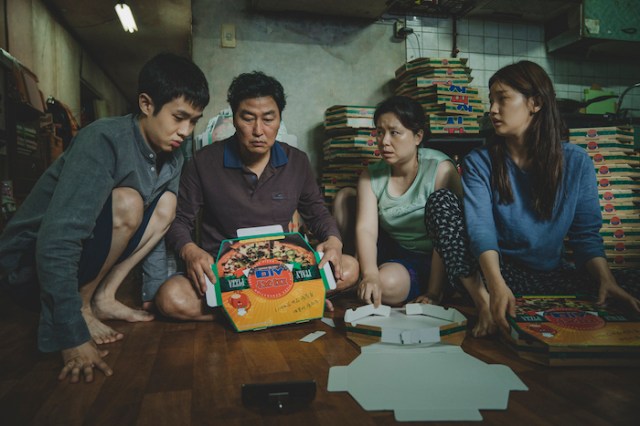 The class dynamics exploited in Bong Joon-ho’s Parasite, certainly the movie of the year regardless of what you think about it, gives rise at first to comedy of the most uncomfortable kind. This has always been Bong’s strong point, though when he’s off his game it’s usually because he has trouble maintaining his comic tone. In movies like Okja and Snowpiercer, which belong to sci-fi or fantasy genres, keeping that tone wasn’t a big problem, though the lack of consistency did make those films feel less important by the end than the way they felt at the beginning. Because Parasite takes place in a relatively realistic social setting the tone is especially important.
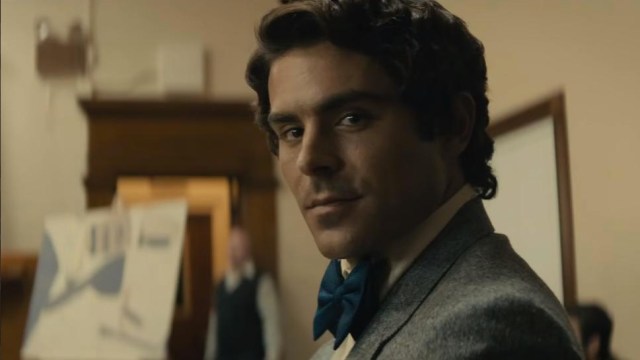 As the most notorious serial killer in American history—quite an accomplishment, if you think about it—Ted Bundy has been the focus of volumes of journalism and analysis and scads of films, mainly documentaries. Director Joe Berlinger, who made this circumspect profile of the killer, played with unusual subtlety by Zac Efron, has already made a doc series about Bundy, but apparently he wasn’t done with him. The narrative sectionalizes the part of Bundy’s life in the late 70s and early 80s that occurred afer most of his many murders had been committed, while he was living in Florida with a single mother named Elizabeth Kloepfer (Lily Collins) in relatively conventional middle class comfort. Much of the movie, in fact, it from Kloepfer’s point of view. She meets Bundy in a bar, and per his post-arrest reputation, he is charming and solicitous, even to a woman saddled with a kid, a situation she has been conditioned to believe is a deal-breaker for any long-term romantic relationship. Their first night together he doesn’t have sex with her, and makes her breakfast the next morning.
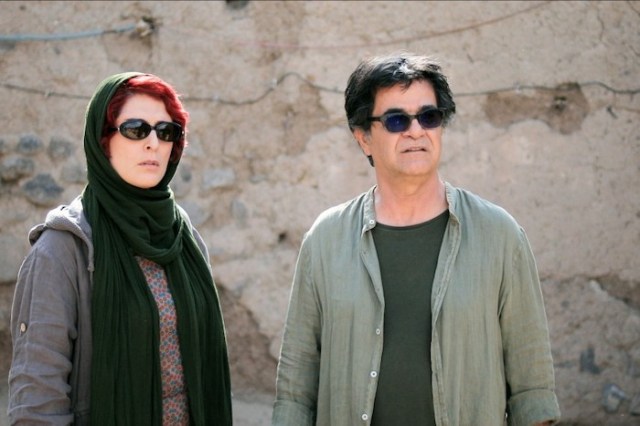 In his last samizdat production, Taxi, Jafar Panahi spent almost the entire running time behind the wheel. He spends a good portion of his latest movie also in a car, thus in a way extending a cinematic style perfected to obsessive lengths by his late mentor Abbas Kiarostami, many of whose last films took place in moving vehicles. For Panahi, the device takes on an extra layer of meaning, since he is banned from making movies for 20 years by the Iranian government. His first two forbidden works were resolutely indoor affairs, but with Taxi and now 3 Faces he endeavors to get out of the house, and cars provide just enough cover for him to scratch his creative itch without being noticed (cameras are by necessity very small when filming in a car, and no crew). However, here he’s also incorporated a long automobile trip into a story that takes him far from Tehran, into the mountains bordering Turkey, where people are familiar with his celebrity but not close to any government organs that might risk his being exposed.
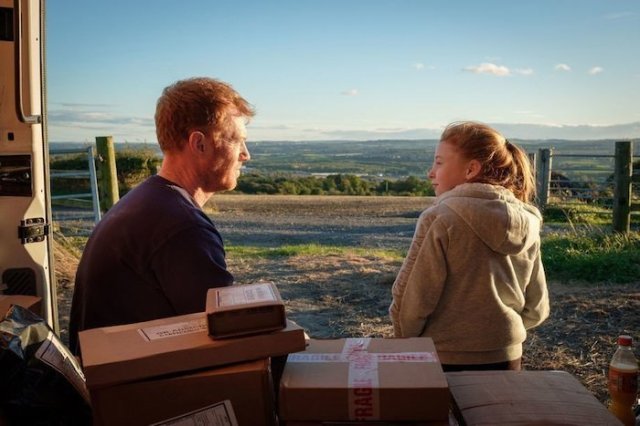 At this point in his career Ken Loach is neither anybody’s fool nor anything less than what he resolutely says he is in his films—a staunch socialist muckraker with no qualms about using rough sentimentality to drive home his political points. Consequently, he’s been more appreciated and honored at continental film festivals (Cannes, especially) than he has by international critics and his fellow Brits. His latest, in fact, may be his most scathing indictment of late stage capitalism, not to mention his harshest rant against what the UK has become socioeconomically in the 21st century. Though film purists will obviously see it as yet another over-the-top screed, in light of yesterday’s general election, it comes across as nothing less than a libertarian horror movie.
 Here’s
  What made the first Zombieland more interesting than it had any right to be was its attention to dweebish detail, in partcilar its lists of dos and donts when navigating a new American landscape where the undead were a daily danger, but a danger that could be reduced to a mere nuisance if the protocols devised by the film’s redneck hero, Tallahassee (Woody Harrelson), were followed to the letter. His opposite number, the bookish rube Columbus (Jesse Eisenberg), needed some time to absorb this wisdom, and while he managed to adjust a few tenets and add some corollaries of his own, the basic manual of chopping and shooting survived into this sequel, whose very title references one of the rules, which is to ensure that a zombie is really finished by zapping it twice with whatever weapon is at hand.
