Sometimes the context of a movie is more interesting than the movie itself. Watching this well-made Jarmusch pastiche I kept asking myself about the Afghan diaspora and its immediate impact on the titular central California city. Quite a few obviously migrated there before and during the American stage of the war in their country, but the movie sits squarely on the case of Donya (Anaita Wali Zada), a former U.S. Army translator who, while sometimes thinking of comrades and family she left behind, is mainly occupied with the more quotidian aspects of her new life in the U.S. She often rubs up against fellow countrymen who have their own problems of adjusting, but the director, Babak Jalali (who was born in Iran), doesn’t seem as interested in them as he is in Donya’s very American fixation on her lack of a romantic relationship, a plot point that isn’t appararent until about halfway through this short black-and-white movie. Until then, Donya’s lack of expressiveness just comes across as a required indie cinema affectation.
Which isn’t to say Fremont is precious or pretentious. It’s well written and funny, but it seems to avoid matters that would make it more insightful or edifying. When Donya’s self-regarding therapist (Gregg Turkington) tries to get more out of her about her background she gives up the intelligence that “I just wanted to get out of there,” without betraying much in the way of desperation—all she wants from the doctor is a sleeping pill prescription—and when a compatriot mentions that his daughter, “a traitor,” is still back in Afghanistan you wait fruitlessly for more. Donya works at a fortune cookie factory in the Bay Area for a Chinese-American family whose voluble patriarch (Eddie Tang) is always mentioning how important their work is in imparting philosophical tidbits. When Donya herself is promoted to the job of writing the fortunes, she thinks first of herself and uses the fortune cookies to troll for dates. Eventually, she gets a nibble, but from someone who lives far away and thus has to borrow a friend’s car to get there. On the way, the car breaks down and she meets a mechanic, Daniel (Jeremy Allen White, probably before his breakout role in The Bear), who is every bit as disaffected as she is. Though not love at first sight, there’s enough curiosity there to justify a return trip to the garage.
Serendipity is often the main motivator in Amerindie cinema, and it can indicate laziness on the part of the filmmakers. That’s not the case with Fremont, but the narrative caution and laid-back vibe translate as attitude that’s all too familiar. This is Jalali’s fourth feature and his second set in the U.S. I’ll definitely check out his other work. It would be interesting to see what he does with something that’s more dramatically ambitious.
In English, Dari and Cantonese. Opens June 27 in Tokyo at Cinema Qualite Shinjuku (03-3352-5645), Human Trust Cinema Yurakucho (03-6259-8608), White Cine Quinto Shibuya (03-6712-7225).
Danny Boyle’s 2002 feature 28 Days Later is considered a watershed movie, since it reinvigorated the zombie genre with new ideas, the most potent of which was that the monsters moved fast and struck fast. Technically speaking, it wasn’t a zombie movie because the monsters were not reanimated dead people but rather living persons who had been bitten by others infected with a man-made “rage virus” who had turned into monsters in the blink of an eye, but the effect that 28 Days Later had on the horror movie landscape was incalculable—there would be no The Last of Us without it. Boyle and his scenarist, Alex Garland, return with the second sequel (though they were merely executive producers of 28 Weeks Later, released in 2007) and, like the original, it comes with plenty of subtext about how the human race has in essence devolved into violence and, specifically, how the UK, where it’s set, has lost its claim to the world’s most civilized character. Great Britain is now internationally quarantined and contains, presumably, the only beings infected with the rage virus. This subset of humanity has “evolved” in various ways that beg the question of their own right to life. The protagonist, a 12-year-old boy named Spike (Alfie Williams), lives on Holy Island off the northeast coast of England in a fortress-like enclave that has returned to pre-modern technology and attitudes. The movie opens with Alfie’s father, Jamie (Aaron Taylor Johnson), taking him to the mainland for his “first kill,” using bows-and-arrows, in what is characterized as a rite of passage. To say that Spike is up for the adventure would be reading too much into it.
Bloodier and even more frantic than the first film, 28 Years Later has a lot on its mind—perhaps too much, given the way the story often lurches away from interesting ideas it might have explored more fully; and, in fact, they may be explored more fully, since Boyle and Garland have already said there will be two more installments. The infected, now naked and covered in sores, still dart around with deadly purpose but there is also a sub-species of bloated creatures that crawl along the ground consuming worms, as well as an “Alpha” who seems to have the intellectual faculties for planning ahead. This development suggests that the infected are indeed still human, a possibility that is put to the test when, late in the movie, as Spike revisits the mainland with his ill mother, Isla (Jodie Comer), to seek out a rumored physician who he hopes can cure her, they encounter an infected female going into labor. When they bring the baby to the doctor, an older man named Kelson (Ralph Fiennes), they come face-to-face with someone whose own humanity, as defined by his vocation, is at sharp odds with those of Jamie and the other inhabitants of Holy Island. Kelson believes all creatures have a right to exist, even the infected, and has erected huge monuments of bones and skulls as a means of giving them dignity in death.
Several side characters indicate that the world outside Britain is pretty similar to the one we live in now but is not necessarily more humane than the people of Holy Island. Boyle and Garland have made comments that 28 Years Later can be seen as a take on Brexit, but viewing it in that way compromises its dramatic power, which is based on our supposed capacity for mercy within the context of self-preservation in a social order that takes for granted the prerogatives of violence. Spike develops a new appreciation of nature and its bounty, including the monsters created by a technology whose purpose was to destroy.
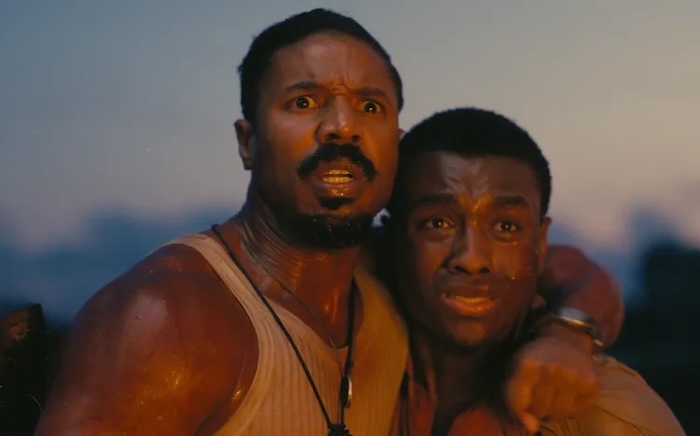
Ryan Coogler’s much-lauded Sinners is another horror movie that subverts its genre elements in order to address a broader horror at large in society, except instead of zombies it’s vampires we have to deal with. Unlike Boyle, Coogler mostly adheres to the standard lore mandated by his chosen genre—stakes through the heart, invitations to enter an abode, avoiding daylight at all costs—and Sinners is way pulpier than 28 Years Later. Set in 1930s Mississippi at the height of Jim Crow, the movie literally sees white people as the devil. In the very first, scene, a bloodied, traumatized young blues singer and guitarist named Sammie Moore (Miles Caton) arrives at church on Sunday morning, where his preacher father reasserts his own admonition that when you play sinful music, the devil will follow you home. Later we’re introduced to the Smokestack Twins (both played by Michael B. Jordan), recently returned from Chicago where for years they worked for underworld elements. They hand a suitcase full of cash over to a stout Klan member in exchange for an old mill they plan to convert into a juke joint. Just as Quentin Tarantino framed the racial dynamic in Django Unchained, the white people in Sinners would just as soon kill a Black person as look at him and from that tension flows the whole logic of the narrative.
In fact, the vampire element doesn’t even appear until halfway through, when a person of Irish background named Remmick (Jack O’Donnell) shows up at the juke joint’s opening revelry with two confederates asking to be let in for a drink. The intentions of Remmick are self-avowedly multi-cultural. He loves the blues and wants to share in its enjoyment, a sentiment that automatically makes him suspicious to these native Southern Black people; but in a sense Remmick’s intentions are pure, because he wants to turn these Black folk into spirits of the night and join his “family,” which sees no color or creed but only worships blood. Better writers than I have already analyzed Coogler’s meaning here; that white people not only want to appropriate Black culture, but appropriate it while effectively erasing the tragic history that gave rise to that culture and which they had a hand in. Maybe the most chilling scene in Sinners is the one where Remmick’s newly turned Black followers join him in a spirited Irish jig.
Sinners‘ horror movie set pieces are more elaborate than those in 28 Years Later, and, again like Django, practically luxuriate in copious amounts of blood. While Coogler has problems trying to tie it all together in the end—there are two-count-’em-two post-credit codas—his penchant for indulging every cinematic impulse is justified by a sufficiently expansive imagination. It’s a great mainstream movie about a fitting subject, and unlike 28 Years Later it doesn’t rely on subtext to make it interesting. Coogler puts everything right there on the screen so that everyone understands exactly what he’s trying to say.
28 Years Later now playing in Tokyo at Toho Cinemas Nihonbashi (050-6868-5060), Toho Cinemas Hibiya (050-6868-5068), Toho Cinemas Shinjuku (050-6868-5063), Toho Cinemas Shibuya (050-6868-5002), Toho Cinemas Roppongi Hills (050-6868-5024).
Sinners now playing in Tokyo at Shinjuku Wald 9 (03-5369-4955), Toho Cinemas Chanter Hibiya (050-6868-5001), Shibuya Cine Quinto (03-3477-5905), Shibuya White Cine Quinto (03-6712-7225).
Nepo baby Jack Quaid has carved out a nice pop culture niche with his Hughie Campbell character on the hit Prime series The Boyz: milquetoasty on the outside but with the soul of a tiger when push comes to shove. He basically recreates the character in this high concept crime action film, where he plays Nathan Caine, who was born with a rare genetic disorder that deprives him of the means to feel pain. Much expository effort is expended early on to explain how this condition rules his life: he only consumes liquid food so as not to accidentally bite off his tongue; keeps a timed beeper that tells him when to pee so that his bladder doesn’t burst; and all manner of sharp corners in his apartment are buffered with sliced tennis balls. To cap the milquetoast image he’s the assistant manager at a SoCal credit union where he keeps to himself, so when a fetching new employee named Sherry (Amber Midthunder) starts flirting with him and invites him out for lunch, he’s not sure how much danger he’s in. As it turns out, it’s more than he possibly could have imagined.
Nate falls hard for Amber, and later, when the bank is robbed by a bunch of masked psychos, they take her hostage after killing the manager and forcing Nate to open the safe. Fueled up by love-released testosterone Nate decides to save Amber and his genetic condition gives him a de facto superpower, since no matter what they do to him he can’t feel discomfort, though he sure can bleed and bruise. The script practically writes itself at this point, and the directors, Dan Berk and Robert Olsen, are careful to peg all the wince-inducing violence to jokes about how nothing really fazes Nate, who feigns suffering with mock dramatic vocal inflections in order to convince his attackers that their beatings and stabbings are having the desired effect, but he just keeps coming back for more.
There’s not much to the movie beyond the no-pain concept, and the story development alternates between multiple predictable plot twists and backstory that explains Nate’s mindset (naturally, he was bullied as a child, since other kids thought they could torture him without consequence). It does end with one of the most knock-down-drag-out fights in action movie history, so if you’re into that kind of thing this is the movie for you, but I wonder what kind of fun is that when every blow results in a wisecrack.
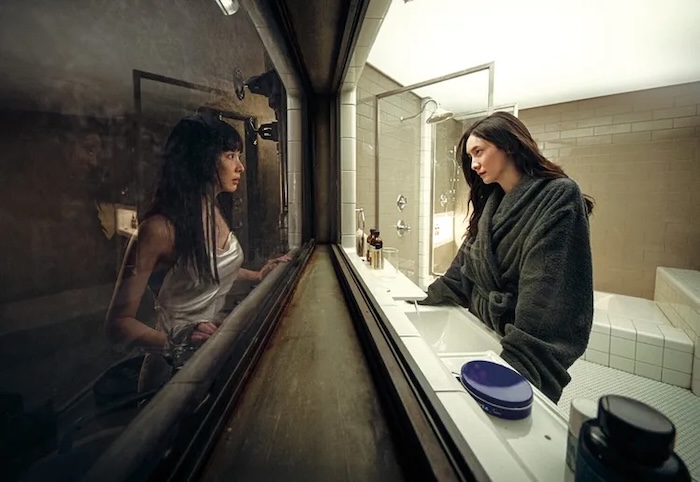
The pain in the trashy erotic thriller Hidden Face is all of the emotional type and affects each of the three principals in different ways and at different times. Set in the world of high-rent classical music, the movie’s characters are types that only exist in this sort of Korean drama, where Schubert is shorthand for iconoclasm and artistic ambition is inseparable from status-seeking. The moody, elitist cellist Soo-yeon (Cho Yeo-jeong) leaves a video message for her fiancee, conductor Seong-jin (Song Seung-heon), saying she’s taking some time off without mentioning what that means and for how long. It’s a problem because she’s one of the chief soloists for the orchestra Seong-jin directs and they’re working on a cello concerto. Under pressure from Soo-yeon’s rich mother, who also runs the orchestra, Seong-jin has to find a replacement and hits on a former fellow student of his fiancee’s named Mi-joo (Park Ji-hun), who happens to have the right qualifications.
Soon enough, Seong-jin and Mi-joo are getting it on in the finely appointed new house that Soo-yeon’s mother bought for them and which used to be owned by Soo-yeon’s and Mi-joo’s former teacher. Soon enough we learn what has happened to Soo-yeon, and it isn’t nice. In fact, Mi-joo seems to be punishing her, and as the story, which is based on a 2011 Colombian movie, reveals itself through flashbacks and flash-forwards, the various subterfuges of all the characters are revealed. Unsurprisingly, given the amount of money on display and the narrow range of moral rectitude evident among all the main characters, there’s no one to cheer for as they do their best to hurt one another to their own individual advantage.
It’s nasty fun while it lasts, and the sex is pretty graphic for a mainstream Korean feature, but the motivations are mechanical and the dark humor isn’t pointed enough to burst through the slimy coating of venality for venality’s sake. Hidden Face is a well-made genre exercise without many original ideas.
Novocaine opens today in Tokyo at Toho Cinemas Nihonbashi (050-6868-5060), Toho Cinemas Hibiya (050-6868-5068), Toho Cinemas Shinjuku (050-6868-5063), Toho Cinemas Roppongi Hills (050-6868-5024).
Hidden Face, in Korean, opens today in Tokyo at Shinjuku Piccadilly (050-6861-3011), Human Trust Cinema Yurakucho (03-6259-8608), Human Trust Cinema Shibuya (03-5468-5551).
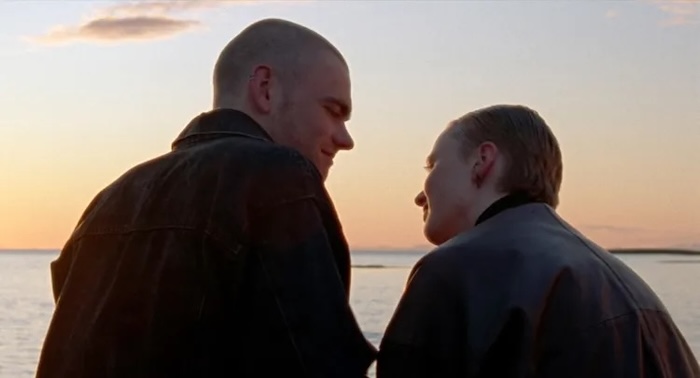
Often when tragedy strikes we are unprepared for it. The work of addressing it thus becomes fraught with circumstance and time seems to press in like a great weight. There’s no time to stand back and collect your faculties. The Icelandic director Rúnar Rúnarsson knows how to convey this feeling, though he’s greatly helped by his actors, who miraculously remain in the cinematic moment, presumably take after take after take. Unfolding from one dusk to another, the movie pegs its temporal effect on the way Iceland’s sky changes color and mood over the course of a full day. We open with university students Una (Elín Hall) and Diddi (Baldur Einarsson) sitting at the edge of the water watching the sun set, their affection for each other palpable and deep. “Let’s make babies together,” Diddi says offhandedly, but the intent is clear, and strikingly tender. They walk home and fall asleep in each other’s arms.
There is already a measure of discomfort in the interaction, because in the morning Diddi is fly to his home town, where he will break up with his girlfriend. Over the course of this eventful day, we will learn that Una and Diddi’s romance has been long gestating; that they started out as bandmates at their school and eventually fell in love. But because he has maintained a long-distance relationship with his girlfriend, Klara (Katla Njálsdóttir), the tryst is hidden from almost all Diddi’s and Una’s acquaintances except Diddi’s brother, Gunni (Mikael Kaaber). On the way to the airport, Diddi’s taxi is involved in a tunnel fire that kills many motorists, including him. By the time Una wakes up it has become a national tragedy. Now, she is yet another member of the mourning party of people who knew Diddi. When Klara arrives later that day, devastated, how is Una to handle it? At first she avoids the other woman as if by instinct, but it’s no use. Klara knows that Una was close to Diddi without understanding the true nature of that closeness, and she is intractably drawn to her.
Through a day of compensatory but somehow celebratory drinking, Diddi’s friends deal with his loss while Rúnarsson keeps his focus on Una. The viewer is privy to how each emotionally charged human response to the tragedy affects her and her hesitantly budding friendship with Klara, and the development offers both tension and release, usually at the same time. The movie is all amorphous feeling, like something conceived through the filter of a hangover, and by the next sunset Una and Klara have forged a connection born not of grief but of spiritual kinship. They know things about Diddi his other friends and family never could, and thus they know each other.
The death of someone close to the protagonist also figures prominently in Chie Hayakawa’s second feature, Renoir. The protagonist is an 11-year-old girl, Fuki (Yui Suzuki), and the death is that of her father, Keiji (Lily Franky), though it is slow and drawn out since he has terminal cancer. Just as Rúnarsson tried to show how people react to a loved one’s sudden death, Hayakawa explores how people get used to the idea of a known impending one. As it stands, Fuki is left to pursue her own interests, regardless of how frivolous they are, as her working mother (Hikari Ishida) is busy moving her father in and out of the hospital. Death is not an abstraction to Fuki, but something that must be gotten through, and Renoir is essentially a study in adolescent distraction.
The movie is at least partly autobiographical and set during the heady days of the 80s bubble, but unlike a lot of Japanese directors Hayakawa doesn’t rub your nose in it. Nostalgic touches are kept to a minimum so as to concentrate on a young girl’s keeping her head as her family loses theirs. Set against her mother’s need for emotional stability and her father’s desire for physical stasis, Fuki is free to form her own connections, whether through a potentially dangerous dating hotline, a rich classmate with family problems of their own, or her English teacher, who recognizes something special in the girl, something the audience is meant to recognize as well. She is also free to fantasize about better things, but that goes without saying for someone her age.
Though the movie is eventful in an episodic way, its slow pacing stalls the overall momentum. When death arrives it’s a relief, a response that’s natural given how tortuous Keiji’s treatment had become, but one that leaves Fuki in a conundrum Hayakawa can barely conjure. Unlike her debut work, the chillingly prescient Plan 75, which confronted death from a much different perspective, Renoir feels overly cautious and tentative, as if the director doesn’t entirely trust what she remembered.
When the Light Breaks, in Icelandic, opens June 20 in Tokyo at Bunkamura Le Cinema Shibuya Miyashita (050-6875-5280), Shinjuku Musashinokan (03-3354-5670).
Renoir, in Japanese, opens June 20 in Tokyo at Toho Cinemas Chanter Hibiya (050-6868-5001), 109 Cinemas Premium Shinjuku (0570-060-109), Shinjuku Piccadilly (050-6861-3011), Shibuya Euro Space (03-3461-0211).
When the Light Breaks photo (c) Compass Films & Halibut, in coproduction with Revolver Amsterdam, MP Filmska Produccija, Eaux Vives Productions, Jour2Fete, with The Party Film Sales
Renoir photo (c) 2025 Renoir Seisaku Iinkai + International Partners
Given the often self-contradicting comments attending Francis Ford Coppola’s late-career magnum opus since its premiere at Cannes last year, it’s difficult to determine if anyone thinks it’s a movie with “appeal.” Though not nearly as long as it could have been, the movie’s multiple storylines and complex themes makes the two-hour-plus running time feel like a chore, even for arthouse freaks. The general opinion is that it’s good in that it’s ambitious and well-made, but hardly a classic in the way one might think a Coppola late-career magnum opus should be. Though no one expects another Godfather or Apocalypse Now, Coppola has made some good movies since the 70s, and this comes across as merely a huge project without many elements that stick in the imagination.
The central hangup is the fantasy-derived nature of the story. Set in an alternative version of New York called New Rome, the film relies on allegory that is heavily representational right from the start, centered on a Howard Roark-like architect, Cesar Catalina (Adam Driver), whose vision is grand, self-inflating, and at odds with the conventional sensibilities of the powers-that-be, including the mayor, Franklyn Cicero (Giancarlo Esposito), and the city’s reigning billionaire Robert Moses type, Hamilton Crassus III (Jon Voight). Catalina has visions of greatness that he believes mere mortals cannot comprehend and thus is unremitting in his determination to see them realized, but for the most part the obstacles in his way are tabloidy in texture: sex scandals, inter-family squabbles that turn murderous, and pots of money being spilled all over the place. Apropos the city’s name, decadence is the default narrative mode, and each elaborately designed character stands for some facet of civilizational decline. There are plots and subplots that make sense, but they aren’t coordinated so much as attached to pre-existing literary ideas, including bits of Hamlet and pseudo-hippie tracts like Siddhartha. If the big problem is that the establishment doesn’t want to recognize Catalina’s genius, then there has to be better ways to convey that genius than long, grammatically correct soliloquys.
It’s thus hard to recommend as a movie, even if much of it is visually fantastic and dramatically intriguing. There’s a lot of money up there on the screen and it shows, and the cast alone may be worth your while just to see how all these actors deal with their weird characters and knotty lines. In addition to the aforementioned stars there’s Shia LaBeouf, Aubrey Plaza, Laurence Fishburne, Jason Schwartzmann, and even Coppola’s sister, Talia Shire (playing Jon Voight’s mother!). If you think of it as a spectacle rather than a film, you’re halfway to deciding whether you might want to see it.
Opens June 20 in Tokyo at Toho Cinemas Nihonbashi (050-6868-5068), Marunouchi Piccadilly (050-6875-0075), Shinjuku Piccadilly (050-6861-3011), Toho Cinemas Shinjuku (050-6868-5063).
The topic of how to address an elderly parent’s impending death is common in Asian arthouse cinema, and there are very few new angles from which to approach it. Chinese director Chen Xiaoyu’s debut feature, Gone With the Boat, takes matters slowly and cautiously, and while it’s affecting in its own quiet way it doesn’t make any kind of distinct impression. The elderly person in question is 72-year-old Zhou Jin (Ge Zhaomei), who has lived by herself in a riverside village since her carpenter husband recently died and seems entirely self-sufficient. She has two adult children, the tense, ambitious Jenny (Liu Dan), who runs an English language school in Shanghai with her American husband; and Qin (We Zhoukai), who doesn’t seem to have any kind of fixed job or residence. They rarely visit their mother, and when they do they don’t stay long. But once Jin is diagnosed with an inoperable brain tumor they are forced to face their filial responsibilities and be by her side, choices that invariably lead to friction, not only with their mother, but with each other.
Initially the conflict is over their mother’s treatment. Jenny wants Jin to take advantage of aggressive methods, but Jin sees it as being pointless and would prefer dying at home. Qin takes his mother’s side, and the two siblings alternate staying with Jin as she enters her final weeks, though Jenny’s school is having serious financial problems that demand her attention. Qin has no such obstacles and nothing better to do, and so he spends the bulk of his time with Jin. Gradually, Chen reveals the source of the family’s troubled interrelationships. There was an older son who died young, plunging his parents into remorse over how they forced him to take over the father’s business, and so they encouraged their two later children to go out into the world. Moreover, Jin was either orphaned or given up by her parents to an adoptive family, who expected her to marry their son when she was old enough, but wed another instead. Consequently, she has never had a family to fall back on—her adoptive brother visits, intent on putting Jin’s affairs in order, but she rejects his help—and has only her children, grandchildren, and the house she made into a home. She wants a simple funeral, a wish that perplexes her neighbors.
Chen does a good job of weaving these various personal enmities into a believable family saga, and maintains enough mystery to keep the viewer intrigued. Qin seems to have a constitutional repulsion to marriage (it’s hinted he might be gay); and Jenny is estranged from her older teenage son, who left school and home to pursue a career as an actor, with the implication that his father is not the same man as the father of Jenny’s younger daughter, Sue. As a leitmotif, the director makes frequent references to the boats required by residents of the village, as if they provided more stability than an actual house. It’s an odd metaphor for a movie that’s so formally stolid and narratively inert.
Thai director Pat Boonnitipat’s How to Make Millions Before Grandma Dies is, as suggested by its title, a less serious movie about the same subject, though in its own way it really isn’t that different. Opening in a comic mode with various family members kissing up to their widowed matriarch, Grandma Menju (Usha “Taew” Seamkhum), who owns a nice piece of property in the Chinatown section of Bangkok, the story sets up a classic cynical dilemma: Who deserves to inherit her legacy? From the get-go it appears that the least likely benefactor would be her college dropout grandson, M (Putthipong “Billkin” Assaratanakul), whose interest in life starts and ends with his collection of video games. Boonnitipat’s aims are made clear by how he presents the various family members. Everyone, including M’s parents, cousins (one of whom makes a living through Only Fans), uncles, and aunts, present themselves as worthy heirs. Grandma, who is good-natured to a fault, takes it all in stride. M has designs, but he keeps them hidden.
Invariably, the other shoe drops and M tells Grandma that she has cancer, a diagnosis everyone else has kept hidden from her. Impressed by his candor, Grandma takes more interest in M to her other relatives’ chagrin, and M moves in as a full-time caregiver. For a time, M’s mercenary mission seems obvious, especially to the other family members, but as he gets closer to Grandma and learns her story he inadvertently sees what kind of a world exists beyond the computer screen and can’t help but get caught up in it. Consequently, he draws closer to Grandma than either of her own two children, M’s striving mother Sew (Sarinrat “Jear” Thomas) and gambling-addicted Uncle Kiang (Sanya “Duu” Kunakurn).
Boonnitipat uses M’s naivete to show the audience this world, which is not that different from the one conveyed in Gone With the Boat, but the director expresses a much keener enthusiasm for his images and sounds, and the movie makes this corner of the Thai capital, with its rich ethnic heritage and unique history, vivid and fascinating. Though predictably sentimental—it is one of the decade’s highest-grossing films not only in Thailand but throughout Southeast Asia—it’s also rigorously honest about the process of dying slowly. We know M will somehow reap the inheritance his relatives covet, but by actually being present, emotionally as well as physically, he realizes what that legacy is worth and acts conscientiously, not only toward his grandmother, but to everyone else in his family, whether they like it or not.
Gone With the Boat, in Chinese and English, now playing in Tokyo at Grand Cinema Sunshine Ikebukuro (03-6915-2722).
How to Make Millions Before Grandma Dies, in Thai, now playing in Tokyo at Shinjuku Piccadilly (050-6861-3011), Cine Switch Ginza (03-3561-0707), Human Trust Cinema Shibuya (03-5468-5551).
Though American in tone, the plot mechanics of this nominally Armenian feature scan Eastern European to a fault. Tragedy is played for laughs, at least at first, while the characters are shamelessly played as broad stereotypes that reinforce the black comic mode. The hero is a classic schlub, and, in fact, is nicknamed Charlie Chaplin by his tormentors as more than just an insult. His name actually is Charlie, and as played by Armenian-American writer-director Michael Goorjian, he’s preternatually naive. It’s 1948, and Stalin has invited all Armenians who escaped the World War I Turkish-led genocide to repatriate in what is now Soviet territory. Charlie, an orphan who was smuggled out of Armenia as a little boy and made it to the U.S., has recently lost his wife and takes Stalin up on his offer, expecting to reclaim his heritage. He arrives with only a smattering of the language and, in the train station, helps a woman retrieve her son who has gotten lost in a crowd of people. The woman happens to be the Armenian wife of a local Russian official, and she asks her husband to help Charlie get a job. Instead, the husband, miffed by this stranger’s grating American attitude, no matter how benign the intent, has him arrested and thrown in prison.
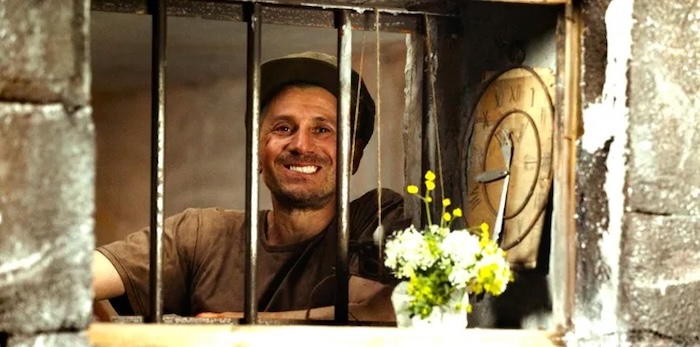
Fooled into signing a confession he can’t read, Charlie is sentenced to hard labor in Siberia but, due to damage caused by a fortuitous earthquake, all prisoners set for transfer are kept on site to repair the walls. Charlie settles into a daily grind of backbreaking work and occasional beatings meted out just for the hell of it. To pass the time, he sits at the window of his cell and spies on the neighbors, a young couple the husband of which is one of the tower guards at the prison and who has a knack for painting that his wife doesn’t seem to appreciate. It’s like a kinder version of Rear Window: Over months and even years, Charlie’s fascination with this couple turns into an obsession, as he loses himself in the drama of their everyday existence, even if he has to make up his own dialogue. The script is just clever enough to paper over the more obvious plot holes and contradictions, and Goorjian knows how to modulate the emotional temperature to keep the viewer interested, but if you’ve seen any Eastern European tragicomedies of this ilk you can predict not only where the story is going, but how it will get there, and the last half hour, while compelling, feels often like a retread of something that was probably better.
The film is saved by its skillful editing and the supporting Armenian and Russian cast, whose caricatures turn out to be deeper than what first impressions might imply, especially in the way they differentiate between the two national outlooks. The old guy who constantly lectures Charlie on the greatness of Armenian culture is a running joke that never flags.
In Armenian, Russian and English. Opens June 13 in Tokyo at Toho Cinemas Chanter Hibiya (050-6868-5001), Kino Cinema Shinjuku (03-5315-0978).
Though it’s the usual stylish froth you would expect from a mainstream Korean movie featuring two of the country’s most popular stars, Love in the Big City manages to make a timely statement about the state of affairs for young Koreans with regard to dating and romantic commitment. The two main characters are stereotypical fictional constructs in their own way, but their interactions say something significant about the local brand of toxic masculinity and how it affects the lives of people who simply want to live their lives as they please. The female lead, Jae-hee (Kim Go-eun), is privileged and free-spirited in a way that grates on her fellow university classmates, especially the boys, who find her less than solicitous to their sensibilities. The only one who seems unmoved by her sassy attitude and flouting of social norms is Heung-soo (Noh Sang-hyun), who at first seems slightly annoyed. Eventually we learn that he really doesn’t care that much, because he’s gay.
A closeted gay, of course, an attribute that’s the film’s dramatic centerpiece. Both Jae-hee and Heung-soo are majoring in French literature, and they quickly bond over their interpretation of Camus, a writer who they admire for his iconoclasm. This common interest draws them together and Jae-hee, being both sensitive and nosey, almost immediately realizes Heung-soo is homosexual and is thus even more drawn to him as a friend and fellow non-conformist. Eventually, she invites him to move into her flat, where they create their own kind of semi-impoverished bohemia. The close juxtaposition of their lives puts each in stark contrast to the other’s. Though both are a little too fond of alcohol—Love in the Big City has even more scenes of bingeing than the average Korean feature—they manifest the loss of inhibition differently. Jae-hee would be called sexually profligate in a Western movie, though here she’s mostly just romantically indiscreet, and tends to hook up with guys who can’t handle her candor. Heung-soo is constitutionally paranoid about anyone finding out about his sexual proclivities, and keeps his affairs closely concealed, especially from his mother, who suspects her son’s leanings but refuses to accept them. Heung-soo’s disposition with regard to his sexuality has the opposite effect on his relationships than Jae-hee’s does for hers—he rejects lovers who get too close even when their intentions are sincere and understanding. He just can’t risk it.
Matters come to a head when one of Jae-hee’s boyfriends discovers she is living with Heung-soo, thinking at first that they are secret lovers and thus forcing Jae-hee to reveal that Heung-soo “doesn’t like women,” a statement that turns Heung-soo against her. It’s at this point where what has been implied becomes obvious: Jae-hee and Heung-soo can only be friends in this rarefied world they’ve created, a world that’s automatically delineated by Heung-soo’s fear of being outed. A friend told me that, in terms of social content, Korean films are about 20 years behind the West, and this movie would seem to confirm that opinion, but the central relationship, while steeped in cliches requisite for big budget Korean love stories, is so finely calibrated and the actors so invested in their roles that the movie’s statement hits home. Love in the Big City also projects optimism by showing how the two roommates move beyond their codependency into responsible maturity.
In Korean. Opens June 13 in Tokyo at Toho Cinemas Nihonbashi (050-6868-5060), Toho Cinemas Hibiya (050-6868-5068), Cinemart Shinjuku (03-5369-2831), Toho Cinemas Shibuya (050-6868-5002), Toho Cinemas Roppongi Hills (050-6868-5024).
Though the central dilemma posed by this action film should be significant for Japanese viewers—an elderly woman is scammed out of a large amount of money by a telephone caller pretending to represent her grandson, who the caller says has been arrested—the cultural distinctions may cause consternation. The freedom with which the title character, played by 94-year-old actor of the moment, June Squibb, goes about her daily routine points up a measure of independence that may feel somewhat alien to Japanese seniors, but I would venture to guess Thelma’s circumstances are invented in such a way so as to make the action prerogatives at least halfway believable. The film’s depiction of the differences between living by oneself in one’s own home and living in a facility should be taken with a grain of salt. Japanese viewers might find it fantastical.
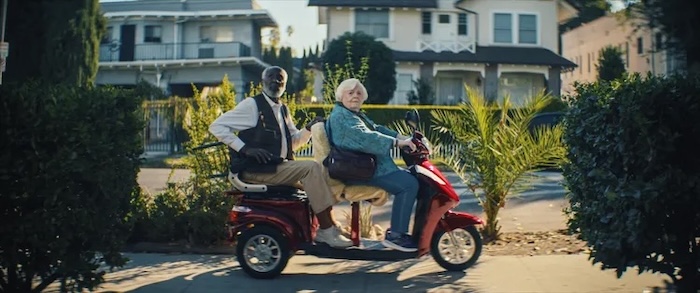
Director Josh Margolin is more concerned with adapting the conventional revenge narrative to the situation of the post-AARP crowd, and he demonstrates enough imagination in that regard to keep you interested without forcing you to consider how preposterous it all is. Thanks to Squibb, Thelma’s reaction to finding out she’s been had feels both correct and slightly batty—she’s the kind of old lady who would never raise her voice but will always make sure she understands what’s going on in order to make her point. So when the police tell her there’s little they can do to get her $10,000 back, she flips her wig, figuratively speaking, and gets to work trying to figure out who the fraudsters are. Margolin gets a lot of mileage out of her relationship to the slacker grandson, Daniel (Fred Hechinger), who loves his grandma and mostly relies on her for economic succor, mainly by lending her his expertise with modern digital life. He’s essentially the tech geek that every crime movie of this ilk requires, but in this case he’s serving an avenger who not only isn’t savvy with devices but is constitutionally against them (“Technology is what got us into this mess in the first place”). But because Thelma is forced to do the leg work herself, she has to improvise much more than John Wick does, and therein lies the movie’s implacable charm. Recruiting her old person’s home-bound best friend, Ben (the late Richard Roundtree—the original Shaft!), mainly for use of his motorized cart but also for emotional backup, she penetrates the criminals’ lair with savvy and moxie, and finds that the motivations for cheating old people are more complicated than they seem on the surface. But, in any event, she gets hers.
As an action movie, Thelma is, by necessity, slower and more deliberate, and it’s in that style where most of the humor is invested. It’s not just age that keeps Thelma from going ballistic (“I move from point to point”), even when she’s brandishing a firearm; but once she’s riled up no one can keep her down, not even Malcolm McDowell, who plays the heavy with a wink, a scowl, and his own batch of senior health issues. He’s the perfect foil for the old dame.
Now playing in Tokyo at Toho Cinemas Chanter Hibiya (050-6868-5001), Toho Cinemas Shinjuku (050-6868-5063), Shibuya Cine Quinto (03-3477-5905).
Director Ti West and his acting collaborator, Mia Goth, have managed to accrue enough hip cachet with their porn/slasher hybrid trilogy to attract a higher class of supporting cast: Kevin Bacon, Giancarlo Esposito, Elizabeth Debicki, Bobby Cannavale, Michelle Monaghan, and even Halsey do grunt work as colorful side characters in the concluding chapter of the series, which sees the 70s-80s adult film star, Maxine Minx (Goth), attempt to scale the Hollywood heights by getting cast in a sleazy establishment-certified horror film being directed by a haughty Brit auteur with visions of John Carpenter crossover grandeur, albeit in the opposite direction. Since MaXXXine is pure, shameless 80s pastiche, there isn’t a whole lot of aesthetic and subtextual distance between what this auteur, Elizabeth Bender (Debicki), is trying to do and what West accomplishes with tongue stuffed implacably in cheek, which gives the viewer pause: Is West making fun of me? I guess you’d have to ask someone who was fully awake to the cultural charms of the 80s, because I mostly slept-walked through the decade.
Maxine, you’ll remember, was the only survivor of the porn production in the first movie, X, that was set upon by the psychotic old lady (also played by Goth), who, as we learned in the second part of the trilogy, Pearl, was sent over the edge when her own dreams of youthful stardom were railroaded by men who only wanted sex. Maxine, now ensconsed successfully in L.A.’s sex business underground (she drives a vintage Mercedes), attempts to break out, but there is a shadowy figure stalking her who knows what happened at Pearl’s farm back in Texas. Is this figure the Night Stalker serial killer who’s all over the news? Does his threat to expose her dirty secret through his private dick proxy (Bacon) have any traction? It’s difficult to say, since Maxine is conceived as such a badass, both socially and professionally, that you can only assume the stalker really doesn’t know who he’s dealing with.
But that would be assuming too much, because West’s script is so flimsy in terms of motivation and premise-building that you can’t tell where the 80s slasher parody ends and the clever sendup of Hollywood attitude starts. It’s not so much the grotty special effects and the cheesy hard rock guitar score, which are fun in their own diminished way, but rather the sense that West and Goth don’t really seem to have any original ideas of their own. Unlike X, which at least made an effort to scope the close kinship between porn and horror, MaXXXine has nothing on offer except winking jokes about how everyone in L.A. is a failed Hollywood bizzer, including the actual bizzers themselves. Had West focused on that aspect of the movie industry, he might have made something truly terrifying.
Opens June 6 in Tokyo at Toho Cinemas Nihonbashi (050-6868-5060), Toho Cinemas Hibiya (050-6868-5068), Toho Cinemas Shinjuku (050-6868-5063), Shibuya Cine Quinto (03-3477-5905), Toho Cinemas Roppongi Hills (050-6868-5024).










 philipbrasor.com