Review: The Making of a Japanese

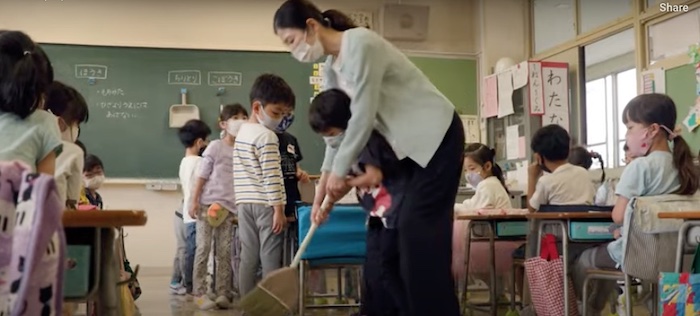
Those of us who were educated in a Western school system may balk at the title of Ema Ryan Yamazaki’s documentary about what goes on at a Japanese public elementary school. It suggests that public education’s goal is indoctrination rather than edification, and when you really think about it, maybe it isn’t so different from a Western liberal arts education, which, at bottom, prepares children for a life of employment, even if it ideally is supposed to make young minds more worldly. Perhaps the Japanese title of Yamazaki’s film is more revealing: “Elementary School is a Small Society.” The director focuses on first graders and sixth graders in order to contrast and gauge the changes that Japanese children undergo as they grow toward adolescence through the guidance of the school system. And true to the Japanese title, Yamazaki concentrates on those aspects of school policy that have to do with shaping young minds to accept their responsibilities as members of a community. It’s not just that the kids help serve food during meal times or clean their rooms and hallways, tasks that they seem to enjoy. It’s also instructors and administrators holding the children to account for how they think about themselves and act toward others. 

One of the more interesting sequences in the film centers on a first-grade girl who is preparing for a musical performance in which she will play the crash cymbals. When she makes a mistake, the teacher scolds her in a seemingly gratuitous fashion. She is devastated, but eventually buckles down and learns her part. The film implies that she is a better person for this travail, and there’s no reason to doubt it. Stripped of her agency by the cold attention of authority, she will undoubtedly strive to please not only that authority, but the people with whom she spends her time. Similarly, the primacy of the “undokai” (sports meet day) in Japanese schools reinforces in children the joy of working toward a goal but also shows them the cost of losing. Though all children have to experience such things, the structured nature of the competitions, at least as it’s presented here, tends to stress the success-failure dichotomy. For sure, it’s not enough just to show up and participate. You have to prove your worth. Even when the kids are drilled in disaster preparedness, the emphasis is on strict adherence to protocols regardless of their understanding of the reason for those protocols. 

Yamazaki says in the production notes that this methodology is “a double-edged sword” and acknowledges that some people may find it problematic, but it’s obvious she thinks it’s necessary and valuable. If the viewer is less sure of that pronouncement, it has less to do with cultural signifiers and more to do with lack of balance. The movie contains almost no scenes of or reflections on the children’s scholastic development. It’s all about their social conditioning, and thus it seems as if Japanese schools are all about indoctrination. For those of us who have had exposure to the Japanese education system there are other omissions. Corporal punishment, once a staple of early education in Japan and still exercised, reportedly, in some schools, isn’t mentioned at all. The problem of bullying, which is endemic in Japanese schools (all schools everywhere, for that matter) and could be thought of as a by-product of the push to conform, also gets little attention. And because the movie was shot at a school in Setagaya, one of Tokyo’s more affluent areas, something needs to be said about the academic competition that will soon ensue for entrance to prestigious junior high schools and how that pressure will come to bear on not only the students but their parents. The teachers who testify to how hard they work and their initial doubts with regard to the methods they must use have to contend with their supervisors, but also the parents who may think they aren’t treating their kids as well as they are treating other students. Being a responsible member of society, even a small one, is an admirable goal, but sometimes society doesn’t repay the effort as much as you hoped it would. 

In Japanese. Now playing in Tokyo at Cine Switch Ginza (03-3561-0707). (Some screenings will have English subtitles.)

The Making of a Japanese home page in Japanese

photo (c) Cineric Creative/NHK/PYSTYMETSĀ/Point du Jour

Posted in Movies | Tagged | Leave a comment

Review: Alcarràs

Winner of the Golden Bear at the 2022 Berlin Film Festival, Carla Simón’s second feature is, like her first, set in the Spanish countryside, this time in the agricultural region of Catalonia, which is undergoing huge changes due to real estate investments. The property in question is a peach orchard run by three generations of a family that doesn’t actually own the land they work. It was granted to them by the landowner following the Spanish Civil War, when the farmers hid the landowner and his family from the Republican army, and the landowner told the farmers they could use the land in perpetuity, but no deed was signed. It was essentially a gentlemen’s agreement, and the current heir to the landowner has given in to financial pressure from an interested corporation and sold the land for a solar farm. The farmers have until the end of the summer to harvest what will be their last crop. 

This crisis only serves to exacerbate the kind of intra-family frictions that are common when so many members depend on one source of income for their livelihoods. At the center is Quimet (Jordi Pujol Dolcet), the short-fused, de facto head of the household now that his father, Rogelio (Josep Abad), the son of the man who made the handshake deal for the land, is old and effectively retired. Quimet’s three children vary greatly in age, from teenage Roger, a burgeoning marijuana cultivator, to preschooler Iris (Ainet Jounou), who loves nothing better than to playact war games and sci-fi scenarios with her young twin cousins in the fields and forests surrounding their house. Simón presents their life as an idyll that’s being destroyed by modern technology whose large-scale benefits are good for people in general but whose short-term effects upend and supplant traditions that have sustained this region for centuries. Though the director is careful to provide background as to how other farmers are being driven off their land by speculators and produce wholesalers who purposely keep prices low, she’s mostly interested in how these dynamics affect families at the micro level. So Quimet quickly finds himself at odds with his brother-in-law Cisco (Carles Cabós), who decides to take the landowner’s offer of employment with the company that will manage the solar farm. Since Cisco is clandestinely working with Roger on his pot plants, his enmity with Quimet infects the son, and all these various conflicts incite the stereotypical male Mediterranean hormones, thus alienating the females in the family, in particular the middle daughter, Mariona (Xènia Roset), whose resentment of macho attitudes intensifies accordingly. As the summer stretches on and the family struggles to meet their goals before the trees are removed, the bonds that have kept the family together slacken, but the unit doesn’t disintegrate. Whatever else Simón’s dramatic mission is, she seems intent on the idea that while a farming family is nothing without the soil, they remain family even when the land is taken from them.

At slightly over two hours, Alcarràs‘s tension occasionally slackens as well, but in a way that’s how real life works—even as one’s external situation becomes increasingly desperate, the instinct to live in the moment persists, so the violent outbursts and episodes of heartbreak seem almost random, as they merely puncuate broader scenes of everyday existence. If it all works as well as it does it’s because the actors work as well as they do. Though all are local people who have never acted before and are not related to one another, they come across as a real family fully invested in one another’s well-being. I suppose they all know what to do because they come from similar families. There are some things you just can’t “perform.”

In Catalan and Spanish. Now playing in Tokyo at Toho Cinemas Chanter Hibiya (050-6868-5001), Kino Cinema Shinjuku (03-5315-0978), Human Trust Cinema Shibuya (03-5468-5551).

Alcarràs home page in Japanese

photo (c) 2022 Avalon PC/Elastica Films/Vilaut Films/Kino Produzioni/Alcarras Film AI

Posted in Movies | Tagged | Leave a comment

Review: Kraven the Hunter

The Sony wing of the MCU—the Spider-verse, to be more precise—continues its trudge toward the next blockbuster Spidey installment with the origin story of one of Peter Parker’s nemeses, who is positioned here as a hero in his own right; and that makes sense within the purview of the classic Marvel m.o. One thing that early fans of the comic books appreciated about Stan Lee’s vision was that both heroes and villains operated within complicated personality paradigms, unlike DC Comics characters, who lived in a decidedly Manichean world. Kraven is Sergei Kravinoff (Aaron Taylor-Johnson), the son of Russian crime boss Nikolai Kravinoff (Russell Crowe), who teaches both Sergei and his other son by a different mother, Dmitri (Fred Hechinger), how to hunt big game, skills that, in Sergei’s case, are enhanced to super powers after he is attacked by a lion in Africa and treated with a special potion by a local woman named Calypso (Ariana DeBose), who later becomes a high-powered London-based lawyer. As a source idea it isn’t much more imaginative than being bitten by a radioactive spider, but what’s really risible is that these super powers are never delineated beyond the usual bulging muscles and ability to run very fast without getting worn out. 

Kraven, the moniker Sergei adopts to carry out various special ops for whomever wants to hire him, is this shady character who lives off the grid and establishes a worldwide reputation as a badass, and true to the Marvel ethos his sore spot is his relations to his family, especially his father, who has become one of the biggest corporate criminals in the world, and Dmitri, who is trying to make a career as a musician under his father’s guidance and possesses a striking talent for mimicry. Nikolai’s own worst enemy is another Russian mafia boss who wants his “territory,” Aleksei Sytsevich (Alessandro Nivola), whose moral compass is even more haywire than Nikolai’s, owing mainly to the fact that he himself has been dosed with another potion, one that turns him into a two-legged rhinoceros under stressful circumstances. He’s like the Hulk’s evil cognate. The Rhino, as he’s called, kidnaps Dmitri, thus drawing Sergei back into the family orbit, despite his hatred of his father, in order to save his brother, a task that leads to a lot of mass destruction in both town and country. 

At no point does Spider-man show up amidst this mayhem. He isn’t even mentioned, and the ending predictably keeps things open-ended so that a sequel is anticipated. Though better than the Venom series and light years ahead of Madame Web and Morbius, Kraven the Hunter is similarly coy about its place in the Spider-verse and thus feels even more like a (very expensive) holding gambit, but I really wonder if the next Spider-man movie will have room for all these other superhero-villains. I like the Spider-man movies fine, especially the animated ones, but I can’t see the series gaining anything compelling by incorporating these characters, who can’t even hold their own in movies that are only about them. 

Now playing in Tokyo at Toho Cinemas Nihonbashi (050-6868-5060), Marunouchi Piccadilly (050-6875-0075), Toho Cinemas Hibiya (050-6868-5068), 109 Cinemas Premium Shinjuku (0570-060-109), Shinjuku Wald 9 (03-5369-4955), Shinjuku Piccadilly (95906861-3011), Toho Cinemas Shinjuku (050-6868-5063), Shibuya Cine Quinto (03-3477-5905), Toho Cinemas Roppongi Hills (050-6868-5024).

Kraven the Hunter home page in Japanese

Posted in Movies | Tagged , , | Leave a comment

Review: The Monk and the Gun

There’s a naive charm to this second feature by Bhutanese director Pawo Choyning Dorji that initially might be misconstrued as patronizing in nature, but Dorji obviously knows whereof he writes and the wit and warmth of the presentation are so effective that the movie, regardless of how reductive it may seem, wins you over. Like It’s a Mad, Mad, Mad, Mad World without the slapstick, The Monk and the Gun follows half a dozen comic plotlines in parallel until all converge in the end, and each story is so carefully measured against the principal theme—how difficult it is to “learn” democracy—that the conclusion has the force of an epiphany, even though it’s more of a joke. 

Set in 2006, when the king of Bhutan abdicated so that his nation could adopt a republican-style system and become “a truly modern country,” the central event is a mock election that is meant to teach democratic principles to a skeptical populace, most of which loved their monarch and thought the old system was just fine as it was. We see election workers preparing citizens for the vote, potential candidates already gearing up for future campaigns, and the hoi polloi discussing whether all the fuss is really worth it. Amidst all this business two lines of intrigue are introduced. In the first, an elderly Buddhist lama (Kelsang Choejay) in a mountain monastery, after hearing that the king is stepping down, orders one of his monks, Tashi (Tandin Wangchuk), to acquire two guns without stating why he needs them. In the second, an English interpreter, Benji (Tandin Sonam), meets an antique gun collector, Ron (Harry Einhorn), at the airport to help him track down a rare American Civil War-era rifle that was one of many imported to Bhutan during its own war with Tibet in the 19th century. You don’t need to be Stanley Kramer to predict that the pahts of these two firearms seekers will cross, but while we understand Ron’s reason for wanting the gun, the lama’s remains unknown. Tashi is just doing what he’s told, and not only doesn’t know his master’s purposes, but he has never seen a gun before. It isn’t until he stops at a way station for refreshment (“black water” = Coke) and sees 007 on TV in the anteroom brandishing a machine gun that he understands the purpose of the thing he seeks. Meanwhile, the election officials are becoming increasingly frustrated with the attitudes of the king’s subjects, who either believe that voting is inherently divisive (“You aren’t supposed to like the other side”) or are already cultivating a cynical attitude toward political gamesmanship. 

Dorji masterfully orchestrates these different vectors with dialogue that is comically precise and revelatory. When Tashi manages to snag the prize gun before Benji and Ron can get the money they promised to the owner (who first refuses their offer of $75,000, thinking it “too much,” and finally gives in to $32,000) he is puzzled when the pair offers him the same amount for the gun. “I don’t need money,” he says. “I just need the gun.” Though this kind of cultural dysphoria is common in such movies, Dorji delivers it without the condescending baggage that usually comes with it. In fact, the encounter says more about America’s, not to mention the West’s, attitude toward tools of destruction than it does about any perceived backwardness on the part of the Bhutanese. If anything, The Monk and the Gun is as much about the primacy of common sense as it is about the pitfalls of politics. 

In Dzongkha and English. Opens Dec. 13 in Tokyo at Human Trust Cinema Yurakucho (03-6259-8608), Shinjuku Musashinokan (03-3354-5670). 

The Monk and the Gun home page in Japanese

photo (c) 2023 Dangphu Dingphu: A 3 Pigs Production & Journey to the East Films Ltd. 

Posted in Movies | Leave a comment

Review: Sidonie in Japan

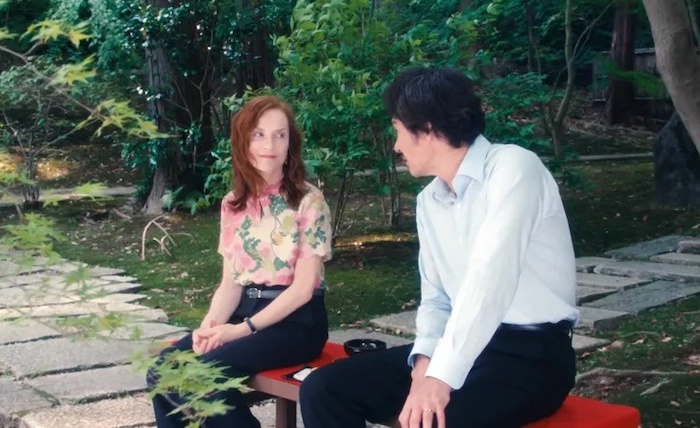
Since Isabelle Huppert has done so many movies for Korea it seems only fair she’d do one for Japan, but I would hardly call Sidonie in Japan parity. The ones she did for Korea were directed by Hong Sangsoo, who is hardly a typical Korean director and, while the two she did that were set in Korea (the third one was set in Cannes) certainly addressed Korean life to a certain extent, they avoided the usual cliches because Hong, as iconoclastic a director as they come, obviously wouldn’t stand for that. Sidonie, however, was directed by a French person, Elise Girard, who seems to have fallen for the usual “enigmatic East” nonsense and litters her screenplay with familiar Japanese images and ideas that land with a thud: the mannered stillness, the well-meaning but misconstrued gestures of omotenashi, the sense of romantic love as a tragic inevitability, not to mention copious references to exotic food and art. 

Huppert’s Sidonie is an author who comes to Japan to promote her first book, an auto-novel written when she was much younger and which has recently been translated. Her glum demeanor was precipitated by the death of her husband, Antoine (August Diehl), a year earlier, a tragedy from which she still hasn’t recovered. It’s often suggested that she expects the trip to take her mind off her mourning, but for some reason Antoine’s ghost haunts her even more as she goes about her business. Her Japanese publisher, Mizoguchi (Tsuyoshi Ihara), is an even more sullen customer while being “much younger” than Sidonie expected, a man who utters declamatory platitudes in French for no discernible reason (“I find the world absurd”) and who readily confesses to being in an unhappy marriage. For some reason the book tour skips Tokyo and mostly darts around the Kansai region, hitting Kyoto, naturally, where Sidonie gets an earful of Tanizaki and his shadows, not to mention the usual temples and rock gardens. Every so often Sidonie sees or senses Antoine’s presence, phenomena that Mizoguchi, being Japanese, understands instinctively. The two eventually fall into a brief affair that feels like an expression of survivor’s guilt on both sides (Mizoguchi’s father’s family died in Hiroshima), and then part amiably, the better for having embarked on a sexual dalliance in the tasteful Japanese manner.

Apart from the familiar stranger-in-a-strange-land elements, the movie’s most distracting quality is the clash of acting styles. Huppert is typically naturalistic, letting her character develop through the accommodation stages of being in a foreign country, from veiled suspicion to genuine curiosity, in a steady manner; while Ihara continually broadcasts the doom-and-gloom in his character’s soul as if trying to impress Girard. In the end, the director finally allows a joke to slip through and the relief is so palpable as to be shocking.

In French, English and Japanese. Opens Dec. 13 in Tokyo at Cine Switch Ginza (03-3561-0707).

Sidonie in Japan home page in Japanese

photo (c) 2023 10:15! Productions/Lupa Film/Box Productions/Film-in-Evolution/Fourier Films/Mikino/Les Films du Camelia

Posted in Movies | Tagged , | Leave a comment

Review: Food, Inc. 2

Robert Kenner and Melissa Robledo’s sequel to Kenner’s 2011 documentary Food, Inc. covers much the same territory, but the filmmakers obviously felt that in the wake of the pandemic some issues needed reiteration and clarification. Eric Schlosser, who wrote Fast Food Nation, produces again, and he and Michael Pollan, the author of The Omnivore’s Dilemma, are the main talking heads. Technology is their chief bugaboo as it applies to agriculture and food processing, but this time they go a little further into the economics of food production and food service, including the low wages paid to both farmworkers and fast food employees. Thus, the movie seems particularly timely in the wake of Trump’s victory (he makes an appearance here because as president he signed a bill that made it possible for meatpackers to avoid intrusive inspections) since Trump’s vow to deport millions of undocumented foreigners will have a huge impact on the prices of produce and meat, though the film doesn’t mention that. What it stresses is the weakening of antitrust legislation that has reduced competition, thus empowering a few corporations to dominate the food sector. From there, Schlosser and Pollan discuss a variety of bad outcomes, including the mass introduction of additives that make unnutritious processed food more addictive, the destruction of farmland dedicated to single crops, and the bankrupting of small farmers to the benefit of corporate mega-farms.

Among the new issues that the doc attempts to tackle, meat substitutes are the most interesting. So-called plant-based “meats” are shown to be not much better than ultra-processed foods (“it’s not health food”); and cultured meat, while now being promoted as a solution to the greater environmental and ethical problems of livestock raising, isn’t as feasible as its boosters claim, so Schlosser, who is nothing if not a realist, says the only solution is to cut back on meat consumption in order to rid the industry of animal cruelty and save the environment, a move that would undoubtedly make meat more expensive, though the movie doesn’t say that explicitly. It does talk at length about how lower income people have become obese due to buying cheaper processed foods rather than fresh foods, but it doesn’t really talk about the so-called developed world’s demand for low prices, which is really the reason Big Agriculture has succeeded. 

As with the first Food, Inc., the sequel gives the impression that there’s almost nothing you can do on a micro level to make things better. Even limiting one’s animal-based protein intake to seafood is shown to be debilitating, but at least the filmmakers show solutions that are doable (kelp farms that double as shellfish farms). Though Schlosser is more optimistic than Pollan, the movie in general tries not to be too despairing about the future of food, but with Trump coming back in a few months ready to trash any regulations that rein in Big Ag and the major food producers, there will probably be plenty of material to make an even scarier Food, Inc. 3 sometime down the line.

In English and Portuguese. Now playing in Tokyo at Shinjuku Cinema Qualite (03-3352-5645), Human Trust Cinema Shibuya (03-5468-5551).

Food, Inc. 2 home page in Japanese

photo (c) 2023 Another Perfect Meal, LLC

Posted in Movies | Tagged , , , | Leave a comment

Review: White Bird

When the YA genre became more relevant in the 1980s, the idea of using fiction aimed directly at teens to teach about social issues was treated almost experimentally since many of those issues were considered adult in essence, but now it’s often difficult to distinguish between issue-based stories for grownups and those for adolescents, probably because entertainment prerogatives have overtaken both approaches. Marc Forster’s White Bird is a sequel of sorts to the 2017 film Wonder, in which a boy with a genetic facial deformity is bullied by schoolmates. One of those bullies eventually apologizes to the boy, but only after he is expelled for his actions. The bully, Julian (Bryce Gheisar), is seen starting over in White Bird at a new private school in New York, and is himself subjected to rough treatment by someone who scans as a bully. Depressed over his prospects, Julian returns home to his parents’ upper west side apartment where, naturally, his parents are absent, though his French grandmother, a world famous artist named Sara (Helen Mirren), has just arrived in order to receive some sort of recognition from the Met. Understanding his dilemma, she tells him her own story about surviving World War II as a Jewish girl in occupied France. 

The bulk of the movie is this flashback tale, which recounts Sara’s childhood as the daughter of a doctor. When the Nazis show up, her parents are taken away, but Sara (Ariella Glaser) manages to escape with the help of a handicapped boy in her class, Julien (Orlando Schwerdt), who hides her in the family barn with the full knowlege of his parents (Gillian Anderson, Jo-Stone Fewings). She spends a year in the barn and during this time forms a budding romantic relationship with Julien, who home schools and entertains her. The on-the-nose irony here is that previously Sara ignored Julien because of his handicap and developed a crush on another boy who turned out to be a Nazi-in-the-making. This is the lesson that adult Sara wants to impart on her grandson, but, of course, before that happens, we have to go through the drama and intrigue of a Holocaust narrative, which involves insidious antisemitism and amazing self-sacrifice. 

White Bird, in line with what has become de rigeuer for YA stories, is premised thematically on the concept of “being kind,” an honorable mission but one that tends to feel understated in a tale centered on genocide. Moreover, the moral is so pat that it slides off the veiwer’s consciousness like water off a duck’s back. Teens can handle emotional and ethical complications, as proved by such YA classics as The Giant Robot and The Outsiders. What we have here is Morality Lite. 

Opens Dec. 6 in Tokyo at Toho Cinemas Nihonbashi (050-6868-5060), Toho Cinemas Chanter Hibiya (050-6868-5001), Kino Cinema Shinjuku (03-5315-0978), Toho Cinemas Roppongi Hills (050-6868-5024). 

White Bird home page in Japanese

photo (c) 2024 Lions GateFilms Inc. and Participant Media, LLC

Posted in Movies | Tagged , | Leave a comment

Review: A Big Home

According to Japanese government statistics cited at the beginning of this documentary, about 42,000 children in Japan require “protective care.” Half of these minors live in “children’s homes,” which are not foster homes or orphanages, but they are nevertheless “living separately from” their parents. The reasons vary and include death, illness, abuse, and “financial issues.” The movie basically goes inside one of these children’s homes in Tokyo and profiles several residents who range in age from seven to 14 and also includes one who is about to depart the facility and another who already has. According to regulations, the children must leave the home once they turn 18 (though under special circumstances they can extend their stay). The filmmakers do not mask the faces of the children profiled nor the employees who work in the home, though not much else is revealed about them, and that’s for a reason. Society tends to discriminate against these children because they are growing up in such a facility. 

The bulk of screen time is given over to interviews with the children: how they go about their everyday lives and how they feel about their situation, including their relationships with whatever family members they are in contact with (or, for that matter, not in contact with), as well as their interactions with the staff of the home and students at their schools (they attend regular public schools). They are perceptive and smart, and understand their situation very well. As one child puts its, “What’s normal here is not normal for most people.” The most pressing problem for them is coping with the world once they turn 18 and have to support themselves. Though they have the opportunity to attend university just like anyone else, they obviously don’t have access to the kinds of resources afforded to children who live with their parents, and thus are at a disadvantage when it comes to higher education. 

Director Ryo Takebayashi says in the production notes that he hopes the movie becomes a “good luck charm” for the children he filmed, understanding that they may struggle after they leave the facility. He thinks if they relive the moments he captured then they can “realize they always had the strength to overcome difficulties.” He also wants viewers to see things “they’ve never noticed before, even though they were right under our noses.” In order to protect the children he and the producers have limited the documentary’s exposure to theatrical screenings, meaning no streaming and no physical media for either sale or rent. In addition, the media outlets who report on the movie are asked to include as little information about the children or the facility as possible. All these restrictions fall within the purview of the production but defeat whatever edifying mission the filmmakers have in mind for the material. If these children are so readily subjected to discrimination because of where they grew up, the source of that discrimination should be addressed by the film instead of just being tacitly assumed. When you hide all the particulars of the “children’s home” system, it becomes impossible to discuss anything meaningful about these children’s situation. There is no input from the government officials who authorize the system (which prioritizes the prerogatives of parents, even those who have abused their offspring), nor any comments from social workers whose job it is to place these children in the facility. It’s understandable why parents and others who may have had a hand in the children living in the home do not want to be interviewed or even mentioned, but that doesn’t mean the filmmakers can’t explain what’s behind these decisions in a general way and why exactly these children have to put up with such terrible prejudices. In the end, the documentary is a well-meaning attempt to inform the public of the existence of these facilities, but without understanding why and how they exist, the children become merely victims of a social environment that has failed them. 

In Japanese. Opens Dec. 6 in Tokyo at Kino Cinema Shinjuku (03-5315-0978), Shibuya Parco White Cine Quinto (03-6712-7225).

A Big Home home page in Japanese

Posted in Movies | Leave a comment

Tokyo Filmex 2024

I hadn’t been to Filmex since 2015, owing mainly to the fact that for a while after co-founder Shozo Ichiyama resumed his role of chief programmer at the Tokyo International Film Festival, the two events overlapped to a certain extent. During and after the pandemic they were even held simultaneously. I had essentially gotten out of the habit of applying for a press pass, since I used to attend as the representative writer for EL Magazine (given that I was the only writer for EL Magazine, it went without saying) and EL stopped publishing in 2017. 

But this year the temporal gap between TIFF and Filmex (Nov. 23-Dec. 1) was several weeks, and there were a few movies at the latter that I had missed at the Busan International Film Festival, so I thought I’d return. Besides, they were celebrating their 25th anniversary. Alas, they didn’t accept this blog as reason enough to grant me a press pass, but they did give me a general pass (usually for industry people) for a nominal fee, so I was in. The more difficult part came when ticketing started and those with passes were asked to apply online through the ticketing platform that Filmex had contracted with. Unlike the similar system used by BIFF, applicants were required to register using their smartphones (with BIFF, any device would do), and while I do have a Japanese carrier, which is also required (thus blocking out foreign press and guests), for some reason my phone was unable to complete the “authentication” process needed to get into the system. Apparently, it had something to do with my carrier, Rakuten, which the fine print in the instructions warned me might make it difficult for me to sign up. I followed the extra instructions in the fine print but to no avail. Several days before the festival was to start, I still was unable to reserve tickets to the screenings I wanted to see and contacted the press rep at Filmex, who told me that ticketing issues could only be solved by the ticketing platform but that Filmex also had a means of reserving tickets online for those without phones. I filled out the spreadsheet with the names of the films I wanted to see and waited…and waited. No response. I sent another email and got no reply, so I went back to the fine print on the ticketing platform, which said at the very end that if all the stated remedies still didn’t yield success then I could call a number on the phone for authentication. The number was in the U.S. and that’s what I did. I got a recording and a prompt to type in a four-digit number sent to my registered email address and then I was in. 

I made all my ticket reservations hoping the screenings were not sold out yet, but I needn’t have worried. Of all the screenings I attended most were only half filled, and none had attendance over 70 percent. Part of the reason may be the venue: all the main screenings were at Marunouchi Toei, one of the last classic movie palaces in Tokyo (a balcony!), but still pretty old. Some of the screenings took place at smaller “mini-theaters,” but those were not accessible with my pass. In any case, I didn’t see many other people with passes at the screenings and only one or two I actually knew. 

Though I spotted Ichiyama hanging around during the festival, he wasn’t listed as a programmer. Still, his original mission for Filmex seems to be intact: showcasing mostly vanguard Asian and Japanese art films and a handful of European features. One complaint I’ve always heard about Filmex from others is that Ichiyama tends to highlight the same directors every year, which is not a problem for me since I like those director as well. This year, that club was represented by Jia Zhangke, Hong Sangsoo, and Lou Ye. I’d already seen Jia’s Caught By the Tides, the opening film, at BIFF so I was able to skip that (just as well, since the Filmex print didn’t have English subtitles). I did catch Hong’s By the Stream, the closing film, which wasn’t shown at this year’s BIFF for some reason, as well as Lou Ye’s An Unfinished Film. Lou was on the jury for the Filmex competition, which An Unfinished Film was not a part of, obviously.

Due to logistics, I only got to see eight films, and the only true dud was the Japanese feature, The Gesuidouz, about a hapless punk band led by a female lead singer who intends to commit suicide on a certain date, more or less as a kind of aesthetic gesture—not punk so much as Euro-nihilistic—but the group becomes a hit in its own way. I found it utterly amateurish in the worst way. Nominally a comedy, the movie’s jokes were not funny and, in any case, only make sense to Japanese viewers; the music was disposable; the storyline baffling. Even the post-screening Q&A, which the director did not attend, was a flat bore. 

I was most impressed by the two Indian films I saw, both of which, like the best film I’ve seen so far this year, All We Imagine As Light, were directed by women. Santosh, by the Indian-British director Sandyha Suri, is another harsh study of Indian gender discrimination but presented as a police procedural. A rookie female officer is caught up in the rape-murder case of a woman from a lower caste, forcing her to address her own prejudices toward marginalized social groups and the cruelties that Indian society in general are so quick to inflict on them. During the Q&A Suri said that, as a British production, it has been submitted by the UK as its representative for an International Feature Oscar, since it’s all in Hindi, thus giving India perhaps two possible Oscar nominees. I sort of doubt that. Then there was the debut feature by Shuchi Talati, Girls Will Be Girls, an English-language movie set at a private boarding school in the Himalayas during the 90s and centered on a teenage girl from a middle class family who is her class’s star pupil but also something of a klutz when it comes to social and personal matters. She takes up with a handsome transfer student who charms her mother in a way that makes her suspicious. The frankness and humor of the script make it a very different kind of coming-of-age story, one that conveys a bracingly unconventional take on adolescent desire. 

Continue reading
Posted in Movies | Tagged , , , , | Leave a comment

Number 1 Shimbun, December 2024

Here’s a link to our media column in this month’s Number 1 Shimbun, put out by the Foreign Correspondents’ Club of Japan. It’s about how Asahi Shimbun got credit for a scoop that was originally reported by Shimbun Akahata, the news organ of the Japanese Communist Party.

Posted in Media | Tagged , , | Leave a comment