Review: Gondola

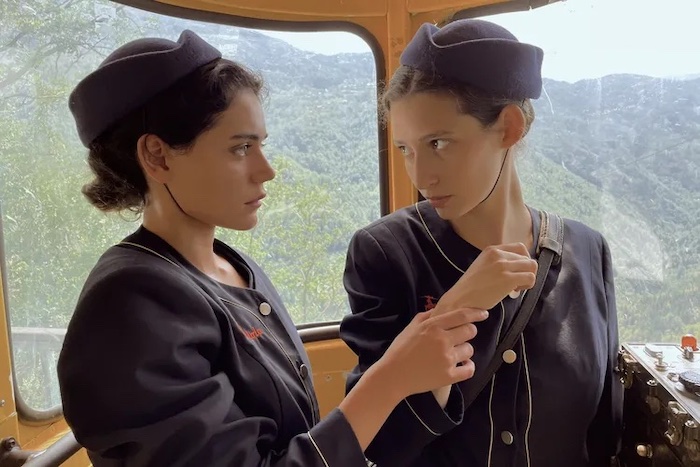
The German director Veit Helmer is famous for shooting movies in Eastern Europe and Western Asia, though the locations seem to have less to do with thematic settings than with convenience. His latest is set in Georgia, and in interviews Helmer has said the only reason for shooting in Georgia was because they have interesting cable cars, the mode of transportation that sparked his imagination for this tale, which is about two female cable car operators, one a slightly cynical veteran, Nina (Nini Soselia), the other a new recruit with a more naive disposition named Iva (Mathilde Irrmann). If this gentlest of movies has any conflict, it’s between the two women and their boss, a stout, humorless man who doesn’t tolerate the kind of relaxed work ethic the women abide by. The cable car is an important means of public transportation in this sparsely populated corner of Georgia, and the two operators take advantage of its unique qualities to entertain themselves and their fares, much to the consternation of their supervisor. In one of the film’s many magical realist moments, the women install ropes on the gondola and use them to suspend an elderly man in a wheelchair below so that he can get a true bird’s eye view of the scenery, a segment that may trouble more thoughtful moviegoers: What kind of safety precautions did the film crew carry out, since the cable cars themselves look pretty old.

The film has no dialogue, which intensifies the whimsical quality of the story. Nina and Iva, who pass each other on an almost half hourly basis during work shifts, eventually fall in love from a distance and strike up a romance, and the mute component of their relationship makes it feel even more precious than it normally would be. As the wheelchair episode illustrates, they are quite mischievous and one could infer that Helmer sort of looks at LGBTQ romances in that register, but except for some casual nudity Gondola, with its cartoony action and funny looking marginal characters (lots of grumpy but well-intentioned grandmas and grandpas), could easily pass for Saturday afternoon family fare. More interesting than the very slight story is the scenery, which is probably why Helmer really decided to film in this part of Georgia with its dramatic mountain ranges, friendly and cute livestock (which ride the cable cars as well), and gingerbread-house hamlets. The movie doesn’t attempt to engage with our modern world and thus qualifies as escapism of the purest sort. It’s a finely created confection that melts in your mouth before vanishing completely. 

Now playing in Tokyo at Cinema Qualite Shinjuku (03-3352-5645).

Gondola home page in Japanese

photo (c) Veit Helmer-Filmproduktion, Berlin and Natura Film, Tbilisi

Posted in Movies | Tagged | Leave a comment

Media watch: NHK gets flak for its special about the Johnny Kitagawa scandal

Noriyuki Higashiyama (NHK)

Japan’s public broadcaster, NHK (Japan Broadcasting Corp.), has announced that it will resume hiring talent from the entertainment agency formerly known as Johnny & Associates, whose late founder, Johnny Kitagawa, had been accused of sexually abusing more than a hundred boys who worked for the company as idols since it was established in the 1960s. Last year, the company’s management acknowledged the abuse following the broadcast of a BBC documentary that covered the matter in detail. Subsequently, Johnny & Associates changed its name to Smile-Up Inc., which took on the task of compensating the victims of the abuse, while a brand new company, Starto Entertainment, took over management of the idols that formerly had toiled for Johnny’s. Like all broadcasters in Japan, NHK relied heavily on Johnny’s for on-air talent and stopped using the agency after the scandal broke. At the press conference on Oct. 16 where the announcement was made, NHK President Nobuo Inaba said that his company was satisfied that the two companies had clearly separated their business tasks, thus paving the way for NHK to resume using Starto’s actors and singers, a move the Asahi Shimbun said would “likely lead to other major networks again signing up those affiliated with the new talent agency.”

One of the core aspects of the scandal is that Kitagawa’s abuse of the boys in his charge continued for years despite being exposed fairly early on by some media outlets. The reason such exposure was muted and not covered by other media outlets was due to the company’s power within the entertainment industry, especially among broadcasters, which in Japan are invariably part of larger media companies. Because Johnny’s male idols were so popular, broadcasters and others who hired them felt they couldn’t compete without them and thus ignored Kitagawa’s crimes. That included NHK, despite the fact that, as a public broadcaster, theoretically NHK doesn’t rely on ratings for its financial solvency because it receives funding from mandatory subscriptions. But NHK has always paid close attention to ratings, especially since the turn of the millennium when the internet started eroding viewership for TV broadcasts in general. Since then, NHK has increasingly mimicked commercial TV programming, which depends greatly on popular talent, and so NHK also hired Johnny’s idols for dramas, so-called variety programs, and talk shows. Thus NHK was also indirectly complicit in Kitagawa’s crimes, since it kept using the company in full knowledge of those crimes. 

Coincidentally or not, four days after its announcement, NHK broadcast its own documentary about the Kitagawa scandal. Though in many ways redundant, given that the BBC’s documentary was originally aired in March 2023 (though its content had already been revealed two months earlier) and Japan’s mainstream media had subsequently covered every aspect of Kitagawa’s crimes, due to its unique standing in Japan as a media outlet NHK was able to put together a more incisive report about those crimes and how Johnny & Associates kept a lid on them for so many years. The program even addressed NHK’s responsibility, though not necessarily to the satisfaction of some viewers. Following the broadcast, many people complained online about some of the documentary’s content and even accused NHK of producing and airing it so as to let itself off the hook for its failure to acknowledge Kitagawa’s sins earlier and resume hiring former Johnny’s talent. The timing was a bit too conspicuous. 

Continue reading
Posted in Media | Tagged , | Leave a comment

Review: Riddle of Fire

Just as lo-fi was once an indicator of indie authenticity in the realm of recorded music, the Tarantinoian idea of reviving the use of actual film stock will automatically strike some movie fans as a demonstration of genuine moviemaking rigor in this digital age. From a purely procedural aspect it does carry more weight. A director can keep demanding takes until the cows come home on digital without any serious financial burden (other than that related to staff and cast compensation for their extra time), while every take on an actual “film set” will cost money in terms of stock and processing. This was one of the first things that occurred to me during the opening credits of newcomer Weston Razooli’s kids adventure epic. In bold orange type the film proudly announces it was shot on 16mm Kodak film. The proof is in the pudding of the ultra-low budget production design and presentation, which occasionally falls to the level of the truly bad. Moreover, the acting is about school play grade, including the performances by the adults, and you can tell Razooli didn’t have the economic backing to reshoot some scenes that are completely incoherent due to botched line readings and on-screen talent accidentally glancing into the camera lens.

But sometimes accidents work to a movie’s advantage, and the plot and direction of Riddle of Fire (a title that doesn’t seem to have any bearing on the story) complement the amateurish production values in a way that adds to its charm and, dare I say, poignancy. The film has the look of something made in the 70s, but it takes place right now, centered on a trio of foul-mouthed, pre-adolescent delinquents-in-the-making whose determination to play a video game they’ve stolen from a warehouse sends them on an odyssey of mischievous larceny and challenge to adult authority that will have you cheering their cheeky resourcefulness. The plot, which incorporates elements of medieval fantasy and Little Rascals/Stranger Things rambunctiousness, could have been written by a bunch of kids who just wanted to make their own movie, and so develops by dint of its own immature logic, free from the strictures of mediated credibility. Armed with paint-ball guns and riding souped up mini-bikes, Alice (Phoebe Ferro) and brothers Hazel (Charlie Stover) and Jodie (Skyler Peters, convey cocky confidence in their own powers of survival as they take on an actual coven of witches who poach wild animals to support their illegal taxidermy business, though the kids’ main adversary in trying to steal a speckled egg in the coven’s possession in order to make a blueberry pie for Hazel and Jodie’s bedridden single mom (don’t ask) is a rude, cowboy-hatted ex-con named John Redrye (Charles Halford) who acts as the coven’s bagman and muscle, though conveniently for the sake of the movie he’s also rather dim. “He looks like he plays the jug in a hootenany band,” is Hazel’s withering first impression. And while these various dynamics intersect in a comical manner, there is also tension and some scenes of acute discomfort as our three heroes’ impulsiveness gets them into real danger. There’s also a well-handled sentimental thread involving the head witch’s (Lio Tipton) very young daughter, Petal Hollyhock (Lorelie Olivia Mote), helping the ragamuffins achieve their goals out of a sense of budding friendship because her mother has kept her isolated and home-schooled her whole life. 

In terms of pure momentum, Razooli (who also plays the head witch’s good-for-nothing brother and gives himself the best lines) keeps the action flowing and has a fine command of montage and camera movement that suggests he could have made something commercially viable if more money were at his disposal, but as it is Riddle of Fire is not only a promising debut, but a uniquely entertaining film experience the likes of which would not have been possible if it had been backed by a studio. In that case, it likely would have ended up like a Stranger Things episode directed by Quentin Tarantino, which, I’ll admit, is something I’d love to see, but it wouldn’t have been as interesting as this. 

Now playing in Tokyo at Shinjuku Musashinokan (03-3354-5670), Human Trust Cinema Shibuya (03-5468-5551).

Riddle of Fire home page in Japanese

photo (c) Riley Can You Hear Me? LLC

Posted in Movies | Tagged | Leave a comment

Review: Grace

With Russia in the international cultural dog house thanks to its antics in Ukraine, it might be surprising that this art house film has made such an impact on the festival circuit. But not only are there no martial or nationalist elements in the script, the movie is a generic downer in the Russian fashion, meaning it has absolutely no agenda that could be taken as being political. Director Ilya Povolotsky mostly sticks to the cruddy grey back roads of forlorn vilages that look as if they haven’t seen a visitor since the collapse of the Soviet Union as he chronicles a road trip of an unnamed father (Gela Chitava) and his preternaturally sullen teenage daughter (Maria Lukyanova). 

Their destination is the sea, but their purpose is never fully revealed until they reach it, and even then you may wonder if they had something else in mind. Povolotsky isn’t interested in motivations or even desires. He dwells on disappointment and resentment. For the most part, this pair, who are traveling by means of an aged, rust-colored RV, don’t talk to each other except to extract needed information. The landscape suggests a blighted economy that’s two steps away from Mad Max-level ruin. They buy black market gasoline from shady characters, set up a mobile cinema and sell contraband beer and snacks, and peddle pirated porn DVDs to truckers in parking lots, a pastime that gets them run out of town in at least one instance. The girl highly resents her father’s penchant for truck-stop prostitutes, which don’t seem to cheer him up anyway, and mostly spends her time taking Polaroids of the scenery, which she and Povolotsky capture in all its magnificent decrepitude. Which isn’t to say there isn’t a plot, only that it reveals itself in fits and starts and mostly hangs over the movie like a curse, as if daring you to make sense of it. The girl falls in with an equally morose young biker who stalks the caravan and takes advantage of her enmity toward her father, but to say there’s any love between the two would be assuming too much from a movie where the most consequential occurrence is when the police turn the RV back from a seaside road because of a “fish plague” that Povolotsky is gracious enough to visualize for us. 

For the first half of the film I thought the story might actually be taking place during the Soviet era, but then a cell phone shows up and a laptop figures centrally in the latter half of the story. The bleak visuals have a timeless quality that draws you in, conveying a mysterious nostalgia for something you have no memory of but can still feel. It’s a haunting movie of restless pans and dollies, populated with pale, skinny ghosts who seem to have never had the chance to live anything that could be called a satisfactory life, which sort of matches my prejudices about Russia.

In Russian. Now playing in Tokyo at Theater Image Forum Aoyama (03-5766-0114).

Grace home page in Japanese

Posted in Movies | Leave a comment

Review: Joyland

In this debut feature by Pakistani filmmaker Saim Sadiq, the protagonist, Haider (Ali Junejo), is introduced playing hide-and-seek with his nieces in the family compound in Lahore. Haider is comfortable with kids in a milieu lorded over by his wheelchair-bound father (Salmaan Peerzada) and older brother, Saleem (Sameer Sohail). But while Haider is a good Muslim husband to Mumtaz (Rasti Farooq), a professional makeup artist, and an obedient son, he is a misfit, and not just because he hasn’t held a decent full-time job in years. He likes being a househusband, even if it means taking care of somebody else’s house and somebody else’s children. But when Saleem’s wife, Nucchi (Sarwat Gilani), gives birth to her fourth daughter, push comes to shove and Haider is expected to make an effort to contribute offspring of his own, in particular a boy to carry on the family name, even though neither he nor Mumtaz are crazy about having kids of their own. But first, he has to get a job, a prospect that upsets the current order, meaning when he goes out, Nucchi will require someone to take his place, and that would be Mumtaz, who really likes the job she has.

This simple setup contains a classic conflict in that Haider and Mumtaz, who are quite close without being terribly romantic or sexually active, possess sensibilities that clash with the tradition-bound prerogatives of their family. The ringer that makes Sadiq’s story unique and utterly compelling is Haider’s new job. A friend who works at a cabaret invites him to audition for a slot as a background dancer to one of the club’s secondary “erotic” stars (which means she lip-syncs provocatively to popular Bollywood tunes). Haider has neither the experience nor the proclivity for such a vocation, but once he sets his eyes on the star in question, a trans woman named Biba (Alina Khan), he is smitten, and endeavors to become not only a capable dancer, but Biba’s lover, goals he fulfills in relatively short order. Of course, he hides the actual nature of his job from his family, but not from Mumtaz, who not only approves, but is envious. When she asks him to demonstrate his new talents he does so awkwardly and she says with a smile, “I’ve never seen you move so much.” Obviously, that’s what love does to a person, but what makes this development so refreshing and revolutionary is that it isn’t framed as a betrayal of Mumtaz, who begins to accept Haider and Biba’s affair, albeit tacitly. Haider’s queerness isn’t an issue for Sadiq—when Biba talks about saving money for surgeries, Haider replies he likes her the way she is. The point is that love makes Haider bolder in action and more of himself, which means he is willing to sacrifice not only for Biba’s affections, but for Mumtaz’s happiness, and, of course, he misunderstands both because he’s naive by temperament. As it stands, Biba is sharp and domineering as both a paramour and an employer because she has to be in order to survive, and once her act starts getting popular thanks to Haider, she wonders what his desires will cost her in the long run. “I have nothing that’s my own,” Haider despairs to Mumtaz, and Biba sees this desperation as confining and misdirected, and eventually pushes him away. Haider returns to his wife to give her the support she needs as both a woman and a member of his family, but she only wants one of those things. The other one crushes her spirit.

Sadiq throws curveballs that keep the viewer guessing as to where the story is going. Early on, when Haider’s occupation is discovered by his family and neigbors in the most hilarious way, we expect the revelation to have ramifications that never materialize, and a subplot about a widow who takes care of the father because it gives her companionship and purpose is played as an illustration of the sour prejudices inherent in tradition, but Sadiq leaves it unresolved, because that’s likely what would happen in real life. The director confounds dramatic conventions in such new and radical ways that the alternatives come across as more vividly plausible and exciting. Joyland is a love story made up of so many intriguing layers that you often forget that it’s set in a world where transgressions against social norms are subject to the fiercest public proscriptions. It makes you feel doubly alive just being around these characters.

In Punjabi & Urdu. Now playing in Tokyo at Shinjuku Musashinokan (03-3354-5670), Human Trust Cinema Shibuya (03-5468-5551).

Joyland home page in Japanese

photo (c) 2022 Joyland LLC

Posted in Movies | Tagged | Leave a comment

Review: Exhuma

A truism about the Korean box office is that it’s mainly supported by mid-budget mainstream fare, which is a bit of a dodge because it’s often difficult to tell where mid-budget movies end and blockbusters begin. This long, incident-packed occult thriller has been a godsend in a year when Korean theatrical revenues are being sapped big time by streamers, and while its production values and special effects pale in comparison to blockbusters like The Moon (a huge dud), the cast is chock full of A-listers, thus making it a big deal by the calculus of what really matters in Korea: star power. The cast is headed by veteran leading man Choi Min-sik, as geomancer Sang-deok, whose sidekick in these supernatural goings-on is a mortician, Yeong-geun, played by Yoo Hae-jin, one of those actors who, like Song Kang-ho, has gone from character parts to a wide range of leading roles with more force than a cannonball. The female lead, a shaman named Hwa-rim, is played by one of Korea’s most formidable TV drama stars, Kim Go-eun, while Hwa-rim’s own assistant, Bong-gil, is heartthrob Lee Do-hyun. So if any movie, regardless of content or genre, is bound to draw ’em, it’s this one.

That said, Korean occult thrillers tend to not make as much sense outside of Korea. While the country’s ecumenical religious culture provides room for a wide range of faiths, the localization of the particulars of those faiths can be baffling to outsiders. The Buddhist precepts that anchor the plot of Exhuma are filigreed with lots of superstitious mumbo-jumbo that Koreans might understand instinctively but which require head-scratching leaps of logic for the rest of us. In a nutshell, a wealthy Korean family living in L.A. flies Hwa-rim and Bong-gil over from Korea to investigate the illness of the young patriarch’s newborn son, which seems to be connected to some bad dreams the patriarch is having. Hwa-rim determines that the culprit is the patriarch’s grandfather, whose spirit is uneasy in his grave back in Korea, and so they recommend exhuming the coffin and moving it to a more auspicious location, a task assigned to Sang-deok, who knows his feng shui, and Yeong-geun, who knows how to hire teams of men with shovels. The job, however, turns out to be stickier that it would seem on paper. The grave is located in a remote spot on the top of a deserted mountain with almost no markings except for some numbers that look like coordinates. Director Jang Jae-hyun gets plently of mileage out of the dried brown vegetation and the constantly overcast skies, and stages a great grave-opening ritual, complete with pig corpses and sacrificed chickens, though not as elaborately impressive as the one in The Wailing. At this point in the development, while the viewer is probably convinced that these four professionals are on the up-and-up in terms of knowing their shit, they are very much into the job for the money, and assume that this family will pay big bucks regardless of what they actually do or even achieve. So it comes off halfway a scam, especially if, like me, you find all the numerology and fixation on names and bureaucratic arcana (for reasons that seem entirely frivolous, you can’t cremate a body on a rainy day) rooted more in theater than in spirituality. But then something goes wrong when a mortuary employee unexplainedly opens the coffin before it’s reinterred, releasing something that wreaks havoc on the family and our four ghost-busters. 

Speaking of The Wailing, as in that wild and woolly horror epic, Japan’s influence over the Korean peninsula is central to the ghostly goings-on in Exhuma and only add to the thematic disorientation for those of us who didn’t grow up under such a historical shadow, but I suspect that a lot of Korean viewers will also wonder what the hell is happening once a ten-foot samurai starts walking the earth and slapping humans around. I never quite got the connection with the rich family—something to do with the grandfather’s wealth being derived from his service to Korea’s former colonizers—but in any case the plot runs off the rails several times before it settles into something that approximates stasis. The thing is, I thought The Wailing was even more ridiculous, but it was the absurd lengths to which the production went that impressed me. This is weak meat in comparison, so filled with myriad insignificant detail that I felt over-stuffed without being satisfied. 

In Korean and English. Opens Oct. 18 in Tokyo at Kadokawa Cinema Yurakucho (03-6268-0015), Shinjuku Piccadilly (050-6861-3011), Shibuya Cine Quinto (03-3477-5905).

Exhuma home page in Japanese

photo (c) 2024 Showbox and Pinetown Production

Posted in Movies | Tagged , , | Leave a comment

29th Busan International Film Festival: A conversation with Shonali Bose and Nilesh Maniyar

Chika Kapadia and Shonali Bose in a still from A Fly on the Wall

Several years ago, Chika Kapadia, an Indian man of many talents and appetites, was diagnosed with thyroid cancer and given two months to live. He contacted his long-time friends, Mumbai-based filmmakers Shonali Bose and Nilesh Maniyar, and asked them to make a film about his final days. He planned to end his life at the facility of the nonprofit organization Dignitas in Zurich, which provides legal physician-assisted suicide, and wanted them to be there to witness his death. The film was barely finished before it premiered Oct. 4 at BIFF, where Bose and Maniyar participated in two post-screening Q&A sessions with audience members. The following conversation took place in the BIFF Guest Lounge on Oct. 5 following the second screening.

Continue reading
Posted in Movies | Leave a comment

Review: Joker: Folie à Deux

I’m not sure what to make of this genre of movies and TV shows that exists simultaneously within a superhero universe and without it. In the first Todd Phillips Joker movie the only real narrative connection, besides the setting, to the world of Batman, where the Joker originated, was that brief scene near the end when the parents of Bruce Wayne are mugged by a bunch of thugs who’d been inspired by the antics of the Joker in the movie we were watching. That conceit is completely gone in the sequel, which concerns itself only with the character of Arthur Fleck and his problems. In fact, I see no possibility of Fleck’s villainous alter-ego moving on to the kind of organized criminal activity in which the Joker of the comic book/movie series partakes. And that’s fine, since it allows Phillips’ movies to more or less stand on their own, but, unfortunately, that also means they will fail or succeed completely on their own.

The plot core of Joker: Folie à Deux is the trial of Fleck (Joaquin Phoenix) for the murders he committed in the first movie, and as such relies on courtroom cliches that overshadow the main aims of the story, which is to show Fleck as a psychologically damaged individual whose peculiar brand of extroverted sociopathy (though by nature he is an introvert) infects others who have something against society. At this stage in Fleck’s development, he can clearly distinguish between his own personality and the invented character of the Joker, and it is this dichotomy that attracts the equally intense but qualitatively different form of sociopathy exhibited by fellow psychiatric prison inmate, Lee Quinzel (Lady Gaga). In the rarefied context of captivity, for these two it’s love at first sight, and obviously they can’t spend as much time together as they’d like, so they join a music activity program, which Phillips uses to make the movie itself into a jukebox musical filled with standards from the Great American Songbook and AM radio pop hits from the 60s-80s. The numbers as performed by Phoenix and Gaga work well enough in isolation, but they are supposed to be in service to the love story, which is predicated on Quinzel’s infatuation with the Joker persona rather than Fleck himself. In that regard, Fleck’s real personality, that of a self-conscious, self-torturing victim, is a turnoff for Quinzel, which means if he wants to hold on to her, he has to be the Joker full time, and that means doing the violent deeds the Joker does and saying the misanthropic things the Joker says 24/7.

Needless to say, none of this works within the larger story of the trial, which quickly descends into farce, but farce with a purpose, which is to show that the Joker, and not so much Fleck, deems himself above the petty demands of “justice.” He just wants to set shit on fire. And that’s not only what Quinzel wants, it’s also what his incel fans out in the real world insist upon, and while Phillips gets his big loud finish accordingly, it feels as if there’s nothing at stake except a temporary breakdown in law-and-order, for whatever that’s worth in this hellhole called Gotham City. And since we’ve already see how corrupt and sadistic the guards in the psychiatric prison are, not to mention how venally the court system operates during the trial, all the mayhem feels deserved. If that isn’t how nihilism operates in narrative fiction, then I’m Samuel Beckett. 

Now playing in Tokyo at Toho Cinemas Nihonbashi (050-6868-5060), Toho Cinemas Hibiya (050-6868-5068), Marunouchi Piccadilly (050-6875-0075), 109 Cinemas Premium Shinjuku (0570-060-109), Shinjuku Wald 9 (03-5369-4955), Shinjuku Piccadiy (050-6861-3011), Toho Cinemas Shinjuku (050-6868-5063), Toho Cinemas Shibuya (050-6868-5002), Toho Cinemas Roppongi Hills (050-6868-5024).

Joker: Folie à Deux home page in Japanese

photo (c) & TM DC (c) 2024 Warner Bros. Ent.

Posted in Movies | Tagged , , | Leave a comment

Review: About Dry Grasses

Much less tedious than the only other Nuri Bilge Ceylan movie I’ve seen, Winter Sleep, this typically long award-winner proceeds leisurely into a narrative that mostly stays on course aside from a few detours into philosophical muckraking. The protagonist, middle school art teacher Samet (Deniz Celiloglu), is, like the protagonist in Winter Sleep, a sourpuss who alienates many of those he interacts with, but unlike that other character, a landlord, he has no station in life that affects his interlocutors, who are free to dismiss his bitchy ramblings without consequence. And he does have something to bitch about: being stuck in the mountains of Anatolia for four years on assignment, which he likens to penal exile. Soon he will finish his sentence, so to speak, and can put in a transfer to Istanbul, where he believes his spiky intellect will have more of a purchase, but then he gets embroiled in a scandal that threatens to derail his plans.

Samet and a colleague, the more complacent Kenan (Musab Ekici), are accused by several students of “inappropriate behavior,” and while this behavior is not elaborated upon by either the accusers or the administrators who put the two teachers on notice, the audience has already seen how Samet acts in the presence of his star pupil, the admiring 14-year-old girl Sevim (Ece Bagci), whose tacit overtures to Samet are frustrated when he essentially throws her under the bus during a particularly unnecessary surprise search of school bags by the principal. Though Samet’s previous attentions don’t register overtly as pedophilia, the accusation brings out his petulant, defensive side in the worst ways. He now not only has a reason to dismiss and badger his pupils more, but greater emotional ammunition with which to take pot shots at the culture that informs this particular corner of Turkey. Fortunately, Ceylan has balanced his misanthropy with the more worldly attitude of another teacher, Nuray (Merve Dizdar), a woman who lost a leg in an explosion that may or may not have been a terrorist attack, and whose political consciousness has been raised as a result. In a wonderfully written and performed long conversation between the two, Nuray takes Samet to task for his nihilism, accusing him of having no foundation of moral certitude to judge the rest of the world, which he wants nothing to do with. The conversation is sparked by Samet’s implications that Kenan, who is sweet on Nuray, may really have behaved inappropriately around his students, though the viewer knows it is just a jealous reaction to Nuray’s acceptance of Kenan’s attentions. Samet doesn’t really know himself, though, in the end, he always seems to get what he wants, even if it isn’t what a dick like him needs. Nuray attempts to give it to him, but can’t penetrate his carapace of entitled resentment.

Ceylan fortifies this vision of personal desolation with natural light playing off a perpetually snowy landscape, and ends with a tentative truce between teacher and students, including Sevim. But we know in the end there is no hope for a guy like Samet. In a way, he’s the perfect anti-hero for our blighted age, a man who doesn’t appreciate the advantages he has compared to others because his self-importance is so monolithic.

In Turkish. Opens Oct. 11 in Tokyo at Human Trust Cinema Yurakucho (03-6259-8608), Shinjuku Musashinokan (03-3354-5670).

About Dry Grasses home page in Japanese

photo (c) 2023 NBC Film.Memento Production/Komplizen Film/Second Land/Film I Vast/Arte France Cinema/Bayerishcer Rungfunk/TRT Sinema/Playtime

Posted in Movies | Tagged | Leave a comment

Review: The Great Escaper

Reportedly Michael Caine’s last film and definitely Glenda Jackson’s last because she died not long after it was completed, this widely reported true story is further proof that old British actors, male and female, can still not only find work, but leading roles. Caine plays Bernard Jordan, an 89-year-old resident of a care facility who in 2014 sneaks out without permission to attend the 70th anniversary of D-Day celebrations in Normandy, having been there on the fateful day as a member of the Royal Navy. Jackson plays his wife, Irene, who doesn’t go due to her ill health, but supports his decision, which eventually interests media that absolutely love the fact that this old codger is misbehaving for nominally patriotic reasons. In fact, his reasons are slightly more complicated than they think, and if the movie turned out differently from where I thought it was going, it had more to do with what I tend to expect from these kinds of movies. But it doesn’t stray far from the formula, and I thought it lost several opportunities along the way. But that’s the problem with “true stories”: You have to stick to what really happened.

There’s not a whole lot of suspense generated by Jordan’s subterfuge, which involves Irene covering for him by telling the staff he’s out for an early walk as he boards the cross-channel ferry and becomes part of a group of other British veterans on their way to the bash. The joke here is that Jordan needed to sign up with an excursion in order to attend, and his care home forgot to make the application, thus forcing him to sneak out. But once he does he becomes part of a group anyway, which includes an alcoholic RAF veteran (John Standing) who, like Jordan, has a secret score to settle in France. There’s also a younger, PTSD-rattled veteran of a more recent war who can’t quite handle the excitement, as well as a bunch of Germans who were likely shooting at them on the beach. Invariably, the film includes some tepid flashback scenes of Jordan’s and Irene’s courtship, as well as an extended bit about the landing itself where Jordan has to calm down a tank driver. 

The director, Oliver Parker, has trouble maintaining a tone, what with Irene cracking wise with the care staff back in Blighty and Jordan addressing very difficult emotions in France, as well as with the memories of those who didn’t survive. If I had to choose, I would take Jackson over Caine simply because Jackson has the more colorful role. Caine is pretty much what you would expect Michael Caine to be like in such a movie. It seems almost too easy for him, but you can tell Jackson gave Parker probably more than he asked for, and I liked that. 

Opens Oct. 11 in Tokyo at Toho Cinemas Chanter Hibiya (050-6868-5001), Toho Cinemas Shinjuku (050-6868-5063), Human Trust Cinema Shibuya (03-5468-5551).

The Great Escaper home page in Japanese

photo (c) 2023 Pathe Movies

Posted in Movies | Tagged , | Leave a comment