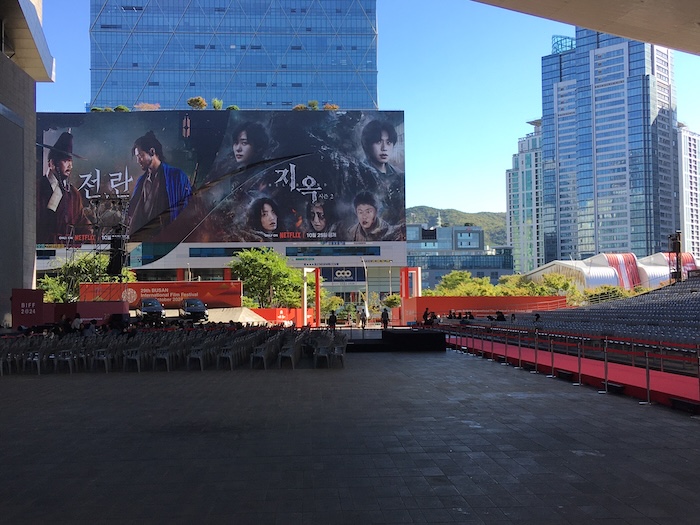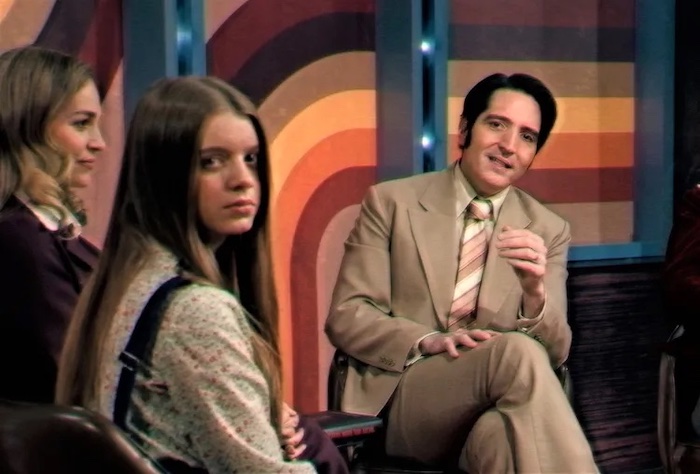
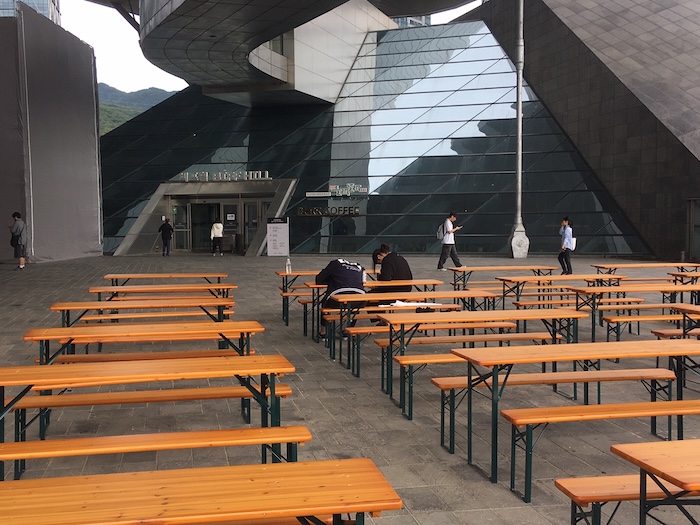
29th Busan International Film Festival, Oct. 8, 2024

I’m sitting in Gimhae Airport now waiting for my flight, which is very early, meaning I’ll get home before lunch. As I think I mentioned last year (the year before?), several years ago the festival stopped providing transportation between the airport and the Haeundae resort area, where they put people up, and it’s been a blessing in disguise, because although I have to pay my own way now, I take the subway, which is much more relaxing and reliable than the limousine bus they put me on. Invariably the bus always gets stuck in Busan’s nearly 24-hour traffic, thus adding an extra layer of stress that I don’t need. I know exactly how long it takes for the train to get to where I need to go. 

Another blessing in disguise was the fact that Wang Bing’s Youth (Homecoming) is screening after I leave the festival. I surely would have felt obliged to see it, since I think he’s one of the best documentary filmmakers working today, but this year he has two at BIFF and, as you probably know, they’re invariably marathons. Today I sat through the second part of his supposed trilogy, Youth (Hard Times), which is 3 hours and 45 minutes, and while I enjoyed it, I don’t know if I could sit through another one like it, though Homecoming is considerably shorter. I thoroughly enjoyed the first part of the trilogy, Youth (Spring), when I saw it at BIFF, mainly because it was so action-packed. Hard Times deals with the same textile factories in Zhili, China, but has more of a focus on the difficulties the workers encounter with their employers, and as such is less interested in only young people. Though the majority of these migrant workers are under 25, there are still quite a few people as old as 41 (Wang introduces each worker as he goes along with the person’s name, home province, and age), so it isn’t chiefly occupied with “youth” the way the first movie was. He also has a tighter hold on “stories” he picks up since they have built-in drama: a somewhat irresponsible kid loses his paybook, which gives his boss an excuse to withhold pay, an action that leads to some offscreen violence and the kid landing in the local jail; an employer who, faced with his own police inquiry after beating up an unpaid supplier who’s demanding his money, skips town without paying his workers, prompting said workers to commandeer the rented factory space and selling off all the equipment to make up for their lost wages; and a protracted negotiation between management and a bunch of workers who think the per-piece rate their getting is a ripoff. I only dozed off once, which is saying something.

From my perch, the buzz movie of the festival this year (outside of the streaming series previews, which were the biggest attraction among press people) has been The Height of the Coconut Trees, a Japanese film directed by the busy Chinese cinematographer Du Jie. Various reports explain that Du and his family settled in Yokohama in 2020 when they couldn’t return to China because of the pandemic. Looking to make the kind of personal film he probably wouldn’t have been able to make in China, he adapted his writing to Japanese characters, settings, and situations. The overall movie isn’t that coherent (a friend informed me that in its earlier incarnations it was even more incoherent) but it does make sense as a film, and is beautifully shot and scored. It’s mostly about two young couples whose relationships founder for entirely different reasons, and contemplates suicide in a very sedate manner. There’s some gorgeous imagery and intriguing use of nonlinear plot development, though in one crucial scene Du relies too much on monologues to explain things that don’t need that much explanation. His vagueness is actually his strength.

Continue reading
Posted in Movies | Leave a comment

29th Busan International Film Festival, Oct. 7, 2024

Yesterday I helped two women from Vietnam work the subway ticket machine and we rode the train together to Haeundae. They work for a Vietnamese film production company and were going to the Westin Hotel to help set up the Vietnam Night party, which they invited me to. I’ve only gone to one party so far this year. They used to post the party and reception information on the white board in the press center, but not this year so the only way you can know about them is through the grapevine, on which I don’t hang. Besides the free food and booze, I always meet interesting people at the BIFF parties. I skipped the Vietnam bash, though, since I had dinner and drinks with some friends and the Westin is a bit of a hike from where I’m staying.

Interesting mix of movies yesterday. I had failed to score tickets to the two screenings of the Korean film, A Girl with Closed Eyes, so I ended up watching it in the video library. It’s one of those police thrillers that Korea does so well, even when the plot is convoluted and over-complicated. This one was no different, but the psychological undercurrents were more intriguing than usual. The crime is the murder of a novelist whose bestseller is based on a kidnapping case from 15 years ago, and the suspect is the woman who had been kidnapped as a girl. Caught red-handed with the shotgun used to kill the writer, she insists on talking only to a particular female detective, who, it turns out, used to be her best friend before the kidnapping. The story drops plenty of red herrings regarding the book publisher, a shady tabloid reporter, and the detective’s own father before zeroing in on the particulars of the murder victim, who the suspect claims is the man who kidnapped and tortured her back in the day but was never caught due to her reticence in providing the police with details about the man. It’s a world premiere, and I haven’t read any outside reviews yet, but I assume it will be picked up in Japan since the two female leads are quite popular.

The other Korean film I saw was Hong Sangsoo’s A Traveler’s Needs, which isn’t his latest. His latest isn’t playing at the festival, which is strange because he usually has two every year. (It just played at the NY Film Festival, I think) Anyway, Traveler is the third appearance of Isabelle Huppert in Hong’s filmography, so I guess that qualifies her as a member of his repertory company. She plays a French tourist who’s slumming around Seoul and supporting herself by giving French lessons on the most casual basis. Her clients are solicited through word-of-mouth and the lessons are mainly conducted in English, which I thought was a good joke, especially given Hong’s penchant for scenes rooted in drunken conversation. In this case, the “lessons” consist of the “students” describing their “feelings” in English and then Huppert translating them into written French on cards. Hong revives his gimmick of repeating conversations several times in the course of the film, since the students invariably answer her questions with the exact same answers. It’s one of Hong’s more frivolous scripts, and Huppert is obviously enjoying herself. I can tell she was definitely getting drunk from all that Korean liquor. 

Continue reading
Posted in Uncategorized | Leave a comment

29th Busan International Film Festival, Oct. 6, 2024

The high point of my Saturday at the festival was interviewing Shonali Bose and Nilesh Maniyar, the directors of the Competition Documentary entry, A Fly on the Wall, which is about a friend of theirs, Chika Kapadia, who, after being diagnosed with terminal thyroid cancer and given less than two months to live, decided to undergo assisted suicide in Switzerland and invited the filmmakers to record his last days, including his death. The movie has a certain rough appeal in that the two directors, who had never made a documentary before, knew they couldn’t plan what would happen, though they tried their best to at least be prepared for anything. The difficulties started from the get-go. Bose has dual citizenship, India and US, while Maniyar has only Indian citizenship, and Switzerland requires Indian nationals to apply for a visa, which took time that Kapadia didn’t have, so while Bose stayed with Kapadia for the rest of his days and is the co-center of the film, Maniyar stayed behind in India and directed remotely, sifting through the recordings Bose made on her iPhone. Several times during this recording, Kapadia almost called it off for one reason or another—family objections, his own doubts as to the ethics of the project (he took seriously one commenter on his blog accusing him of being “elitist and judgmental”). But while he and Bose talk at great length about the right to end one’s own life, a view that offends many people, the overall documentary is less an issue film than one about an extraordinary individual who, in line with his outlook on life, was very determined in his choice of how and when to die. Kapadia was trained as an electrical engineer, which made him semi-wealthy, and then threw it all away to become a standup comedian, and later, being a dedicated diver, abandoned that line of work to move to Bali and become a professional scuba diver. While such a person’s dedication and ambition is certainly admirable, it doesn’t take much imagination to see that such a person can also be arrogant, and much of the drama in the film is derived from his attitude and how it clashed with Bose, who was trying at once to satisfy his wishes and make a film that had meaning, because it wasn’t as if she’d have any chances of doing retakes. After I return from Busan, I will transcribe the interview and post it on this blog. It was a remarkable conversation.

The other films I saw yesterday were less impressive, but I don’t know if that was a matter of contrast. Certainly, I was disappointed with Jia Zhang-ke’s newest film, Caught by the Tides, which I had been looking forward to probably the most. Made during the pandemic, the movie is a clever collage of used and unused footage from previous features, as well as new footage that could be shot under rather strict circumstances. The result is a film that attempts to review the last 20-odd years of Chinese economic development through Jia’s jaundiced eye and structure it as a kind of romantic tragedy. Zhao Tao plays a dancer-entertainer in Datong in 2001, the same character she played in Unknown Pleasures, whose boyfriend, a ne’er-do-well played by Li Zhubin, decides to leave town and try to take advantage of the coming economic boom. Eventually, Zhao goes looking for him, taking her to various places that Jia covered in his intervening body of work. The film’s structure is necessarily loose and free-form, moving from documentary realism to semi-staged dramatic tableaux and slightly stylized musical numbers (the music, I will have to say, is impressively used). And while Jia succeeded in what he set out to do, the film didn’t move me, probably because the connecting plot never felt organic enough to pull me in. In the end, when Li just returns to Datong because he’s tired and disabled by a stroke, it feels anticlimactic. 

Continue reading
Posted in Movies | 1 Comment

29th Busan International Film Festival, Oct. 5, 2024

The assassination of President Park Chung-hee in 1979 has received a lot of cinematic attention in South Korea recently, as if some kind of floodgates were opened. Several years ago there was The Man Who Stood Next, which thoroughly probed the background of the killing, and last year there was the box office hit 12.12 The Day, which is also being screened at this year’s festival. A third film, Land of Happiness, opened two months ago in Korea and mainly focuses on the court martial of one army office who participated in the assassination. Curiously, it’s being shown at the festival as part of a Special Program dedicated to the films of actor Lee Sun-kyun, who committed suicide last year. It was Lee’s last film, and while he does play the soldier in question, he’s not the star, which is Cho Jung-seok, the actor who plays his lawyer. It’s quite a workout, in fact, and given Lee’s typically sullen acting demeanor, it surely overshadows the late actor’s performance. As for the film, it’s well made and jerks sufficient tears, but it seems the story has been over-fictionalized just for that purpose. More interesting is the casting of Yoo Jae-myung as General Chun Do-hwan, the man who led the post-assassination coup that is the story of 12.12, and as in 12.12 the producers decided to change his name, though everybody knows who he’s supposed to be. In that movie he was played by Hwang Jung-min as a mad villain, whereas Yoo sees him as a slick mafia figure whose evil is more sedate and cunning. It’s quite a contrast, and only proves how much the Korean film industry is willing to manipulate history in accordance with its aims. 

Evil of very different stripe is manifest in Black Box Diaries, Japanese journalist Shiori Ito’s documentary about the legal and psychological ordeal that followed her 2015 rape by veteran journalist Noriyuki Yamaguchi. Ito decided to direct the documentary herself, and while I’m not sure that was the best idea, she keeps the various facts and lines of development clear and incisive. Though most of the movie is in Japanese, the narration and titles are all in English, thus reflecting the fact that the producers are American and that it isn’t entirely certain the movie will have a Japanese audience. I spoke to the producer on Wednesday and he said that it would likely open in Japan in December, though Ito also told me there’s no guarantee yet, as if she’ll believe it when she sees it. The heart of the dramatic element is the police decision to not carry out the arrest warrant for Yamaguchi at the last minute, and the anonymous investigator who was in charge of the case tells Ito plainly that it was due to “pressure from above,” most likely Prime Minister Shinzo Abe, whose hagiography, which Yamaguchi wrote, was scheduled to be published the same week as the arrest was to take place. Ito had no choice but to pursue a civil suit against Yamaguchi, which she eventually won, but it wasn’t easy, and she does an admirable job of explaining the nuts and bolts of her team’s legal strategy. 

Continue reading
Posted in Movies | Leave a comment

29th Busan International Film Festival, Oct. 4, 2024

One immediate observation after one full day at the festival: Chanel and Netflix seem to have taken over. As I mentioned yesterday, Chanel, in addition to sponsoring the Asian Film Academy, now gives out an award to a vital female Asian filmmaker. They also provide a commercial that runs before every screening with Brad Pitt and Penelope Cruz supposedly recreating a scene from Claude Lelouch’s A Man and a Woman. At one point, Pitt whispers to Cruz that he thinks they’ve somehow “annoyed” the wait staff at the restaurant where they’ve ordered steaks, of all things. After the second go-round, I was already annoyed by the spot and dread the fact that I will have to sit through them countless times for the rest of the festival. It’s enough to drive one to the video library. As for Netflix, the opening film was the premiere of production that will probably be available on the streaming service in a few weeks and there are billboards all around the Cinema Center and the Haeundae resort area advertising the movie, Uprising, and Season 2 of Hellbound, which is also being shown at the festival.

Nothing I saw yesterday made a huge impression. As also mentioned yesterday, Kiyoshi Kurosawa, this year’s Asian Filmmaker winner, has two newish films at the festival (both have already been released in Japan). I saw the French language one, The Serpent’s Path, last summer and didn’t think much of it. I caught Cloud yesterday at a press screening and probably thought even less. At his press conference, Kurosawa insisted that he was essentially a “B-movie” director in that he likes to filter his ideas through genre tropes, which is why many people consider him a horror movie maven. I think he wanted to say that he was open to all kinds of films, and Cloud is essentially a social critique about the commercial and behavioral effects of the internet done up as an American action film. It starts out as a morality tale about a young man (Masaki Suda) who is trying to make it rich as a reseller of questionable goods on the web and ends up somewhere in the vicinity of Reservoir Dogs, only without the witty banter and carefully laid out plot. I understand that genre movies don’t necessarily need to be plausible to be effective as genre movies, but the bogus action and motivations were beyond the pale in this case, not to mention the shouty acting of several players. 

Continue reading
Posted in Uncategorized | Leave a comment

Review: Civil War

Alex Garland’s extrapolation of the current U.S. crisis of cultural division to its most extreme ends is very disturbing not just because of the ultra-violence on display but also due to its purposeful vagueness. The second American civil war is being fought between two sides whose positions are never fully explained. Even the journalists covering the conflict, who are centered as the protagonists of the film, don’t seem to know. It’s why the veteran photojournalist, Lee (Kirsten Dunst), is leading the troupe from New York to Washington, so as to actually find out. We know that the national military is battling something called the Western Forces, the product of an alliance between Texas and California, a combination I would never have come up with myself, but Garland obviously means to put across the notion that chaos rules—there’s also a “Florida alliance” that seems to have its own separate agenda. Also unclear is on which side of the political-cultural divide the current president stands, and as the events of the movie unfold it becomes apparent that much of the killing is more or less an expression of settling scores, meaning the war is an excuse for anyone with a gun to get theirs. And that’s what makes it supremely scary, because, as extrapolations go, it’s easy to see how we get from our present situation to the one in the film. 

But if the movie is “about” anything it’s the way violence is a kind of drug, which is where the media come in. Lee, though seasoned and not at all sentimental, understands how dangerous the appeal of her job is, and you can see the culmination of that sensibility in another veteran along for the ride, Joel (Wagner Moura), who admits to digging the high. The older New York Times reporter, Sammy (Stephen McKinley Henderson), is less enthusiastic and appears vexed by his colleagues’ enthusiasm, which soon infects ambitious rookie, Jesse (Cailee Spaeny), who idolizes Lee until circumstances give her the opportunity to make a name for herself, and at that point all bets are off. The plot takes the form of a road trip through hell, with the quartet using their press credentials to get close to the action and witness atrocities that are carried out so casually that they approach the surreal. Garland, a seasoned director as well as a published novelist, knows that his profession has had something to do with this capacity for cruelty, since the combatants often take cues from action figures in big budget movies. The film’s most frightening scene has Jesse Plemons as a soldier (Which side? I couldn’t tell) who feels his rifle gives him the power to act as judge, jury, and executioner. During the climactic battle in Washington, the gung-ho attitude of the rebels who are closing in on the White House mimic that of the heroes you see in countless war movies, and then you figure out their mission is to assassinate everyone in the executive branch. 

Though Civil War in admirably thorough in its presentation of a nightmare scenario that feels real, in the end its cynicism gets the better of it. As an avid moviegoer I admit to falling for the kind of violence that Garland is offering up for our delectation as a way of interrogating our appreciation of what it’s done to the American consciousness, but there’s a certain “whataboutism” behind the movie’s thematic thrust that’s a turn-off; which isn’t to say it can’t happen this way.

Now playing in Tokyo at Toho Cinemas Nihonbashi (050-6868-5060), Toho Cinemas Hibiya (050-6868-5068), Marunouchi Piccadilly (050-6875-0075), 109 Cinemas Premium Shinjuku (0570-060-109), Shinjuku Wald 9 (03-5369-4955), Shinjuku Piccadilly (050-6861-3011), Toho Cinemas Shinjuku (050-6868-5063), Shibuya Cine Quinto (03-3477-5905), Toho Cinemas Roppongi Hills (050-6868-5024).

Civil War home page in Japanese

photo (c) 2023 Miller Avenue Rights LLC; IPR.VC Fund II KY

Posted in Movies | Tagged , , | Leave a comment

29th Busan International Film Festival, October 3, 2024

My very slight favored status as a reliable press participant at the Busan International Film Festival—I’ve attended every edition since 2001, except for two years during the pandemic—has not been recognized this year. No free accommodations, no advance ticket bookings, no invitation to the Opening Ceremony. Someone in the know suggested it was a budget thing, since the present administration cut government funding for the festival, but I think my name just got dropped somewhere over the course of the year. The people I usually deal with in the press office don’t seem to be working for the festival any more. In any case, I’m staying at a “guest house” whose only merits are that it’s a block from the subway station and serves breakfast, though you have to fix your own eggs. 

Since I didn’t have an invitation to the opening ceremony I watched it via a streaming service, which is actually a better way to appreciate it. When I attended in person I usually had a bad seat and couldn’t really see anything—not that there’s really anything to see. The endless parade of celebrities and film people gets pretty repetitious, and the remarks are scripted, except for Portuguese director Miguel Gomes’, whose entire filmography is being showcased this year. He gave a short, sweet, improvised speech in which he invited anyone who sees him wandering around the festival to come up and chat. “I speak English, French, Portuguese, and a little Spanish.” Good to know. 

The theme this year is “Vision of Asia: Ocean of Cinema,” which adheres to the ongoing marine vibe the festival tries to maintain, since the sea is so close. And while BIFF has always prided itself on being the premiere Asian film festival, this year it seems particularly bound to the continent. There were much fewer guests on the red carpet from Europe this year (the U.S. never really figures at all, thank God), and there was a noted increase in Chinese film people compared to last year. Iran wasn’t represented as much as it usually is, perhaps owing to the fact that BIFF asked director Mohammad Rasoulof to head the New Currents jury. Rasoulof had a warrant issued for his arrest  by the Iranian government when he was out of the country, so, of course, he’s in exile now. He wasn’t there last night, but was “en route” as the emcee said. 

Continue reading
Posted in Uncategorized | Leave a comment

Review: Laapataa Ladies

The Hindi title translates as something like “lost” ladies, though technically speaking the two females in question are misplaced by dint of negligence, a notion that makes this otherwise strained comedy interesting in terms of what it has to say about the status of women and the institution of matrimony in India. Though the plot device of two brides being switched out accidentally has a certain Restoration comedy feel to it, here it manages to make sense within the context of traditional arranged marriages, which still holds sway in certain parts of India. The fact that the story takes place in 2001 lends more creedence to a plot that some will find absurd, but it probably had more to do with the available technology, since early model cell phones and the absence of widespread internet figure into the workings of the story. In a nutshell, two brides from different weddings get on the same train to travel to their respective husbands’ home towns. They are both veiled in very similar outfits (as are quite a few other women on the train—it’s apparently the auspicious season for weddings), the train is crowded, and the journey long, so when one of the husbands yanks his wife off the train to get off at their stop, he pulls the wrong hand. His real bride continues on, unaccompanied, until the end of the line.

Once the husband, Deepak (Sparsh Shrivastava), discovers his mistake, it becomes imperative to find what happened to his real bride, Phool (Nitanshi Goel), who, it turns out, is in a distant village on her own. More to the point, Jaya (Pratubha Ranta), the woman Deepak pulled off the train, provokes suspicion in the village, especially that of the conniving police chief (Ravi Kishan), who wonders why she doesn’t seem all that much bothered by her predicament. Is she the “bandit bride” who’s been swindling innocent men on a crime spree? Given that this is an Indian production and is clearly aimed at a general audience, director Kiran Rao allows the various storylines plenty of time to develop, so as Phool is adopted by the impoverished demimonde of the town she finds herself in, and thus comes to understand the true value of friendship, Jaya insinuates herself into the life of Deepak’s village where her academic knowledge of agriculture is utilized to help save the local rice crop. Meanwhile, the police chief endeavors to get to the bottom of Jaya’s providence in order to extract some sort of monetary gain. 

Though the twists and turns are predictable and the comedy uneven, the feminist undercurrents are effective given the current situation in India. Phool learns about being self-reliant while Jaya’s situation (spoiler!) is such that she is perfectly justified in trying to escape her marital fate, since the man she is betrothed to is a widower whose first wife met a horrible end. And because the better jokes revolve around traditional gender-based beliefs, especially with regard to things like face coverings, the value of “girls’ education,” and whether a wife has to obey a husband who doesn’t have her best interests at heart, the movie maintains its ability to surprise until the end. 

In Hindi. Opens Oct. 4 in Tokyo at Human Trust Cinema Yurakucho (03-6259-8608), Shinjuku Piccadilly (050-6861-3011), Human Trust Cinema Shibuya (03-5468-5551).

Laapataa Ladies home page in Japanese

photo (c) Aamir Khan Films LLP 2024

Posted in Movies | Leave a comment

Review: Late Night with the Devil

For their first movie set in the U.S., Australian horror maven-brothers Cameron and Colin Cairnes hit on a novel idea that would seem to require a sensibility they weren’t born to. Late Night with the Devil is essentially a real-time rendering of an episode of a fictional American late-night TV talk show from the 70s. The fact that the Cairnes nailed the tone of that particular genre of television in its time makes one wonder just how ubiquitous it was globally, but in any case, they’re helped enormously by actor David Dastmalchian, who plays the troubled, ambitious host, Jack Delroy, a man whose only desire is to knock Johnny Carson off the late-night throne, if even for one ratings cycle. Delroy’s show, “Night Owls with Jack Delroy,” we are told during a well-written preface narrated over a montage of shocking news stories from that era, was once considered edgy, but due to personal tragedy and other unforeseen developments, Delroy was never able to capitalize on the initial buzz, and some five years into the show it has slipped badly and is in danger of being cancelled, so during sweeps week in 1977, which happens to coincide with Halloween, he goes for broke with a live broadcast featuring a girl who is supposedly possessed by the devil. 

Though the conceit of structuring the film as a real TV show occasionally gets away from the Cairnes—Is this a documentary about that particular show, or merely found footage?—the dialogue and visuals recreate the era with stunning verisimilitude, which presents its own problems when supporting what is nominally a horror film. The setup is exacting and thus takes longer than it should, and consequently no horror elements show up until halfway through the movie. The first two guests before the girl comes out for the big finale are meant to provide context to the studio audience: a medium named Christou (Fayssal Bazzi) whose shtick isn’t entirely convincing; that is, until he starts projectile vomiting black goo; and a magician named Carmichael (Ian Bliss) who is now in the business of debunking “charlatans” like Christou, much as the Amazing Randi did with regard to people like Uri Geller. When the possessed girl, Lilly (Ingrid Torelli), is brought out with her handler, the Stanford parapsychologist Dr. June Ross-Mitchell (Laura Gordon), Carmichael tries to explain away the demonic ramblings of the spirit within her, Mr. Wiggles, by performing a neat bit of hypnosis on the audience, and for a moment the movie conveys genuine suspense. But the other shoe has to drop and when it does, all hell literally breaks loose, since Delroy’s constant need to pump the segment for all its visceral power in order to cause a sensation goes against the doctor’s warnings, thus allowing Mr. Wiggles ingress into our world. 

The Cairnes also intensify their critique of media smugness by showing what happens on set during the commercial breaks, as the pushy asshole producer badgers employees and Delroy gets worked up about whether the home audience is properly worked up itself. In a sense, the horror stuff and this comment on the distorting effect of TV work at cross purposes, since neither is sufficiently elaborated upon to make any points beyond the most obvious ones. And the ending, which goes on two beats too long, dampens the effects of the shocks that preceded it. But those shocks are pretty good in that they are as funny as they are gross. 

Opens Oct. 4 in Tokyo at Toho Cinemas Hibiya (050-6868-5068), Toho Cinemas Shinjuku (050-6868-5063), Shibuya Cine Quinto (03-3477-5905), Toho Cinemas Roppongi Hills (050-6868-5024).

Late Night with the Devil home page in Japanese

photo (c) 2023 Future Pictures & Spooky Pictures

Posted in Movies | Tagged , | Leave a comment

Review: Beetlejuice Beetlejuice

Though Tim Burton is an artist in every sense of the word, we tend to approach him as a filmmaker whose work evinces joy because those works are fun to watch. This is the guy whose first feature was a vehicle for Pee Wee Herman. And when we think of those Burton films that were less successful artistically, it was usually the ones where the fun was in shorter supply. The long-overdue sequel to one of his best films, Beetlejuice, has already been touted as a return to form, mainly because it is so purely enjoyable in an adolescent way, which tends to overwhelm the notion stuck in the back of my brain that it’s rather a sloppy movie, more intent on delivering grisly jokes than in presenting an integrated movie experience. But, then again, Beetlejuice the character, as perfectly realized by Michael Keaton with absolutely no loss in comical impact despite the fact (because of the fact?) that he is now closer temporally to the state the character embodies than he was in 1988, is all about chaos anyway, so who should expect a tidy storyline?

Maybe it’s my own memory that’s the problem, but I didn’t brush up on the original until after I saw the sequel, and Burton isn’t particularly concerned about bringing people like me up to speed, so he integrated any backstory obligations into the present tale by reviving the Deetz family with the elimination of the paterfamilias in a comically macabre manner, thus simplifying matters enormously. The remaining members are thus reunited at the home where they were haunted by the ghosts of the previous owners. The teenager of the house, Lydia (Winona Ryder), who was bamboozled into almost marrying the mischievous, decayed Beetlejuice back in the day, is now a middle-aged TV psychic with a history of addiction and a manager-BF, Rory (Justin Theroux), who seems woefully unsuited to keeping her mental health issues at bay. Stepmom Delia (Catherine O’Hara) is some kind of multimedia artist, and the new addition to the household, Lydia’s own teenage daughter, Astrid (Jenna Ortega), by a man who’s already moved off this mortal coil, thinks her mother’s spritual vocation is a crock and her extended family a bunch of weirdos—which, of course, they are. Ironically, it’s Astrid who, by an accident that went over my head, ends up in the afterlife and thus those she left behind invoke Beetlejuice’s return to somehow help her find her way back. However, this time the sly imp has his own crisis to address, a former wife, Delores (Monica Bellucci), he dismembered some centuries ago and who has reassembled herself via staple gun to come and get him, more out of connubial determination than any sense of revenge, which seems to be a more frightening prospect to the inveterate bachelor-for-eternity. The chaos, in other words, is purposely built-in, which is why the plot (or plots, since there are several) runs off the rails at a certain juncture and all you’re bound to remember is the bloody set pieces, of which the extended musical number set to Richard Harris’s unforgettable version of “Macarthur Park” is the topper.

In short, Beetlejuice Beetlejuice is, pardon the cliche, meta in the best way. It continually comments on our familiarity not only with the previous film and the characters, however slight that familiarity may be, but with Burton’s entire gestalt—the actors often seem to be more in on a joke than in playing their characters. Willem Dafoe’s late-in-the-movie cameo as a private dick of the dead is the funniest extended non sequitur I’ve seen all year. There’s absolutely no reason for him to even be here, but…why not? The fact that Dafoe, a relatively minor presence, was the exuberant face of the film during the initial press junket says more than I ever could about how much people enjoy working with Tim Burton. It’s not just the audience who has fun.

Now playing in Tokyo at Toho Cinemas Nihonbashi (050-6868-5060), Toho Cinemas Hibiya (050-6868-5068), Marunouchi Piccadilly (050-6875-0075), 109 Cinemas Premium Shinjuku (0570-060-109), Shinjuku Wald 9 (03-5369-4955), Shinjuku Piccadilly (050-6861-3011), Toho Cinemas Shinjuku (050-6868-5063), Human Trust Cinema Shibuya (03-5468-5551), Toho Cinemas Roppongi Hills (050-6868-5024).

Beetlejuice Beetlejuice home page in Japanese

photo (c) 2024 Warner Bros. Ent.

Posted in Movies | Tagged , , , , | Leave a comment