Review: Weekend Rebels

The latest in a series of German movies on the theme of neuro-divergency was a box office hit in its native land, and it’s easy to see why. Clearly a mainstream effort, Weekend Rebels is based on a popular blog-turned-bestseller that approaches autism with disarming frankness leavened by a comic touch that’s obviously designed to acclimatize viewers to the behavior of people on the spectrum. In that regard, the filmmakers deserve props, but the production itself exudes a kind of harmless predictability, as if the story’s development had been structured as a power point presentation. In fact, in one scene a character says to another that his explanation of how he deals with his son’s autism sounds like “a TED talk.”

The character in question is Mirco (Florian David Fitz), the father of ten-year-old Jason (Cecilio Andresen), who has Asperger’s, a condition that mostly manifests in extreme OCD tantrums. To the casual outsider, Jason’s behavior is that of a very spoiled child, and thus Mirco and his wife, Fatime (Aylin Tezel), are subjected to withering looks whenever Jason acts out in public. Explaining that Jason is autistic does little to encourage tolerance, which is probably an anti-PC way of looking at the issue anyway, so both parents learn to cope with these situations the best they can, but Fatime has to address the problem on an almost constant basis since Mirco’s job as a national sales manager for a fast food chain keeps him on the road almost constantly. Eventually, Fatime has a kind of breakdown and Mirco is forced to confront his employer with an ultimatum, which she miraculously gives in to, offering Mirco not only a management position that allows him to go home at 5 every day, but also a pay raise. With his weekends now completely free, he endeavors to spend more time with Jason and quickly realizes what his wife had to deal with, including battling with the public education system to prevent Jason from being transferred to a school for students with “special needs.” The thing about Jason is that he understands his condition, as well as the cultural atmosphere surrounding it (“I’m not Rainman,” he screams at one point), and in his inherent stubbornness refuses to surrender to the social slot in which the establishment, regardless of how well-meaning its intentions, tries to place him. Since the same OCD tendencies that make his parents’ lives difficult also focus his energies on certain interests, mainly astrophysics, once his attentions are engaged he is willing to negotiate his behavior in order to pursue those interests. When a classmate asks what his favorite football team is, he is stumped, and Mirco uses this dilemma as a basis for bonding. They will attend games for all 56 German football clubs so that Jason can decide which one will be his favorite.

As a promotional medium for German professional football, the movie works extremely well, though those of us who aren’t necessarily into the niceties of the sport may also find the scenes of boisterous fans (which freak out Jason at first) and complicated explanations of regional sports peculiarities less than engaging. But the premise lends itself to the high drama that often marks interactions with people on the spectrum, since the visceral experience of attending live soccer games intensifies the problems that many people with Asperger’s have in public situations. However, in the movie these effective dramatic moments are often spoiled by the peppy pop song soundtrack and a style of montage-heavy editing that reduces everything to a bland porridge of sameness. As Jason himself states at one time while describing how the universe was formed, “chaos is now accepted by scientists as part of nature,” and it might have been more to the movie’s benefit had the filmmakers themselves adopted that credo.

In German and English. Opens Nov. 15 in Tokyo at Shinjuku Piccadilly (050-6861-3011), Kadokawa Cinema Yurakucho (03-6268-0015).

Weekend Rebels home page in Japanese

photo (c) 2023 Wiedemann & Berg Film GMBH/Sevenpictures Film GMBH

Posted in Movies | Leave a comment

Media watch: Three countries stake their claim on Okinawa

Still from “Longiness Remix” video

Our column this month in the Foreign Correspondents Club of Japan’s Number 1 Shimbun is about the government purposely neglecting to report two sexual crimes allegedly perpetrated by U.S. military personnel stationed on Okinawa to the Okinawa prefectural government. The point of the piece is to discuss Okinawan women’s inferior status in the eyes of both the U.S. military, which considers the island “spoils of war,” and the Japanese government, which thinks of Okinawan women as something it can sacrifice for the sake of national security. Both views indicate the colonialist mindsets of the two countries. 

Now we want to add a third country that shares this outlook, even if China’s claim on Okinawa is, ostensibly, at least, purely cultural. In her occasional column for the Asahi Shimbun, University of the Ryukyus associate professor of international political history, Akiko Yamamoto, writes about a video by the Okinawan rapper Awich that has become very popular on the Chinese website Bilibili, which is fashioned after the Japanese video site Niconico Douga. On both platforms, viewers can submit comments on the video they’re watching in real time and have those comments appear in the video in a fleeting manner. The music video in question presents the song “Longiness Remix,” a reggae-inflected hip-hop tune in which Awich and three other Okinawan rappers express pride in their Okinawan identity using language and references specific to Okinawan culture. 

Yamamoto explains that the song adheres to classic hip-hop protocols as set out by the original Black crews who launched rap in the late 70s: pride in one’s roots and community, loyalty to friends and family, and a drive to make life better for oneself and one’s children. (Of course, these aren’t the only themes that hip-hop pioneers covered back in the day, but they’re the ones that Yamamoto is using to advance her thesis) However, the message that has gotten through to Chinese fans of the video and Awich’s music is a bit different. Many of the positive comments floating by on the Bilibili screen as the song plays cheer for Okinawan independence, an issue that Awich is certainly cognizant of but doesn’t address at all. Of course, viewers might interpret some of the lyrics as advocating for Okinawan independence. Awich encourages the “passing down” of Okinawan mores from generation to generation and embracing Okinawan culture to withstand outside pressure for change, entreaties that could be inferred as supporting independence from Japan, but the song doesn’t seem to carry any overt political message. 

Continue reading
Posted in Media | Tagged , , , , | Leave a comment

Review: The Animal Kingdom

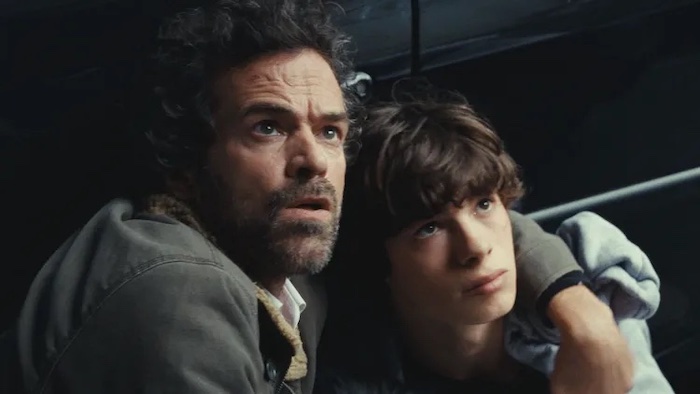
I already started having problems with the premise of this horror-fantasy in the first minutes, despite how masterfully conceived the opening scene is. A father, Francois (Romain Duris), and his teenage son, Emile (Paul Kircher), are sitting in a Paris traffic jam, locked in a heated argument, when an ambulance nearby starts shaking and a bird-man pops out and starts threatening people before fleeing. The episode introduces the “disease” that is at the heart of the story, a condition that slowly transforms humans into seemingly random animals. As it turns out, Francois and Emile are on their way to the hospital to visit Francois’s wife and Emile’s mother, Lana, who is herself changing into what looks like an ape. During the movie we see other changelings patterned on lizards, wolves, and seals. The wide variety of species seems somewhat arbitrary and saps the film of coherence, even as a parable; but, more importantly, it indicates the script’s lack of focus, even as it offers up set pieces that are quite effective in making isolated points.

Lana is transported to a small town in the countryside where a “treatment facility” has been built for these “patients,” though as it turns out many have already left society and are living in the wild. The idea of the facility is that these creatures (or “critters,” as many citizens derogatorily call them) are considered dangerous and must be locked up. During transport, Lana escapes, and Francois spends much of the rest of the film looking for her as he and Emile start a new life in the town without letting their new neighbors know why they are there. As it happens, Emile starts showing signs of his own transformation that he at first keeps from his father, and as he tries to adjust to his new school and new friends, his dilemma becomes doubly terrifying. 

Thus The Animal Kingdom works on several allegorical levels: as a coming-of-age tale with queer overtones; and as a comment on racially charged prejudices about the “other.” For me it works best as a straightforward family drama, mainly because Duris and Kircher work so well together. Since emerging himself in film as a kind of awkward youth several decades ago, Duris has become one of France’s most versatile performers, and Kircher, who was so extraordinary in Winter Boy, can switch easily between panicked terror and goofball wiseguy without losing sight of the basic personality of his character. But Thomas Cailley’s direction can’t control the sudden shifts in tone, from comedy to horror to action to melodrama, as easily as the actors do and it’s often difficult to get a purchase on what he’s trying to achieve. When Francois berates a police officer for saying that the creatures must be locked away or killed, he yells that “in Norway” they’ve figured out a way for humans and changelings to live together in harmony. The joke falls flat because the scene is so charged with anger and frustration. It probably would have been hilarious if told in a different context. 

In French. Now playing in Tokyo at Human Trust Cinema Yurakucho (03-6259-8608), Shinjuku Piccadilly (050-6861-3011), Human Trust Cinema Shibuya (03-5468-5551).

The Animal Kingdom home page in Japanese

photo (c)2023 Nord-Ouest Films-Studiocanal-France 2 Cinema-Artemis Productions

Posted in Movies | Tagged , | Leave a comment

Review: Robot Dreams

Straightforwardly a film about loneliness and the search for connection, Pablo Berger’s animated feature, based on a graphic novel by Sara Varon, eschews dialogue for a rich sound design that complements its colorful, densely built 2D visuals. The setting is Brooklyn in the mid-1980s, which is populated by animals of all species and ethnic peculiarities, not a human among them. Our protagonist is Dog, a seemingly under-employed canine living in a nice studio apartment overlooking a busy street. Despite the clamor and constant movement that goes on outside his building, he mostly sits around eating processed food and watching television alone. One day he sees a late night ad for companions and orders one. What arrives is a generic silver-colored robot, which requires some assembly. Without much ado, Dog now has a friend, who we assume is programmed for such a task, and yet genuine affection is equally offered on both sides. 

The idyll is spoiled by an accident of timing. The two friends go to the beach at Coney Island, and after Robot unwisely enters the water his parts rust up and he can’t be moved by Dog, who goes home to fetch tools and manuals, returning the next day only to find the beach closed for the season. Unable to enter he goes home crestfallen, leaving Robot to dream about someday being found and/or reunited with his friend, as Dog tries in vain every trick in the book to make those dreams a reality. The kick here is the dreams, which range from all-out fantasy to musical numbers to old Hollywood-style melodrama. As Robot lays under the accumulating sand, Dog gets on with his life, forges other friendships that fade in due time. When the season begins again he rushes to Coney Island and finds that Robot is gone, the only evidence of his existence a piece of his hand. The viewer knows, however, that Robot has been picked up by an illicit metal scavenger who has sold what’s left of him to a scrap yard, which, in turn, sells the parts to a hobbyist who endeavors to put him back together with other parts cannibalized from different devices. 

The story, whose inertia has more to do with vibes than with plotting, doesn’t necessarily go where you expect it to go, and while the the movie is steeped in non-realism, the situation that unfolds is not only believable, but sublimely affecting because it makes so much sense emotionally. At once heartbreaking and humane (despite the fact that there isn’t a human in sight), Robot Dreams is the kind of movie that gives sincerity of purpose a good name.

Opens Nov. 8 in Tokyo at Human Trust Cinema Yurakucho (03-6259-8608), Shinjuku Musashinokan (03-3354-5670), Human Trust Cinema Shibuya 03-5468-5551).

Robot Dreams home page in Japanese

photo (c) 2023 Arcadia Motion Pictures S.L., Lokiz Films A.I.E., Noddles Production SARL, Les Films du Worso SARL

Posted in Movies | Leave a comment

Tokyo International Film Festival 2024

Here are links to the articles I wrote for this year’s TIFF website. Thanks to Karen Severns and Fumi Kawakubo.

Or Utopia Q&A

She Taught Me Serendipity Q&A

TIFF Lounge: Payal Kapadia and Hirokazu Kore-eda

The Englishman’s Papers Q&A

Lust in the Rain Q&A

The Unseen Sister Q&A

Teki Cometh Q&A

Sima’s Song Q&A

TIFF Lounge: Nippon Cinema Now directors’ discussion

Sammo Hung Masterclass

Bury Your Dead Q&A

Promise, I’ll Be Fine Q&A

TIFF Lounge: Kiyoshi Kurosawa Masterclass

In His Own Image Q&A

Adios Amigo Q&A

Traffic Q&A

My Friend An Delie Q&A

Posted in Movies | Tagged , , , | Leave a comment

Review: Gondola

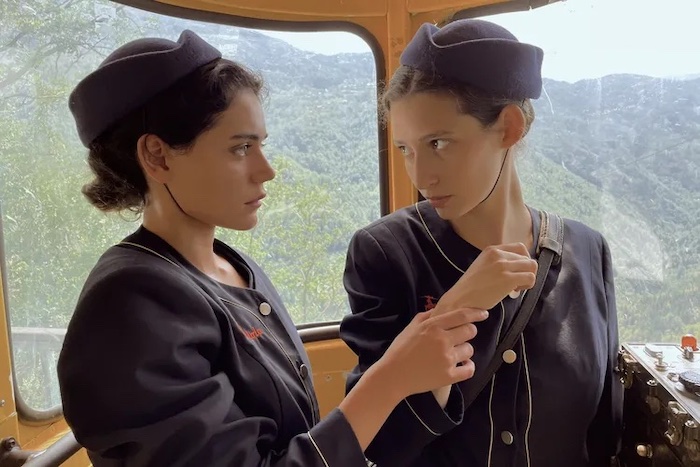
The German director Veit Helmer is famous for shooting movies in Eastern Europe and Western Asia, though the locations seem to have less to do with thematic settings than with convenience. His latest is set in Georgia, and in interviews Helmer has said the only reason for shooting in Georgia was because they have interesting cable cars, the mode of transportation that sparked his imagination for this tale, which is about two female cable car operators, one a slightly cynical veteran, Nina (Nini Soselia), the other a new recruit with a more naive disposition named Iva (Mathilde Irrmann). If this gentlest of movies has any conflict, it’s between the two women and their boss, a stout, humorless man who doesn’t tolerate the kind of relaxed work ethic the women abide by. The cable car is an important means of public transportation in this sparsely populated corner of Georgia, and the two operators take advantage of its unique qualities to entertain themselves and their fares, much to the consternation of their supervisor. In one of the film’s many magical realist moments, the women install ropes on the gondola and use them to suspend an elderly man in a wheelchair below so that he can get a true bird’s eye view of the scenery, a segment that may trouble more thoughtful moviegoers: What kind of safety precautions did the film crew carry out, since the cable cars themselves look pretty old.

The film has no dialogue, which intensifies the whimsical quality of the story. Nina and Iva, who pass each other on an almost half hourly basis during work shifts, eventually fall in love from a distance and strike up a romance, and the mute component of their relationship makes it feel even more precious than it normally would be. As the wheelchair episode illustrates, they are quite mischievous and one could infer that Helmer sort of looks at LGBTQ romances in that register, but except for some casual nudity Gondola, with its cartoony action and funny looking marginal characters (lots of grumpy but well-intentioned grandmas and grandpas), could easily pass for Saturday afternoon family fare. More interesting than the very slight story is the scenery, which is probably why Helmer really decided to film in this part of Georgia with its dramatic mountain ranges, friendly and cute livestock (which ride the cable cars as well), and gingerbread-house hamlets. The movie doesn’t attempt to engage with our modern world and thus qualifies as escapism of the purest sort. It’s a finely created confection that melts in your mouth before vanishing completely. 

Now playing in Tokyo at Cinema Qualite Shinjuku (03-3352-5645).

Gondola home page in Japanese

photo (c) Veit Helmer-Filmproduktion, Berlin and Natura Film, Tbilisi

Posted in Movies | Tagged | Leave a comment

Media watch: NHK gets flak for its special about the Johnny Kitagawa scandal

Noriyuki Higashiyama (NHK)

Japan’s public broadcaster, NHK (Japan Broadcasting Corp.), has announced that it will resume hiring talent from the entertainment agency formerly known as Johnny & Associates, whose late founder, Johnny Kitagawa, had been accused of sexually abusing more than a hundred boys who worked for the company as idols since it was established in the 1960s. Last year, the company’s management acknowledged the abuse following the broadcast of a BBC documentary that covered the matter in detail. Subsequently, Johnny & Associates changed its name to Smile-Up Inc., which took on the task of compensating the victims of the abuse, while a brand new company, Starto Entertainment, took over management of the idols that formerly had toiled for Johnny’s. Like all broadcasters in Japan, NHK relied heavily on Johnny’s for on-air talent and stopped using the agency after the scandal broke. At the press conference on Oct. 16 where the announcement was made, NHK President Nobuo Inaba said that his company was satisfied that the two companies had clearly separated their business tasks, thus paving the way for NHK to resume using Starto’s actors and singers, a move the Asahi Shimbun said would “likely lead to other major networks again signing up those affiliated with the new talent agency.”

One of the core aspects of the scandal is that Kitagawa’s abuse of the boys in his charge continued for years despite being exposed fairly early on by some media outlets. The reason such exposure was muted and not covered by other media outlets was due to the company’s power within the entertainment industry, especially among broadcasters, which in Japan are invariably part of larger media companies. Because Johnny’s male idols were so popular, broadcasters and others who hired them felt they couldn’t compete without them and thus ignored Kitagawa’s crimes. That included NHK, despite the fact that, as a public broadcaster, theoretically NHK doesn’t rely on ratings for its financial solvency because it receives funding from mandatory subscriptions. But NHK has always paid close attention to ratings, especially since the turn of the millennium when the internet started eroding viewership for TV broadcasts in general. Since then, NHK has increasingly mimicked commercial TV programming, which depends greatly on popular talent, and so NHK also hired Johnny’s idols for dramas, so-called variety programs, and talk shows. Thus NHK was also indirectly complicit in Kitagawa’s crimes, since it kept using the company in full knowledge of those crimes. 

Coincidentally or not, four days after its announcement, NHK broadcast its own documentary about the Kitagawa scandal. Though in many ways redundant, given that the BBC’s documentary was originally aired in March 2023 (though its content had already been revealed two months earlier) and Japan’s mainstream media had subsequently covered every aspect of Kitagawa’s crimes, due to its unique standing in Japan as a media outlet NHK was able to put together a more incisive report about those crimes and how Johnny & Associates kept a lid on them for so many years. The program even addressed NHK’s responsibility, though not necessarily to the satisfaction of some viewers. Following the broadcast, many people complained online about some of the documentary’s content and even accused NHK of producing and airing it so as to let itself off the hook for its failure to acknowledge Kitagawa’s sins earlier and resume hiring former Johnny’s talent. The timing was a bit too conspicuous. 

Continue reading
Posted in Media | Tagged , | Leave a comment

Review: Riddle of Fire

Just as lo-fi was once an indicator of indie authenticity in the realm of recorded music, the Tarantinoian idea of reviving the use of actual film stock will automatically strike some movie fans as a demonstration of genuine moviemaking rigor in this digital age. From a purely procedural aspect it does carry more weight. A director can keep demanding takes until the cows come home on digital without any serious financial burden (other than that related to staff and cast compensation for their extra time), while every take on an actual “film set” will cost money in terms of stock and processing. This was one of the first things that occurred to me during the opening credits of newcomer Weston Razooli’s kids adventure epic. In bold orange type the film proudly announces it was shot on 16mm Kodak film. The proof is in the pudding of the ultra-low budget production design and presentation, which occasionally falls to the level of the truly bad. Moreover, the acting is about school play grade, including the performances by the adults, and you can tell Razooli didn’t have the economic backing to reshoot some scenes that are completely incoherent due to botched line readings and on-screen talent accidentally glancing into the camera lens.

But sometimes accidents work to a movie’s advantage, and the plot and direction of Riddle of Fire (a title that doesn’t seem to have any bearing on the story) complement the amateurish production values in a way that adds to its charm and, dare I say, poignancy. The film has the look of something made in the 70s, but it takes place right now, centered on a trio of foul-mouthed, pre-adolescent delinquents-in-the-making whose determination to play a video game they’ve stolen from a warehouse sends them on an odyssey of mischievous larceny and challenge to adult authority that will have you cheering their cheeky resourcefulness. The plot, which incorporates elements of medieval fantasy and Little Rascals/Stranger Things rambunctiousness, could have been written by a bunch of kids who just wanted to make their own movie, and so develops by dint of its own immature logic, free from the strictures of mediated credibility. Armed with paint-ball guns and riding souped up mini-bikes, Alice (Phoebe Ferro) and brothers Hazel (Charlie Stover) and Jodie (Skyler Peters, convey cocky confidence in their own powers of survival as they take on an actual coven of witches who poach wild animals to support their illegal taxidermy business, though the kids’ main adversary in trying to steal a speckled egg in the coven’s possession in order to make a blueberry pie for Hazel and Jodie’s bedridden single mom (don’t ask) is a rude, cowboy-hatted ex-con named John Redrye (Charles Halford) who acts as the coven’s bagman and muscle, though conveniently for the sake of the movie he’s also rather dim. “He looks like he plays the jug in a hootenany band,” is Hazel’s withering first impression. And while these various dynamics intersect in a comical manner, there is also tension and some scenes of acute discomfort as our three heroes’ impulsiveness gets them into real danger. There’s also a well-handled sentimental thread involving the head witch’s (Lio Tipton) very young daughter, Petal Hollyhock (Lorelie Olivia Mote), helping the ragamuffins achieve their goals out of a sense of budding friendship because her mother has kept her isolated and home-schooled her whole life. 

In terms of pure momentum, Razooli (who also plays the head witch’s good-for-nothing brother and gives himself the best lines) keeps the action flowing and has a fine command of montage and camera movement that suggests he could have made something commercially viable if more money were at his disposal, but as it is Riddle of Fire is not only a promising debut, but a uniquely entertaining film experience the likes of which would not have been possible if it had been backed by a studio. In that case, it likely would have ended up like a Stranger Things episode directed by Quentin Tarantino, which, I’ll admit, is something I’d love to see, but it wouldn’t have been as interesting as this. 

Now playing in Tokyo at Shinjuku Musashinokan (03-3354-5670), Human Trust Cinema Shibuya (03-5468-5551).

Riddle of Fire home page in Japanese

photo (c) Riley Can You Hear Me? LLC

Posted in Movies | Tagged | Leave a comment

Review: Grace

With Russia in the international cultural dog house thanks to its antics in Ukraine, it might be surprising that this art house film has made such an impact on the festival circuit. But not only are there no martial or nationalist elements in the script, the movie is a generic downer in the Russian fashion, meaning it has absolutely no agenda that could be taken as being political. Director Ilya Povolotsky mostly sticks to the cruddy grey back roads of forlorn vilages that look as if they haven’t seen a visitor since the collapse of the Soviet Union as he chronicles a road trip of an unnamed father (Gela Chitava) and his preternaturally sullen teenage daughter (Maria Lukyanova). 

Their destination is the sea, but their purpose is never fully revealed until they reach it, and even then you may wonder if they had something else in mind. Povolotsky isn’t interested in motivations or even desires. He dwells on disappointment and resentment. For the most part, this pair, who are traveling by means of an aged, rust-colored RV, don’t talk to each other except to extract needed information. The landscape suggests a blighted economy that’s two steps away from Mad Max-level ruin. They buy black market gasoline from shady characters, set up a mobile cinema and sell contraband beer and snacks, and peddle pirated porn DVDs to truckers in parking lots, a pastime that gets them run out of town in at least one instance. The girl highly resents her father’s penchant for truck-stop prostitutes, which don’t seem to cheer him up anyway, and mostly spends her time taking Polaroids of the scenery, which she and Povolotsky capture in all its magnificent decrepitude. Which isn’t to say there isn’t a plot, only that it reveals itself in fits and starts and mostly hangs over the movie like a curse, as if daring you to make sense of it. The girl falls in with an equally morose young biker who stalks the caravan and takes advantage of her enmity toward her father, but to say there’s any love between the two would be assuming too much from a movie where the most consequential occurrence is when the police turn the RV back from a seaside road because of a “fish plague” that Povolotsky is gracious enough to visualize for us. 

For the first half of the film I thought the story might actually be taking place during the Soviet era, but then a cell phone shows up and a laptop figures centrally in the latter half of the story. The bleak visuals have a timeless quality that draws you in, conveying a mysterious nostalgia for something you have no memory of but can still feel. It’s a haunting movie of restless pans and dollies, populated with pale, skinny ghosts who seem to have never had the chance to live anything that could be called a satisfactory life, which sort of matches my prejudices about Russia.

In Russian. Now playing in Tokyo at Theater Image Forum Aoyama (03-5766-0114).

Grace home page in Japanese

Posted in Movies | Leave a comment

Review: Joyland

In this debut feature by Pakistani filmmaker Saim Sadiq, the protagonist, Haider (Ali Junejo), is introduced playing hide-and-seek with his nieces in the family compound in Lahore. Haider is comfortable with kids in a milieu lorded over by his wheelchair-bound father (Salmaan Peerzada) and older brother, Saleem (Sameer Sohail). But while Haider is a good Muslim husband to Mumtaz (Rasti Farooq), a professional makeup artist, and an obedient son, he is a misfit, and not just because he hasn’t held a decent full-time job in years. He likes being a househusband, even if it means taking care of somebody else’s house and somebody else’s children. But when Saleem’s wife, Nucchi (Sarwat Gilani), gives birth to her fourth daughter, push comes to shove and Haider is expected to make an effort to contribute offspring of his own, in particular a boy to carry on the family name, even though neither he nor Mumtaz are crazy about having kids of their own. But first, he has to get a job, a prospect that upsets the current order, meaning when he goes out, Nucchi will require someone to take his place, and that would be Mumtaz, who really likes the job she has.

This simple setup contains a classic conflict in that Haider and Mumtaz, who are quite close without being terribly romantic or sexually active, possess sensibilities that clash with the tradition-bound prerogatives of their family. The ringer that makes Sadiq’s story unique and utterly compelling is Haider’s new job. A friend who works at a cabaret invites him to audition for a slot as a background dancer to one of the club’s secondary “erotic” stars (which means she lip-syncs provocatively to popular Bollywood tunes). Haider has neither the experience nor the proclivity for such a vocation, but once he sets his eyes on the star in question, a trans woman named Biba (Alina Khan), he is smitten, and endeavors to become not only a capable dancer, but Biba’s lover, goals he fulfills in relatively short order. Of course, he hides the actual nature of his job from his family, but not from Mumtaz, who not only approves, but is envious. When she asks him to demonstrate his new talents he does so awkwardly and she says with a smile, “I’ve never seen you move so much.” Obviously, that’s what love does to a person, but what makes this development so refreshing and revolutionary is that it isn’t framed as a betrayal of Mumtaz, who begins to accept Haider and Biba’s affair, albeit tacitly. Haider’s queerness isn’t an issue for Sadiq—when Biba talks about saving money for surgeries, Haider replies he likes her the way she is. The point is that love makes Haider bolder in action and more of himself, which means he is willing to sacrifice not only for Biba’s affections, but for Mumtaz’s happiness, and, of course, he misunderstands both because he’s naive by temperament. As it stands, Biba is sharp and domineering as both a paramour and an employer because she has to be in order to survive, and once her act starts getting popular thanks to Haider, she wonders what his desires will cost her in the long run. “I have nothing that’s my own,” Haider despairs to Mumtaz, and Biba sees this desperation as confining and misdirected, and eventually pushes him away. Haider returns to his wife to give her the support she needs as both a woman and a member of his family, but she only wants one of those things. The other one crushes her spirit.

Sadiq throws curveballs that keep the viewer guessing as to where the story is going. Early on, when Haider’s occupation is discovered by his family and neigbors in the most hilarious way, we expect the revelation to have ramifications that never materialize, and a subplot about a widow who takes care of the father because it gives her companionship and purpose is played as an illustration of the sour prejudices inherent in tradition, but Sadiq leaves it unresolved, because that’s likely what would happen in real life. The director confounds dramatic conventions in such new and radical ways that the alternatives come across as more vividly plausible and exciting. Joyland is a love story made up of so many intriguing layers that you often forget that it’s set in a world where transgressions against social norms are subject to the fiercest public proscriptions. It makes you feel doubly alive just being around these characters.

In Punjabi & Urdu. Now playing in Tokyo at Shinjuku Musashinokan (03-3354-5670), Human Trust Cinema Shibuya (03-5468-5551).

Joyland home page in Japanese

photo (c) 2022 Joyland LLC

Posted in Movies | Tagged | Leave a comment