Review: Fallen Leaves

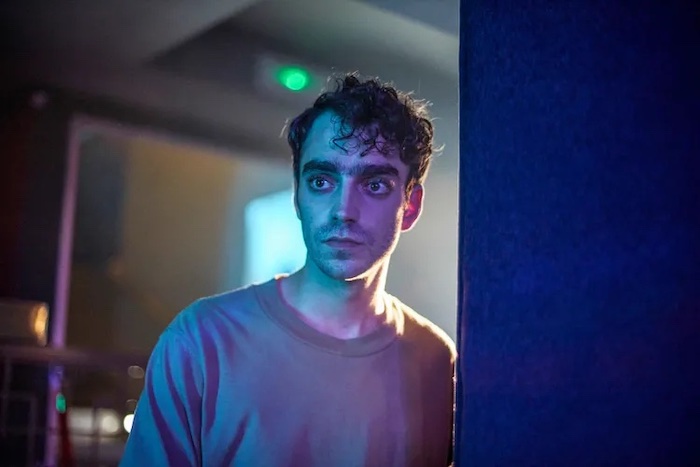
Tonally and thematically, there isn’t much difference between Aki Kaurismäki’s newest film and his previous ones. The production design is still impeccably nondescript, the dialogue strictly utilitarian, the attention to quotidian detail limited to a lower class socioeconomic field. If there is anything distinctive about Fallen Leaves it’s how the director makes all these factors serve a conventional love story so as to make it as pure a love story as possible. The movie offers little in the way of surprise. If anything, its dramatic arc feels etched in granite; but the particulars of the romance on display are depicted with the kind of passion that Kaurismäki has rarely exhibited before. He still locates the humor in all his tableaux because he can’t seem to avoid it, but now there’s an underlying layer of pathos that feels more organic than it did in his more overtly melodramatic films, like The Match Factory Girl. It’s pathos that anyone can identify with.

Much of this sadness is related to work. Holappa (Jussi Vatanen) toils in a metal factory as a sand-blaster, but his drinking on the job eventually gets him fired. Ansa (Alma Pöysti) is first shown as a grocery store employee who herself is fired after she tries to take some merchandise home that has been thrown out because its sell-by date has passed. Through the course of the film, these occupational troubles will plague both characters in their own respective ways—Holappa’s by his own volition, meaning his alcoholism, and Ansa through the basic cruelty and bureaucratic indifference of the capitalist system. Though the use of these themes is as schematic as it always is in Kaurismäki’s films, the focus on character rather than circumstance makes them more emotionally effective. These two principals meet cute in a karaoke bar where they’ve been dragged by respective friends. In Holappa’s case, it’s his work buddy Huotari (Janne Hyytiäinen), who during the visit tries to pick up Ansa’s friend, Liisa (Nuusa Koivu), thus causing our protagonists to notice each other. It’s clear from their awkward glances that interest is sparked, a connection the actors achieve with the sparest of movement. From here, the relationship develops at a pace that, for Kaurismäki at least, could be considered light speed, and so the bumps along the way are even more startling for how monumental they feel when juxtaposed against the backdrop of Helsinki’s drabber environs. In a typical rom-com touch, Holappa loses Ansa’s phone number, and is forced to repeatedly revisit the movie theater where they had their first date (to watch a Jim Jarmusch film, naturally) in hopes she will stop there, too. Later, when they wonder if they should go to the next level, Ansa has misgivings about Holappa’s drinking, which turns out to be much worse than she originally thought, and delivers an ultimatum in a quiet but decisive manner that derails Holappa’s masculine self-possession. The break feels all the more tragic for its utter familiarity.

Though Kaurismäki continues to mine the cliches of romantic drama for the rest of the movie, he never loses sight of what it is about these two people that appeals to the viewer, namely their belief that love can make this unfeeling world tolerable; which isn’t to say that Fallen Leaves is an exercise in wretchedness. Even if Ansa and Holappa are bruised in mind and body, they hold on to a hope that’s affecting in its credibility and good nature. It’s an ending that more than earns its right to the word “happy,” even if it’s typically low-key in the Kaurismäki style. 

In Finnish. Now playing in Tokyo at Kadokawa Cinema Yurakucho (03-6268-0015), Shinjuku Cinema Qualite (03-3352-5645), Euro Space Shibuya (03-3461-0211).

Fallen Leaves home page in Japanese

photo (c) Sputnik Oy 2023

Posted in Movies | Tagged | Leave a comment

Review: The Taste of Things

This Belle Epoque-set adaptation of Marcel Rouff’s 1924 novel about a well-to-do French epicure may be the most indulgently gorgeous entry into that sub-genre called food porn cinema. In the hands of director Tran Anh Hung, who used his sumptuous talents to the same effect in his Vietnam-set debut feature, The Scent of Green Papaya, the preparation of elaborate meals using ingredients that are grown or raised or caught by the people who construct them is so devotedly depicted that you may not be able to stand it. And the operative word here is “prepared,” because while there are some scenes showing people (almost always men as wealthy as their host) devouring the food and effusively singing its praises afterwards, the idea is to imbue the craft of meal preparation with the kind of mystery one would more readily attribute to the performing or musical arts. One can only look on and gape in wonder.

That said, The Taste of Things doesn’t have much of a plot. The epicure is Dodin (Benoît Magimel), whose source of wealth is never revealed. He certainly seems to have no other vocation but growing produce and raising fowl for his table. And while he does participate in the elaborate preparations, they are mainly the handiwork of his full-time cook Eugénie (Juliette Binoche), who, at the time the story takes place, has been in Dodin’s employ for some 20 years. In fact, they come across as a married couple in that they often share a bed as well as a kitchen, but for reasons not fully explained, Eugénie has never accepted Dodin’s proposals, and at this point he doesn’t seem bothered by what appears to be a determination to maintain her freedom, a stance that’s all the more admirable when we understand the circumstances of the girls who come to work at Dodin’s provincial household in lesser stations. It’s clear that Eugénie herself once filled such positions, and now that she’s proved her worth she means to make the most of it to the point where she is treated as a peer by Dodin’s landed gentry pals, who practically beg to be invited to his table. So it feels almost grautitous when Eugénie starts presenting with signs of chronic illness—fainting spells and bouts of nausea that the local physician can’t quite fathom, but it’s not really a mystery. One of Tran’s better choices is to have his principals look their age, which would appear to be mid-50s. As Eugénie fades and Dodin despairs, the two necessarily trade places, with the latter becoming the chef he always aspired to be and she turning into the pampered, if dying, celebrity of the estate.

If that isn’t enough to make The Taste of Things as memorable as it thinks it is, it probably has more to do with the viewer than with the film, which achieves its aims with startling precision. There’s an inevitability to the whole aesthetic that feels over-determined, which is Tran’s stock-in-trade as a filmmaker. He doesn’t need a vivid story or colorful characters to fulfill his expressive needs. He simply requires a minimum of essential ingredients to satisfy appetites. He couldn’t have found a better property. 

In French. Opens Dec. 15 in Tokyo at Bunkamura Le Cinema Shibuya Miyashita (050-6875-5280), Cine Switch Ginza (03-3561-0707), Shinjuku Musashinokan (03-3354-5670).

The Taste of Things home page in Japanese

photo (c) 2023 Curiosa Films—Gaumont—France 2 Cinema

Posted in Movies | Tagged , , | Leave a comment

Review: The Worst Ones

Right from the start, Lise Akoka’s and Romane Gueret’s fiction feature about an indie film crew making a fiction feature about disadvantaged kids in a suburban French town seems to be skewering the methodology of the Dardenne brothers. The director of the film-within-the-film, a bearded gentleman named Gabriel (Johan Heldenbergh), is almost immediately identified as being Belgian, though he tends to get more specific later in the movie by calling himself Flemish. There’s also an early scene that feels lifted wholesale from the Dardennes’ The Kid With a Bike. If this is parody it might have worked if the film-within-the-film were better, but it’s stuffed with cliches about the poor and, unlike with the Dardennes, Gabriel’s poetic tendencies dominate his approach to the material. In that sense, The Worst Ones—the title is an observation by one of the kid actors about how the filmmakers are only auditioning children with miserable backgrounds—should more accurately be described as a farce about the hypocrisy surrounding liberal good intentions, but its humor is curdled by a sour attitude toward all the participants, including the youngsters who are nominally being exploited for art and commerce.

The best thing about the movie is the interactions between the young actors and their response to being in the spotlight. The youngest, Ryan (Timéo Mahaut), has the most complicated relationships. A towheaded troublemaker whose ADHD is like an open wound, Ryan lives with his well-meaning and responsible older sister because social workers have decided his mother’s mental health problems make her unfit to be a guardian, though she insists she can cope. Ryan thus has a certain native understanding of his character, a boy like him being raised by a drug-addicted grandmother, but can’t command the self-possession necessary to take Gabriel’s direction, which is not only too specific for Ryan to comprehend but clueless in its determination to wring “realism” out of someone who is ignorant of artifice. In one scene Gabriel flies into a rage because Ryan keeps smiling at tormentors who are about the beat the shit out of him, which seems like a much more realistic reaction to the scenario than what Gabriel wants. Silmilarly, teenage Lily (Mallory Wanecque), already branded as the high school slut, is cast as a pregnant 15-year-old with trauma to spare, a role she internalizes easily because she’s still mourning the death of her little brother from cancer. In the simulated sex scene between Lily and Jessy (Loïc Pech), it is Lily—still a virgin, despite her image—who makes the most of her homemade method acting, while Jessy, a juvie sexual blowhard in real life, explodes in a homophobic fit of frustration at the AD because he can’t transcend his self-consciousness. Lily sees her makeshift professionalism as placing her above her sneering peers’ immaturity. She’s determined to see this acting gig through to a career, but she lacks the life experience necessary to leave the job on the set and ends up developing a serious crush on the older sound technician, following a path of misread signals to a broken heart. Lily’s opposite number is Maylis (Melina Vanderplancke), a freckle-faced, sexually fluid adolescent who quits halfway through the production because she has caught on that the whole thing is a scam, a decision that immediately makes her the most interesting character in the movie, but she doesn’t appear again. What a waste.

It wasn’t until after I watched the movie that I learned all the kid actors were themselves amateurs, and thus wished I could read French in order to sample local reviews to see if anyone accused Akoka and Gueret of the kind of exploitation they were implying Gabriel was guilty of. That, of course, is a value judgement, but despite a few missteps I think the Dardennes on the whole make good, important movies about subjects that deserve more attention. By the same token, The Worst Ones also deserves attention. I just wish it were more deserving of appreciation. 

In French. Now playing in Tokyo at Theater Image Forum Aoyama (03-5766-0114). 

The Worst Ones home page in Japanese

photo (c) Eric Dumont – Les Films Velvet

Posted in Movies | Tagged | Leave a comment

Review: Vortex

It’s logical that Gaspar Noé’s latest film be compared to Michael Haneke’s Amour. Both are about impending death. Both focus on elderly couples. Both are unflinching in their depiction of how the body deteriorates in real time. The main difference is that while Haneke addressed dementia to a certain extent, Noé goes all in, and perhaps this is the reason for the difference in tone. Per the title of his film, Haneke showed how love cannot conquer death, no matter how powerfully felt that love is. And while Noé opens his film with a dedication that seems to convey the same thing—”To all those whose brains will decompose before their hearts do”—the subsequent two hours and 25 minutes takes a very clinical look at this deterioration, so much so that Noé resorts to a continual split screen that follows the unnamed spouses, played by Françoise Lebrun and veteran Italian director Dario Argento, in parallel, as a means of showing how, at one point, they became separated first by the wife’s loss of cognitive function (the exact moment is graphically depicted by the screen dividing like a living cell) and second by the husband’s loss of any ability to consider his wife’s welfare. In that regard, Vortex is even a more appropriate title here than Amour was for Haneke’s situation: The pull of death is inevitable and inexorable. 

The split screen device is not a gimmick. Though it takes a while to get used to—the viewer isn’t sure on which side to fix their gaze—it renders the feeling of alienation and loneliness terrifyingly immediate. It also inflates the desperation that both spouses feel. The husband seems to be a film scholar or critic, and his office is a chaos of papers and books that, under normal circumstances, would simply indicate a cluttered life but here seems to register a cluttered mind, or, more precisely, a mind that can no longer sort things out. One of the more disturbing scenes shows the wife, who used to be a clinical psychiatrist, absent-mindedly tidying up this clutter and then rip and flush down the toilet the husband’s notes for a book he is writing. It’s perhaps already obvious from the husband’s own failing mental faculties that he will never finish this book, but his cries of despair when he realizes what she’s done are as heart-wrenching as any you would hear from a parent who loses a child. Speaking of which, the third wheel in the movie is their adult son (Alex Lutz), who fully understands what is happening to his parents but can do nothing meaningful about it, owing to both his father’s stubborn insistence that he can take care of things and the son’s own distractions with drug addiction (a state that may have been exacerbated by his close proximity to his mother’s prescription pad), divorce, and unemployment (he appears to be a film professional). Another particularly effective scene has the son trying to convince his father to enter himself and his mother into an assisted living facility while his own young son plays with toy cars in a childish, violent manner. The slamming sounds he makes visibly terrifies the wife, though her son and husband either don’t notice or don’t care. Similarly, there is a slight sub-plot concerning the husband’s one-sided pursuit of a younger female colleague that is not only unseemly in its revelation of a man who doesn’t seem to bother with what his wife thinks, but highly troubling in that his belief that this woman was at any time some sort of paramour appears to be a figment of his imagination.

If Noé’s ending isn’t as emotionally devastating as Haneke’s it’s because the love at the center of the latter’s movie makes itself felt with a rare intensity. Noé’s approach is more existential and, consequently, more frightening in a visceral sense. As in all his films he takes the natural development of his stories well beyond their limits in the most provocative manner possible, but since he’s talking here about death as something everyone will face, he doesn’t have to drive the idea home. All he has to do is show what happens to this particular couple, and it’s scary enough. I’d hate to refer to Haneke as sentimental, but compared to Vortex, Amour is practically a romantic comedy. 

In French. Now playing in Tokyo at Human Trust Cinema Yurakucho (03-6359-8608), Shinjuku Cinema Qualite (03-3352-5645), Human Trust Cinema Shibuya (03-546805551).

Vortex home page in Japanese

photo (c) 2021 Rectangle Productions – Goodfellas – Les Cinemas de la Zone – KNM – Artemis Productions – Srab Films – Les Films Velvet – Kallouche Cinema

Posted in Movies | Tagged , | Leave a comment

Review: Winter Boy

Christophe Honoré’s film about a troubled 17-year-old boy is as conflicted and frustrating as its protagonist, qualities that make it difficult to get a purchase on its intentions and the direction of the story in the beginning, which turns out to be the point. Lucas (Paul Kircher) already comes across as damaged goods when he first shows up, describing his constant unease in voiceover as if to a dictaphone. “All my ideas frighten me,” he says and then quickly rejects the possibility of love in his life, though he is carrying on a sexual affair with another boy at his boarding school in a provincial French town. The sex is explicit but presented wholesomely, so Honoré is obviously trying to get beyond the adolescent hangups that stereotypically plague this kind of cinematic character. The real nature of Lucas’s anxieties don’t come to the surface until after his father, Claude, is killed in a car accident, a tragedy that Lucas believes he foresaw. The boy’s subsequent breakdown has a theatrical aspect that makes you wonder how much of his suffering is for show, but the sudden inconsistencies in his temperament point to something more disturbing. His mood swings like a pendulum in a hurricane during the wake and funeral, which his grieving mother, Isabelle (Juliette Binoche), asks him not to attend, knowing what damage it might do to his already fragile equilibrium. If Lucas’s narration initially indicates an immature personality full of itself, the behavior on display dispels any notion that the boy knows what he’s doing. By the time he accompanies his older brother, Quentin (Vincent Lacoste), to his home in Paris you don’t know what to make of him.

You’re not too sure what to make of Quentin, either. A budding painter desperately trying to find a gallery or a patron for his work, Quentin should know better than to introduce his volatile little brother to the big, bad city, where Lucas quickly jumps the rails by coming on to Quentin’s roommate, Lilio, a gay man who dabbles in prostitution to make ends meet. Giving in to his new milieu, whose dangers he embraces, Lucas thinks he has every right to do the same, and Quentin has no choice but to send him back to the countryside, where his breakdown becomes complete. Isabelle, who isn’t too stable herself, can only look on in despair as he enters an institution. By this point, Honoré has abandoned his coy methodology and gone full bore into revealing the pain and insecurities that Lucas has been living with. The movie’s lurch into psychological drama is just as complete as the boy’s breakdown, and the wonder of Honoré’s direction is how he sustains this dramatic tension to the end. As a study in youthful abandon and what it covers up, Winter Boy has few peers, but viewer beware: It requires patience. 

In French. Opens Dec. 8 in Tokyo at Cine Switch Ginza (03-3561-0707), Shinjuku Musashinokan (03-3354-5670).

Winter Boy home page in Japanese

photo (c) 2022 L.F.P.*Les Films Pelléas*France 2 Cinema*Auvergne-Rhōne-Alpes Cinema

Posted in Movies | Tagged | 1 Comment

Media watch: Kishida’s premiership sustained by inferiority complex

Yoshimasa Hayashi

It’s commonly thought that Japan is run by its bureaucracy and that politicians don’t have much to do with shaping and moving policy. Though it’s an over-simplification this belief still has merit. All you have to do is look at the ruling Liberal Democratic Party’s current widespread campaign funds scandal to realize that raising money is the over-riding concern for its members, who seem to have no time or interest to do anything else.

Even the prime minister spends more energy just holding on to power than he does steering the country. The current premier, Fumio Kishida, is a perfect example. He’s been in the post for two years and done nothing memorable. In fact, what he’s best known for is keeping the job while his public support sinks lower and lower. Even his plan for a tax cut was met with disapproval. 

According to former Asahi Shimbun reporter Hiroshi Samejima on his website, Samejima Times, Kishida’s obsession with remaining in his position at any cost, even if it hurts his party, springs from an inferiority complex related to his educational history. Kishida graduated from Waseda University, which is a fine school but not the University of Tokyo, which his father and grandfather attended. Kishida, in fact, tried to get into Todai three times and each time failed to score high enough on the entrance test. In real terms, it hardly makes a difference. Only one prime minister has graduated from Todai since it changed its name from Tokyo Imperial University—Yukio Hatoyama, and he graduated with an engineering degree. Real elites get into the Law Faculty, like Yoshimasa Hayashi, who belongs to the same LDP faction that Kishida heads. Kishida has received criticism from fellow party member for maintaining leadership of his faction, called Kochikai, after he became prime minister, especially from his predecessor in that seat, Yoshihide Suga. Samejima believes that Kishida is holding on to both positions for dear life because he is thinking about his “legacy.” He has no real accomplishments to show for his time in power, so he means to make his mark as a so-called kingmaker, but to do that he thinks he has to remain at the head of his faction until he is no longer prime minister. That’s because the second in line for faction head is Hayashi, who he thinks would quickly eclipse him in terms of influence, especially since he is the very definition of an elite politician: graduate of Todai’s Law Department, post-graduate degree from Harvard, fluent English speaker. Moreover, he has been ministers of defense, agriculture, education and foreign affairs, a resume that is much more “decorative,” in Samejima’s view, than Kishida’s. Samejima says Hayashi is being called the “new hope” within Kochikai, which worries Kishida to no end. 

The rivalry between Kishida and Hayashi isn’t new. Hayashi, four years younger and a fourth generation seshu (dynastic) Diet MP—Kishida is third generation—vied against Kishida once before for the LDP presidency, in 2012, and though neither prevailed Hayashi definitely got in Kishida’s way. Moreover, Samejima says Hayashi’s “presence” in Kochikai is more prominent, despite the fact that Kishida is its nominal chief. That’s because Hayashi only recently became a member of the more powerful Lower House, having been an Upper House member since he first ran for the Diet. *Hayashi’s Yamaguchi constituency overlapped with that of the late Shinzo Abe, and he couldn’t run against Abe for a Lower House seat and expect to win, even though Hayashi actually grew up in Yamaguchi. Abe lived his whole life in Tokyo. But since prime ministers almost never come from the Upper House and Hayashi still has ambitions to that end, in 2021 he ran for the Lower house in a different Yamaguchi constituency and won. Nevertheless, Kishida still was seen to have a slight advantage, because he formed a tight relationship with Abe after the latter regained the prime minister’s office in 2012. 

But since Abe is gone and Kishida is nominally at the top, he has nowhere to go but down—or maybe sideways. Hayashi’s credentials are more impressive, at least on the surface, than Kishida’s. When Kishida was foreign minister under Abe he made no impression because Abe took the diplomacy reins himself, leaving Kishida with nothing important to do. Hayashi, on the other hand, distinguished himself more as Kishida’s first foreign minister, maintaining a close relationship with China in his role as chairman of the Diet friendship federation with China and a fairly close relationship with US President Joe Biden. Where Kishida could reserve some reassurance is in the notion that US ambassador to Japan Rahm Emmanuel doesn’t seem to be taken with Hayashi, mainly because of that close relationship to China. Anecdotally, Kishida reportedly felt left out during the recent Camp David summit between Japan, Korea, and the U.S., where everybody else except Kishida, including Hayashi and acting deputy chief cabinet secretary Seiji Kihara (who is the LDP member closest to Emmanuel) chatted casually in English between working sessions. Samejima seems to believe that this incident prompted Kishida to remove Hayashi from the foreign minister post in the September cabinet reshuffle and replace him with Yoko Kamikawa, a diplomatic lightweight who could never overshadow Kishida. In any case, Hayashi himself isn’t much good at political maneuvering, so he didn’t complain. 

Continue reading
Posted in Media | Tagged , , | Leave a comment

Review: A Boy’s Life

The Japanese title of this Austrian documentary translates as “Mengele and I,” which is misleading but in a different way than the English title is misleading. The film is basically a monologue by Holocaust survivor Daniel Chanoch who, as a boy, was at Auschwitz and had some passing acquaintance with the infamous physician Josef Mengele, who conducted unspeakably cruel experiments on many of the camp’s prisoners. However, Chanoch doesn’t talk much about Mengele, and the only related anecdote that puts the two together in any kind of close proximity is when the doctor used Chanoch as a kind of model to show the Red Cross that he was treating the inmates in accordance with the rules of war, a lie that prompted Chanoch to label the Red Cross “hypocrites” of the worst kind because they certainly would have known what was going on in the camp. But the English title, A Boy’s Life, also feels disingenuous, with its air of adolescent insouciance by association with old scouting magazines and youthful martial platitudes. Then again, as Chanoch’s story progresses, he keeps insisting that his take on the horrors he witnessed, and sometimes participated in, will likely alienate many of his listeners since he doesn’t feel “traumatized” by them. His outrage and anger is real, but the moral of the story here is that in order to survive such a hell as a child, you have to resist emotions that could lead to despair, since despair under such circumstances in turn leads to death. The fact that he still adheres to this credo in his late 80s is probably why he can speak so matter-of-factly about what happened to him.

A Boy’s Life is the third installment in directors Christian Krones’ and Florian Weigensamer’s series of documentaries about witnesses to the Holocaust. The first, A German Life, was an interview with Joseph Goebbels’ secretary, and the second, A Jewish Life, was with a Jewish businessman who survived the camps. The presentation is austere: Chanoch sits against a black background and just talks. Occasionally, the directors insert contemporary newsreel footage and official film records that are interesting in and of themselves but don’t really illustrate anything Chanoch is talking about. At first, Chanoch’s heavily accented English is difficult to understand, but as his verbal mannerisms take coherent shape and his personality comes to the fore, the story he tells emerges with stunning clarity. Born in Lithuania in 1932, Chanoch was only 12 when he was liberated by the Americans in Gunskirchen, Austria. When he was very young and local pogroms against Jews were in force, he got by because he was blonde. He once accompanied his father, a lumber merchant, to Palestine, which he describes as a paradise. Back in Lithuania, the Germans eventually invaded, and, still impressionable, little Daniel became enamored of military pomp, first that of the Russians and then the Germans. “But then my childhood ended when I was 8,” he says. The German occupiers, along with their Lithuanian lackeys, executed more than 100,000 Jews after confining them to a ghetto. Chanoch managed to escape and thus became “independent” in mind and spirit, meaning he looked upon the killings and indignities from a certain remove, always wary of what was going on around him and adjusting accordingly. Consequently, he was able to navigate the Holocaust through cunning and a certain degree of ruthlessness, while constantly witnessing the mass killing of others, not to mention cannibalism and the death march from Poland to Austria. He could have been the model for the protagonist of The Painted Bird. His story is no less incredible.

If the narrative has any resonance right now it comes through Chanoch’s retelling of his eventual journey to his beloved Palestine, which was not a Jewish state when he arrived after having traveled there “illegally” from Italy. He says nothing about Zionism or the violence that preceded the establishment of Israel, but his story and the way he presents it highlights the notion that he and his fellow Jewish refugees were done with Europe. Though the Axis powers had been vanquished, these self-exiles knew the Jews would still be unwelcome, especially in Eastern Europe where many of them grew up, and so took that opportunity to leave and never return. By all appearances, Chanoch lived a good and productive life thereafter, which is why he could remember so vividly without falling into depression. As he says at one point with a chuckle, “People don’t like how I react to things.” But the fact that he does react that way makes his recounting of these events that much more reliable. 

In English, German and Russian. Now playing until Dec. 16 along with A German Life and A Jewish Life in Tokyo at the Tokyo Photographic Art Museum Hall, Ebisu (03-3280-0099).

A Boy’s Life home page in Japanese

photo (c) 2023 Blackbox Film & Medienproduktion GmbH

Posted in Movies | Tagged | Leave a comment

Review: Retribution

You can set your watch to the release of any new Liam Neeson action vehicle, and in this particular case “vehicle” is the operative word, since all said action takes place in a car that’s wired to explode if anyone contained therein attempts to get out. If that sounds like a movie you’ve seen before, you probably have and just as likely forgot about it; though, apparently, Retribution is based on a French film, which is sort of amazing since it’s so devoid of anything that smacks of a distinctive imagination that you wonder why the producers even bothered to pay for the rights. 

Neeson plays what I assume is—based on his accent and those of his children—an American named Matt Turner living and working in Berlin as a high-end financial consultant who seems to have pissed some of his clients off if we can take the phone calls we hear at face value. Talking on the phone seems to be Matt’s default setting, as his wife (Embeth Davidtz) and two children, teenage Zack (Jack Champion) and younger Emily (Lilly Aspell), rarely bother to address him on their own. Matt finds out on the fateful day that he has forgotten it’s his turn to drive the kids to school, and so he does so grudgingly while pressing clients on speaker to not sell or otherwise transfer their assets out of his supervision. The kids in the back seat roll their eyes and scroll through their WhatsApp messages. Then Matt receives a call from a voice-altered individual who tells him about the bomb installed under his seat and how if he or the kids get out, or if he calls the police, the bomb will go off. The caller wants Matt to send him money from a Middle Eastern account, but unlike in Speed, the template for this kind of mobile ransom story, Matt is allowed to stop the car, so there is a bit of variety, as well as humor. At one point, the car’s forward momentum, not to mention the movie’s, is slowed by an anti-capitalist demonstration. (Gotta love those Germans.)

As usual, Neeson is too much of a professional to coast, and he stokes his anger furnace sufficiently in counter-threatening the bad guy while also showing how Matt slowly realizes that he hasn’t really been there for his kids up to this point, a rather pointless dramatic add-on since it makes it seem as if he’s only going to save their lives because he suddenly feels guilty about his poor fathering skills. Director Nimród Antal has no choice but to keep things moving and the film is better than some previous Neeson actioners in that it builds tension, though the payoff isn’t potent if only because the big reveal isn’t that surprising. According to my watch, we can expect the next Neeson movie in Japan on May 1, 2024. 

Now playing in Tokyo at Shinjuku Piccadilly (050-6861-3011).

Retribution home page in Japanese

photo (c) 2022 Studiocanal SAS-TF1 Films Production SAS

Posted in Movies | Tagged | Leave a comment

Review: Napoleon

People tend to complain when movies that endeavor to explain an important historical event fudge the facts, though anyone who has seriously studied history understands that there are always multiple versions of specific narratives, and the really important thing is to use discernment and native intelligence to reach conclusions that are at least plausible. Some historical movies, of course, don’t even bother and, in fact, make a point of not bothering. Ridley Scott’s big budget interpretation of the life of Napoleon Bonaparte fits easily into this category, since he’s said as much in all the blustery pre-release promotional materials and interviews. According to a number of recent articles, the French have already dismissed the movie as ahistorical nonsense, but that’s OK, too, as long as the movie holds together as a movie and renders what made Napoleon a vital figure understandable, but it doesn’t. Entertaining in spurts—mostly when it lingers on a battlefield—Napoleon shows potential as a sendup of the little corporal’s life but fails to hold together as a story, and history, in order to be at all true to itself, must have a coherent story.

The problems are mainly mechanical. Following a stirring guillotine sequence that conveys the spirit of the Revolution, the movie tries to explicate the Reign of Terror in such a way as to make it clear why a relatively insignificant personality like Napoleon’s could rise in the ranks to become a general so quickly, but the script relies so heavily on psychology that it fails to make sense of the political elements at play, and you’ll beg for a timeout to consult the relevant Wikipedia page on your phone. Consequently, Napoleon’s (Joaquin Phoenix) ascent to the throne comes across as inexplicably inevitable rather than cleverly calculated. By the same token, Napoleon’s relationship with his wife, Josephine (Vanessa Kirby), which competes with the battle scenes for the bulk of screen time, feels stuck from the beginning in a mucky chemistry that makes it difficult to understand what either thought they could get out of the arrangement except abject misery. I assume the passionless rutting and constant deriding of each other’s machinations is supposed to demonstrate the pointlessness of any connubial effort exerted for the sake of maintaining an imperial line, but besides generating a few good jokes at the emperor’s expense the marriage scenes’ only purchase on the story is the way they reinforce Napoleon’s reputation as the most royal of cuckolds. The rightly praised battle scenes may benefit mainly from being juxtaposed with the messiness of everything else in the film, since Scott is obviously fixated on getting them to not only make visual sense, but also logical integrity so as to play up the various vectors of force that led to either victory or defeat. If Scott had limited the whole movie to the Battle of Austerlitz, where the tactics are vividly delineated and the action directed for maximum visceral power, he might have had a masterpiece. 

Similarly, the exciting depiction of the Battle of Waterloo, which ended Napoleon’s career once and for all, might have provided a fitting climax to countervail any confused misgivings the viewer had formed up to that point, but Scott insists on sallying on to the emperor’s exile on St. Helena, where the movie just peters out, much like Napoleon’s sexual energy at any given moment. I will hand it to Phoenix, though. He manages to make his character a consistently petty, disagreeable man right up to the end, and while I believe that was Scott’s intention, I really don’t think it was a wise one. 

Now playing in Tokyo at Toho Cinemas Nihonbashi (050-6868-5060), Toho Cinemas Hibiya (050-6868-5068), 109 Cinemas Premium Shinjuku (0570-060-109), Toho Cinemas Shinjuku (050-6868-5063), Shibuya Cine Quinto (03-3477-5905), Toho Cinemas Roppongi Hills (050-6868-5024).

Napoleon home page in Japanese

Posted in Movies | Tagged , | Leave a comment

Review: This Is What I Remember

Kyrgyzstan director Aktan Arym Kubat says his latest film is a sequel to his debut fiction feature, The Adopted Son, which came out in 1998. Given that all his subsequent work has been autobiographical in nature, the “sequel” label may need further clarification. It seems to have less to do with an interrupted storyline than with the methods utilized to produce both films. For the most part, Kubat uses the same actors and locations in all his movies, but the actor who played the title character in The Adopted Son is the same actor who plays the son of the protagonist in his latest film, and since Kubat himself plays the father of these characters in both films, This Is What I Remember could be seen as a continuation of The Adopted Son. But that’s where the similarities end.

Kubat plays Zarlyk, who has been missing and presumed dead for 23 years after traveling to Russia for work. His son (Mirlan Abdykalykov), whose name happens to be Kubat, eventually finds a photo of Zarlyk on a website of “unknown persons” and goes to retrieve him, but Zarlyk has no memory of his family because he was injured in an accident shortly after arriving in Russia. Moreover, he was rendered mute. After returning to his home town, he spends his days obsessively collecting garbage in the town while his old friends and his son’s family fret about his mental state. Zarlyk’s return particularly upsets his former wife, Umsunai (Taalaikan Abazova), who, believing him dead, has remarried. Her new husband is the town’s much despised loan shark, Jaichy (Nazym Mendebairov), a man of means who drives a Lexus and lives in a compound. For most of the film, Zarlyk’s friends and relatives endeavor to make him remember his old life, often in comical ways that might feel cruel to the average viewer, but soon the normal rhythms of life take over and while Zarlyk’s responses to his environment don’t change significantly, the dynamic in his relationships does; that is, until Umsunai expresses interest in reconnecting with Zarlyk, a possibility that angers Jaichy’s mother, Kadicha (Anar Nazarkulova), who, in accordance with the tenets of Islam that hold forth in the compound (though not so much among the townspeople, who are comparatively carefree about religion), looks upon Umsunai as her personal servant. She tries to get the town elders to commit Zarlyk to a psychiatric institution, saying he is a danger to the community, citing as evidence a fire that was believed to have been started by Zarlyk. 

What’s intriguing about Kubat’s choices is the way he approaches Zarlyk’s condition, which doesn’t change appreciably over the course of the movie. Instead, it is others’ reactions to his condition that change, and within that contrast we realize Zarlyk does have something that can be called a memory. It’s just that it isn’t what people expect it to be. Zarlyk has basically embarked on a new life, one in which he accumulates new memories that may only have ambiguous connections to those he has lost but which are just as vital to his connection to the community, including his family. It is this connection that attracts Umsunai, who, since entering into Jaichy’s more orthodox household, has lost the freedoms she used to take for granted. Zarlyk may not remember her, but he is still the good man she once married. 

In Kyrgyz and Arabic. Opens Dec. 1 in Tokyo at Shinjuku Musashinokan (03-3354-5670).

This Is What I Remember home page in Japanese

photo (c) Kyrgyzfilm, Oy Art, Bitters End, Volya Films, Mandra Films

Posted in Movies | Tagged | Leave a comment