“2046,” October 2004

The movie reviews I wrote for the Asahi Shimbun between 1996 and 2010 are not available on the internet, so I am slowly trying to add them to this blog.
Someone once said that it wasn’t until Wong Kar Wai’s Chungking Express was screened at Cannes in 1994 that critics started saying Asia was the future of movies. Wong’s film was somewhat pretentiously hailed as the second coming of Godard, though Wong himself described Chungking as a “student film,” because he was still learning to direct the kind of movies he only saw in his mind. In the ten years since, his work has become increasingly assured, both visually and narratively. If Chungking and the follow-up, Fallen Angels (’95), seemed like collages of clever but disparate themes, Happy Together (’97) and In the Mood for Love (’00) were obsessive in their dedication to the idea that romantic love was the only theme worth making movies about.

Wong’s latest, 2046, is a sequel to In the Mood for Love–itself a sequel to Wong’s 1990 film Days of Being Wild–which chronicled a love affair between a married newspaper reporter, Mr. Chow (Tony Leung), and a married woman, Mrs. Chan (Maggie Cheung), in 1962 Hong Kong. 2046 takes place five years later and focuses only on Mr. Chow, who remains psychically wounded by the memory of that affair.

Mood was about what happens to passion when it’s repressed. Mr. Chow and Mrs. Chan consummated their love only once, and their restraint lent the movie a palpable sexual tension that a more explicit film could never achieve.

The Chow that slithers through 2046 is almost a different being. He returns to Hong Kong after having lived for a time in Singapore, cynical and predatory. He’s something of a gigolo. He recently ended an affair with a dramatically melancholy woman (Gong Li, dressed for a funeral) who had a weakness for gambling. However, we only get to see him in action when he seduces a bar hostess named Bai Ling (Zhang Ziyi), a neighbor of his at the stylishly run-down Oriental Hotel, which is the same place he carried out his single sexual assignation with Mrs. Chan.

Wong presents this affair as a series of transactions, a zero-sum game whose currencies are money and time. After weeks of flirtatious jousting as “drinking buddies,” Chow finally gets Bai Ling into bed and pays her for it. Much later, when Chow’s passions have cooled and Bai Ling comes to visit his apartment for emotional comfort, he tells her she can stay “for a price.” It’s the same old story–boy seduces girl, girl falls for boy, boy loses interest–only here it comes with a balance sheet.

Chow isn’t a complete jerk. Jin Wen (Faye Wong), the daughter of the hotel owner, falls in love with Tak (Takuya Kimura), a Japanese businessman who’s living there temporarily. Her father hates the Japanese and forbids his daughter to see him any more. After Tak returns to Japan Chow helps Jin Wen correspond with him using his room number as an address.

He takes advantage of the situation for his own benefit. Having been downsized by his newspaper, Chow starts writing novels for cash. He uses Jin Wen and Tak as models for characters in his science fiction novel 2046. In the book, Jin Wen is an android with whom Tak falls in love.

2046 happens to be the number of the room where Jin Wen resides, and where Chow and Mrs. Chan had their moment. Chow writes about a “train that leaves regularly” for the year 2046, where travelers can “regain their memories.” No one ever comes back.

Wong’s fractured narrative is full of loaded and obvious symbols, but isn’t meant to add up to anything storywise. Reportedly he had in mind a much different movie when he started it four years ago. It was to be a projection of Hong Kong fifty years after its reversion to Chinese rule. Whatever happened in the meantime, this certainly isn’t that movie, and one can easily see that Wong has mostly forced a plot onto bits and pieces of ideas that probably occurred to him as he went along. He is famous for not using written scripts, and was still adding and subtracting things days before it was shown at Cannes. That may account for the fact that Maggie Cheung, who receives a “special appearance by” credit, is only seen for a few seconds.

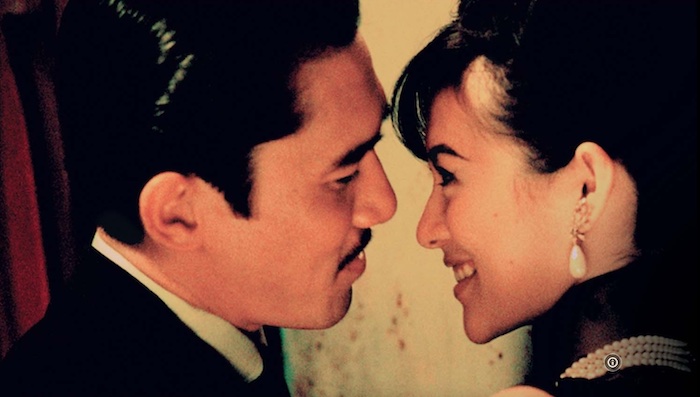
It’s important to remember that Chungking Express had a similar patchwork feel, but the pieces were of wildly varying character. Here, all the sequences, regardless of each one’s relevance to other sequences, feel equally intense. Wong wants to prove only one thing, that nothing conveys romantic passion better than the movies do. His greatest accomplishment in 2046 is a scene near the end where Tony Leung pushes Gong Li against a damp wall and kisses her long and hard, smearing her blood red lipstick all over her panting mouth. Wong simply wants to give us the greatest movie kiss of all time. They’ll probably still be impressed in 2046.

Posted in Movies | Tagged , , , , | Leave a comment

Review: A Year-End Medley

I’ve never been a big fan of holiday movies, whether they’re Christmas-, Hannukah-, Thanksgiving-, or New Years-themed. There’s something a bit too circumscribed about them, and the effort to maintain a contextual holiday “spirit” is, I find, dispiriting. This Korean movie, made for TV, seems to take as its model the Love, Actually style of mutiple plot lines interwoven into a kind of holiday quilt. The timeframe starts on Christmas Eve and ends New Years morning, and while almost all the stories are romantic in nature, they cover enough ground to draw you in…up to a point. 

Almost all the action revolves around a high-end Seoul hotel, which provides the requisite luxury production design without having to dive into fantasy-land. The two main plotlines involve female staff. So-jin (Han Ji-min), the hotel’s catering captain, has to manage the wedding ceremony and reception of Seung-hyo (Kim Young-kwang), the guy on whom she’s had a crush since they were in a pop band together in university. Lee-young (Won Jin-ah), an aspiring musical actor who works on the housekeeping staff, is put in charge of the executive suite when the hotel’s new, young CEO, Yong-jin (Lee Dong-wook), has to use it for a week after his home is made uninhabitable by an exploding boiler. These two stories blend in with other, lesser tales that explain the economic situation of the hotel and the various characters’ back stories, some of which involve relatives or acquaintances of the principals with their own stories, like So-jin’s high school age brother (Jo Joon-young), who has a crush on a classmate, a champion figure skater (Won Ji-an); or the hotel’s middle aged widower doorman, Sang-gyu (Jung Jin-young), a former student activist who runs into his first love (Lee Hye-yeong) before the wedding rehearsal of her daughter at the hotel. Then there are some stories that are basically untethered, the most potent of which is about an up-and-coming pop singer (Seo Kang-Joon) who is performing at the hotel while being wooed by a powerful talent agency, which wants to cut out the singer’s long-time loyal manager (Lee Kwang-soo), who himself seems to be in love with the singer. Then there is a self-defined loser, Jae-yong (Kang Na-neul), who decides to blow all his money on a nice room before committing suicide on New Years Eve. 

For the first hour or so, the filmmakers do a pretty good job of juggling the various storylines, and while some are better than others, they gel in a satisfactory manner as they make their way to the fateful date, but in the end they actually remain in their separate lanes and are thus entirely predictable, which is another thing I don’t like about holiday movies. You always know how they’re going to end.

In Korean. Now playing in Tokyo at Shinjuku Piccadilly (050-6861-3011), Marunouchi Piccadilly (050-6868-0075). 

A Year-End Medley home page in Japanese

photo (c) 2021 CJ ENM Corp., Hive Media Corp.

Posted in Movies | Leave a comment

Media watch: Starting deadline for paying back COVID loans approaches

Local notice soliciting applicants for COVID loans

One of the government’s countermeasures to address the economic hardship caused by COVID-19 was interest-free loans, called tokurei kashitsuke, for households whose income had dropped appeciably due to the pandemic. Though these kinds of loans have always been available, the conditions were eased in order to allow a wider cross-section of people to apply for them. Applicants could borrow up to ¥2 million at one time without the need of a guarantor. The new loan processing regime started in March 2020 and the final application period ended in September of this year. The total number of loans approved through the end of August was 3.35 million for a total of ¥1.43 trillion. 

According to the Asahi Shimbun, about 2.6 million loan recipients will be required to start paying them back in January. (Recipients could start paying the loans back at any time, and some people have already started.) There is apparently concern that many of these recipients will not be able to pay back the loans any time soon, and the government has been accepting applications to have the payback period postponed or even cancelled. Actually, the government had already postponed the payback deadline several times since the special loan was implemented, but now, with the January deadline being finalized, they have to address the reality that many household that received the loans remain in financially straitened circumstances. It has already been confirmed that about 7,500 loan recipients have declared bankruptcy (1,247 of them in Tokyo), and about 30 percent—representing a total of 791,000 loans—have so far applied to have them forgiven. 

Continue reading
Posted in Media | Leave a comment

Review: Pictures of the Old World

Filmed in 1972 but not released until 1988 due to censorship by the communist Czechoslovakian government, this documentary by filmmaker Dusan Hanak qualifies as the Slovakian cognate of Griel Marcus’s description of Bob Dylan’s Basement Tapes as a window into the “old, weird America.” Hasak sought rural folk who were old enough to remember what Slovakia was like in the previous century, using pictures taken many years before by a Soviet photographer. The Czechoslovakian authorities objected to the fact that the interviewees tended to rhapsodize about their lives prior to the communist takeover in the late 1940s, but it seemed to have less to do with resentment toward the regime than the usual nostalgic impulses. In any event, Hanak seemed more interested in pre-World War I reminiscences. 

But the reason Pictures of the Old World has been called the greatest Slovakian film of all time has more to do with the strangeness of the stories, which often veer off into philosophizing and religious rapture. These people are so bound to the soil that they can’t even conceive of a political dimension to their lives. Though their memories are sharp despite their advanced ages, they live in the present with a kind of vengeance. “If I didn’t drink I’d be useless,” says one man with regard to the strife that has infected his marriage for half a century. In fact, there are more than a few tales of wives taking axes to their husbands. Marriage seems to figure in every interview, as well as death, which, of course, is just around the corner. “I’ll die this year,” says one old woman without any indication of fear, “I can feel it.” Also, more than one person says they are looking forward to the afterlife because this one is just too hard. “I don’t know how to rest,” says a grizzled farmer. When Hanak tries to elicit what these people find of value in their lives they have no comprehension of what he’s after. Life is something you get through. 

But it’s not as if the subjects are completely removed from the world. One goes on and on about the 1969 moon landing, and offers his own theories about space travel and the science behind it. Another shows off his facility with the French language even though he doesn’t seem to remember how he obtained it. In fact, the only constant in the interviews is that the men invariably drink (“alcohol is excellent”) and the women are invariably miserable (“I only know sadness”). Both seem to believe they were put on earth to work, and resent it. In their honesty the viewer can discern not only how people of a previous century thought and dreamed, but how it affected their speech and behavior. It’s a window not just into the old, weird Slovakia, but an entirely different planet.

In Slovakian. Now playing in Tokyo at Theater Image Forum Aoyama (03-5766-0114).

Pictures of the Old World home page in Japanese

Posted in Movies | Tagged | Leave a comment

Review: Mad God

Sometimes the back story of a movie is more interesting than the movie itself. Phil Tippett is a legendary special effects maven who has worked on some of Hollywood’s most prestigious and popular sci-fi and fantasy films, including Robocop and Starship Troopers. However, while he was coming up with the images and technology to make those films what they were he was working on his own film, reportedly for 30 years. The long gestation period was not due to artistic uncertainty or lack of funds, but rather to the painstaking nature of the work itself. Mad God uses stop-action animation, which is time-consuming; but Tippett also designed the sets, which are consistently elaborate and detailed, not to mention the myriad beings that populate the movie, each one a study in bizarre anatomy and sartorial craziness. The fact that many of these elements only appear on the screen for a second or two was apparently not something that particularly bothered Tippett. He had a vision and he was going to achieve it at any cost. 

The narrative lines are as complicated and intricate as the mise-en-scene, which means that Mad God is often impossible to follow, and best appreciated as a cornucopia of dystopian images. The protagonist is referred to in the credits as the Last Man (voiced by Alex Cox, though much of the dialogue is incoherent), a character dressed in steam-punk couture who descends into a wet, rust-encrusted netherworld filled with industrial detritus and dismembered dolls. Consulting a map at every turn, the Last Man appears to be on some kind of deadly mission, and the movie’s plot takes on the trappings of an odyssey, with each new location providing a distinct episode of danger and lunacy. The dystopian ideas are expressed in scenes showing slave-like minions made of straw performing various kinds of labor, some industrial, some military in nature, while being tormented and often killed by bizarre creatures that seem to be carrying out the wishes of a cadre of overlords depicted in background stock footage shown on monitors (this footage contains the only images of actual human beings). Among the ruins there are also doctors experimenting on humanoid forms in the goriest manner and scientists testing terrifying weapons. Female sexual subjugation is rampant and obvious. 

Mad God is so dense with outrageous visual information that the horrors eventually outpace themselves and simply become curious pictures. Whatever Tippett is trying to say remains obscured by his wealth of inventiveness—there are enough unique ideas here to undergird a dozen animated features, but he seems determined to throw them all together. Though not as emotionally affecting as the work of Czech master Jan Svankmajer, Mad God may be the last word in animated horror, even if its overall effect is one of wonder rather than disgust. 

Now playing in Tokyo at Shinjuku Musashinokan (03-3354-5670), Human Trust Cinema Shibuya (03-5468-5551).

Mad God home page in Japanese

photo (c) 2021 Tippett Studio

Posted in Movies | Tagged , | Leave a comment

Review: Black Adam

What’s most compelling, if not downright shocking, about Jaume Collet-Serra’s attempt to inject some much needed thematic mojo into the so-called DC Extended Universe is that while the origin story of a character that was mostly relegated to either villain or minor hero status is given A-level treatment, it doesn’t necessarily elevate the character himself to full-fledged superhero status. For one thing, Collet-Serra’s reputation has been built mainly on thrillers and horror films, and the requisite battle scenes in Black Adam that show the protagonist laying waste to hordes of attackers are quite graphic when compared to your average superhero blockbuster, including those involving the MCU. But even more striking is the overt politics behind the violence. The scenes that take place in our own time are set in a fictional northern African country that scans Muslim/Arab, and the main conflict is between Black Adam (Dwayne Johnson), a kind of demigod whose body was entombed for 5,000 tears by an evil king, and the Justice Society of America, which very clearly represents the Western forces that occupy the region both militarily and economically. Black Adam is, to use a crude term from the past, a third world liberator.

So the carnage that ensues in the usual predictable manner is unleashed upon the products of the military-industrial complex, which doesn’t enjoy the usual proper payback in the end; and that’s quite a change for a Hollywood movie of this scale and ambition. In that regard, Johnson, the biggest American movie star of the moment in terms of box office cred, is a revelation, because he seriously has it in for these (mostly white) mercenaries, even as his understanding of what’s actually going on is depicted as being naive. Johnson’s skills as a showman (from playing the heel in hundreds of pro wrestling bouts) serve him well in a role who villainous attributes are brought to bear on the kind of oppressors his type of character usually represents in these films. 

The ringers are the relatively new additions to the DCEU that comprise the Justice Society—Doctor Fate (Pierce Brosnan), Hawkman (Aldis Hodge), Atom Smasher (Noah Centineo), and Cyclone (Quintessa Swindell). With only Brosnan distinguishing himself as a star presence, the group can’t possibly assert itself on the screen in the shadow of Johnson, and each member essentially cancels one another out for your attention. It’s up to the civilians, let by local resistance fighter Adrianna (Sarah Shahi), to inform the besuited interlopers that they have been summoned to put down a force that, whether he knows it or not, is protecting “the people.” Had the writers maintained the integrity of their early convictions, Black Adam might have been a biting indictment of all that’s hypocritical about the ultra-violent superhero genre, but in the end all the various parties have to align with conventional Manichean types for a hackneyed laser-and-space-bending battle to the death, which in this case is that of the real villain, a descendant of the evil king known as Sabbac (Marwan Kenzari). The transgression was nice while it lasted. 

Now playing in Tokyo at Toho Cinemas Hibiya (050-6868-5068), Toho Cinemas Nihonbashi (050-6868-5060), Marunouchi Piccadilly ((050-6875-0075), Shinjuku Wald 9 (03-5369-4955), Shinjuku Piccadilly (050-6861-3011), Toho Cinemas Shinjuku (050-6868-5063), Human Trust Cinema Shibuya (03-5468-5551), Toho Cinemas Roppongi Hills (050-6868-5024).

Black Adam home page in Japanese

photo (c) 2022 Warner Bors. Ent. All Rights Reserved TM & (c) DC

Posted in Movies | Tagged , | Leave a comment

Media watch: Death row inmates question the way they meet their ends

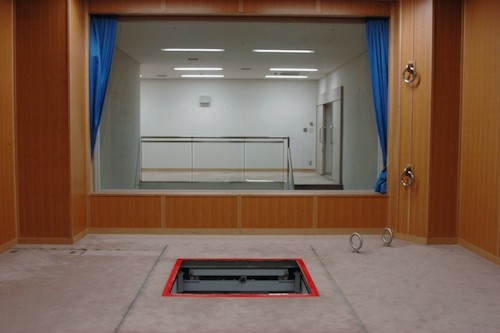
Several days ago, most major media outlets reported on a ¥33 million lawsuit filed by lawyers for 3 inmates on Osaka Detention House’s death row to change their execution method due to the cruel nature of the way those executions are carried out. The inmates contend that Japan’s chosen means of killing persons convicted of capital crimes, hanging, is in clear violation of Article 36 of the Constitution, which prohibits the torture of anyone, including convicted criminals. The suit also says that Japan’s method of execution “runs counter” to the International Bill of Human Rights. 

According to an April 29 article in the Asahi Shimbun, the suit filed in Osaka District Court claims that when an inmate is hanged—meaning they fall through a trap door a certain distance so that the rope around their neck snaps the spine—they can remain conscious for several minutes and experience great pain and fear before they finally succumb. In some cases, the body of the executed person can be “damaged severely,” thus destroying the person’s “dignity.” The suit does not contest the three inmates’ convictions or sentences, but only the method of execution.

The plaintiffs also state that if the government insists that hanging is not a cruel form of punishment, then they should explain and demonstrate publicly the actual circumstances surrounding executions in Japan. 

Asahi explains that in 1948 the Japanese Supreme Court ruled that execution by hanging was constitutional and “the most humane method” by “taking into consideration the current environment.” The matter came to the court’s attention again in 1955, and the decision was the same, implying that there was “no proof” that the method was “cruel.” Hanging has been the means of execution since the Meiji Era. 

The reporting says nothing about another aspect of death row that anti-capital punishment advocates insist also qualifies as cruelty: Inmates are not informed beforehand of their execution date, which means they find out only when they are summoned to the gallows. Consequently, death row inmates spend their entire incarceration in fear of the knock on their cell door and cannot properly prepare themselves for the end. 

Social media discussion of the news story has been almost uniformly against the lawsuit, with many commenters saying that the plaintiffs have no right to question their method of execution since they themselves carried out cruel killings. Some even say that it is the harsh nature of the execution method that makes Japan’s capital punishment system an effective deterrent to crime. 

Nevertheless, Japan remains only one of three OECD countries to retain capital punishment. The US and the Republic of Korea are the other two, and Korea has not executed anyone since 1997. Though it is doubtful that the Osaka District Court will find in favor of the plaintiffs, the trial, if the suit isn’t dismissed out of hand, may at least buy the three inmates some time. Still, the purpose seems to be to publicize the nature of Japan’s execution system, which is certainly more mentally and physically brutal than the most common US method. In line with the protocol of keeping the execution date a secret from inmates, the government is not keen on publicizing executions, and only in recent years has the Ministry of Justice even announced that they have taken place. If deterrence really is the reason behind retaining hanging as the official method of execution, then it would make sense to publicize how the hangings are carried out. But they don’t, and you have to wonder why. 

Posted in Media | Tagged , | Leave a comment

Review: Happening

The Japan distributors of Audrey Diwan’s 2021 Venice Golden Lion winner are probably patting themselves on the back for having waited so long to release Happening in Japan, since Annie Ernaux, the author of the novel on which it’s based, won the most recent Nobel Prize for Literature. That’s the kind of PR boost you can only pray for, but I hope that viewers intrigued by the pedigree of the film understand what they’re in for. Ernaux’s story, presumably autobiographical to a certain extent, since almost all her work is, is about a young woman’s quest to undergo an abortion in 1963, when the procedure was illegal in France. Even talking about it could land you in trouble with the authorities. Ernaux and Diwan make this aspect the main thrust of their story, which is both painfully personal and sociologically relevant, even to our own age. 

Anne (Anamaria Vartolomei) is studying literature at a university in a conservative town in southwestern France, aiming to advance to a graduate program, when she discovers that she is pregnant. Understanding that being a single mother would effectively end any of her career ambitions, she is desperate to be rid of the embryo, but has nowhere to turn. Bolder than her fellow female students, who seem resigned to following the usual domestic track after graduation, she is curtly told by a much older doctor to get lost when she indirectly brings up her wish. And while the doctor who previously told her of her pregnancy sympathizes with her plight he refuses to even discuss her options lest he not only lose his license but go to jail. Anne, of course, cannot possibly talk about it to her parents, tavern owners who are proud of their daughter for being the first person in their family to attend university. And when she finally reveals her condition to her two best friends in the dorm, one of them immediately cuts her off, as if she were a leper trying to touch her. 

Diwan does not reveal the father of the child until well into the film, and while this man feels an obligation at first he conveniently uses Anne’s pugnacious attitude to justify his failure to find a solution. In a sense, Anne’s downward spiraling circumstances—Diward marks each successive week of pregnancy with a title card—come to feel as if they comprise a societal conspiracy against her, and for the first half, at least, the dialogue has an over-determined quality that seems designed to explain everything in unmistakable terms. Moreover, while the boys are predictably mercenary in their behavior—once rumors spread, Anne’s male classmates all hit on her—the narrative takes surprising turns, as when one potential boyfriend, Jean (Kacey Mottet Klein), after also unsuccessfully trying to get into Anne’s pants becomes something of a savior by hooking her up with an underground abortionist. It’s then when the horrors really begin, and Diwan is unflinching in her depiction of the process, which seems interminable. More than anything, Happening underscores the contradictory attitudes that even the most liberal-minded person can have about pregnancy and abortion. Anne is not only cruelly isolated by her situation, but made to pay an unbearable price for it. 

In French. Opens Dec. 2 in Tokyo at Bunkamura Le Cinema Shibuya (03-3477-9264), Shinjuku Piccadilly (050-6861-3011), Marunouchi Toei (03-3535-4741).

Happening home page in Japanese

photo (c) 2021 Rectangle Productions – France 3 Cinema – Wild Bunch – Srab Film

Posted in Movies | Tagged | Leave a comment

Review: The Electrical Life of Louis Wain

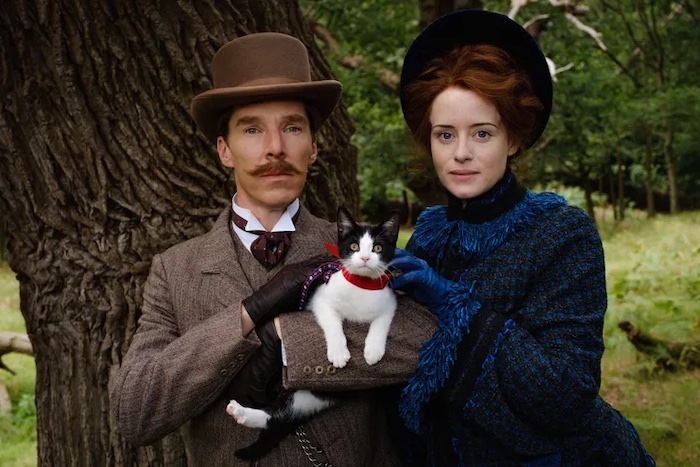
History mainly views Louis Wain as the Englishman who made the world safe for cat pictures. He didn’t photograph them. He drew them, initially with great verisimilitude and then in a more whimsical, anthropomorphic style, but when his feline illustrations first appeared at the end of the 19th century they were novel because cats were not really considered pet material. They caught mice and other vermin and were mostly despised by people of good station, which should have included Louis Wain, since he was born to a noble family, and that, essentially, is the gist of this muddled biopic starring a very animated Benedict Cumberbatch as Wain.

These days, a personality’s like Wain would probably be described as being on the spectrum (he was posthumously diagnosed as schizophrenic), but in Victorian England he was considered an eccentric by those who knew him and irresponsible by his family, which had somehow lost most of their fortune and relies on his talents as a freelance illustrator to get by. This was especially trying for him since his fatherless household comprised his mother and five sisters, and his polymath interests extended to composing operas and inventions based on electricity. Nevertheless, the family tries to keep up appearances, and after they hire a governess, Emily (Claire Foy), to attend to the younger sisters and Louis falls in love with her, the eldest sister, Caroline (Andrea Riseborough), is scandalized because of the class difference. But Louis, whose particular psychologigal constitution makes it difficult to change his mind with arguments based on propriety, marries Emily anyway, and their shared appreciation for things that most people aren’t interested in is most clearly represented by their adoption of a stray kitten, which they name Peter. When Emily falls ill and leaves the story, Louis cannot cope with the loss and turns to drawing cat pictures, because it’s the only way he can keep his memory of Emily alive.

The remainder of the movie explores Wain’s artistic gifts as the man himself falls victim to a larger constellation of nervous disorders, which eventually land him in an institution. Meanwhile, his cat drawings are an international sensation that he can’t quite enjoy because he neglects to copyright them, and while he accumulates friends along the way who try to advise him to his benefit, Wain’s manic predilections come to dominate not only his behavior but the mood of the movie. That said, Will Sharpe’s direction is for the most part light-hearted, and some viewers may find the tonal shifts jarring if not offensive given how they reflect on the subject of mental illness. Cat lovers may appreciate the movie as an historical document without necessarily loving the movie itself. Actual cats don’t get much screen time, only their graphic representations. 

Opens Dec. 1 in Tokyo at Toho Cinemas Chanter Hibiya (050-6868-5001), Toho Cinemas Shinjuku (050-6868-5063), Shibuya Parco White Cine Quinto (03-6712-7225), Toho Cinemas Roppongi Hills (050-6868-5024).

The Electrical Life of Louis Wain home page in Japanese

photo (c) 2021 Studiocanal SAS – Channel Four Television Corporation

Posted in Movies | Tagged , , | Leave a comment

Media watch: Is Japan ready for uterus transplants?

According to an article published by Asahi Shimbun on Nov. 25, Keio University has applied to the health ministry for permission to carry out uterus transplants. If permission is granted, the ministry will start screening applicants for the procedure early next year, after which clinical trials will be launched. Last July, the Japan Medical Association studied the prospects for uterus transplants and agreed to permit clinical trials, which would be the first step toward actual transplant operations. The JMA’s summary stated that the transplants would be for women in their 20s and 30s diagnosed as being unable to bear children, women who were born without uteruses, and women who had undergone hysterectomies due to benign tumors. (Women who had had hysterectomies because of malignant tumors are not eligible.) As with donated eggs, transplanted uteruses can only be from blood relatives of the recipient, typically an older, pre-menopausal woman like a mother or an aunt. Anti-rejection medication is administered following the transplant procedure and menstruation is monitored for at least 6 months to determine the viability of the transplanted organ. The recipients retain their ovaries, from which eggs are harvested and fertilized. The resulting embryo is then implanted in the transplanted womb. Any baby that is subsequently brought to term is delivered via caesarian section. Since the mother must continue taking anti-rejection drugs, she is allowed a maximum of two babies. Eventually, the transplanted uterus is removed. The cost of the operation alone is estimated at ¥25 million, but as the article points out there are still many issues to be resolved before any transplant can be performed.

The first uterus transplant took place in Saudi Arabia in 2000 on a 26-year-old woman, but the uterus turned out to be not viable. After more testing on animals was carried out over the years, the first child born to a woman via a transplanted uterus was in Sweden in 2014. As of October, there have been 98 uterus transplants worldwide that produced 52 babies. The procedure to remove the uterus from the donor takes 8-10 hours and the implant operation takes about 5, so it is a large-scale surgical matter. According to an assistant professor at Keio who talked to Asahi, uterus transplants differ significantly from other transplant operations in that they are not performed to save or otherwise extend the lives of their recipients. The purpose is simply to provide women who are not able to conceive or deliver children with another option to give birth. Viable uteruses can be transplanted from either living donors or deceased donors, but initially in Japan only living donors will be allowed, though, according to the assistant professor, deceased donors are more appropriate due to any surgical complications when operating on a live donor. But because of existing Japanese transplant guidelines and laws, the JMA will need to discuss the related ethics first, and they plan to do so next year along with the Japan Gynecological Academy. 

Continue reading
Posted in Media | Tagged | Leave a comment