Dreamworks reportedly hopes to develop this animated feature into a franchise, but so much of it is pastiche that it might be difficult to pass off as original. The premise is that the heroes are not only “bad guys” in movie parlance, but animals that tend to have a negative image in real life: snakes, piranha, tarantulas, sharks. The head of this motley crew of criminals is a wolf voiced by Sam Rockwell at his sleaziest, and while wolves have generally been rehabilitated in recent decades through the services of environmental groups (as have sharks, even though they still kill people), the movie appropriates the old Hollywood cliche of wolves, meaning guys on the make, especially when it comes to their approach to women.
The other element that makes the movie more generic than distinctive is that it’s a heist movie whose particulars about the job in question seem to have been cribbed from every other heist movie, in particular the Soderbergh “Oceans” series. George Clooney is even mentioned by name, as if two cinematic universes had passed each other in the night. There are car chases and evil geniuses and corruptible politicians, but all these different aspects are more or less thrown into a stew of jokes and pop cultural asides that stall the plot’s forward momentum. The object of larceny is a bank and the mechanizations of the steal get buried under all this comedic business and sideways moves for the sake of romantic intrigue: Wolf “makes love” to the state governor, a fox (Zazie Beetz), whom, naturally, he ends up really falling in love with, though his original purpose was to distract her. The villain, of course, isn’t Wolf or his team of fanged, clawed accomplices, but rather a guinea pig (Richard Ayoade) named, of all things, Professor Marmalade. (Where’s Paddington when you need him?) It’s not spoiling anything to say that the “crooks” end up looking like the good guys because they fight the real “evil” in the world. One for all and all for one, though the “one” in this case would seem to be the franchise.
Subtitled version opens Oct. 7 in Tokyo at Toho Cinemas Shinjuku (050-6868-5063), Toho Cinemas Roppongi Hills ((050-6868-5024).
Movies, especially American movies, love characters who are ground down by the effort to just get by, and usually they are allowed some measure of triumph. Andrew Bujalski’s Support the Girls, which is set in a Hooters-type family restaurant in suburban Texas, is so dense with circumstance that the viewer doesn’t have time to parse whether the various people moving across the screen are getting by or triumphing. Though ostensibly a comedy, the laughs are so hard won that you almost feel guilty for being entertained.
Bujalski doesn’t give us a plot, but instead a structure within which various stories play out in pieces and segments. At the center is Lisa (Regina Hall), the manager of Double Whammies, who is serious about her work and her dedication not only to her customers, but to her employees—female servers who wear revealing clothing and understand why. For the most part they’re in their early 20s and know that they can make a lot in the way of tips by flaunting what they’ve got, but Lisa is protective and strict in this regard: She’ll boot a customer who “disrespects” her girls but she’ll also send a worker home if she goes over a certain line. In other words, Lisa is a real manager, but Bujalski is careful to balance her authoritarian bent with a conscientiousness born of bitter experience. “I can take fuckin’ up all day, but I can’t take no trying,” seems to be her abiding attitude toward labor, and the girls appreciate it, especially the veteran Danyelle (Shayna McHayle), whose attachment to the establishment is tentative—she might not come in on time if the babysitter is late and doesn’t care if she called out—but whose loyalty to Lisa is unequivocal.
It’s the way Bujalski contrasts what goes on in the restaurant with what goes on outside of it that makes the movie unique, and the latter is mostly about Lisa’s struggles with the economy. During the day depicted, she has to take time off to visit rental properties that are probably out of her reach and then meet with the sleazy owner of Double Whammies (James Le Gros) who is not shy about slamming diversity if it even looks sideways at his bottom line; and he’s frankly getting sick of Lisa reminding him of his responsibilities. These scenes are simultaneously funny and painful to sit through, because you know they’re not at all funny for Lisa, and since Bujalski isn’t the kind of director who is here to make you feel good, you know he isn’t going to reward Lisa in the end with a happy ending, because those things just don’t happen. As matters at the restaurant spin out of control this funny-tragic dichotomy only intensifies. Support the Girls is a rare movie and an even rarer study of what most American workers have to put up with. You suffer every day but when you step outside yourself and look at the situation straight, you just gotta laugh.
Opens Oct. 7 in Tokyo at Shimokita Ekimae Cinema K2, Shimokitazawa.
Now that Shinzo Abe’s state funeral is history, we can get back to the business of mocking politicians, like former prime minister and sports honcho Yoshiro Mori, whose penchant for gaffes is even more fulfilling than Taro Aso’s. On Sept. 10, Tokyo Shimbun ran a story about a plan to erect a bust of Mori as a bid to “show appreciation” for what he’s done for the Japanese sports world. Mori was the chairman of the committee that organized the 2019 Rugby World Cut in Japan, and, of course, he held the same position for the 2020 Tokyo Olympics and Paralympics—until he didn’t due to his infamous way with words.
Japan has a lot of statues in public places, so the Mori bust is hardly an anomaly. Probably every prime minister has had his likeness immortalized in bronze and placed in a prominent place in his home town or prefecture. What makes the Mori bust slightly different is that the idea started with sports folks rather than hometown supporters and the like. Toshiaki Endo, a Liberal Democratic Party lawmaker, is pushing the idea. At one point, Endo was Olympics minister, and he said that in May the group of people who want to make the Mori bust contacted him for assistance and Endo agreed. One member of the group is fellow lawmaker and former Olympic speed skater Seiko Hashimoto, who took over as chairman of the organizing committee after Mori was forced to step down because of remarks that insulted women and others who have, you know, common sense. Other members of the group also worked for the Olympics and the Rugby World Cup (though the Japan Rugby Association has said it is not involved), and they all want to honor MorI for “the good deeds” he did in the sports world. One unnamed source told Tokyo Shimbun that the group is just friends of Mori who feel bad that he left the Olympics under a dark cloud and think he should get more credit for the positive things he did.
Usually, busts or statues are erected after their subjects die, but Mori isn’t the first individual to be honored with a bronze likeness during his lifetime. For instance, the original “faithful dog,” Hachiko, showed up when his statue, probably the most famous in Japan, was unveiled in the plaza at Shibuya Station, according to “statue journalist” Takehiro Sumi, who also points out that former prime minister Hiromi Ito had a statue erected before he died, but it was torn down by forces who objected to the peace treaty he signed after Japan won the Russo-Japan War. Sumi says the history of public statuary tends to progress in waves. The second wave started in the 1990s and mostly focused on anime characters as tourist attractions. We are now at the start of a third wave, he thinks, launched by the erection in Tokyo of a statue of the comedian Ken Shimura, who died from COVID in 2020. Still, Sumi insists that the “attitude” toward public statues has remained pretty much the same since the Meiji Era: They’re always paid for and put up by friends of the subject.
Having jumped ship on the beloved British series around the time Dan Stevens left, I assumed this movie installment would be an entirely self-contained episode with no need to brush up on what happened in those latter seasons I missed. For the most part, that’s the case, but Simon Curtis’s film is so beholden to the style and rhythms of TV that I couldn’t help but wonder if the script had been cannibalized from an idea discarded for the series itself. In any case, its main purpose is to say goodbye to one particular character in a grand way, but the emotional contours of this farewell are flat. There’s no feeling of finality in the gesture, as if there will just be another episode next week.
As it stands, A New Era has two plotlines that don’t necessarily complement each other. In one, the elderly Lady Grantham (Maggie Smith) learns that she has inherited a villa in the south of France from a man she knew only briefly many years ago. The news gives rise to speculation in the Grantham household that she and this marquis had fooled around and fell in love back in the previous century, and that, perhaps, Robert (Hugh Bonneville) was the issue of this liaison, though no one really has the guts to confront Mrs. Grantham with this supposition. Most of the household ends up traveling to the continent to straighten the matter out since the marquis’ widow (Nathalie Baye) and son (Jonathan Zacca) are understandably quite put out. In the other storyline back at Downton, an American film production company has taken over the estate to make a silent film (yes, the Granthams need the cash) and just as they are about to begin, the producer demands it be a talkie, which is inconvenient for its female star (Laura Haddock) who, like the Jean Hagen character in Singin’ in the Rain, has a pretty nasty voice. Lady Mary (Michelle Dockery) is thus recruited to dub her lines, which leads to all sorts of drama.
The movie is pleasant enough, and Dominic West has a good time making fun of his career in American accents as the barely closeted leading man of the film-within-the-film, but the class dynamics that pretty much prop up the TV series are barely articulated. The servants essentially get to play their betters in the movie as extras, a clever idea that screenwriter Julian Fellowes squanders by making the subtext the text itself. By the end of the movie you understand what he means by a “new era,” but it’s not what I expected. Fellowes simply keeps the door open for more episodes. So even though you don’t need to know the series backwards and forwards to appreciate A New Era, only true fans will probably get anything out of it.
Now playing in Tokyo at Toho Cinemas Nihonbashi (050-6868-5060), Toho Cinemas Hibiya (050-6868-5068), Toho Cinemas Shinjuku (050-6868-5063), Human Trust Cinema Shibuya (03-5468-5551), Toho Cinemas Roppongi Hills (050-6868-5024).
Twenty-five years after she perished in a car crash while fleeing paparazzi in Paris, Princess Diana’s overstuffed legacy hardly needs another cinematic boost (that biopic with Kristen Stewart opens in Japan next month), but this HBO documentary does a pretty convincing job of bringing the media—and with it, the general populace—to task for destroying the woman with too much tough love. Assembled by Ed Perkins completely from available footage and unencumbered by voiceover narration and talking head comments, the movie is as pure a distillation of poisoned public image as we’re likely to see, and that’s simply because no other person in the history of celebrity culture has been as doggedly covered as Diana Spencer.
Though Perkins generally adheres to the chronology, he opens with her death, which conveniently gets that out of the way, thus allowing the viewer to absorb the wildly divergent tone and import of the images as they come. He wisely chooses footage that also plays up the environment in which Diana rose as a public figure, especially the economic doldrums of Britain in the 80s and how her youth and seeming iconoclasm was so appealing to a public that was tired of the dourness of everyday life as embodied by Buckingham Palace. He also focuses on her privilege and how it informed that seeming lack of artfulness in her dealings with both the House of Windsor and the attendant press. Much is made of the 12 year age gap with her husband, who, inevitably perhaps, comes off badly, though the portrait is more sympathetic than it is in The Crown. If anything, the future king seems more like someone who simply received bad advice and was even worse as gauging the media’s propensities than Diana was. Even after marriage, he was winkingly, approvingly portrayed by the press as still reveling in a bachelor’s life, thus pointing up the obvious inherent sexism in the coverage. Invariably, Diana’s disillusionment, first in her marriage, then in her “position,” was conveyed as being “willful” and ungrateful.
It wasn’t until after the divorce and the revelation that Charles had been continually unfaithful that the public’s sympathy fell on her side, but even here, Jenkins managed to bring in recordings that reveal the media’s real agenda, which was totally exploitative. If they championed Diana’s charity work and progressive mindset, it was all a means to an end, which was to ridicule the monarchy in contrast in order to boost their bottom lines. Throughout The Princess we keep hearing about the “damage” she caused to the royal family, and, for sure, the royals really bring that damage upon themselves, but the media plays it up in such a way as to put more pressure on Diana than she’s capable of withstanding. She died not so much because the press wouldn’t leave her alone, but because by that point there was absolutely nothing and no one left to protect her, including her so-called loyal public.
Opens Sept. 30 in Tokyo at Toho Cinemas Chanter Hibiya (050-6868-5001), Bunkamura Le Cinema Shibuya (03-3477-9264).
Some Japanese people abandoned in China and their children
We rarely have anything positive to say about the late Shinzo Abe, but with his state funeral happening tomorrow we wanted to point out at least one good thing he did. This year marks the 50th anniversary of normalized relations between Japan and the People’s Republic of China. One result was the repatriation of Japanese people who had been left behind in China at the end of World War II. Almost all were children at the time. Some were even infants. They were raised as Chinese by Chinese people, but many knew they were Japanese by birth and desired to reclaim their ancestry and nationality. However, it took a long time, and some, it is assumed, have never been able to “return” to Japan and probably never will, considering how old they would be.
According to an article in the Sept. 19 Asahi Shimbun, after Japan surrendered in the summer of 1945, many Japanese who were on the Asian continent struggled to make it back to the Japan and were reluctant to bring their children because of the hardship and danger involved, so they left them with Chinese people, usually peasants. The Japanese government officially deemed such children 12 years old and younger as being Japanese “orphans,” while for some reason girls 13 and older were considered to have “decided to stay of their own volition,” perhaps because many of them were married off to older Chinese men. Over the years, the health ministry says that about 2,500 orphans have been repatriated, but of the women who supposedly stayed of their own accord, more than 4,000 have returned to Japan to live.
The awkward title of this mystery, based on a best-selling novel, describes a small town in rural Australia that has been suffering through a drought for some time. The intent seems to be to prepare an environment of discomfort and depression into which the story is then injected, and to an extent it works. The town is an unpleasant place, but the reasons go further than the climate. The movie opens with a catastrophe: a woman and her son have been murdered in their home, with the presumed killer, the woman’s husband, dead by his own hand, or so it seems. A big city cop named Aaron Falk (Eric Bana) returns to the town, where he grew up, for the funeral, but reluctantly. Falk himself was marginally involved in the death of a female friend when he was a teenager, and some in the town still think he had something to do with the death. When the presumed killer’s parents ask Falk to hang around and try to prove their son’s innocence, he obliges but with serious reservations.
Though the mystery itself is competently developed, the aforementioned atmospheric details add so much dead weight to the action that following the story becomes something of a chore. Falk reconnects with an old girlfriend whose utility to the plot is not clear, and as the requisite red herrings pile up Falk becomes more aggressively determined in his investigation, despite or perhaps because of the general air of hostility he encounters at every turn for leaving the town long ago without resolving whatever role he played in the death of his childhood friend. His sudden departure meant he must have been guilty of something. And while these varying, often conflicting dynamics add to the drama, they aren’t marshaled in a way that makes the core mystery satisfying. Falk’s mean-spirited detective work comes off as a means of addressing these obstacles but it’s hard to follow his logic toward any viable solution. As a result, The Dry, true to its title, offers no suspense or, for that matter, cumulative excitement. It’s inert, like the dusty air that hangs over everything in the town.
Now playing in Tokyo at Shinjuku Cinema Qualite (03-3352-5645).
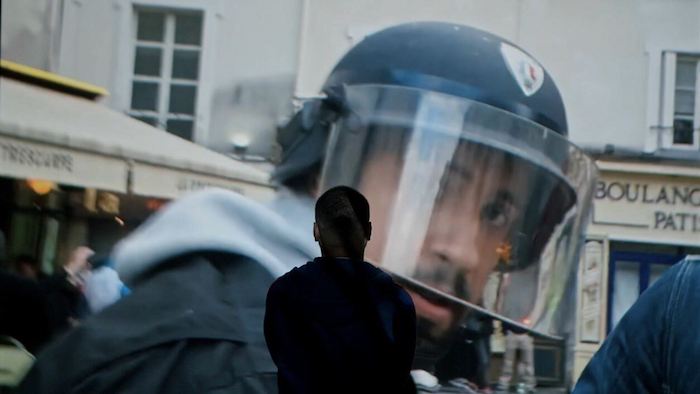
For those of us who don’t live in France or, for that matter, the EU, the so-called Yellow Vest Movement, in which mostly working people and far-left and far-right elements opposed to Emmanuel Macron’s neoliberal policies clashed violently with police during large-scale street demonstrations, was a typically French phenomenon. There always seems to be demonstrations taking place in Paris, as if France were a nation of preternaturally aggrieved citizens. Most likely this conclusion is born of lack of fundamental knowledge of the French situation, but, in any case, it points to the supposition that French people are at least engaged, if not necessarily in politics then in the everyday struggle to make those in power understand how much pain that power can exact on them. Journalist David Dufresne’s assembled footage documentary about the movement focuses on the main product of this struggle, violence, and whether it is the state that determines how and when that violence is applied.
All the video in the movie was recorded digitally by demonstrators, media, or police (mostly through bodycams), and Dufresne prompts discussion of their content among the people who participated and scholars whose job it is to interpret such images. Many are so violent as to be unsuitable for mainstream broadcast, and much of this violence is perpetrated by the police, though there are shots of demonstrators getting their licks in, so to speak. Dufresne, however, isn’t interested in trying to be even-handed. It’s obvious from both the English title of the movie (the original French title translates to something like “a well-behaved country”) and the bulk of the commentary that the authorities in any society have the upper hand because they can wield violence more readily than the citizens can. What mainly interests him is how violence is a function of emotional overreaction, and whether the state can use that to its advantage. When the police, after the fact, defend their actions they often seem to be ignoring the proof of their viciousness that’s right in front of our eyes. In one potent scene a large group of young Arab men are being made to kneel painfully for hours, seemingly because it pleases the police who have subdued them. After a while, the constant battering of demonstrators’ heads and bodies becomes numbing, which may be a point: the police themselves are so used to it they don’t think of it as “violence” any more.
The commentary is illustrative without always being coherent, but it is consistent in the way it frames the violence as being inevitable given the varieties of social imbalance. Some scholars mention that the state can only hold power with the consent of the majority, but that theory doesn’t properly take into consideration the present media environment, where proof of the brutality of authority is available everywhere. Ironically, a subtext of the movie is that the cops themselves feel they are the victims, because their actions are always on display. One even tells Dufresne that he can’t do his job properly because of the fear that someone might be nearby recording him with their phone. It’s as if he were saying that citizens are depriving him of his right to a monopoly on violence.
Violence was the overt point of the Nazi regime’s hold on authority, and Sergei Loznitsa’s documentary about the massacre at Babi Yar in the Ukraine, where more than 33,000 Jews were murdered en masse in 1941, attempts to place the atrocity in its historical context by accessing only contemporaneous films and photos and then post-dubbing ambient audio to give the images more presence. The opening title cards claim that Loznitsa wants to plumb the “meaning” of the massacre, which sounds odd at first, since the Nazis already had decided on the extermination of Europe’s Jewish population. But the footage and the commentary he digs up attests to the concept that the Jews were convenient scapegoats for almost anyone, not just Germans under the sway of Hitler. Ukraine, after all, was a Soviet state, and Jews, as a minority, were caught between the communist authorities and the aggrieved non-Jewish locals. When the Germans move in and take control, they have little trouble assembling a Ukrainian militia to do their bidding, which is to suppress the Soviet presence. The Jews are accused of collaborating with the Soviet secret police in acts of sabotage, and are summarily rounded up and transported to the titular ravine, just outside of Kyiv, where they are shot and buried. However, other Jews are simply told to show up at designated locations where they are then taken to be killed. The monopoly of violence here is absolute. The Germans instigate the atrocity, but they carry it out with the help of Ukrainians, who likely imagine they have no choice. POWs, communist functionaries, Ukrainian nationalists, and Roma were also executed.
Loznitsa’s context necessarily includes plenty of footage detailing the horrors of the Nazi occupation, whose corollary purpose was to normalize the dehumanization of Jewish people. However, a quarter of the documentary takes place after the war, when the Soviets round up all the Germans they can get their hands on and put them on trial. In this section we hear testimony, from both Germans on trial and civilian Ukrainians who witnessed their actions, and then see the Germans publicly hanged, their bodies twitching under overcast skies surrounded by hundreds of spectators. For the most part, nobody during the trial says the word “Jew.” All the victims are conveniently nameless. But it’s the final image of the film that really adds the context, especially given what’s happening in Ukraine right now (the movie was completed and originally released in 2021): Babi Yar ravine, still holding bodies, became a receptacle for industrial waste in 1952.
The Monopoly of Violence, in French, is now playing in Tokyo at Euro Space Shibuya (03-3461-0211).
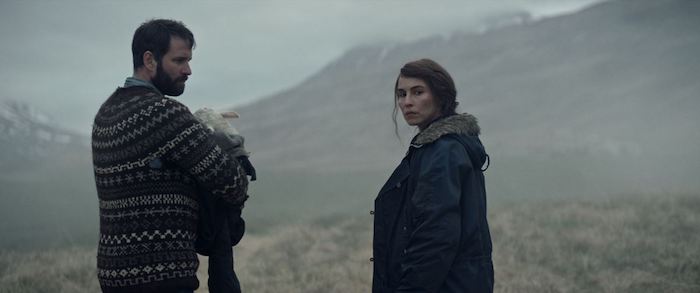
Though it does contain a cosmic joke that’s shockingly funny if not particularly original, Icelandic director Valdimar Johannsson’s Lamb seems stuck for most of its running time in narrative limbo. Atmospherically creepy and purposely bizarre, its milieu is nevertheless so steeped in everyday tedium that the movie can’t muster the power necessary for either horror or black comedy. Part of the problem may be that Johannsson sets the story up with such visual assurance. Lamb is set on an isolated farm in a large meadow surrounded by majestic snow-capped mountains that are often shrouded in mist, an environment that accentuates the sullen demeanor of the central couple, Maria (Noomi Rapace) and Ingvar (Hilmir Snaer Gudnason), who go about their chores with a quiet determination that seems to hide a deeper misery.
Most of their attention is focused on sheep, which Johannsson depicts in such a way as to bring out any nuance of expression on the animals’ part. The dark portent that the script requires to sell its central joke is generated by the normal human-animal relationship you see on a working farm. Maria and Ingvar show no particular affection for their four-legged charges—until lambing season when one ewe discharges a female that leaves the couple blinking in disbelief, the first time in the film they’ve manifested any raw emotion.
Maria and Ingvar endeavor to raise this lamb as their own daughter, and it’s suggested several times that the animal is a surrogate for a child that was lost. Cut off from anything resembling human society, they can do this without raising eyebrows, since there are no eyebrows to raise; that is, until Ingvar’s brother, Petur (Bjorn Hlynur Haraldsson), shows up unexpectedly. At first, Petur, a former addict and general misbegotten soul (nobody calls him a “black sheep,” but that seems to be the message), finds the lamb’s position in the household disturbing, but in a sudden and very disconcerting change of heart, he decides she’s adorable and becomes a kind of doting uncle, which frees his brother and sister-in-law to spend more time for themselves. Then Petur spoils the vibe by making moves on Maria, with whom he obviously had a relationship in the past.
Lamb never quite gets back on track after this detour, which seems both unnecessary and dramatically destablizing. The portentous elements continue to accummulate, but they become less portentous as the viewer navigates this inter-familial subplot. It’s definitely a lost opportunity. The couple’s affection for their lamb-child contrasts starkly with their disregard for the welfare of the other sheep, in particular Maria’s resentment of the ewe that gave birth to Ada, which is what they name the lamb. It’s a theme I expected Johannsson to explore more fully, but he’s so distracted with other matters that by the time he gets back to it you’ve lost the plot.
In Icelandic. Now playing in Tokyo at Marunouchi Piccadilly (050-6875-0075), Shinjuku Piccadilly (050-6861-3011), Shibuya Parco White Cine Quinto (03-6712-7225).









 philipbrasor.com