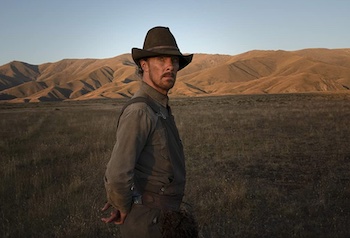
Though Clint Eastwood has never officially stated when he plans to retire as a director, it seems to be that he once said something about leaving acting behind, but I may have imagined that. In any event, having entered his 90s, Eastwood still insists on starring in his movies, and it’s getting more difficult to justify these appearances, even when he’s playing a character that is sufficiently old. His latest takes place in 1979, so the viewer is spared the trouble of having to make concessions with the kind of post-millennial sensibilities that Eastwood isn’t very keen on representing. His character, Mike Milo, is a cowboy, more specifically a one-time rodeo rider who works in some capacity for a horse breeder named Howard (Dwight Yoakam), who fires Mike in the first scene because he’s a “has-been,” a line that I first took as a joke since Eastwood looks so frail to begin with. Apparently, Milo hurt himself badly some years ago and has since become dependent on pain pills, but it’s not clear if that’s the reason Howard is firing him. It’s a pretty incoherent scene, and becomes even more puzzling when the movie quickly jumps a year into the future and Howard is attempting to rehire Milo for a one-off job: Go down to Mexico and bring back his teenage son, who lives with his floozy of a mother in a perpetual state of delinquency.
Though Nick Schenk’s script is based on a novel by Richard Nash (who’s credited as co-screenwriter), it doesn’t really give us much to work with, and the questions raised by Milo’s mission—Why Milo? Why does Howard suddenly want the boy to live with him?—are simply tossed to the side because the movie isn’t really interested in the job Milo is carrying out. It’s all about the journey. Milo eventually finds the kid, named Rafo (Eduardo Minett), and discovers the mother, Leta (Fernanda Urrejola), living is luxury due to some connections she has with underworld figures. At first, she seems happy to get rid of Rafo, but she changes her mind, again for reasons that make little sense, and after Milo and the boy leave, along with his fighting rooster, which give the film its title, she sicks a bunch of bruisers on the pair to bring them back, but they manage to elude their pursuers by hiding out in a nice old Mexican town where Milo finds work breaking horses and Rafo learns how to be responsible. That’s pretty much as far as the “story” goes. The film, however, seems to be more or less a kind of refutation of Eastwood’s reputational style. Milo is, of course, anything but macho at his age, and while his romance of a middle aged Mexican restaurant owner needs to be taken with a sack of salt, it’s nice to see one of Eastwood’s stock cowboy personalities, with all his rough edges in tact, relax and look at the sunny side of what’s left of his life. But in the end, Cry Macho feels muddled, its clear sentimental intentions clouded by a lazy attitude toward narrative. Though I don’t begrudge Eastwood his desire to keep making movies, this one really does look like it was made by a nonagenerian with cognitive problems.
Opens Jan 14 in Tokyo at Toho Cinemas Nihonbashi (050-6868-5060), Toho Cinemas Hibiya (050-6868-5068), Marunouchi Piccadilly (050-6861-3011), Shinjuku Wald 9 (03-5369-4955), Shinjuku Piccadilly (050-6861-3011), Toho Cinemas Shinjuku (050-6868-5063), Human Trust Cinema Shibuya (03-5468-5551), Toho Cinemas Roppongi Hills (050-6868-5024).
On December 26, Japan’s public broadcaster NHK aired a special program on its BS1 satellite channel about the making of the official documentary for the 2020 Tokyo Olympics and Paralympics, which is being directed by Nara-based filmmaker Naomi Kawase. One scene depicts a man whom NHK described in the explanatory subtitles as someone who had participated in an anti-Olympics demonstration and received money for his participation. Then, on January 9, NHK Osaka, which had produced the special, issued an apology, saying that some of the information conveyed in the explanatory titles had not been properly vetted. That night, there was a two-minute message aired on BS1 explaining the problem and apologizing to viewers and those associated with the Olympic documentary.
According to Asahi Shimbun, the scene in question was part of a program segment in which NHK was following another director, whom Kawase had asked to cooperate on the documentary, as he interviewed anti-Olympic protesters. The subject of the interview was not identified, but the chyron (explanatory titles) described him as a demonstrator who had been paid for protesting against the Olympics. According to NHK the chyron had been written by the NHK director based on “supplemental materials,” but apparently he hadn’t double checked whether the man actually participated in any anti-Olympic demonstrations. After the special was aired viewers wrote to NHK to complain about the segment. Then, in early January, NHK somehow located the man and learned that even when he was originally interviewed for the documentary—in June, before the Games began—he actually said that in the past he had appeared at demonstrations, though none had been protests against the Olympics, and he was sometimes paid for his participation. The only thing he said about the Olympics during the interview was that he was “thinking” of participating in an anti-Olympics demonstration “in the future.”
NHK said it had no intention of “fabricating” information. The problem was simply the result of a misunderstanding and lack of rigorous checking on the part of NHK staff. However, Asahi Shimbun said that before the special was aired, it had been shown to people “related” to the production, and none requested revisions. Asahi does not say whether any of these related persons were working on the Olympic documentary itself, but in its apology NHK insisted that the special was completely the responsibility of NHK, and Kawase had nothing to do with it. It should be noted, however, that while the interview with the anonymous “demonstrator” was aired by NHK, the interview itself was carried out for the purposes of Kawase’s documentary.
Nevertheless, Kawase, who has cultivated an enviable reputation with documentaries and feature art films that have won prizes at prestigious international film festivals, has received a certain measure of criticism on social media from people who think her documentary is essentially pro-Olympics propaganda. According to a January 6 posting on the media watchdog website Litera, these critics mainly cite a statement Kawase made during the NHK program where she insisted, “It was we [meaning Japan] who invited the Olympics [to Tokyo] 7 years ago,” adding that the nation as a whole was pleased to win the bid and happy to host the Games. Actually, a fair number of people had advocated that it should have been cancelled outright after it was postponed in 2020, so Kawase’s recent social media critics begged to differ, saying that there had never been a strong national—or for that matter regional—consensus regarding the Tokyo Olympics.
The Olympics ended without any serious problems regarding the COVID epidemic, which was one of the main reasons that protesters demanded the Games be cancelled. So in that regard, the pro-Olympic camp was vindicated. However, there were other reasons for people to object to the Games—the snowballing costs being shouldered by the Japanese public, the displacement of long-term residents by the construction of venues, the diversion of funds from 2011 disaster victims in the Tohoku region—and the feeling among Kawase’s critics was that if she doesn’t address these objections in her documentary, then the film will end up being nothing more than a propaganda device. More to the point, it was wrong for Kawase to generalize that everyone in Japan was happy about the Olympics. (It remains to be seen how Kawase addresses the anti-Olympic movement in the finished documentary, or is she does at all.)
Litera is also suspicious of Kawase’s intentions, since her media appearances in relation to the documentary tend to contain glowing descriptions of the Olympic spirit and the International Olympic Committee charter. When confronted with the COVID issue, she said that any such anxiety in relation to the Olympics had no meaning, and while there was no appreciable increase in infections among people involved with the Games, Litera thought that her assurances regarding people’s fears came off as sounding tone deaf at the very least. After all, if the public really had been unanimously excited about hosting the Olympics, the fact that they were eventually barred from attending the Games due to COVID countermeasures should have been a crushing disappointment.
ADDENDUM, Jan. 11: Asahi Shimbun today published a statement by Kawase about the NHK faux pas, saying that she was not shown the footage of that interview in question by the director in charge of the interviews, and stressed that she was merely one of the subjects of the NHK special. Also, journalist Ryu Honma, speaking on the web talk show “Hitotsuki Mansatsu,” commented that the people NHK should apologize to are those who organized the anti-Olympics protests, not Kawase and the staff of her documentary project.
ADDENDUM, Jan. 14: On this week’s edition of the web program “No Hate TV,” activist/editor Yasumichi Noma talked about the video segment that NHK apologized for, and provided a bit more background. The director Kawase recruited to carry out the interviews is Kakuei Shimada, who attended film school with Kawase. According to Asahi Shimbun, Shimada was tasked with interviewing “anti-Olympics demonstrators,” though other media made it sound as if Shimada was just supposed to do man-on-the-street interviews in general. The Litera article said that in the controversial scene, NHK set up its camera at a distance and recorded Shimada talking to the man in question, so it’s not as if the interview was destined to be in the final documentary. In any case, as both Litera and Noma point out, the audio quality is poor. But Noma was also struck by the setting. If Shimada was trying to get comments from anti-Olympics protesters, then it made sense that he would go to a demonstration to seek them out, but the scene of the interview is not the new National Stadium, where most of the demonstrations took place in the month of June 2021. He says it looks like Sanya, the district in the shitamachi area of Tokyo where day workers traditionally gather for jobs. What’s notable about Sanya is that it is the preferred place to go to recruit anyone for purposes of mobilization, and that right wing groups have been known to go there and pay people to show up at their demonstrations in order to make it look as if whatever cause they are protesting/advocating has a lot of support. So Noma thinks that Shimada purposely went to Sanya to try and find people who had been paid to protest the Olympics, but this guy is the only one he found, and, from what was eventually discovered in a follow-up interview by NHK, he never attended an anti-Olympic rally. This, of course, brings up the question of NHK’s rationale for following Shimada to Sanya: Didn’t they think it strange he was going to Sanya, rather than to the National Stadium, to do interviews? Also, Noma brings up Shimada’s background. As a director, he is probably most famous for his music videos of Japanese punk groups with a nationalist bent, a related theme that is also touched upon in the Litera article, which mentions Kawase’s close association with Akie Abe, former prime minister Shinzo Abe’s wife and a fellow believer in “Japanese spirituality.”
Japan tends to go through intense phases with regard to popular breeds of pet dogs. About 50-60 years ago it was the spitz, and 20-30 years ago you couldn’t pass a dog run without stumbling over a dozen or so chihuahua. Right now the dominant breed is overwhelmingly the toy poodle.
The ubiquity of certain breeds points to the widespread and often lucrative enterprise of pet breeding, which was unregulated in Japan only until recently, and even the new laws may not be entirely effective in protecting animals. An article that appeared last month in the economic magazine Toyo Keizai by pet journalist Mika Sakane took one example of a breeder in Matsumoto, Nagano Prefecture, as representative of the business in general. The breeder, a man named Koji Momose, was arrested, along with some employees, in mid-December on suspicion of violating the animal welfare law. One of his facilities in the Nakayama district of the city contained 360 dogs confined to enclosures of differing sizes stacked four to six cages high. These cages, some of which held more than one dog, were invariably filthy, and almost all the animals were ill or injured in some way. A few were blind and many had trouble breathing. It turns out that Momose had other facilities and police estimated the total number of dogs in his care was around 940. Due to “lack of workers,” according to a statement made by the breeder, these other facilities were in no better shape than the one in Nakayama, and Sakane reports that Momose had talked to other media several days before his arrest admitting that he himself regularly performed C-sections on dogs to deliver puppies, even though he is not a licensed veterinarian. Moreover, he did not anesthetize the dogs when he operated, though he says he did administer “sedatives.” When asked where he learned how to perform C-sections, he said he had watched real veterinarians do it. A representative of the local sanitation department, which is in charge of animal welfare, told the press that “sedatives” are not the same as anesthesia in veterinary surgery.
The mind-boggling box office success of the latest Spider-Man installment during another surge in the pandemic only goes to prove that there’s no such thing as too much Spider-Man, and while some will point to the MCU imprimatur as being its own reason to print money, essentially such cynicism shortchanges the peculiar appeal of the web-spinning superhero, an appeal that Sony, as the only studio outside the Disney universe to still have control over a Marvel character, is too lucky to possess and not ambitious enough to appreciate properly. During my own brief elementary school comic book phase Spider-Man was the most interesting superhero simply because he was a kid who couldn’t quite square his powers with his immaturity, and he genuinely suffered for it. He was the most human superhero because the stories were as much about his doubts and fears as they were about fighting bad guys. There was something of that poignancy in the Tobey Maguire-Sam Raimi trilogy that made so much money, and slightly less in the angtsy, attenuated Andrew Garfield “Amazing” movies. Since Tom Holland’s gig is twofold—he not only plays Spider-Man in his own series, but also plays him as perhaps the future central character in the continuing Avengers franchise—his personality as Peter Parker is more utilitarian, and while the filmmakers have tried to get back to the adolescent self-awareness that is the core of the Spidey story, there’s too much going on in the surrounding films to make it work.
No Way Home is obviously meant to resolve all those problems as a means of getting the character back to basics, and it does an impressive job, logistically at least, in bringing all the conflicting dramatic impulses to bear on that mission. At the end of the last installment, Mysterioso (Jake Gyllenhaal) exposed Spider-Man’s identity as Peter Parker to the world, which threw not only Peter’s life into total chaos, but those of his girlfriend, MJ (Zendaya), and best friend, Ned (Jacob Batalon)—specifically, their chances of getting into MIT. He can no longer effectively fight bad guys, but even worse he can’t even safely attend to his scholarly ambitions. So he does something that only makes sense in the context of fantasy blockbusters like these: he uses magic by calling on his new Avenger compatriot Dr. Strange (Benedict Cumberbatch) to use his special powers to make the world forget Mysterioso ever happened. As with the whole X-Men series, this sort of supreme deus ex machina plot device is so open-ended as to be practically meaningless. It’s why an in-context motivational purist like Quentin Tarantino would never be caught within ten feet of an MCU production.
Dr. Strange’s spell causes more than just mass amnesia. It opens up portals to different dimensions, all of which contain those other Spider-Men that were so effectively presented in that animated peculiarity Into the Spider-Verse. By now if you have a connection to the internet, you know what happens, but I promised Sony I wouldn’t tell, so suffice to say that all the previous incarnations of Spider-Man, as well as their most prominent adversaries, get to share the same space for the kind of blowout that guarantees anyone with a Marvel jones will line up twice to see it. As I said, it’s well done in a totally cynical, future-profit-speculating way, and settles Holland’s status as a Peter Parker manque we can believe in, but just as I was exhausted after sitting through this two-and-a-half-hour fan service epic, I can seriously say that there is such a thing as too much Spider-Man.
Now playing in Tokyo at Toho Cinemas Nihonbashi (050-6868-5060), Toho Cinemas Hibiya (050-6868-5068), Marunouchi Piccadilly (050-6875-0075), Shinjuku Wald 9 (03-5369-4955), Shinjuku Piccadilly (050-6861-3011), Toho Cinemas Shinjuku (050-6868-5063), Toho Cinemas Shibuya (050-6868-5002), Toho Cinemas Roppongi Hills (050-6868-5024).
In late 2020, the Japanese government passed a law that recognizes married couples who have children via donated sperm and eggs as being the legal parents of those children. The law would go into effect in one year’s time, meaning, presumably, it became effective last month. Prior to this revision to the civil code, parents who had children using such methods had to go through a convoluted bureaucratic process to have the resulting children registered as being theirs, but even in such cases there were always documentary clues that indicated the child’s biological provenance, a matter that concerned many prospective parents. Since the government is determined to increase the birth rate, it was important to change the law so that parents who wanted to access such treatments due to issues that prevented them from having children otherwise would be encouraged to procreate. In essence, the revision allows the man married to the woman who gives birth to declare himself the legal father of the child even if he did not provide the sperm; and allows the woman who gave birth to the child to be the legal mother even if the egg was donated by a third party. What the law does not do is allow the resulting child to seek disclosure of the identities of any of the donors, a point of contention to some interested groups.
The law indirectly points up the relative lack of regulation covering donated sperms and eggs in Japan, as well as the general practice of in vitro fertilization and artificial insemination. While the revision helps the government maintain its control over who can declare themselves the parent of a Japanese child, which is one of the purposes of the family register (koseki), it has no effect on the process of how these parents acquire the eggs or sperm needed to carry out the desired function of producing a child. Though the government has said it intends to discuss the purchase and sale of sperm and eggs, in which the Japan Society of Obstetrics and Gynecology does not allow its members to partake, it has yet to proceed any further than a declaration of purpose. In addition, many hospitals have suspended artificial insemination treatments, which means more and more couples who wish to carry out such treatments are on their own.
For the second year in a row I have decided to forego a ten best list, since I didn’t see nearly enough of the movies released in Japan in 2021 to make any sort of authoritative judgment on which were the best. Though most of the local distributors have gotten back up to speed with press screenings despite the stubornness of the pandemic, I have apparently been dropped from several lists and though I tried to see as many films as I could after they opened in theaters, I don’t live in Tokyo and the number and type of movies available to me where I live is limited. I have become more used to watching movies online, including quite a few screeners from distributors and publicists who have caught on to the idea that they can get more media attention that way, and while I don’t think my opinions about the movies I see online are any different for having watched them online, the net impact of watching them on a smaller screen and in an environment where distractions are inevitable is certainly different. I might, for example, have concluded that Jane Campion’s The Power of the Dog was the best movie of the year had I seen it on a big screen, but like most people I watched it on Netflix while my partner and the cats continually passed through my fields of vision and (more significantly) hearing.
Minamata
I also missed both of Ryusuke Hamaguchi’s movies, which won lots of awards overseas. One of them, Drive My Car, may very well pick up an Oscar. As I’ve said here before, except for those by a handful of directors, I haven’t had much interest in Japanese movies made after 1990, and I wasn’t greatly impressed by the only Hamaguchi movie I’ve seen so far, Asako I & II, so I didn’t seek the two new ones out. I’m sorry I didn’t, though I’m sure they’ll be available for streaming relatively soon. That said, probably the best movie I saw that was released this year was Japanese, but it was a documentary: Kazuo Hara’s Minamata Mandala, another deep dive into a controversial public health issue that the authorities have tried their best to ignore. At more than six hours, it was even longer than Hara’s last movie, which was about citizens’ lawsuits against the government for asbestos-related illnesses, and I think it’s better since Hara was able to pull together all the disparate arguments that surround Minamata disease into a cohesive statement about the real social effects of industrial pollution and the attendant negligence. Coincidentally or not, it was released in Japan only two months after Minamata, the American feature film with Johnny Depp playing W. Eugene Smith, the photographer who brought the Japanese environmental crisis to the world in the 1970s, and while it was far from a perfect movie, it did a fair job of highlighting the conflict between the affected public and a large corporate entity that relies on the government to protect its interests, even when those interests lead to illness and death. In that regard I would recommend anyone interested in public health issues to see both, though I know that’s asking a lot considering the length and complexity of the former film and the fact that you will have to put up with Johnny Depp playing a drunk in the latter.
September 1, 2023, will mark the 100th year anniversary of the Great Kanto Earthquake, which struck Tokyo and surrounding areas, killing more than 140,000 people. In the days that followed, an additional number of Korean residents of the affected areas were murdered by vigilante mobs, soldiers, and police after rumors spread that Koreans had poisoned wells, set fires, and looted businesses and homes in the confusion caused by the quake. At the time, of course, Korea was a colony of Japan and the Japanese authorities were fearful of the Korean independence movement, and there is a great deal of testimony on record saying that the police and other public entities spread these rumors and furtively encouraged the killings.
On January 1, South Korea’s Yonhap news agency reported that citizens groups from South Korea and Japan have jointly created a petition to demand that the post-quake massacre, which they call an act of “genocide,” be investigated thoroughly by the government of South Korea. According to one of the citizens groups, there is clear evidence that Japan’s interior ministry at the time conveyed the anti-Korean rumors to local governments throughout Japan. The Provisional Government of the Republic of Korea, which was in essence the government of the Korean peninsula in exile at the time and thus supportive of the resistance movement, reported that 6,621 Korean residents of Japan had been killed by military police and vigilante groups, though some reports have estimated the number killed was as high as 10,000. The Japanese government has always maintained that the number killed was only 231.
One of the Japanese citizens groups, Hosenka, has been trying to excavate the remains of Koreans killed during the massacre since 1982. The group also began holding annual memorial services for the victims. Now, however, a representative says that many Japanese public officials, including prominent politicians, have increasingly made “revisionist statements” that suggest there was never a concerted effort to kill Koreans after the quake. The purpose of the petition is to get to the bottom of the matter in an official manner once and for all before the 100th anniversary takes place. The groups are essentially looking for the Japanese government to make a formal apology, which they think would go far to heal the frayed relations between Japan and South Korea brought about by disputes over shared history. Such a reckoning, they say, is vital for the good of eastern Asia as well as a means of avoiding hate crimes in the future, which are on the rise.
The citizens groups are now setting up videos on YouTube for publicity purposes. So far, no mainstream Japanese media outlets have picked up the story.
Over the past month I’ve read many reviews saying that 2021 was an especially great year for music. Given how much longer it took me to compile the following list, I would tend to agree, but we each approach our entertainment needs in different ways, and the ongoing pandemic, which I daresay didn’t expect to still be happening two years on, has definitely affected those needs. I only attended one offline concert this year, and it happened to be a festival, but a festival dominated by local acts and DJs from overseas, and as a result it felt constrained, as if the effort to make sure it went ahead at any cost destroyed the sort of freewheeling vibe that festivals are famous for. I didn’t particularly enjoy it.
But, then again, I’m not the ideal audience for that kind of music, and so I found my needs this year to be more primal, less mediated by any feeling that I should search out skills and an original imagination. On my initial short list there were four punk albums, only one of which was discarded when I finally arrived at my final 18. It wasn’t so much a substitute for the headbanging pleasures I chiefly derived from live performances, but more of an acknowledgement that forced isolation had made my head an uncomfortable place in which to dwell. The visceral charge that good, dedicated punk rock can deliver made me forget myself, pulling me through some bad stretches of doubt and despair over my work, which has mostly vanished—or, at least, the paid kind has. Of course, eventually you have to return to this life, but I wasn’t turning to music to escape life. If anything, the purpose was to reaffirm that I still had my health and am relatively secure financially, which may sound like odd conclusions to arrive at from listening to people play songs. The point was to provide a jolt of meaning to an existence that had become even more sedentary than usual.
Looking over my list now, I realize that the meaning I sought was more purely musical than in past years. My top pick is in a language I don’t understand, and so the drama presented was purely felt on my part. I notice that the list is particularly light on hip-hop, which I’ve always approached intellectually, despite some DJs who really know how to whip up a storm. Yes, it was a good year for music, because I opened up more to pleasure for the sake of pleasure.
On December 22, an item appeared on the Osaka Prefectural government’s official home page. It was an announcement for a contract signing ceremony that would take place after lunch on December 27 in the third floor conference room of the prefectural building. The ceremony would start with an introduction of the participants and then move on to a brief explanation of the terms of the agreement and some words from the two men who would sign/conclude the document. Afterwards, there would be a short Q&A session with the available press and a photo session. The whole thing would be over in 20 minutes.
Such announcements are common and usually attract little notice, but this one was different. One of the men who is signing what the Osaka government is calling a “comprehensive cooperation agreement” is Osaka governor Hirofumi Yoshimura, and the other is Gaku Shibata, the president of the Osaka head office of the Yomiuri Shimbun, Japan’s largest daily newspaper. The general purpose of the agreement, according to the home page, is to “activate regional services for residents of Osaka prefecture.” In order to accomplish this, the two parties will “work together” on a series of endeavors, including education and training of prefectural personnel; dissemination of information; promotion of safety and a sense of well-being; services regarding children and general welfare; regional stimulus measures; industrial development and employment; matters related to health and the environment; and others. A more detailed explanation of the agreement would be provided in a press release distributed after the ceremony.
No major media outlets remarked on the announcement on the day that it appeared. However, various individual media players reacted with considerable alarm afterwards. On the December 24 edition of the web program Videonews.com, freelance journalist Tetsuo Jimbo called the news “shocking.” What does it mean, he asked, that Osaka Prefecture and Yomiuri Shimbun would be “working together”? “Does this mean Yomiuri is going to announce that it is no longer a newsgathering company?” His interlocutor, sociologist Shinji Miyadai, said, “That’s what it sounds like.”
The Osaka government is calling the agreement a “public-private collaboration,” and while Miyadai admitted that often universities and government entities do form working arrangements, usually to study issues, he had never heard of a government entity entering into a partnership with a news media company. Jimbo replied that under normal circumstances the Osaka Prefectural government “should be Yomiuri’s target, not their partner,” and went on to call the pact a “suicidal act” for Yomiuri. What’s even more amazing, he said, was that they were publicizing the agreement, as if it were something to be proud of. Miyadai concurred, suggesting that people who knew anything about the media probably already understood that various news organizations already had informal agreements with local governments but preferred to keep such things under wraps. The fact that no other major news outlet had reacted at all to the announcement so far only went to show that they didn’t find the arrangement questionable. But publicizing it with a ceremony was beyond the pale. Jimbo added that since the ceremony was being held in the prefectural office, only the Osaka Prefecture press club would be invited to cover it, and given that government-affiliated press clubs are stenographers in the first place, none of the reporters will actively question the agreement. Still, the two men wondered if, over the Christmas weekend, any major media outlets would raise a fuss.
Here’s this week’s Media Mix, which is the usual review of themes and persons that I felt stood out in the media during the past year. It’s also the last Media Mix. The Japan Times’ management has decided they no longer want to run the column. As for me, I could go on forever, and I probably will in one form or another, but we’ll see.
Media Mix started in January 1995 with an analysis of Anpanman. It was published biweekly until the spring of 2001, when it became a weekly column. With the exception of a few New Year’s, it has appeared every single week since then without fail. So that adds up to about 1,200 columns comprising more than a million words. My original pitch to the Japan Times was a TV column. I had already been writing reviews of Japanese TV shows for another periodical and when they dropped the column I wondered if JT would be interested in picking it up. Mark Thompson, an editor at JT, suggested I expand the idea to cover Japanese media in general. However, for those first six years when the column came out every two weeks, I still mainly stuck to TV, if not necessarily TV shows. After the turn of the century, however, I relied less on TV as a resource for the column, and not just because I was trying to get a broader sense of how the media addressed particular subjects. Japanese broadcast television hasn’t really evolved much over the past thirty years and I didn’t think there was anything more I could write about it that would be new. More to the point, I grew tired of Japanese TV, and as the internet became the central medium for the distribution of information I concentrated more on news aspects and wrote less about entertainment and celebrities. Another reason for this shift in focus was my increased dependency on input from my partner, Masako Tsubuku, who, for all intents and purposes, is the co-author of Media Mix, especially after it went weekly. She’s responsible for most of the research, but more importantly she helped me frame whatever analysis I applied to a topic from a social standpoint. It goes without saying that the media shapes our perception of the world, and Masako helped me understand, from week to week, how that worked in reality as it affected people.
In letting go of the JT version of Media Mix, I want to thank my editors over the years—Irma Nunez, Rowan Hooper, Simon Bartz, Daniel Robson, Mio Yamada, Elliott Samuels, Shaun McKenna, Ben Stubbings—as well as the JT fact checkers, Haruka Murayama and Rina Yamazaki. If I’ve forgotten anybody, I apologize. Twenty-seven years is a long time. I’d also like to thank Mark Schreiber, whose help with collecting materials was invaluable; and, of course, Mark Thompson, who, as I already mentioned, came up with the idea of Media Mix and always had my back. We will continue writing about the Japanese media on this blog, at least for the time being, so check in occasionally if you’re interested. Thanks for reading.








 philipbrasor.com