
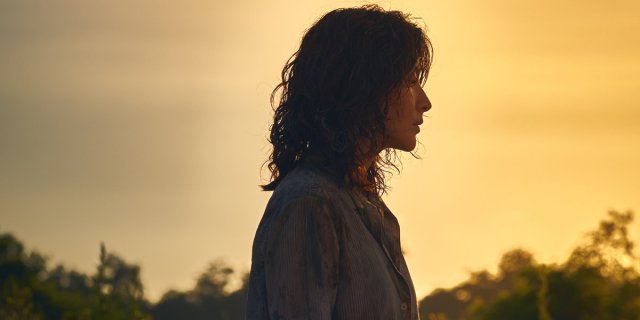
 Bring Me Home is, I think, the third missing child movie I’ve seen this year, which, given the attenuated nature of my moviegoing pastime in the COVID era (I tend to watch TV series at home), practically makes it a subgenre. Compared to something more cerebral like the Spanish movie, Madre (opening here next month), this Korean thriller is pretty straightforward, and because it’s Korea it’s also more viscerally stimulating. First of all, there’s the social elements to contend with, which are always more potent in Korean movies, whether mainstream or indie. Then there’s the violence and emotional extremism, which is also a given in any Korean movie that even touches on criminal behavior. In other words, it’s quite a ride to begin with, and that isn’t even taking into account its questionably exploitative handling of children.
Jeong-yeon (Lee Young-ae) and her husband have been searching desperately for their son who went missing six years earlier. Though both have to a certain extent fallen back into routines of domesticity and work in order to avoid thinking too much of their lost boy, in their calmer moments they separately check the internet and bulletin boards for anything that might indicate he’s still alive. Inevitably, the accumulation of inquiries, regardless of how fruitless they seem, results in the husband receiving an anonymous message from someone who may have seen their son. While racing to confirm the intelligence in the message, he crashes his car and dies.
Insult is added to fatal injury when Jeong-yeon determines that the original messages were a hoax. But the accident makes the news, and the story of the missing boy is resuscitated by the media, leading to two developments that the first-time writer/director, Kim Seung-woo, handles with rare finesse, considering how difficult it could be to pull off without revealing too much. He introduces the employees of a police station in a remote fishing village who notice a resemblance between the missing boy pictured on the news and a local kid, but say nothing to anybody about it. At the same time, Jeong-yeon is hit up by a cruel opportunist who tries to exploit her pain for money. Not only does the resourceful but at this point extremely desperate woman foil the opportunist’s scheme, but learns that his information is reliable, since he is in the business of tracking down stolen children and exacting recompense for assistance in their return.
Suffice to say, that Jeong-yeon would rather tackle the problem alone, and she travels by herself to the fishing village. By this point, the viewer has come to understand that stealing children is not an isolated problem, that many traditional vocations, such as fishing and agricultural, are suffering a lack of manpower owing to South Korea’s falling birthrate, the lowest in the world right now. With this premise in mind, Jeong-yeon’s rapid descent into violent vengefulness becomes both understandable but no less repugnant. In essence, all the inhabitants of this particular village become complicit in the crimes described, and thus are disqualified for any sympathy we may have built up for their sorry lot in life.
This dramatic element is exaggerated by scenes in which children are made to do unspeakable things, thus letting Jeong-yeon off the hook for the unspeakable things she does as well. As always, the technical aspects are flawless and, since this is a Warner Bros. co-production, often breathtaking. And yet, the movie holds you at arm’s length. I think I would have preferred watching a documentary about the issue of child-stealing, if, in fact, it is a social problem as widespread as it’s depicted here.
In Korean. Now playing in Tokyo at Shinjuku Musashinokan (03-3354-5670).
Bring Me Home home page in Japanese
photo (c) 2019 Warner Bros. Ent.
 Right away, I should mention that this documentary about the pioneering Black-owned independent record label was authorized and to a certain extent supervised by Motown’s founder Berry Gordy. It’s essentially a PR gambit and looks like it. The narrative emphasis is on the label’s enormous success and historical importance, neither of which can be denied. Whatever frictions it covers are good-naturedly glossed over with a smile and/or a shrug, and some of the biggest surviving beneficiaries of Motown’s success, most conspicuously Diana Ross, don’t participate.
 Last week, the organizers of the 25th annual Busan International Film Festival announced somewhat abruptly that the festival, originally scheduled to take place Oct. 7-16, would be postponed for two weeks and would instead begin on Oct. 21. It has already been decided and announced that, due to the COVID crisis, the size of Asia’s biggest film event would be scaled back considerably. For one thing, there would be no foreign guests in attendance due to government rules stipulating a 14-day quarantine for anyone entering South Korea. That includes, of course, the usual invited press, of which I have been a member since 2001. It also means that most if not all the non-Korean filmmakers whose works will be shown at the festival will not be able to attend in person. However, the organizers were, and still are, intent on having a live event, with real people attending screenings in real theaters, because that is what a film festival is about and BIFF considers itself a real film festival, i.e., one for the local fans. The two-week postponement was implemented because of uncertainty over the Chuseok holiday period in the first week of October, when many Koreans visit family and friends. The fear is that such activities could result in another spike in infections. If that happens, the two-week lag time might be enough to flatten the curve.

 Given the enormous output of the South Korean film industry, even during its occasionally fallow times, it’s not surprising that certain genres and subjects get covered to death. One is the storied Joseon Dynasty, when a good deal of what we know now as Korean culture developed. It was also a fraught time both politically and socially, as the class system that ruled the kingdom resulted in mass starvation and the tribute the court paid to their Ming overlords in China exacted a heavy price, especially in retrospect. In that regard, Hur Jin-ho’s Forbidden Dream is enormously ambitious. It attempts to be the last word not only on the Joseon Dynasty, but on movies about the Joseon Dynasty, even if it focuses on the relationship between two men.
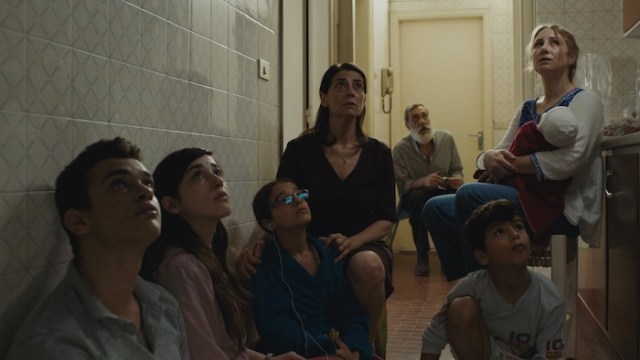 Narrative films that take as their subject current affairs face a dilemma in terms of execution. How much of the story will be irrelevant or even incorrect in years to come? What sort of viewpoint should the direction take, or should a viewpoint be taken at all? In Syria, also called Insyriated (a made up word?) in some markets, is set during the early days of the Syrian civil war, which was almost a decade ago, so in a sense the Belgian director, Philippe Van Leeuw, has some leeway with historical distance in making his decision as to how to approach the conflict, and he has chosen to generalize the circumstances as to lose any specific idea of how the war came about and how it is being fought. Essentially, this is a movie about “all war,” and while that approach doesn’t detract from the film’s dramatic power it does make it that much less convincing as a historical document.
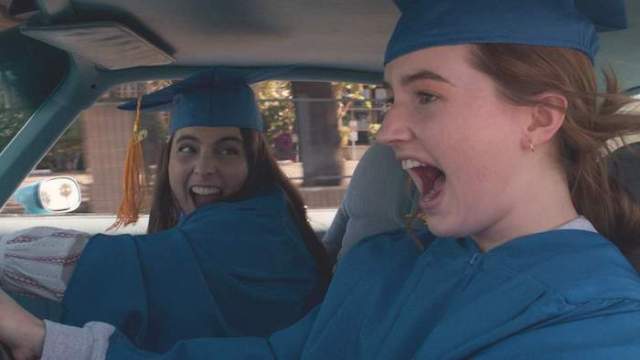 This American teen comedy, focusing almost exclusively on the girls’ experience, is blessed with one of the best titles of recent memory. “Booksmart” implies a brain full of stuff derived from reading materials and outside sources rather than from experience. It’s the opposite of “street smart.” Our two protagonists, Molly (Beanie Feldstein) and Amy (Kaitlyn Dever), are more than just the class nerds, students who get straight As and participate in the astronomy club and school band. They’re also the class snobs in that they put on a front of not caring about what the rest of their classmates do, i.e., popularity through being hip and a willingness to party under any circumstances. Molly and Amy aren’t hip except to their own vision of adult sophistication and responsibility (they proudly flaunt their Warren for President bumber stickers), and in that regard they see themselves as better than their peers because they’ve been accepted to top-flight universities. This self-affirmation, however, is deflated when, during the final weeks of their senior year, they discover that most of those peers are also going to top-flight universities — and without having busted their assses academically the way Molly and Amy did.
 Here’s
  philipbrasor.com