
 Director Taika Waititi sincerely tries to hedge his bets with his Oscar-nominated Nazi comedy by labeling it right off the bat as an “anti-hate satire,” which, of course, gives the impression that the New Zealand director, not-so-fresh off the success of his MCU Thor blockbuster, has only the best intentions when he depicts Hitler as a goof-ball and anti-Semitic propaganda as akin to MAGA-inspired cultural laziness or immaturity or both. And for sure, the movie’s relentlessly inventive stream of jokes that tap directly into our collective sense of how ridiculous that whole regime was, with its uniform fetishes and obsession with whiteness for the sake of whiteness, works a certain magic until you catch yourself wondering what you should make of a group of people hanged in a town square after summary trials for anti-Nazi activities. You’re obviously supposed to be appalled, but then you’re also supposed to fall right back into laughing at the silliness of it all.
There’s nothing inherently wrong with implementing such stark tonal shifts in order to provoke a reaction, but there isn’t enough originality in Waititi’s vision to make that reaction anything more than a reflex. Based on a novel published in 2008, Jojo Rabbit tells the story of 10-year-old Jojo Betzler (Roman Griffin Davis), a dedicated Hitler Youth member who dutifully hates Jews and believes totally in all the ideas of the Third Reich. In his quaint little berg at the tail end of the war, however, he’s something of an odd duck, and earns his nickname at a camp after failing to kill a bunny when ordered to do so. The viewer is thus signaled to understand that Jojo isn’t quite the monster his belief system would make him out to be. In addition, he has devised for himself an imaginary friend who looks a lot like Der Fuhrer himself, and as played by the director he’s a cartoon caricature of Hitler, or, more exactly, the kind of nebbish that Mel Brooks would have concocted had he extrapolated the premise of The Producers to a full-fledged World War II comedy. This hallucinated Hitler is more evil Jiminy Cricket than playmate, and as the movie progresses and Jojo’s conscience is stimulated by outside events that challenge his received prejudices, the real conflict emerges, which is gratifying as far as it goes, but, again, we’re talking about a kid and his unformed intellect, which has been a product of a fairly sheltered life. This isn’t The Tin Drum.
In a sense, it’s a missed opportunity, because Jojo’s seemingly widowed mother, Rosie (Scarlett Johansson), is, we soon learn though Jojo doesn’t, a member of the underground resistance who is hiding a teenage Jewish girl, Elsa (Thomasin McKenzie), in a secret room in their house. Jojo’s entlightenment starts kicking in when he stumbles upon this girl and makes friends with her, thus confounding everything he has absorbed about Jews, though, at first, he resists mightily to the point where he almost exposes her to the local SS. Again, the narrative device feels reflexive and not credible within the frame of the story. Given Jojo’s proclivities, it’s not a given that he wouldn’t snitch on Elsa, but the premise of the movie demands he doesn’t.
That’s as deep as it goes, and while no one expects more from a comedy, the laughs become tiresome. Sam Rockwell plays a cynical local factotum who suspects Jojo’s self-doubt and lets it slide, because, hell, why not? Rebel Wilson is even more of a cypher, a female Nazi tool (she’s already produced 18 Aryan offspring) who is always game for humiliation. By the time the Americans and the Russians arrive the Germans have effectively ridiculed themselves into defeat.
Now playing in Tokyo at Toho Cinemas Nihonbashi (050-6868-5060), Toho Cinemas Chanter (050-6868-5001), Toho Cinemas Shinjuku (050-6868-5063), Shibuya Cine Quinto (03-3477-5905), Toho Cinemas Roppongi Hills (050-6868-5024).
Jojo Rabbit home page in Japanese.
photo (c) 2019 Twentieth Cnetury Fox Film Corp. & TSG Entertainment Finance LLC
 Here’s
 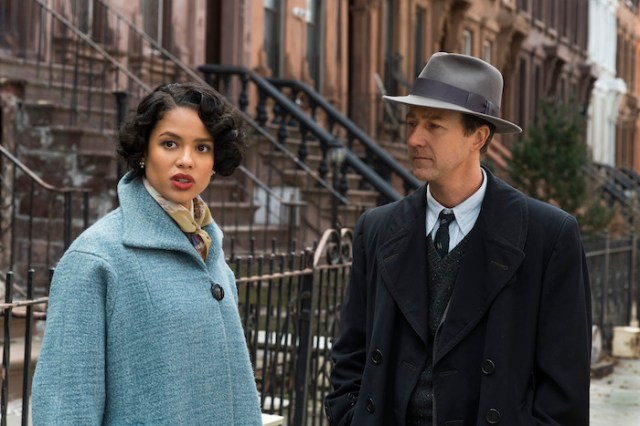 Edward Norton is arguably Hollywood’s most idiosyncratic movie star, a description that will find pushback in some circles for two reasons: Norton doesn’t present as a “star” and his idiosyncrasies aren’t apparent in all the work he’s done. Motherless Brooklyn, a kind of vanity project that Norton has been trying to launch for many years, makes good on this description for various reasons but also points up the problems that the actor-director-screenwriter has trouble seeing through the haze of his ambitions. Since I haven’t read Jonathan Lethem’s source novel I have no opinion about Norton’s decision to change the setting from 1999 to 1957, though given the central plot point of a grasping, corrupt New York city planner modeled after Robert Moses (Alec Baldwin), it at least makes logical sense. However, all the attendant noir elements feel a little too on-the-nose when they are located in an era when film noir was at its historical apex as a form of expression.
 The initial reflexive response to James Mangold’s wannabe epic about the Ford Motor Company’s ambitious entry into the world of auto racing is that it’s late to the 60s nostalgia orgy. As could be predicted with such a high budget Hollywood project the production design is immaculately retrograde, though as is also often the case with high budget Hollywood projects the verisimilitude is sometimes off-putting: the colors a bit too period-bright, the haircuts creepily perfect. What made Mad Men (and, to a lesser extent, Once Upon a Time in…Hollywood) transcend this aesthetic was the way the scripts buried beneath the surface gleam for something that felt real about the time, especially if you lived through it. Ford vs Ferrari, however, simply wants you to bathe in the promise of American exceptionalism, even if one of the main characters is a spiky Brit.
 After it opened last January, this crime-comedy became South Korea’s second biggest box office success in history, prompting all sorts of speculation as to what exactly it represented to the country’s very large movie-adoring population. Though a few of the actors have wide appeal, no one had ever been considered responsible for a comparable hit, so it mostly came down to a happy combination of factors, including central plot points focused on food, a fairly open-ended approach to violent slapstick, and the normal January doldrums, when studios, even in Korea, I suppose, mostly release detritus.
 Whether due to the ravages of age or encroaching apathy (itself a ravage of age), I found it more difficult this year to retain much familiarity with music I listened to. When I started reviewing the year in mid-November in order to compile this list, except for a half dozen albums that had made an exceptionally strong impression during our initial encounter, I seriously questioned if I had really listened to many of the other albums that were in my devices, though I was almost sure I did. One hypothesis is that I don’t listen to any new music on CD any more, only older music, because I stopped buying physical product several years ago, having reached the conclusion that I didn’t want to accumulate any more things in what is left of my life. Whatever else they offer, CDs provide more of an emotional anchor for the music they contain, something MP3s can’t provide. And now that iTunes, as much as I hated it, is gone, the music files on my computer seem that much more ephemeral. In the end, however, a guitar lick here, a particularly clever lyric there did penetrate the fog of my short-term memory, but basically I had to reboot, which explains why I’m late with the list. And it’s not as if I didn’t care about the music I was hearing. If anything, the short list I came up with ended up being pretty long. One aspect that often boosted a record’s appeal in my estimation was whether I’d seen the artist in question play live this year. I don’t attend half the number of shows I did twenty years ago, so maybe I appreciate concerts more than I used to, but one of the reasons I stopped going was that live shows increasingly held less interest for me (ravage of age, check), so if I do go out of my way to see someone, it’s almost always because I like their latest record a lot, so, in a sense, the concert is like a double reinforcement of their appeal. Yeah, I know most people see artists they already like, but for so long, because of my work, I was invited to almost every concert in town, and I took advantage of that. Not so much any more, but that’s not a ravage of age. More of a realignment of priorities. P.S., No decade-best from me. Since the dawn of the millennium, time has been a continual blur.
 Though This Is Spinal Tap effectively made it difficult to make fun of rock musicians, particularly those of the heavy metal variety, in movies for eternity, there’s enough native ridiculousness in the genre for extraneous exercises in parody, a dispensation that directors Juuso Lantio and Jukka Vidrgen exercise in Heavy Trip. It helps oodles that the movie takes place in a small hick town in Finland, a country that, thanks to its air guitar contests that have become world famous, already possesses an air of pop cultural ridiculousness. Approached in those terms, metal has the same basic appeal as professional wrestling. It’s a rarefied art form whose ostensible attraction is bogus. In the case of wrestling, people pretend to fight. In the case of metal, people pretend to adhere to a lifestyle that’s toxically misanthropic (and male). Both characterizations, however, are misleadingly reductive, since the fake fighting in pro wrestling still requires special athletic skills to pull off, while metal musicians get their fake points across with genuine musical chops.
 The class dynamics exploited in Bong Joon-ho’s Parasite, certainly the movie of the year regardless of what you think about it, gives rise at first to comedy of the most uncomfortable kind. This has always been Bong’s strong point, though when he’s off his game it’s usually because he has trouble maintaining his comic tone. In movies like Okja and Snowpiercer, which belong to sci-fi or fantasy genres, keeping that tone wasn’t a big problem, though the lack of consistency did make those films feel less important by the end than the way they felt at the beginning. Because Parasite takes place in a relatively realistic social setting the tone is especially important.
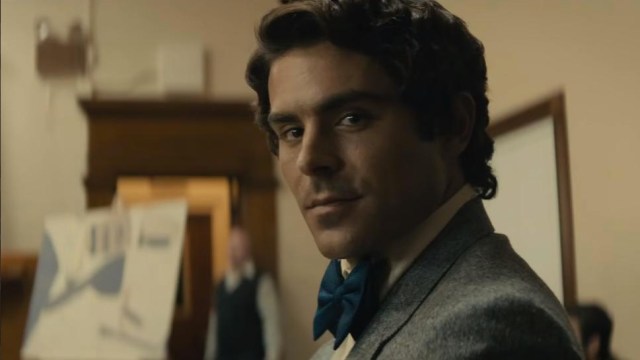 As the most notorious serial killer in American history—quite an accomplishment, if you think about it—Ted Bundy has been the focus of volumes of journalism and analysis and scads of films, mainly documentaries. Director Joe Berlinger, who made this circumspect profile of the killer, played with unusual subtlety by Zac Efron, has already made a doc series about Bundy, but apparently he wasn’t done with him. The narrative sectionalizes the part of Bundy’s life in the late 70s and early 80s that occurred afer most of his many murders had been committed, while he was living in Florida with a single mother named Elizabeth Kloepfer (Lily Collins) in relatively conventional middle class comfort. Much of the movie, in fact, it from Kloepfer’s point of view. She meets Bundy in a bar, and per his post-arrest reputation, he is charming and solicitous, even to a woman saddled with a kid, a situation she has been conditioned to believe is a deal-breaker for any long-term romantic relationship. Their first night together he doesn’t have sex with her, and makes her breakfast the next morning.
 philipbrasor.com