
 When you look at the life of French novelist Romain Gary, there are a lot of incidental notes that could make for fascinating sidetrips by themselves. One is that he is the only French writer to have ever won the Goncourt Prize twice under two different names, which, as it happens, is the only way you can win the Goncourt twice since French law prohibits the same writer winning it more than once. The other incidental I want to know more about is the story behind Gary cowriting the script for The Longest Day, an English language movie that, until Saving Private Ryan, was the most memorable film ever made about D-Day. Gary’s take on the war is especially valuable if you take his memoir, Promise at Dawn, for what it says it is. Personally, I have my doubts, since so much of what happens in the story is almost beyond belief, but maybe that’s just a function of director Eric Barbier’s style of storytelling.
He frames it within a larger story of Gary (Pierre Niney), already a bestselling author and married to British editor Lesley Blanch (Catherine Mc Cormack), in Mexico in the 1950s during the Day of the Dead festivities when he develops a headache he thinks will be the death of him. A lifelong hypochondriac, Gary’s wails of suffering are indulged by Blanch who hires a cab to take them three hours to a hospital in Mexico City, and during the ride she reads the manuscript of his memoir. This scene seems gratuitous, but it does set up the vital premise that Gary is an obsessive writer, a man who can scribble under the most trying of circumstances.
Those circumstances were mostly provided by his mother, Nina Kacew (Charlotte Gainsbourg), a Polish Jew who, according to her, gave up a promising career as an actress in Russia to raise Romain on her own. And she doesn’t just raise Romain. She instills in him an ambition to become, first, a French ambassador and, second (and at the same time), the greatest writer in the French language. When Romain was a little boy, Nina made her living selling hats to snobby women (read: anti-Semites) in the city of Vilnius, but once she had the chance she dragged her son to Nice, where she manages a hotel while pushing Romain to ignore all other considerations except writing.
Thanks mainly to Gainsbourg’s fiercely weird portrait, Barbier’s style makes sense in these formative scenes, but once Romain sets off on his own, first to Paris for an education, then to England and North Africa to fight for the free French after the German invasion, it becomes less credible as a means of telling what amounts to a ripping yarn. The main thrust of the theme is that Nina’s overbearing childrearing technique has had its desired effect, and while Romain writes his ass off in any situation, all the while enduring rejection letter after rejection letter, he suffers mightily from neuroses of inadequacy that affects both his sexual performance (though he seems to have plenty of partners with which to prove that inadequacy in slapstick fashion) and his fitness for battle, not to mention life’s normal vicissitudes. Nevertheless, the film highlights a number of anecdotes each of which would have made The Longest Day even more exciting than it actually was, including a nearly impossible mid-flight, mid-battle sequence in which bombardier Romain talks the blinded pilot of his stricken bomber to a bumpy but safe landing.
But it’s the perfect and perfectly melodramatic ending that finally gives the viewer pause—no way it could have happened this way, you think. It’s a finale worthy of William Styron, a contemporary of Gary’s who also suffered from bouts of delusional depression. Unlike Styron, however, Gary died from suicide, which adds a certain verisimilitude to Niney’s equally overcharged performance. It’s a big story about a big theme, so even for a memoir it probably has a right to be a bit over the top.
In French and Polish. Opens Jan. 31 in Tokyo at Shinjuku Picadilly (050-6861-3011), Cine Switch Ginza (03-3561-0707), Yebisu Garden Cinema (0570-783-715).
La promesse de l’aube home page in Japanese.
photo (c) 2017-Jericho-Pathe Production-TF1 Films Production-Nexus Factory-Umedia
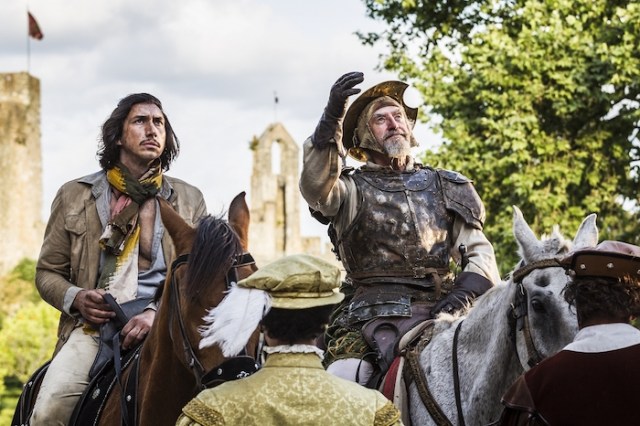 It’s the slightest of serendipities to note that two days after the great Terry Jones died at the age of 77, another Terry who toiled in the same comedy group and, like Jones, a man who made a second career as a director of feature films, finally sees his 30-years-in-the-making epic open in Japan. Granted, Terry Gilliam is surely a more famous filmmaker than Terry Jones, though I would hesitate to call him a more successful one. Jones’ output was slight in comparison, but it was surely more consistent in tone and quality since it mostly had to do with bringing Monty Python’s Flying Circus to the big screen. Does that make Gilliam, a famous asshole with a streak of artistic idiosyncrasy a mile wide, more ambitious? Perhaps, but given that ambition, it will probably be some time before we’re able to properly judge his body of work.
 The unwieldy title of this feature film from Kazakhstan that was trotted out for film festivals is The Horse Thieves, The Road of Time, which is far too much information and points to a loss of clarity as to what the purpose of the movie is as a piece of art or entertainment. For sure, the basic narrative idea, which mixes romantic intrigue with action and danger, is dramatically absorbing, but the whole exotic component of the setting and the culture as emphasized by the cinematography and production design points to its promotion as some kind of precious artifact. Then there’s the subtext of having a Japanese actor play the romantic male lead opposite a Kazakh actor who won a Best Actress prize at Cannes, as well as the directing credit being shared by a young Japanese director, even though the story and overall aesthetic is obviously the product of the award-winning Kazakh director.
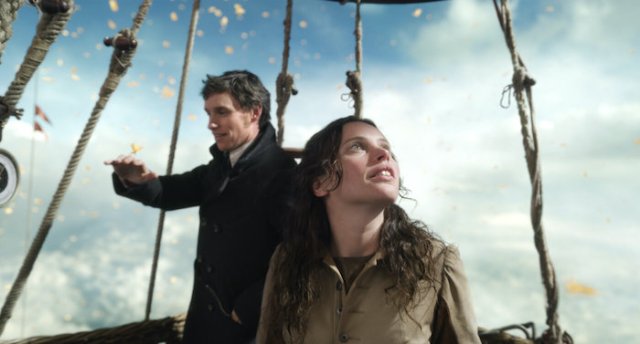 About the only way to approach Tom Harper’s two-handed adventure film is as a problem in search of a solution. Though based thinly on a true story (or, more exactly, elements from several true stories), the film’s adventure component is so limited in scope that in order to remain relevant for 100 minutes a number of hurdles must be overcome, the first of which is that there are only two characters, and the second of which is that the entire adventure takes place in the basket of a hot air balloon.
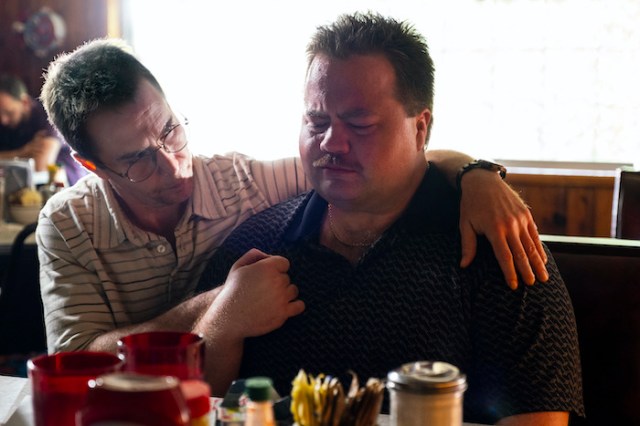 Though Clint Eastwood’s oft-discussed tendency to inject his personal cultural prejudices into his movies seems to become more pronounced with age, he is more likely to get away with that proclivity in films where he also stars, probably because the director’s work as an actor, particularly in the Dirty Harry series, provided his entire public persona with an acceptable facade of conservative independence that comes with its own integrity. Whether you appreciate or abhor his politics, Eastwood is a known entity, and a comfortably familiar one, so wherein presentations such as American Sniper and 15:17 to Paris can come across as reactionary statements, equally skewed movies like The Mule and El Torino feel more like films thanks to Eastwood’s curmudgeonly lead characters. You take them at face value as entertainment rather than as veiled attempts at libertarian persuasion.
 Director Taika Waititi sincerely tries to hedge his bets with his Oscar-nominated Nazi comedy by labeling it right off the bat as an “anti-hate satire,” which, of course, gives the impression that the New Zealand director, not-so-fresh off the success of his MCU Thor blockbuster, has only the best intentions when he depicts Hitler as a goof-ball and anti-Semitic propaganda as akin to MAGA-inspired cultural laziness or immaturity or both. And for sure, the movie’s relentlessly inventive stream of jokes that tap directly into our collective sense of how ridiculous that whole regime was, with its uniform fetishes and obsession with whiteness for the sake of whiteness, works a certain magic until you catch yourself wondering what you should make of a group of people hanged in a town square after summary trials for anti-Nazi activities. You’re obviously supposed to be appalled, but then you’re also supposed to fall right back into laughing at the silliness of it all.
 Here’s
 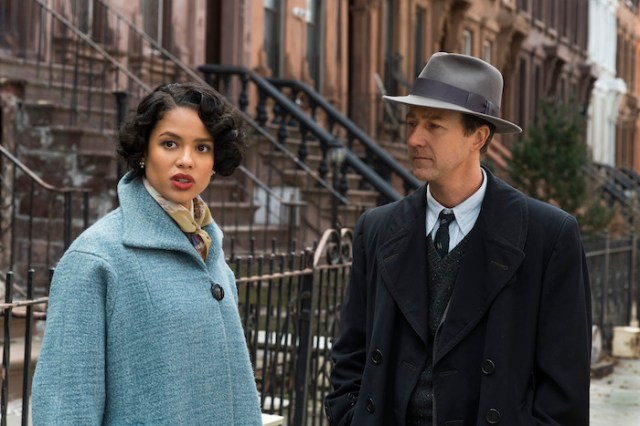 Edward Norton is arguably Hollywood’s most idiosyncratic movie star, a description that will find pushback in some circles for two reasons: Norton doesn’t present as a “star” and his idiosyncrasies aren’t apparent in all the work he’s done. Motherless Brooklyn, a kind of vanity project that Norton has been trying to launch for many years, makes good on this description for various reasons but also points up the problems that the actor-director-screenwriter has trouble seeing through the haze of his ambitions. Since I haven’t read Jonathan Lethem’s source novel I have no opinion about Norton’s decision to change the setting from 1999 to 1957, though given the central plot point of a grasping, corrupt New York city planner modeled after Robert Moses (Alec Baldwin), it at least makes logical sense. However, all the attendant noir elements feel a little too on-the-nose when they are located in an era when film noir was at its historical apex as a form of expression.
 The initial reflexive response to James Mangold’s wannabe epic about the Ford Motor Company’s ambitious entry into the world of auto racing is that it’s late to the 60s nostalgia orgy. As could be predicted with such a high budget Hollywood project the production design is immaculately retrograde, though as is also often the case with high budget Hollywood projects the verisimilitude is sometimes off-putting: the colors a bit too period-bright, the haircuts creepily perfect. What made Mad Men (and, to a lesser extent, Once Upon a Time in…Hollywood) transcend this aesthetic was the way the scripts buried beneath the surface gleam for something that felt real about the time, especially if you lived through it. Ford vs Ferrari, however, simply wants you to bathe in the promise of American exceptionalism, even if one of the main characters is a spiky Brit.
 philipbrasor.com