
 After it opened last January, this crime-comedy became South Korea’s second biggest box office success in history, prompting all sorts of speculation as to what exactly it represented to the country’s very large movie-adoring population. Though a few of the actors have wide appeal, no one had ever been considered responsible for a comparable hit, so it mostly came down to a happy combination of factors, including central plot points focused on food, a fairly open-ended approach to violent slapstick, and the normal January doldrums, when studios, even in Korea, I suppose, mostly release detritus.
Had I seen Extreme Job without knowing about its huge popularity, I might have pegged it as detritus. There’s a certain slapdash quality to the script that would seem to indicate an impatience with coming up with jokes—throw as much as you can against the wall and see what sticks. The opening scene makes a strong case for this theory. A preternaturally inept undercover narcotics police squad is carrying out a bust on a crew of junkie-dealers and plans an elaborate operation that involves at least one member pretending to be a window washer so that he can crash into the room and take the suspects by surprise. You can guess what happens, but the set-up is made super elaborate so that all five officers have a chance to show off their clumsiness. It gets a bit over-involved.
Predictably, the botched bust puts the team on notice with their supervisor, who suggests breaking them up, especially since a rival team of narcos has had such great success lately. The smug head of that team, for reasons that aren’t really clear—is he taking the piss or legitimately offering his rival a chance at redemption?—offers the head of the loser team, Chief Go (Ryu Seung-ryong), a tip about a drug kingpin recently released from prison. Go and his team quickly set up a stakeout near the organization’s headquarters. Naturally, more hijinks ensue to the point where their cover comes close to being blown, but when they notice that the crooks are regularly patronizing a local chicken restaurant they get jobs there as delivery people, hoping to be able to infiltrate the HQ. Then they go deeper when they learn that the owner of the restaurant wants to sell the business. They buy it.
It’s hardly a spoiler to mention that the restaurant, which was formerly a bust itself, turns into a thriving business under the auspices of the narco team. It’s a plot device that’s been used before, most recently by Woody Allen in Small Time Crooks, though director Lee Byoung-heon at least builds it up with some credible entrepreneurial savvy. At first, the squad barely acknowledges the set-up’s commercial side, but once customers start showing up they know they at least have to put on a front and one member, the bumbling Detective Ma (Jin Sun-kyu), happens to have a barbecue recipe from his hometown that he uses to make a special kind of marinated chicken, which instantly becomes a hit, attracting TV travel shows and Japanese tour groups.
Long story short, the crew’s management of the chicken store, which builds to a franchise brand and even synergy with a pizza chain, is much more interesting and funnier than the ongoing surveillance of the drug den, and Lee can’t always make the two storylines work together. A seemingly clever strand to use the franchise to lure the kingpin into some kind of distribution deal is just confusing, and doesn’t seem to lead anywhere, except to the eventual very violent showdown on the Seoul docks where the various police misfits finally get to show off their individual martial arts prowess. Suffice to say that Lee is less successful as a chef-de-action-cinema than the crew is as an accidental model of mercantile ingenuity.
In Korean. Now playing in Tokyo at Cinemart Shinjuku (03-5369-2831).
Extreme Job home page in Japanese.
photo (c) 2019 CJ ENM Corporation, Haegrimm Pictures Co., Ltd.
 Whether due to the ravages of age or encroaching apathy (itself a ravage of age), I found it more difficult this year to retain much familiarity with music I listened to. When I started reviewing the year in mid-November in order to compile this list, except for a half dozen albums that had made an exceptionally strong impression during our initial encounter, I seriously questioned if I had really listened to many of the other albums that were in my devices, though I was almost sure I did. One hypothesis is that I don’t listen to any new music on CD any more, only older music, because I stopped buying physical product several years ago, having reached the conclusion that I didn’t want to accumulate any more things in what is left of my life. Whatever else they offer, CDs provide more of an emotional anchor for the music they contain, something MP3s can’t provide. And now that iTunes, as much as I hated it, is gone, the music files on my computer seem that much more ephemeral. In the end, however, a guitar lick here, a particularly clever lyric there did penetrate the fog of my short-term memory, but basically I had to reboot, which explains why I’m late with the list. And it’s not as if I didn’t care about the music I was hearing. If anything, the short list I came up with ended up being pretty long. One aspect that often boosted a record’s appeal in my estimation was whether I’d seen the artist in question play live this year. I don’t attend half the number of shows I did twenty years ago, so maybe I appreciate concerts more than I used to, but one of the reasons I stopped going was that live shows increasingly held less interest for me (ravage of age, check), so if I do go out of my way to see someone, it’s almost always because I like their latest record a lot, so, in a sense, the concert is like a double reinforcement of their appeal. Yeah, I know most people see artists they already like, but for so long, because of my work, I was invited to almost every concert in town, and I took advantage of that. Not so much any more, but that’s not a ravage of age. More of a realignment of priorities. P.S., No decade-best from me. Since the dawn of the millennium, time has been a continual blur.
 Though This Is Spinal Tap effectively made it difficult to make fun of rock musicians, particularly those of the heavy metal variety, in movies for eternity, there’s enough native ridiculousness in the genre for extraneous exercises in parody, a dispensation that directors Juuso Lantio and Jukka Vidrgen exercise in Heavy Trip. It helps oodles that the movie takes place in a small hick town in Finland, a country that, thanks to its air guitar contests that have become world famous, already possesses an air of pop cultural ridiculousness. Approached in those terms, metal has the same basic appeal as professional wrestling. It’s a rarefied art form whose ostensible attraction is bogus. In the case of wrestling, people pretend to fight. In the case of metal, people pretend to adhere to a lifestyle that’s toxically misanthropic (and male). Both characterizations, however, are misleadingly reductive, since the fake fighting in pro wrestling still requires special athletic skills to pull off, while metal musicians get their fake points across with genuine musical chops.
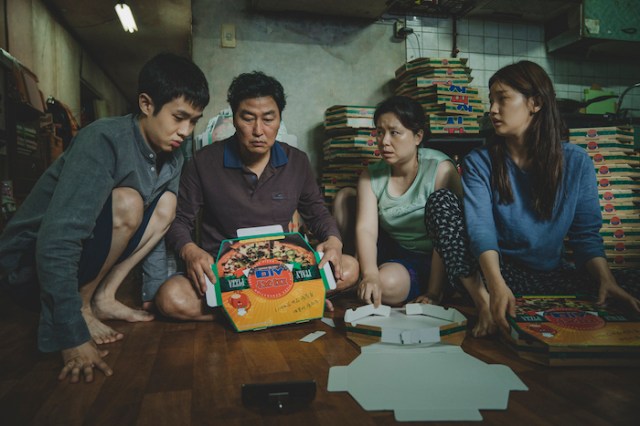 The class dynamics exploited in Bong Joon-ho’s Parasite, certainly the movie of the year regardless of what you think about it, gives rise at first to comedy of the most uncomfortable kind. This has always been Bong’s strong point, though when he’s off his game it’s usually because he has trouble maintaining his comic tone. In movies like Okja and Snowpiercer, which belong to sci-fi or fantasy genres, keeping that tone wasn’t a big problem, though the lack of consistency did make those films feel less important by the end than the way they felt at the beginning. Because Parasite takes place in a relatively realistic social setting the tone is especially important.
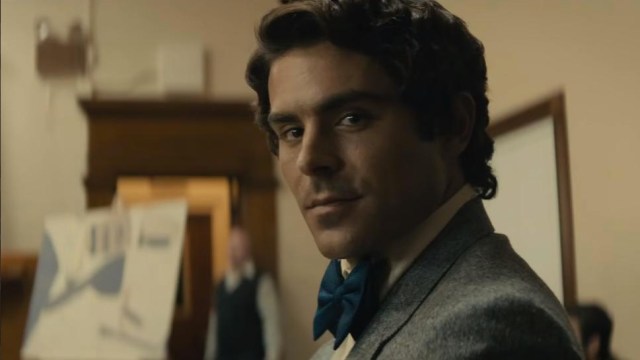 As the most notorious serial killer in American history—quite an accomplishment, if you think about it—Ted Bundy has been the focus of volumes of journalism and analysis and scads of films, mainly documentaries. Director Joe Berlinger, who made this circumspect profile of the killer, played with unusual subtlety by Zac Efron, has already made a doc series about Bundy, but apparently he wasn’t done with him. The narrative sectionalizes the part of Bundy’s life in the late 70s and early 80s that occurred afer most of his many murders had been committed, while he was living in Florida with a single mother named Elizabeth Kloepfer (Lily Collins) in relatively conventional middle class comfort. Much of the movie, in fact, it from Kloepfer’s point of view. She meets Bundy in a bar, and per his post-arrest reputation, he is charming and solicitous, even to a woman saddled with a kid, a situation she has been conditioned to believe is a deal-breaker for any long-term romantic relationship. Their first night together he doesn’t have sex with her, and makes her breakfast the next morning.
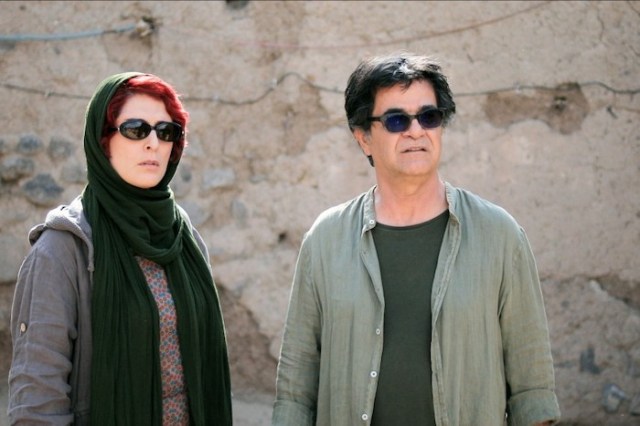 In his last samizdat production, Taxi, Jafar Panahi spent almost the entire running time behind the wheel. He spends a good portion of his latest movie also in a car, thus in a way extending a cinematic style perfected to obsessive lengths by his late mentor Abbas Kiarostami, many of whose last films took place in moving vehicles. For Panahi, the device takes on an extra layer of meaning, since he is banned from making movies for 20 years by the Iranian government. His first two forbidden works were resolutely indoor affairs, but with Taxi and now 3 Faces he endeavors to get out of the house, and cars provide just enough cover for him to scratch his creative itch without being noticed (cameras are by necessity very small when filming in a car, and no crew). However, here he’s also incorporated a long automobile trip into a story that takes him far from Tehran, into the mountains bordering Turkey, where people are familiar with his celebrity but not close to any government organs that might risk his being exposed.
 At this point in his career Ken Loach is neither anybody’s fool nor anything less than what he resolutely says he is in his films—a staunch socialist muckraker with no qualms about using rough sentimentality to drive home his political points. Consequently, he’s been more appreciated and honored at continental film festivals (Cannes, especially) than he has by international critics and his fellow Brits. His latest, in fact, may be his most scathing indictment of late stage capitalism, not to mention his harshest rant against what the UK has become socioeconomically in the 21st century. Though film purists will obviously see it as yet another over-the-top screed, in light of yesterday’s general election, it comes across as nothing less than a libertarian horror movie.
 Here’s
  philipbrasor.com