
 What made the first Zombieland more interesting than it had any right to be was its attention to dweebish detail, in partcilar its lists of dos and donts when navigating a new American landscape where the undead were a daily danger, but a danger that could be reduced to a mere nuisance if the protocols devised by the film’s redneck hero, Tallahassee (Woody Harrelson), were followed to the letter. His opposite number, the bookish rube Columbus (Jesse Eisenberg), needed some time to absorb this wisdom, and while he managed to adjust a few tenets and add some corollaries of his own, the basic manual of chopping and shooting survived into this sequel, whose very title references one of the rules, which is to ensure that a zombie is really finished by zapping it twice with whatever weapon is at hand.
Otherwise, what is mostly maintained is the spirit of stereotyping that, unfortunately, makes whatever nuanced takes on the zombie zeitgeist offered by Double Tap secondary to the immediate identification it provides to the ruder fanboys. It’s been ten years since the original, so maybe time has just been crueler to the overall concept. Irony, for sure, is deader than a double tapped zombie.
The main drawback is that the women are depicted as being even less useful (and less funny) than they were the first time. Little Rock (Abigail Breslin), who was a little girl in the original, is now a grown-ass woman who runs away with a hippie, of all people. Wichita (Emma Stone), whose waggish con-woman schtick provides more credible cynicism than Tallahassee’s kill-em-all sensibility, doesn’t exactly make it as half of a couple, especially when the other half is the purposely annoying Columbus. Most of the plot has to do with these three chasing Little Rock with the added company of a dumb blonde named Madison (Zoey Deutch), who sparks jealous competition on the part of Wichita. Then there’s the doppelganger pair (Luke Wilson, Thomas Middleditch) who only compound the irritation provided by the Tallahassee-Columbus dynamic. The only thing to be said about the lazy road movie structure is that it allows our mortal mirth-makers chances to camp out in both the White House and Graceland, where the opportunity for cosplay proves irresistible to them and excruciating to the viewer. Regardless of Madison’s pleas for everybody not to be “super-judgy,” my verdict is that these people need to get out of the U.S. Does Europe have zombies, too?
Now playing in Tokyo at Toho Cinemas Hibiya (050-6868-5068), Toho Cinemas Shinjuku (050-6868-5063), Toho Cinemas Roppongi Hills (050-6868-5024).
Zombieland Double Tap home page in Japanese.
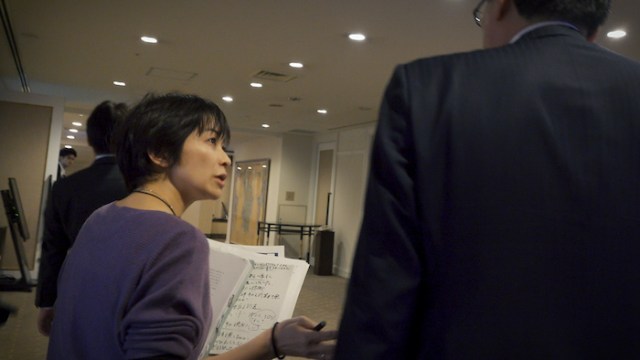 Writer and documentary filmmaker Tatsuya Mori obviously likes titles limited to one letter of the alphabet. The two movies that made him famous, the ones about the Aum Shinrikyo cult, were titled A and A2. The title of his latest, i is a bit of a mystery until it’s explained at the end, so someone, perhaps producer Mitsunobu Kawamura, suggested the secondary title that pointed out it was a film about journalism, or, actually, one journalist in particular, Isoko Mochizuki, who writes for Tokyo Shimbun. Though Mori teaches about media in Japan and is a common pundit on TV for media-related issues, i, apparently, was not his idea, but rather Kawamura’s. The producer also made that fiction film, Shimbun Kisha, that was released several months ago and which was also based on Mochizuki. It was a hit. This is a kind of companion piece and Kawamura thought Mori was just the guy to do it, and he is, except as with all his documentaries, i is more about him than it is about its nominal subject.
 This third exploration of the semi-fictional competition-friendship between the two British comedic actors, Steve Coogan and Rob Brydon, tries to get by on the pure momentum generated by the last installment, The Trip to Italy, which was and will probably remain the high point in the series about two insufferable entertainers tooling around the countryside on some publication’s dime sampling amazing food, accommodations, and scenery while bemoaning their respective personal and professional setbacks. Though Coogan and Brydon got much more mileage out of their considerable celebrity impersonation skills in Italy than they did in the original The Trip, where they simply traveled the English countryside and which was edited down from a TV mini-series, here the surrounding plot is so weak and gratuitous that you almost get the feeling the whole movie was built around these seemingly spontaneous attempts at one-upmanship in the mimicry arts, which peaks during a sequence in which Coogan, attempting to explain to two female acquaintances the importance of moor culture in Spain, is confounded by Brydon’s incessant impersonation of Roger Moore. The scene outdoes Ricky Gervais (also referenced at least twice in the movie, which is nothing if not incestuous about British comedy) in terms of wince-inducing faux hilarity, and you really just want it to stop as soon as possible.
 It could be argued that we don’t need another biopic of Vincent Van Gogh, certainly the most cinematized painter of all time. And on the surface, Julian Schnabel’s treatment of the tormented Dutchman covers much of the same ground that previous movies have, at least temporally. He limits the film to the last year of Van Gogh’s life, but rather than dwell on his state of mind or what might or might not have happened during those last fateful, disputed months, he looks squarely at the work, which makes sense since Schnabel is a respected painter himself.
 Ironically or not, the national film culture that has best represented post-millennial capitalist malaise has been China’s. Many, including me, will credit or blame Jia Zhangke with this development, but it’s really a function of the Peoples’ Republic’s almost schizophrenic approach to economic relativism, the idea that a fully communist regime can adapt market solutions to social policy. The latest piece of evidence proving how pointless this approach has been is Hu Bo’s An Elephant Sitting Still, a nearly four-hour exercise in raging against walls. The movie is set in a town in northeast China that was once an important mining center and which now seems desperate to find any use for itself. This desperation is mirrored in the lives of four characters looking for a way out their difficulties—and out of the town—and not having any success.
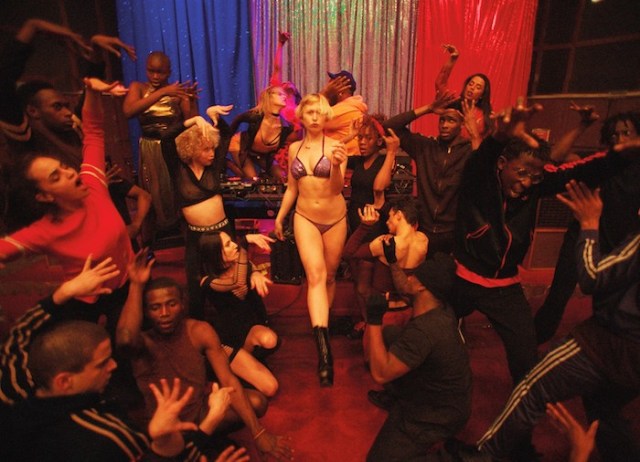 As the poster boy for post-millennial transgressive French cinema, Gaspar Noe has a reputation that precedes him by miles, and while his newest outrage does nothing to confound that estimation, its musical pedigree makes it somewhat less distasteful, at least on the surface. Ugly things happen as they do in all Noe films, but the glaze of manic terpsichorean energy lightens it up substantially, making Climax not only Noe’s most watchable film but perhaps his wittiest as well.
 One surprising thing I learned while watching Julian Schnabel’s movie about the last year of Vincent Van Gogh’s life was just how many paintings he produced. Sometimes he would finish a dozen in a week. This sort of superhuman output clashes with our image of a great painter, who we tend to think hesitates over every brush stroke. Van Gogh, who admitted he was an “animated” painter, just couldn’t help himself.
 philipbrasor.com