
 It says a lot about this reboot that its focus on an origin story that seems quite different from the one put forward in the previous movies is barely coherent; or that it mostly does away with whatever it was Guillermo del Toro brought of himself to a beloved comic book to make it peculiarly cinematic. It’s essentially a faithful rendering of the grossest appeals of the source material beneath a coating of self-mocking humor applied with the broadest of paint brushes. Ron Perlman was no Brando, but his cagey, wisecracking style was perfectly suited to a superhero who is the actual spawn of Satan and understood the irony in the fact that he was working for the so-called powers of good. David Harbour gamely takes over under Neil Marshall’s direction and the only thing that makes an impression besides his razor-sharp cynicism is that, really, anyone could be underneath all that makeup and body latex.
Marshall is your go-to guy for gore (innumerable horror films, Game of Thrones), and he seems as happy as a clam in this material, which has been written into the ground and gussied up with a lot more CG violence that del Toro would have been comfortable with. Explaining the plot, which covers several thousand years and more than few real life historical figures, is a chump’s game, but suffice it to say that the main fanboy draw is Milla Jovovich as an evil queen who was killed by King Arthur in medieval times. Her various body parts were hidden in boxes in farflung places for safe keeping. When the queen gets put back together again, Hellboy, as the main battering ram of the Bureau of Paranormal Research and Defense, is called upon to do the re-dismembering before she gets her revenge on all of humankind. Add to that a secret society of somewhat reactionary royals, true-to-God Nazis, a man with the head of a pig, giants, and Ian McShane as Hellboy’s “dad,” and you get a lot to chew on, so to speak, but most of it is gristle and not very satisfying in the end. One of the things that made the del Toro/Perlman movies compelling was Hellboy’s self-effacing demeanor, and Harbour does explore some of the hero’s more sensitive distractions—it explains his alcoholism, for one thing—but these more thoughtful moments make little sense in a world as resolutely evil as the one depicted. Whenever Hellboy has to rip apart another body or obliterate some real estate, he does so with mixed feelings that belie the glee Marshall conveys in all this bloody mayhem. Admit it, Hellboy, you love killing not because it’s necessary to save people or it’s programmed into what passes for your genes, but because it’s fun.
Now playing in Tokyo at Toho Cinemas Hibiya (050-6868-5068), Toho Cinemas Shinjuku (050-6868-5063), Toho Cinemas Roppongi Hills (050-6868-5024).
Hellboy home page in Japanese.
photo (c) 2019 HB Productions Inc.
 There are few segments in movies of recent memory that so starkly delineate the gulf between the director’s sensibility and that of their protagonist as the one that opens Eighth Grade. I don’t know how old Bo Burnham is, but it’s obvious that the technology ruling the life of his adolescent hero, Kayla (Elsie Fisher), is something he’s not comfortable with. Kayla, an awkward, shy, but also distressingly aware girl who is now in the eighth grade at a public middle school in a well-to-do California suburb, makes YouTube videos in her spare time that attempt to give advice to others her age on how to “put yourself out there” and “be yourself.” Her media skills will be impressive to anyone who came of age before the iPhone was a fixture of teen culture, though they come across as second nature for Kayla. In other aspects of social interaction, however, she’s seriously lacking, which is the point of Burnham’s movie.
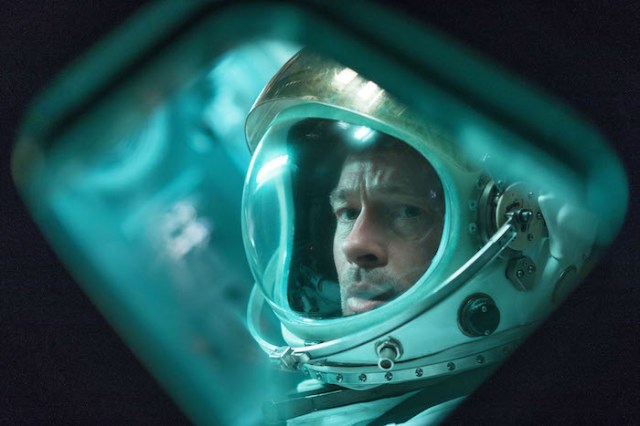 The points of narrative and thematic convergence between James Gray’s last film, the old-school world explorer epic, The Lost City of Z, and his latest film, the old-school sci-fi potboiler, Ad Astra, are too numerous to ignore, but the main point of divergence—the respective stories’ grounding in objective truth—clearly demarcate them in terms of relatability. Lost City was, in part, based on a true story that has developed a patina of legend over the years, and Gray obviously felt some responsibility in keeping the known facts about the legend central to his storytelling. Being set in the future, Ad Astra demands no such adherence to known truths, rather only the kind of verisimilitude we’ve come to expect from sophisticated science fiction movies, and while Gray does an admirable job in this regard, he can’t quite build a story that justifies it all.
 Here’s
  The person played by Rosamund Pike in this harrowing biopic is supposed to be American war correspondent Marie Colvin, who died in 2012 covering the civil war in Syria. However, early on there’s a sense that Matthew Heineman’s film intends to be the last word on battle-hardened journalists and the woman Pike plays could really be any battle-hardened journalist. With her alcoholism, inability to keep loved ones close, and obsession with being as close to danger as possible, she doesn’t even have to be a woman; which is to say, A Private War never really makes a case for Colvin’s storied cynicism and self-destructiveness because it’s all presented as a generic given.
 Though Elizabeth Chai Vasarhelyi’s and Jimmy Chin’s Oscar-winning documentary is ostensibly about world-famous rock climber Alex Honnold, it’s really about how we define heroes nowadays, especially in the context of movies. Honnold in many ways embodies the classic traits of the cinematic hero: reticent, private, obsessed with detail (at one point in the movie it’s suggested he has Asperger’s), indifferent to his effect on others. But as a post-millennial public figure, his most interesting trait is that he performs his heroics without much exposure. After all, he climbs sheer mountain faces away from the nervous gaze of the general public, which is where Vasarhelyi and Chin come in. In their own heroic ambition they decided to film Honnold scaling El Capitan in Yosemite National Park, one of the most forbidding climbs in the world, with multiple cameras operated by trained climbers who would record the feat up close and personally.
 Though it’s tempting to call his latest film a return to form, Jia Zhangke’s output since his last critically acknowledged masterpiece, Still Life (2006), mainly shows an artist grappling with his place in his own world, meaning China. For the most part, Jia’s features operated on the edge of China’s cultural mainstream, hailed by international movie lovers and mostly tolerated by his compatriots who have more control over the industry he works in. The fact that they looked down on his socioeconomically critical stories was not necessarily expressed through action, though for years his countrymen could only see his films on bootlegged DVDs. That changed with A Touch of Sin (2013), a movie that maintained the critical stance but couched it in more populist terms, which the authorities could tolerate because the criticism seemed aimed at society in general rather than policy. Nobody was fooled, but it’s obvious the authorities wanted to claim Jia as their own given his international acclaim and, for that matter, his love for his country. For what it’s worth, Touch was a pretty great movie, but not for the reasons his previous films were great. Always a fan of old gangster films, Jia proved he could handle genre fare, but when he tried to apply this skill to his next movie, Mountains May Depart, with its dystopian plot, the results were confused and, probably due to the fact that he was partly working in a foreign language, thematically incomprehensible.
 Jordan Peele’s Get Out was so on point about its sociopolitical subtext that many critics gave it a pass on its plotting, which, especially toward the end, became stiff and formulaic. It’s clear that Peele has a talent for horror forms, but it’s also clear that these skills have mainly been acquired through osmosis, which makes sense for someone who was making his first horror movie. But what everyone, including myself, took away from the groundbreaking feature was the way Peele incorporated the everyday discomfort that black people feel in a world ruled by white people into a conventional horror story by inflating that discomfort into pure terror. Given how skillfully and convincingly he accomplished this feat, the screenplay’s pitfalls seemed less blatant. In fact, it won Peele an Oscar.
 Here’s
  philipbrasor.com