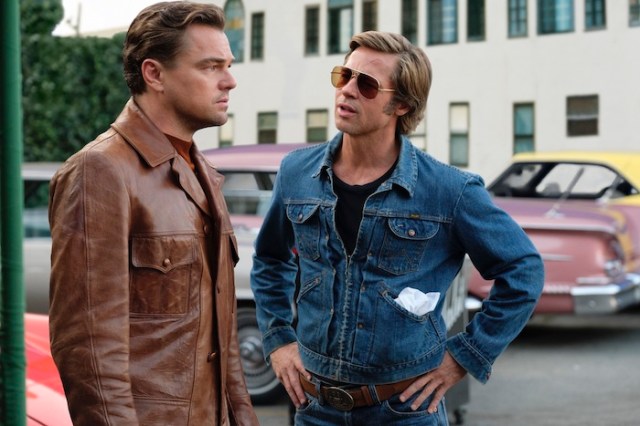
Review: Once Upon a Time…in Hollywood

Technically speaking, Quentin Tarantino’s ninth feature is a historical movie, and he’s said it follows in that genre concept the same as his other so-called “revisionist” movies, Django Unchained and Inglourious Basterds, did. The main and vital difference is that Tarantino was alive during the period that Once Upon a Time…in Hollywood takes place, 1969, and while he was only six at the time, it’s obvious from his take on the setting and the milieu—in particular, the soundtrack, which is filled with AM radio hits of the era—that he remembers something of the texture of those times. For sure, Hollywood is deeply informed by the movies and TV shows of that era, but if feels a lot more relevant to Tarantino’s sensibility than the other two films of this ilk.

Still, as the title implies, it’s a fairy tale, and therein lies the rub. It’s hard not to wonder how much of what’s fabricated for the story adheres to Tarantino’s ideal of what the era represented. Despite the important plot line involving actress Sharon Tate (Margot Robbie), this is definitely a man’s film, even a macho film, and it’s generally approving of the concept of manliness embodied by the two leads, troubled leading man Rick Dalton (Leonardo DiCaprio) and Rick’s loyal stunt double, Cliff Booth (Brad Pitt). Though they’re too young to belong to the Greatest Generation, they don’t adhere to the hippie ethos that was ascendant at the time, and, obviously, neither does Tarantino. Though honorable men as far as that idea goes, Cliff is generally suspected of having murdered his wife (he was not convicted), and Tarantino is pretty coy about leaving his guilt a mystery. For sure, when the chips are down, he can be as violent as a pit bull (which he owns and which plays a very important part in the film), but true to Tarantino’s fantasy of manhood, his expression of violence is never gratuitous, though one can certainly say that Tarantino’s depiction of it is.

Hollywood is also Tarantino’s most structurally interesting film since Pulp Fiction, which is saying a lot since Tarantino plays with structure as if he were in Legoland. In the first part of the film, Rick, who starred in a Western TV series in the late 50s for two seasons, has seen his star descend to the point where, as one agent (Al Pacino in Jewish drag) puts it, he’s now continually getting cast as guest villains in other people’s series, a sure sign that he’s washed up. Nevertheless, he still lives in relative luxury in the Hollywood Hills, with Tate and her new husband, Roman Polanski, fresh from his victory with Rosemary’s Baby, having just rented the house next door. Cliff, on the other hand, still lives in a trailer down below, and his subservient position vis-a-vis Rick belies his own self-possession, which, in Pitt’s hands, is pure aesthetic. Perhaps the biggest obstacle for Tarantino in this formulation of male bonding is that DiCaprio is too earnest in his stylization of male self-pity while Pitt was born to play the cool, unruffled, and totally competent sidekick. You bathe in Cliff’s scenes while you often squirm during Rick’s.

Of course, everybody is primed to expect something apocalyptic because of the Tate subtext, though Tarantino is just as coy with the presentation. In the movie’s best sustained segment, Cliff gives some jailbait a ride to the house where she and a tribe of hippies are squatting. It turns out to be an old movie set that Cliff once worked at, and he hears of a guy named Manson who seems to have some control over these freaks. The segment is tense and open-ended—there’s really no telling what is going to happen—and it sets the audience up in ways that are purposely perplexing, and as long as you buy into the fairy tale premise what develops makes not only perfect sense, but can be taken as being highly satisfying in the Hollywood tradition. Once Upon a Time…in Hollywood is the epitome of the guilty pleasure in that it confounds our expectations with a false sense of security. Agree with it or not, it obviously represents the world as Quentin Tarantion believes it should be.

Now playing in Tokyo at Toho Cinemas Nihonbashi (050-6868-5060), Toho Cinemas Hibiya (050-6868-5068), Shinjuku Wald 9 (03-5369-4955), Shinjuku Picadilly (050-6861-3011), Toho Cinemas Shinjuku (050-6868-5063), Toho Cinemas Shibuya (050-6868-5002), Toho Cinemas Roppongi Hills (050-6868-5024).

Once Upon a Time…in Hollywood home page in Japanese.

photo (c) 2019 Visiona Romantica Inc.
Posted in Movies | Tagged , , | Leave a comment

Media Mix, Aug. 25, 2019

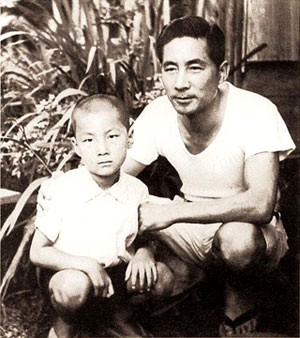
Junichiro and Junya Koizumi

Here’s this week’s Media Mix about the marriage announcement of Shinjiro Koizumi and Christel Takigawa. Shinjiro’s situation is not that unusual in Japanese politics. There are many dynastic lines in government, both national and local, as there are in many other countries. Granted, show biz seems to breed more nepotism than politics owing to the dynamics of popularity and commerce, but once a family finds a way to monetize their political power on a local level they hold on to that power with all their might.

The Koizumi family’s heritage goes back three generations. Former Prime Minister Junichiro Koizumi’s grandfather, Matajiro, was the first in his family to gain public office, and made it as high as minister of communications in the cabinet. However, it wasn’t just a matter of his having a male heir to continue holding on to the family’s Yokosuka constituency. His daughter, Yoshie, fell in love with a political aide in the government (not her father’s, apparently), and they eloped because her parents forbade the union. Once the deed was done, however, Matajiro made the best of it and allowed his new son-in-law, Junya, to change his name to Koizumi, thus becoming an omukosan. It was a fortuitous decision. Junya was handsome and won election easily to the lower house. The couple then produced Junichiro, whose own approach to continuing the line was much less romantic, as pointed out in the column. The woman he married was just out of college and according to a book by Taeko Ishi (about dynastic families), the new wife was effectively shut out of the family, which was and still is mainly managed by Junichiro’s sisters. She wasn’t even allowed to eat meals with the family (which is quite large, including in-laws and children, all living within the same compound). After she divorced Junichiro and his mother died, she showed up to the funeral to pay her respects and was prevented from coming into contact with her ex-husband or other members of the immediate family. She had to wait in a separate room with her youngest son, whom, reportedly, Junichiro has met only once. This is the man Shinjiro wants to take after as a father. God help Christel Takigawa, unless, of course, she’s already in on the plan.

Posted in Media | Tagged | Leave a comment

Review: Rocketman

This is the second big budget biopic of a major flamboyant 1970s male rock musician who eventually came out as gay to be released within the last year, and while the differences between Bohemian Rhapsody and Rocketman are notable, the overall impressions are so similar that the differences will be neglible over time. In that regard, the Freddy movie wins because it came out first and made a ton of money, thus partly exhausting the market for this kind of movie. The gap in box office receipts may also have something to do with the fact that Mercury died 20 years ago and Elton John, played here by Taron Egerton, is still very much with us—in fact, the release of the film, which his husband produced and he oversaw, coincides with his big final world tour.

First off, I belong to that slice of society who believes Elton John is a genius, that he was the respresentative singles artist of the 70s; and while I haven’t really listened to him with much attention since the late 70s, I still feel he has as much to contribute to popular culture as any man his age. But the point of the film is not to reinforce any of those notions; rather, it wants to set the record straight before John becomes a fond memory, and to a certain extent it’s brutal in its depiction of his addictions and insecurities—much more so than Bohemian Rhapsody was with regard to Mercury. Both men were central to the glam rock ethos, even if they weren’t necessarily considered the epitome of the form. What they shared and derived from the genre was an affection for camp for its own sake and scrutiny of the rock life as their subject matter. Bohemian Rhapsody, with its endless stream of behind-the-scenes nudges and mouth-openers, is a truer testament to that ideal, while Rocketman, which is basically musical theater, is closer to the feeling of the ideal.

Consequently, the songs, which everyone knows, aren’t always performed as songs, but rather presented as production numbers, muddying their purpose, which is to clarify and intensify certain emotional episodes in John’s life. They don’t appear in chronological order and sometimes feel oddly misinterpreted by the production team. The songs are as entertaining as always, but they add less to the story than they would have had their progeny been elaborated upon, as the songs in Bohemian were. And while childhood trauma is the life blood of Hollywood biopics, young Reginald Dwight’s is presented as if he’d been born into a Ken Russell production. It’s old-fashioned filmmaking, thus spoiling the nostalgia potential by doubling down on it. The good stuff, the stuff we didn’t really know that much about—like John’s teen career backing black American musicians on tour in the U.K.—also has a layer of fantasy to it, but the kick of discovery makes it work.

And the love story at the center of movie, between John and his straight lyricist Bernie Taupin (Jamie Bell), is so blandly platonic that you wonder if Taupin might have felt short-changed. He comes across as a really dull boy compared to his writing partner. Some may complain that we learn nothing of their writing process, but exploring those sort of mysteries are not the film’s mission, which is to sensationalize a life that its protagonist was never able to handle. Mercury died of AIDS, cut down in his prime by a disease he caught. He never had the chance to burn out. Elton John, on the other hand, overcame his demons a long time ago, and has cruised ever since. Rocketman, as entertaining as it is, is nothing more than a victory lap, a means of showing his fans that they were right to love him all along, even if they stopped listening a long time ago.

Now playing in Tokyo at Toho Cinemas Nihonbashi (050-6868-5060), Toho Cinemas Hibiya (050-6868-5068), Shinjuku Wald 9 (03-5369-4955), Shinjuku Picadilly (050-6861-3011), Toho Cinemas Shinjuku (050-6868-5063), Toho Cinemas Shibuya (050-6868-5002), Toho Cinemas Roppongi Hills (050-6868-5024).

Rocketman home page in Japanese.

photo (c) 2018 Paramount Pictures

Posted in Movies | Tagged | Leave a comment

Peter Fonda interview, 2002

Here is an interview I did with Peter Fonda in 2002 for the Japan Times on the occasion of the rerelease of a restored version of his directing debut, The Hired Hand. For the sake of context, I should mention that I’m pretty sure Fonda was stoned during our conversation. I can’t seem to find this on the JT website. 

Peter Fonda is on the phone from his home in Montana. He says he just finished mowing the lawn and in a week or so will begin shooting a new movie in Canada called “Polly Yesterday.” According to the 63-year-old actor, the film’s storyline “begins with the death of [the Rolling Stones’] Brian Jones in 1969 and progresses all the way up to now.”

Since Fonda is considered at least half responsible for “Easy Rider,” the 1969 movie whose popularity revolutionized American commercial filmmaking and helped define the hippie counterculture, being pegged for something like “Polly Yesterday” sounds like typecasting. “Yeah, it should bring back some memories,” he says. 

Fonda seems to be in the memory business right now. Having seen his artistic credibility reconfirmed with a best actor Oscar nomination for “Ulee’s Gold” in 1997, he was then tapped by Steven Soderbergh for “The Limey” to play what was essentially Captain America, his character in “Easy Rider,” had the pot-smoking biker survived those shotgun-toting rednecks and grown up to invest his cocaine money in a record production company.

For the past year or so, he’s been reliving 1970-71, restoring his directoral debut, “The Hired Hand,” a Western that almost no one saw when it came out. “It only played on 52 screens for two weeks,” he says, though he’s not completely sure why Universal Pictures made no effort to promote it. He suspects the studio “lumped it in with ‘The Last Movie,’ which came out about the same time.” “The Last Movie” was “Easy Rider” partner Dennis Hopper’s own infamous follow-up to that seminal film, and, according to Fonda, “a disaster.” 

Despite being butchered by Universal while Fonda was out of the country, “The Hired Hand” has since garnered an admiring cult. “Martin Scorcese presented the restored version at the Tribeca Film Festival in New York. He loves it and was helpful in the restoration process.”

Fonda himself initiated the restoration. “There was a retrospective in San Francisco a few years ago, and they showed ‘The Hired Hand.’ The print was so bad and the music had been scraped off in some parts. I tried to find a decent print and couldn’t. So me and my editor snuck into the vault at Universal and everything was there: the camera negative, the interpositive, a semi-releasable version, and the NBC television cut which had us puking with laughter it was so bad.”

Fonda made a deal with Universal’s Ron Meyer and raised the money for the restoration. “Now they’re thinking of buying it back,” he says with a chuckle. “I think that’s very funny.”

The changes weren’t that difficult. “I actually made most of them when I first took the film to Europe with [co-star] Warren Oates. I brought along a hot splicer and would go to each print just before it was screened and take out the things Universal had put in that shouldn’t have been there. I had long hair and a beard, and they had no idea who I was, just a freaked-out hippie attacking the film. But I knew which reels to go for. I was able to lift these two pieces out, hot splice them together, and not lose sync. That means there were only six or seven prints in the world that were close to my ideal.”

Finally, it’s payback time. “I think Universal feels foolish, because the press is making a lot of noise about this being a lost treasure. If they want to distribute the film in the U.S., they have the means. And they can make DVDs, which will be marvelous because then I can include different things that people have heard about over the years. We’ll get to show some of the cool shit I had to cut out. It was [Oscar-winning cinematographer] Vilmos Szigmond’s first film, and we can have him talk about it. Historically, it’s very cool.”

He might even talk about how he came upon the script. “I was in London in 1969. The British censors had finally allowed ‘Easy Rider’ to open, and my associate producer, Bill Hayward, and I went there for the opening. I got a call from a woman I knew, who said she promised a friend, Alan Sharp, that she would show me his script. I went from there to the continent where we dubbed ‘Easy Rider,’ and between Paris and Rome, I read the script. I turned to Bill Hayward and said, this’ll be our next movie. It was so well done–the language, the feeling for the American West–and this by a Scotsman who had never even been there.”

Perhaps because it was not written by a Hollywood hack, the script favored character development and atmospheric detail over the usual horse opera cliches. Fonda picked up on this aspect and fashioned what could be called the first impressionistic Western. He says he deliberately teased out the Biblical and mythical elements inherent in the story of a man who abandons his family and then, after seven years of roaming, tries to insinuate himself back in their lives. “When we scouted locations in New Mexico we were looking for a real ghost town. Because Del Norte, as it’s called in the movie, represents Hell. The Rio Grande is the Styx.”

Some critics see “The Hired Hand” as the missing link between the more traditional Western and the “revisionist” movies of Sergio Leone and Clint Eastwood. “What was different for me is that a woman is at the center. Me and Warren Oates are in the movie more, but it’s Verna Bloom as Hannah who’s the true center of the movie. She is the axle. The rest of us just turn around her.”

In this regard, the movie was revisionist in more ways than one. Hannah’s sexual candor may seem tame by today’s standards, but it caused problems in 1971. “NBC said, we can’t have her say that kind of stuff. But the movie loses all meaning without that beautiful scene between Verna Bloom and Warren Oates on the porch. That was cut out of the TV version. They couldn’t handle a woman saying, ‘It doesn’t matter much if it’s you or him. Just down in the dirt sometimes, or in the hay.’ 

Another reason Fonda would like to see a DVD version is that it will finally offer the public a chance to own the spare, guitar-based film score, which has never been released. “One man, Bruce Langhorne, did all that. Universal was mad. ‘Peter, you can’t just hire your friends. What’s he done?’ But he’s a virtuoso on 52 stringed instruments. He could play all the parts in a symphony. His picking hand has a thumb stump and two fingers end at the joint. I want people to hear that. I invited Alan Sharp to a special screening of the restored version in L.A., but he couldn’t come. He said his main regret was that he couldn’t hear that music one more time. I mean, I want the CD, too. And you know what [Langhorne] is doing now? He makes hot sauce.”

Fonda made a Western because he thought it would help him break out of the image straitjacket of “Easy Rider,” though he admits that the two films contain themes that are strikingly similar. “Both movies are journeys; people trying to find things, themselves. In both I find myself dead, but at least in ‘The Hired Hand’ my partner survives to clean up the mess I made. In the beginning of the movie, Robert Pratt falls on his ass, and it’s just another way of saying ‘we blew it’ [a signature line from “Easy Rider”]. We’re not as civilized as we think we are.” 

He even admits that there’s a lot of himself in Harry, the character he plays. “My own marriage was falling apart. I was away a lot making movies.” In the end, it’s obvious that if he had to be remembered for one thing, he’d prefer it be for the Western rather than the hippie biker flick. “Everybody thinks, ‘I wanna see him on a motorcycle smoking marijuana.’ But instead you get me on a horse, without pot, moving slowly. And there’s no rock and roll [laughs]. But Verna Bloom rocks. Warren Oates rocks. And Bruce Langhorne definitely rocks.”

Posted in Movies | Tagged , , | Leave a comment

Review: The Price of Everything

There are few capitalist recreactions as confounding and uninteresting to the hoi polloi as investing in art. Though everyone understands the concept and can perhaps appreciate the economic dynamic at work, most people find the effort involved, not to mention the enormous amount of money needed, to be beyond the pale. Nathaniel Kahn has thus managed to make a documentary for those of us who don’t see the point, if only to clarify that the point is not as esoteric as we think it is. Art is money and always has been. It’s just that in our post-modern world the artists have figured out a way to make it pay for themselves now rather than others in the future.
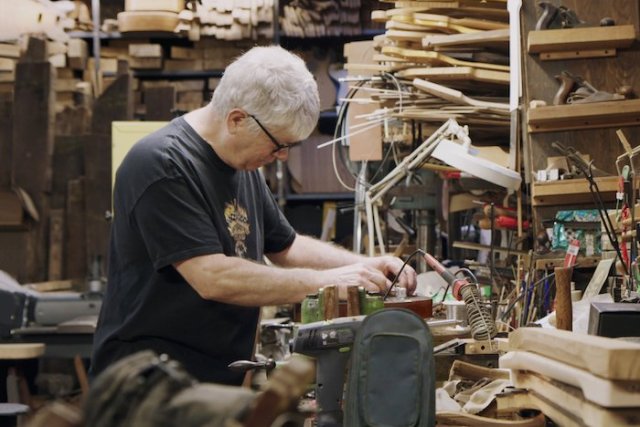
And, of course, some stubbornly try to not make it pay; or, at least, not make themselves slaves to money rather than their art. In order to present this dialectic, Kahn gives us the comically rhyme-fixated duo of Jeff Koons and Larry Poons, two artists who represent opposing axes of the art-commerce matrix. Koons is the former investment banker-turned-conceptual artist who is probably the richest maker of art in the world at the moment, having learned quite quickly how to leverage auction houses to make his future art more valuable. Kahn’s most important contribution to the conversation is showing how auctions don’t merely make dead painters even more famous, but also how past works of living artists boost their standing for future works, which is why Koons can get a couple of million for one of his balloon animals since the owner knows he can sell it down the line for even more.

Poons, on the other hand, is a former wunderkind abstract expressionist who essentially turned his back on the commercial art world and retreated to the underground to work on things that he had not intention of selling. But as Kahn shows, even that kind of reputation counts for something monetarily. It’s only a matter of time that interest in Poons, cultivated by art aficionados who would like to see him reclaim his place in the canon, develops into a kind of frenzy, and when he premieres his latest monumental piece—a painting that takes up a whole room—the cognoscenti are out en masse. Kahn doesn’t take this fable to the next level, and we don’t know if Poons, who is already quite old, cleaned up, but you can bet somebody else did thanks to his resurgence.

The documentary has other deep dives worth pondering, in particular its portrayals of a clutch of wealthy collectors who really do seem to have nothing better to do. Their understanding of the value of the work they own is not limited to monetary concerns—they know their aesthetics—but under Kahn’s close scrutiny their explanations add up to little more than a scrim of cute idiosyncrasies. In that regard, money actually makes more sense as a measure of the value of a work of art. We really have come that far, and gone that low.

Opens Aug. 17 in Tokyo at Euro Space Shibuya (03-3461-0211).

The Price of Everything home page in Japanese.

Posted in Movies | Tagged | Leave a comment

Review: Carmine Street Guitars

As fly-on-the-wall documentaries go, Ron Mann’s small-scaled portrait of a venerable Greenwich Village guitar shop should make even Frederick Wiseman green with envy. Due to its location and hard won reputation, Carmine Street Guitars can expect quite a few celebrity guitar aficionados to drop in on a regular basis, which means all Mann had to do for the five days he shot the film was just hang out. There’s not a lot of explication in the movie—no voiceover or text cards—but Mann knows what the audience wants to know and is able to extract this information with as little prompting as possible.
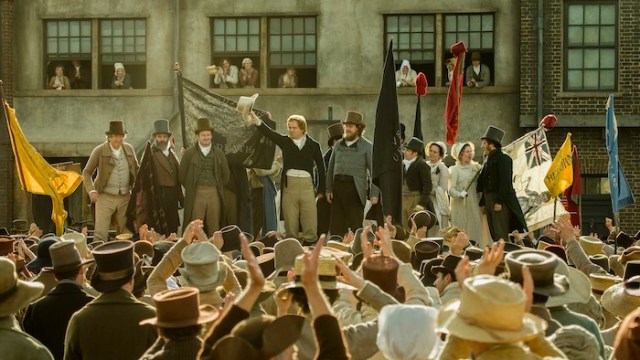
And what Mann is after is not so much the “placeness” of the store and the prestige of its clientele, but the pursuit of craft for its own ends. There are only two employees, owner Rick Kelly and his apprentice Cindy Hulej, who describe how they custom make guitars for special players. What makes Kelly unique as a guitar maker is his attention to materials. He regularly patrols Manhattan looking for dumpsters with discarded wood from demolished buildings (“the bones of New York”), some with very long histories. He turns this wood into guitars, thus making a Carmine Street guitar more than an instrument; it’s a piece of local history, just like Kelly’s enterprise, which he’s been working at since the 1970s. Oh, there is a third employee: Kelly’s octogenarian mother, who answers the phones. She as much a part of this institution as Kelly is.

And while Mann wisely allows the detail of the craft to come through—how to improve resonance through resins, how burning improves resilience—he seems more interested in the idea of the shop, a commercial endeavor that still runs on its own steam and represents a calling that is as responsible for great art as the great art itself. When Nils Cline comes in to buy a guitar for his Wilco boss, Jeff Tweedy, he and Kelly bond over something inexplicable to the viewer but no less poignant, a flaw that makes one guitar tantalizing in its unexplored potential. The famous musicians who chat with Kelly are envious: they may have the glamorous life, but they don’t know themselves through their work as thoroughly as this master builder does. Carmine Street Guitars, both the movie and the store, represent heaven on earth.

Now playing in Tokyo at Cinema Qualite Shinjuku (03-3352-5645), Image Forum Aoyama (03-5766-0114).

Carmine Street Guitars home page in Japanese.

photo (c) MMXVIII Sphinx Productions

Posted in Movies | Leave a comment

Review: Peterloo

As he approaches the twilight of his career, Mike Leigh, perhaps the best and certainly the most idiosyncratic of British filmmakers, has increasingly turned to history to explore his feelings about what it means to be English. His two most prominent historical films, Topsy-Turvy and Mr. Turner, dwelled on the world of the arts, offering Leigh a means of looking at his position on the vector of creativity. His latest, however, is bitingly political, even polemical. It addresses an incident that happened on August 16, 1819, in the city of Manchester. A peaceful pro-democracy demonstration was attacked by British soldiers dispatched by local leaders. Dozens were killed and hundreds injured. Dubbed “Peterloo” because of its temporal proximity to the fateful battle that defeated Napoleon and the fact that it took place on St. Peter’s Field, the event, according to Leigh, should be taught to every British school child, but it’s mostly been lost to time. With his usual scrupulousness, he shows how the massacre came about and what it means for today’s world.
Unfortunately, Leigh’s two-and-a-half-hour film seems likely to meet the same fate as the incident itself. Several months after it played theatrically in the UK, it is mostly forgotten, doomed by negative reviews from critics who normally champion Leigh. They found it wordy, boring, and nagging. Leigh has, of course, done political content before, but he never sacrificed the dramatic appeal of his peculiar method just to make a point. Here, he’s dry and academic, and yet for me, a Yank who happens to love history, it was a revelation as both exegesis and theater. Leigh’s actors speak in bountiful phrases that sound nothing like political speech today, and that may be the problem for most people. To them it sounds like the most opaque Shakespearean poetry, but apparently Leigh worked close with contemporary documents to get the language accurate, and what comes through is the kind of passion for engagement that is, in and of itself, dramatically compelling.

But, most importantly, Peterloo is an angry film, which makes it the opposite of boring in Leigh’s hands. Wellington’s soldiers return from their victory broken and disillusioned while their leader basks in material and public glory. Leigh focuses on one PTSD-wracked redcoat, Joseph (David Moorst), who returns not to a hero’s welcome, but to a family plunged into poverty by rising prices that the government seems ill-equipped to tackle. Eventually, the workers and farmers rise up and demand action, and the response is pure reactionary arrogance. The lords in London, rather than huddle to find a solution, immediately conspire to put down what they see as insurrectionary ungratefulness. Leigh throws us into meetings on both sides of the argument, and doesn’t spare us the lengthy speeches and explanations. It is one of the film’s singular strengths that the characters, even at their voluble worst, convey complications of personality that set the stakes. At the center is Henry Hunt (Rory Kinnear), one of the era’s great orators, who takes up the working man’s cause much to the delight of the people, though it is his pointed loquaciousness that makes him a lightning rod for conservative ire and focuses that enmity to no good end. It doesn’t help that Hunt is proud and smug.

The inevitability of the massacre is as certain as it would be in any disaster movie, and Leigh ratchets up the tension without resorting to specious musical or editing cues. But it’s the detail that is so effective: the troops, understanding their mission, getting drunk on the morning of the massacre; the nobility in their silly finery getting so worked up in their hatred for the hoi polloi they literally spit out their invective; the innocence of the “rabble” as they assemble in the field to hear a fine speech by Hunt that they know they won’t understand. The horror that follows has been given a context that is unmistakable and, even more horrifying, universal in its applicability. 

Opens Aug. 9 in Tokyo at Toho Cinemas Chanter Hibiya (050-6868-5001).

Peterloo home page in Japanese.

photo (c) Amazon Content Services LLC, Film 4 a division of Channel Four Television Corporation and the British Film Institute 2018

Posted in Movies | Tagged | Leave a comment

Media Mix, Aug. 4, 2019

Yoshimoto President Akihiko Okamoto

Here’s this week’s Media Mix about the toxic connection between TV and talent agencies, mainly Yoshimoto Kogyo. As mentioned in the column, almost all of Japan’s major commercial TV networks hold shares in Yoshimoto, which strengthens their mutual dependence, but as Taro Imaichi, a securities writer, explained in a recent blog post, it’s important to note that Yoshimoto is not a listed company, meaning its shares are not publicly traded. Imaichi claims that were Yoshimoto a listed company, they would not be able to get away with many of their questionable practices because they’d be subject to shareholder scrutiny and calls for better governance.

Imaichi has firsthand knowledge of Yoshimoto’s development as a company. It was founded in 1932 and was hardly a major player in the show business world until the 1980s, when Imaichi himself worked for an advertising agency. One of his jobs was negotiating for talent in TV commercials, and he would occasionally visit Yoshimoto’s offices in Osaka, which he described as being dirty, dark, and cluttered. Their fortunes started to rise in the late 80s during the so-called manzai boom, which they were instrumental in sparking. At the time Yoshimoto was a listed company, and had been since 1949. Then, in the late 2000s, Sony launched a takeover bid for Yoshimoto, buying all their outstanding shares with cash. In 2009, Yoshimoto was delisted by the new management (a company that seems to have popped up just for the purpose of managing Yoshimoto), an acknowledgment of some of the shady dealings it discovered at the agency. Imaicihi mentions the scandal of August 2011 involving Yoshimoto’s top comedian at the time, Shinsuke Shimada, who quit show business altogether. Imaichi thinks that if Yoshimoto had been listed at the time, a more thorough investigation of Shimada’s business dealings would have taken place and might have ruined the company, since outside shareholders could have successfully sued.

Since the shareholders now are all related companies, they are all in the same boat, so to speak, and thus are mutually protective of one another’s interests, which now includes a huge contract with the government regarding Yoshimoto’s emerging venture business in international education programs. TV won’t report on the dubiousness of this program, which has afforded Yoshimoto some ¥10 billion in government subsidies, because they have a stake in it as well.

Posted in Media | Tagged , | Leave a comment

Review: Welcome to Marwen

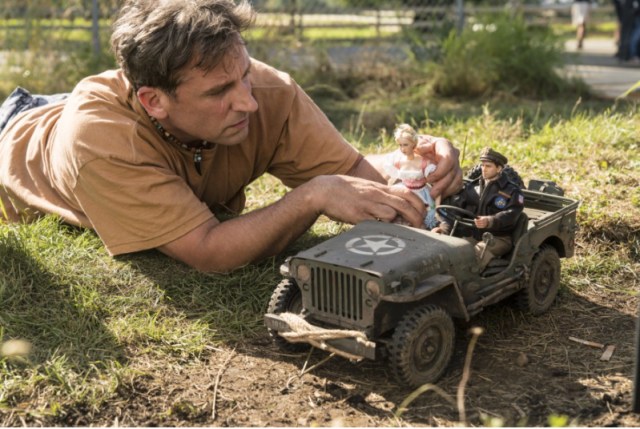
It’s easy to see why Robert Zemeckis was attracted to the true-life story of Mark Hogancamp. Zemeckis’s brief since the Back to the Future series has been fantasy that comments on who we are right now, “we” being invariably Americans. Hogancamp, an illustrator who lives in upstate New York, was assaulted by a group of neo-Nazis who objected to his cross-dressing habits and left him with scars, brain damage, and severe PTSD, all of which ended his career and deprived him of much of his memory. In order to cope, he turned to dolls, and interpolated his struggle into a World War II action tale about him and a group of multi-cultural female commandos taking on German soldiers. He would set up tableaux with the dolls and then photograph them. These photos were recognized as pieces of art and Hogancamp became famous, though the fame only worked to exacerbate his psychological problems—or so Zemeckis’s movie would have you believe.

In the film, Hogancamp’s (Steve Carell) immediate concern is his upcoming testimony against his attackers in court for sentencing. He dreads having to confront them, and the fear sparks nightmares and periods of intense isolation, escaping only to Marwen, the fictional Belgian town he has created in miniature in his backyard. The female soldiers in his make-believe world are all based on women in his waking life—a physiotherapist (Janelle Monae), a bartender (Eiza Gonzalez), the manager of the hobby store where he buys his dolls (Meritt Wever), his visiting nurse (Gwendoline Christie), and a porn actress who he has only seen in films (Leslie Zemeckis). Except for the latter, these women pity and support him, and he repays their kindness by making them action heroes. The ringer is Nicol (Leslie Mann), a new neighbor who also shows pity and provides support, both of which Hogancamp mistakes for romantic interest with predictably tragic results.

But not that tragic. Zemeckis, who has always been pretty good at addressing potentially sentimental material without over-sentimentalizing it (Forrest Gump is the glaring exception), fails to bring the viewer fully into Hogancamp’s mindset, and his regard for women comes across mostly as fetishization. This feeling is mostly due to the transformation of real life characters into dolls, a trick of CGI that’s right up Zemeckis’s alley and adds the requisite entertainment factor to a story that should be almost too painful to watch. But the real-life characters are no less filmic constructs than the doll characters are, and it’s difficult to form any emotional connection with any of them. It’s not as if Welcome to Marwen were two different movies that didn’t work together. It’s more like Zemeckis couldn’t muster the creative vigor to make the contrast between Hogancamp’s real world existence and the life of the (damaged) mind meaningful. It’s simply an exercise in CGI empathy.

Now playing in Tokyo at Toho Cinemas Chanter Hibiya (050-6868-5001), Shibuya Cine Quinto (03-3477-5905).

Welcome to Marwen home page in Japanese.

photo (c) 2018 Universal Studios

Posted in Movies | Tagged , | Leave a comment

Media Mix, July 14, 2019

Here’s this week’s Media Mix about the scant coverage of Kurdish refugees in Japan. An obvious question that often arises when people discuss refugees in Japan is why they even come here in the first place, since Japan is clearly not accepting of refugees. The fact seems to be that the vast majority of people who apply for asylum really are trying to get permission to stay so that they can work, since most are from countries like Vietnam, Nepal, and the Philippines, where political and religious persecution exists but not to the extent it does in other countries. Kurds are definitely considered liabilities by the Turkish government. The main reason why Kurds come to Japan seems to be that those who feel they have to leave Turkey go to a place where they already know someone, relatives or friends they can stay with, and for whatever purpose there is already a small Kurdish community in Japan. I’m assuming that the bulk of Kurdish refugees go to other countries—Canada seems to be a common destination—and once in a while you do hear of Kurdish refugees in Japan going on to a third country as asylum seekers, but since the media doesn’t cover them in the first place, that information is hard to come by.

Japan has relatively good relations with Turkey, so accepting Kurds as political refugees would tacitly acknowledge that Turkey is a repressive country. The problem with this policy is that it puts the government in a difficult position with regard to asylum seekers. They summarily refuse to grant asylum but from that point on there is no realistic way of dealing with those individuals who refuse to go back, which is why they can’t get jobs and often end up in detention for little or no reason. The column mentions journalist Hideki Kashida, who often writes about detained refugees, and in his blog he once described how one Kurd was actually deported. The person was being held in the Ushiku Immigration Center in Ibaraki Prefecture. One day he was in the exercise room when a staff member summoned him for an interview. An officer told him that both his refugee application (not his first) and his provisional release request had been refused, and that he was going to be sent back to Turkey that day. The staff had already collected his belongings. He demanded to speak to his lawyer, but they ignored him, put him in handcuffs, and took him directly to Narita Airport. He didn’t even have a chance to say goodbye to other detainees. When Kashida asked a member of a detainee support group what happened to the man after he got to Narita, the person said they assumed he was accompanied on to a plane by immigration staff and sent back to Turkey. What happens after that, nobody ever knows. Given the cost and trouble (not to mention the potential violence; several deportees have died in the process) involved in such an action, it’s clear why the government has little appetite for forcefully deporting asylum seekers.

Posted in Media | Tagged | Leave a comment