
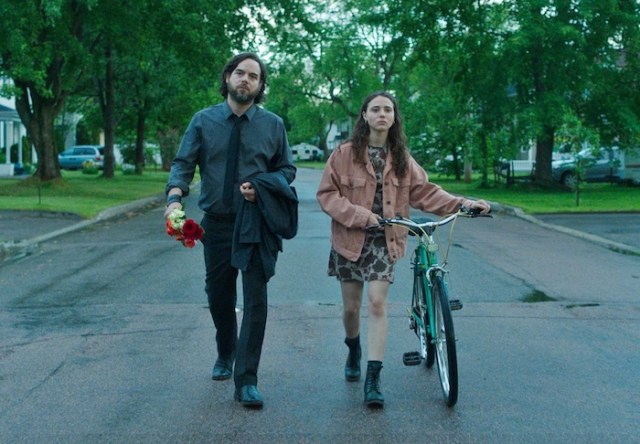
 Disaffected youth is a currency that filmmakers never tire of trying to exchange in hopes of finding a theme that suits their world view. Everybody was young once, and if experience counts for a lot when telling a story, the coming-of-age tale has built-in advantages. In this small Canadian film, the director is a man and the protagonist an 18-year-old girl living through that magic hour of adolescence, from the last month of high school through to the end of the subsequent summer. Leonie (Karelle Tremblay) is typically skeptical about everything in the ways of cinematic teen heroines. She bristles whenever an adult confronts her with her future. “I’m only 18,” she spits back. “I have plenty of time to decide.” Her bad attitude is manifest right off the bat when she bails on a restaurant meal in her honor hosted by her mother (Marie-France Marcotte) and stepfather (Francois Papineau). She pretends to use the rest room and then walks out the door and catches a bus.
The fact that mom doesn’t seem particularly surprised by this rude act indicates Leonie’s personality has been brittle for some time. She barely keeps her contempt for her stepfather—a radio commentator who rails against environmentalists and anti-capitalists—in check, and doesn’t really have any close friends to speak of. While hanging out with a group of associates at a 50s-themed restaurant in her small Quebec town, one friend makes fun of a bearded guy eating alone at the counter, picking up on his couture of flannel shirt, rocker T-shirt, and blue jeans. “What’s life like in 1985?” she teases him. Leonie, however, is intrigued, probably because she seems to think the modern world sucks and that things were better before she was born.
The throwback in question, a thirty-something slacker named Steve (Pierre-Luc Brillant), becomes Leonie’s confidant. He teaches guitar and lives in his mother’s basement. One of Leonie’s projects for her aimless summer is to take guitar lessons from Steve, and he proves to be a gifted musician, which prompts the inevitable question: Why isn’t he playing in a band, making a living from a skill he obviously enjoys? Steve has no ready answer; something about being averse to the big city and a personality that doesn’t accommodate itself to group dynamics. In essence, he’s the other temperamental side to Leonie’s misanthropy—less caustic, more resigned to life without drama. And for a while, their easy relationship forms the core of the film’s sensibility. Writer-director Sebastien Pilote brings up the obvious sexual tension between them a few times without letting it get anywhere, and what he misses in potential drama he makes up for with naturalism that is refreshing without being doctrinnaire. In fact, the movie’s lack of emotional payoffs is what makes it so strangely appealing. There is only one scene of violence in the film, and it comes at the expense of property not people. The most fraught relationship is not that between Leonie and Steve but rather between Leonie and her birth father (Luc Picard), a former union leader whose advocacy for the local paper mill ended in failure and forced him to leave town. He now works seasonally “up north” on an undesignated project. Leonie has formed the opinion that his stepfather had something to do with his exile, but the truth ends up being much more problematic, and Leonie can’t cope with the way it makes her feel.
That Leonie’s fate is no more certain at the end of the movie than it was at the start is another risky gambit that Pilote pulls off with disarming ease. Generally speaking, fiction films that attempt to address life as it’s really lived come off as either pretentious or just plain boring, especially when the protagonist is an 18-year-old “brat.” The Fireflies Are Gone is not nearly as entertaining or emotionally satisfying as Lady Bird, but it’s more credible and the lessons it teaches more affecting.
In French. Opens June 15 in Tokyo at Shinjuku Musashinokan (03-3354-5670).
The Fireflies Are Gone home page in Japanese.
photo (c) Corporation ACPAV Inc. 2018
 Disney’s latest live action—or, more precisely, CGI-assisted—remake of a beloved animated classic hits perhaps too close to home in my case. The original Aladdin was the first movie I reviewed for a print publication, albeit in capsule form, and the memory of seeing it at my first-ever press screening is indelible, though that movie was so overwhelmed by Robin Williams’ participation that, other than the simple, crowd-pleasing plot, little of the film itself made much of an impression. Seeing the new version, I now attribute this perceptive gap less to the passage of time than to Disney’s generic storytelling style. Suddenly, all the things I liked and disliked about the original but had forgotten about came flooding back, but it was a weird kind of nostalgia. Except for Williams, have things changed so little since 1992?
 There’s something refreshingly irreverent about Hiroshi Okuyama’s debut feature, but it’s not in the Japanese title, which translates directly as “I hate Jesus.” Appropriately small-scale in both production values and ideas, the movie posits Christianity as an object of curiosity. People of faith will find it quaint at best, while the rest of us may think it’s grandly pulling a leg or two, though in spots it reveals a disarming seriousness. If, in the end, it doesn’t say much about organized religion, it does say something interesting about the cult of Christ.
 At one point at the beginning of Frederick Wiseman’s monumental documentary about the New York Public Library, someone basically calls it a holy place for secular people. That’s a fair description of any library, but New York’s is special in that it not only provides the largest research resource collection of almost any institution in the world, it actively involves its users in the life of the city’s vast culture. Entering the huge, beautiful main branch at 5th Avenue and 42nd Street, with its famous marble lions and elegant wood paneling, is like entering the city’s soul—the good ecumenical soul that should be at the heart of every great city’s endeavor.
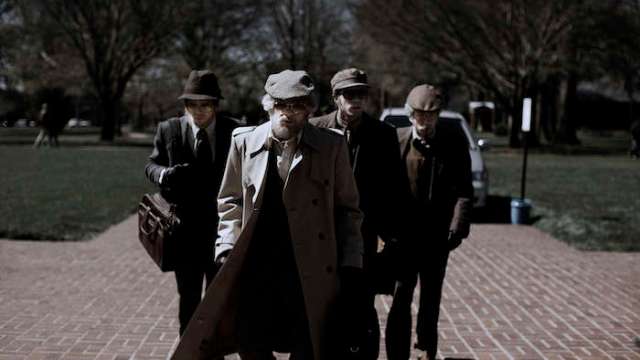 Though it doesn’t really amount to much in the end, director Bart Layton’s decision to claim up front that his heist movie is a bona fide “true story”—as opposed to a movie “inspired” by one—is a fairly bold step, and compels him to add inserts wherein the actual people involved in the caper provide details, albeit from inside prison, thus letting us know rather soon how the heist turns out. It’s not really much of a spoiler, because despite unerring confidence in their criminal skills, the two masterminds behind the robbery, art student Spencer (Barry Keoghan) and his less savvy pal Warren (Evan Peters), who’s the beneficiary of a sports scholarship, don’t really give the impression that they know what they’re really getting into.
 Rebellious teens come in all shapes, sizes, and modes of seriousness, and thus are reliably timeless as cinematic characters. The hook for this debut feature by Crystal Moselle is that it’s based on a popular Instagram account and uses the subjects of that account as actors mostly playing themselves, though the plot is contrived and even a bit elaborate. The world depicted is that of female skateboarders in Manhattan, most of whom enjoy very little in the way of family life or educational opportunities. Camille (Rachelle Vinberg), a dedicated skater living out on Long Island, falls into this milieu after injuring herself while skating and receiving a command from her worried Spanish-speaking mother (Elizabeth Rodriguez) that she can no longer partake of the pastime, so in order to avoid her mother’s gaze she takes the train into the city to do her thing.
 Having seen Mimi Leder’s On the Basis of Sex, I approached this documentary about the life of Supreme Court justice Ruth Bader Ginsburg equipped with a certain store of images and facts that I assumed would aid me in understanding the iconic legal hero, and was somewhat taken aback when I left with more questions than when I went in. It’s not often that a dramatic narrative feature tells you more about a subject than a documentary, and the only answer I can come up with is that the filmmakers of RBG, Julie Cohen and Betsy West, are so enamored of their subject they assumed that devotional regard would satisfy anyone who viewed it, including the members of the Academy of Motion Picture Arts and Sciences, who nominated it for an Oscar.
 Gus Van Sant manages to recover from recent poor choices (Sea of Trees, Promised Land) with the help of Joaquin Phoenix and an inspired cast of A-listers in supporting roles. The vehicle is perhaps less impressive than any of its component parts, but the somewhat tired theme of personal redemption is at least given a new lease on life with a totally bonkers take on addiction porn. Basically a biopic of the parapalegic cartoonist John Callahan (Phoenix), who died in 2010 at the age of 59, Don’t Worry trades mainly in black comedy undercut by some rather nasty truths about human nature. Set in the 1970s and 80s, the script moves liberally back-and-forth in time with little regard for narrative coherence, which actually saves the film from having to justify Callahan’s actions or even make sense of them.
 Here’s
  philipbrasor.com