 In the press synopsis for his documentary, American director Miki Dezaki calls the comfort women issue “perhaps Japan’s most contentious present-day diplomatic quandary,” which is true to an extent but misleading in terms of scale. The issue of the comfort women, the euphemism used by the Japanese military to describe women who sexually serviced soldiers at officially sanctioned brothels during World War II, needs to be approached from the standpoint of overall responsibility for the Pacific War, which remains to this day unsettled in Japan while it has been mostly decided elsewhere. Though Japan was not alone in committing atrocities against civilian populations during that conflict, its acknowledgement of Japan’s primary role in instigating the war for purposes of territorial expansion has shifted over the years. The comfort women issue is simply one part of this problem.
Dezaki’s main contribution to a better understanding of the issue is his insistence that it is politically fraught. He sees it, right now anyway, as a no-holds-barred battle between ideologies in Japan, between purist right-wingers who can’t tolerate the thought that their fathers and grandfathers did something so terrible as kidnap young girls, mainly from colonial Korea but also from Japan and other countries, and force them into prostitution, and more cosmopolitan left-wingers who reflexively renounce anything the right wing stands for. Because of his unique position as a filmmaker—a Japanese-American who can gain interviews with both sides—he’s able to delve more deeply into the self-styled logic that each side brings to the argument, and since he himself obviously aligns with the non-revisionist side, he takes special care in allowing the conservative side to state their positions and their grievances.
Dezaki thus avoids many of the polemical traps that others who have tackled the subject tend to fall into. And his thoroughness is admirable, as he looks at not only the history of the “narrative” of the comfort women issue, but its context in the burgeoning conservative movement exemplified by the post-millennial rise of Shinzo Abe and his supporters in the right wing lobbying group Nippon Kaigi. The problem here is that Nippon Kaigi, as put forth in many Western accounts of their significance, is rendered almost monolithic, when in actuality it has had little effect on the public imagination. Interviews with popular right wing celebrities like Kent Gilbert and Yoshiko Sakurai (who figures prominently in the trailer but doesn’t get much screen time) prove that the right wing is obsessed with certain statistics that only bolster their case in isolation. It doesn’t take much pushback from the left wing (or acacemic-with-no-ideological-axes-to-grind) pundits interviewed to tear down their arguments, which, in the end, points up the film’s main drawback.
It’s been the strategy of the revisionists (a term Sakurai, for one, denies, as if the right wing version of the war is the one everyone has accepted) to limit their argument to facts that can be documentarily proven, because they believe, somewhat naively, that people only trust stuff that’s written down. But history is also about experience and human nature and our understanding of how those things work over time. Though there is plenty of documentary evidence showing that the comfort women were coerced and fooled by the authorities at the time, both Japanese and Korean, the main reason most believe the few surviving sex slaves is that there is no reason not to believe them. We understand what men do during war and despite specious claims that the comfort station system was set up by private vendors and all the women were “professional” prostitutes, there was nothing that happened during the war years that was not overseen by the Japanese military authorities. More to the point, even so-called professional prostitutes were essentially enslaved since, like the soldiers they serviced, they had no choice in the matter. The point is that the right wing, constitutionally repulsed by the whole sexual element involved and willfully ignorant of how men feel they can treat women any way they like, especially under extreme circumstances like a war, tries to use circumscribed logic to deny Japan’s responsibilities when, in truth, war creates monsters. This is the aspect of the comfort women issue that was not addressed in Shusenjo, and I don’t think it’s because it’s too nuanced or difficult to understand. It’s just that the reactionary side of the argument has managed to control how that argument is framed.
In English and Japanese. Now playing in Tokyo at Image Forum Aoyama (03-5766-0114). Special English and Japanese subtitled version screened Friday evenings.
Shusenjo home page in Japanese and in English.
photo (c) No Man Productions LLC

 Here’s this week’s Media Mix about clothing that’s appropriate for work and other situations. Though dress codes are certainly not limited to Japan, there seems to be a feeling here, especially in media circles, that it’s only natural for companies and other organizations to demand their employees follow certain protocols with regard to appearance. Schools tend to be the most notorious in their demands, going so far as to order students with natural highlights to dye their hair black so as not to suggest they may be dyeing their hair brown. And in a real sense, the “problem,” if there is one, is that people in positions of authority feel they have a duty to socialize young people under their nominal care. The weird thing, as pointed out in the column, is that eventually such control becomes evidently counter-productive, as in the case of International Christian University trying to persuade its freshmen not to wear “recruit suits” to the school’s welcoming ceremony.
 When Rikiya Imaizumi’s latest movie premiered last year at the Tokyo International Film Festival, the official English title, Just Only Love, sounded a bit like nails on a chalkboard. The IMDb lists the movie’s English title as What Is Love?, which is a direct translation of the Japanese title, Ai ga Nan da. Some months later, I’ve actually come to the conclusion that the TIFF-designated title more accurately reflects the movie—not so much its story or theme, but rather its somewhat incoherent take on infatuation.
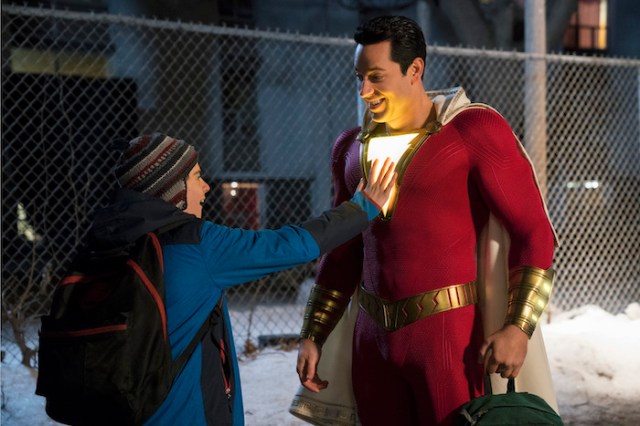 Boosted as a welcome light touch for the DC Comics movie universe, this rambunctious, somewhat unfocused comedy doesn’t really pass muster as a proper superhero feature, and it’s difficult to tell whether that’s the point. If you broke it down as you would a normal story you’d find two trains of thought: a touching tale of a foster child finding a family that’s more supportive of his needs than he could ever expect, and a hackneyed fairy tale about the same boy being gifted with super powers he has a hard time dealing with. As far as the latter thread goes, the recent Into the Spider-verse already nailed that particular theme, and the former thread is never really given a chance to make its case since it’s always being interrupted by the superhero stuff. What’s left is mostly confusion, though quite entertaining as such.
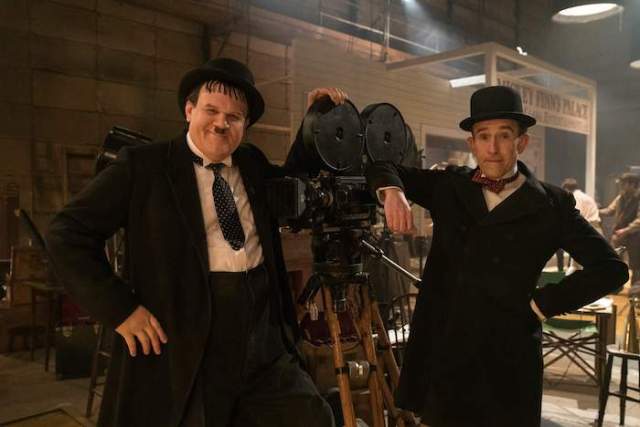 Jon S. Baird’s loving tribute to the legacy of Stan Laurel and Oliver Hardy falls into a trap common to biopics of performers. The film focuses on an episode in the comedians’ career that occurred late in life, thus allowing the filmmakers simultaneously to provide an overview of that career and a comment on how it turned out. It’s the early 1950s, and Laurel and Hardy are obviously past their prime. They are touring music hall theaters throughout England, staging famous slapstick bits from their movies. Their fans are their age or older. Younger people, who don’t have widespread access to TV yet, barely know them and so aren’t interested in the show, which means the performances are lightly attended except in the larger cities. This background provides the narrative with its requisite bittersweet tone, and while Baird doesn’t force the point, he doesn’t seem to feel obliged to make any other case for their situation at the moment, which is made even more melancholy by the fact that the purpose of the tour is to drum up industry interest in a new movie, which Stan (Steve Coogan) is constantly working on by pitching new sketch proposals to his partner (John C. Reilly), who doesn’t seem particularly interested. Due to health problems and his relatively new wife (third? fourth?), Ollie has already assumed the attitude of a retired man.
 Kudos to director Felix Van Groeningen for managing to fuse two different memoirs about the same topic into a movie that doesn’t become a mine field of conflicting points-of-view. The true story of Nic Sheff’s decade-plus battle with drug addiction was the subject of two books, Sheff’s own and another written by his father, David Sheff, a veteran journalist. Both were published in 2008 and recall events that started in the early 1990s. It’s both chronologically apt and a bit worrying that Nirvana plays such a prominent role in the beginning of the movie.
 It’s tempting to imagine that the British director Andrew Haigh is encountering the milieu of his latest film with the same kind of fresh awareness that the audience encounters it as it watches his movie. There’s something about this depiction of the seedier parts of Portland, Oregon, that feels almost shocking in its unexpectedness. Based on a novel by the songwriter Willy Vlautin, whose band the Delines covers much the same kind of rustic waywardness as that put forth in the film, Haigh’s script always seems to be in the process of unfolding truths that don’t come easy. It keeps you off balance, and slightly on edge.
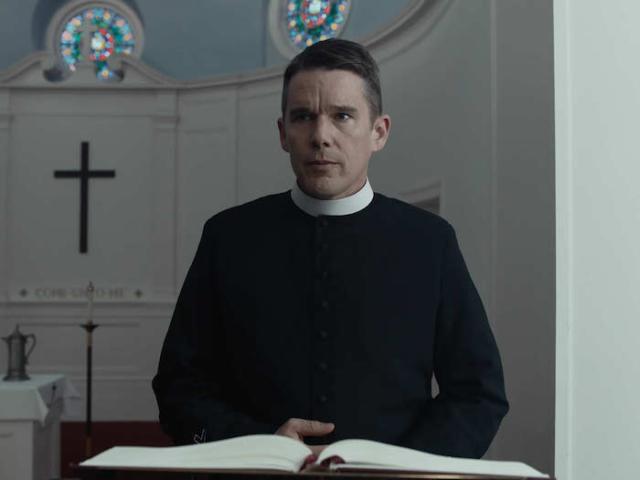 Though I rarely acknowledge such matters, Paul Schrader was royally screwed last February when he failed to receive the Best Original Screenplay Oscar for his latest film. It was bad enough that Ethan Hawke, who won all sorts of awards from critics’ groups for his performance in the lead role, wasn’t even nominated, but Schrader was a screenwriter before he was a director, and First Reformed may be the most cogent realization of his distinct world view and approach to cinematic storytelling. In fact, the most brilliant detail in his screenplay is the provenance of the First Reformed Church that provides the setting for the story. Its main appeal in the 21st century is not its status as a sanctuary from material suffering or the lucid world view of its sympathetic pastor, Reverend Toller (Hawke), but its historical relevance as a main stop in upstate New York on the Underground Railroad during the days of slavery. It’s a tourist attraction, which pretty much sums up the way Schrader has come to rationalize his fundamentalist upbringing and the state of his own faith.
 The comic challenge for Adam McKay, who made his name with Will Ferrell vehicles, in depicting the life of former Vice President Dick Cheney is not that no amount of satire could make the George W. Bush administration seem more ridiculous than it was, but that we already have a near perfect lampoon of the venality of Washington D.C. as represented by the second-in-command: Veep. Granted, McKay, as he did with The Big Short, is attempting to graft semi-serious real life matters onto frat boy stock situations, and there certainly wasn’t a bigger mess of frat boy toxicity than the Bush II White House. The real problem with this kind of approach is that the actors seem to be having much more fun than the audience is.
 philipbrasor.com