
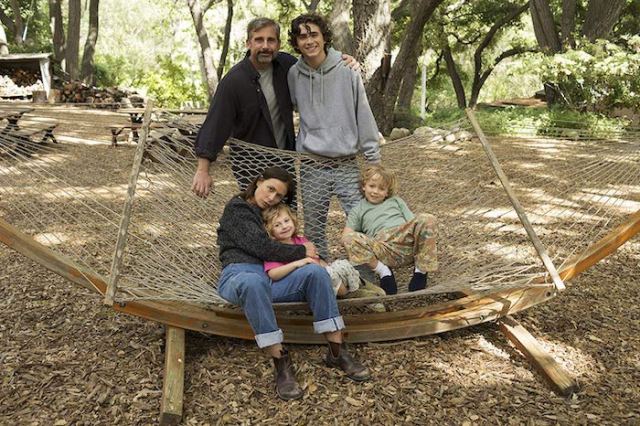
 Kudos to director Felix Van Groeningen for managing to fuse two different memoirs about the same topic into a movie that doesn’t become a mine field of conflicting points-of-view. The true story of Nic Sheff’s decade-plus battle with drug addiction was the subject of two books, Sheff’s own and another written by his father, David Sheff, a veteran journalist. Both were published in 2008 and recall events that started in the early 1990s. It’s both chronologically apt and a bit worrying that Nirvana plays such a prominent role in the beginning of the movie.
The narrative moves back-and-forth through time in an attempt to figure out not only how a kid (Timothee Chalamet) from such a privileged and liberal-minded family could end up a slave to pills and meth but why his father’s (Steve Carell) equally liberal-minded approach to the problem—he prefers to see the “enemy” as the addiction and not his son—never really worked. In that regard, Van Groeningen perhaps places too much emphasis on the milieu. David lives in a rambling designer home situated in idyllic, wooded isolation in Northern California with his second wife, Karen (Maura Tierney), who effectively raised Nic since they married when he was about 10. Nic is still in touch with his more standoffish birth mother (Amy Ryan), who also lives in upper middle class comfort in Los Angeles. Van Groeiningen’s point is that Nic became an addict despite his surroundings, an unnecessary implication since it is almost always the case that it is an addict’s personality that’s the problem rather than his surroundings or his upbringing exclusively; except, of course, that privilege has its emotional traps as well.
Still, it’s mainly David’s movie, and while scenes that address Nic in a more deliberate manner are plentiful, they are more or less illustrative of the kind of spiraling-down behavior we’ve become accustomed to in movies about addiction—the constant lying to loved ones, the casual criminality, the multiple failed attempts at rehabilitation. But then again, David’s scenes are mostly reactive. With each failure of his son to kick his habit and, thus, his own failure to come up with a plan that works, he sinks deeper into his own depression and instability. Though he tries not to fall back on “platitudes,” as he calls them, David cannot help but reach for every possible remedy, regardless of how suspicious he was of them earlier. At one point, he even buys some meth himself and tries it in an attempt at empathy that goes nowhere.
Though I haven’t read either book, it’s easy to get the feeling that both are open-ended essays on their authors’ respective experiences and what those experiences taught them. As such, the action in the movie doesn’t always feel consistent, as if Van Groeningen needed to create situations in order to provide the viewer with a comprehensible narrative, and that may explain why the movie never reaches a satisfying conclusion. By all rights, it shouldn’t, because that’s how life works, but the arc of the drama here creates certain expectations. The habits of conventional moviemaking are sometimes as difficult to kick as opium.
Now playing in Tokyo at Toho Cinemas Chanter Hibiya (050-6868-5001), Toho Cinemas Roppongi Hills (050-6868-5024), Shinjuku Cinema Qualite (03-3352-5645).
Beautiful Boy home page in Japanese.
photo (c) 2018 Amazon Content Services LLC

 It’s tempting to imagine that the British director Andrew Haigh is encountering the milieu of his latest film with the same kind of fresh awareness that the audience encounters it as it watches his movie. There’s something about this depiction of the seedier parts of Portland, Oregon, that feels almost shocking in its unexpectedness. Based on a novel by the songwriter Willy Vlautin, whose band the Delines covers much the same kind of rustic waywardness as that put forth in the film, Haigh’s script always seems to be in the process of unfolding truths that don’t come easy. It keeps you off balance, and slightly on edge.
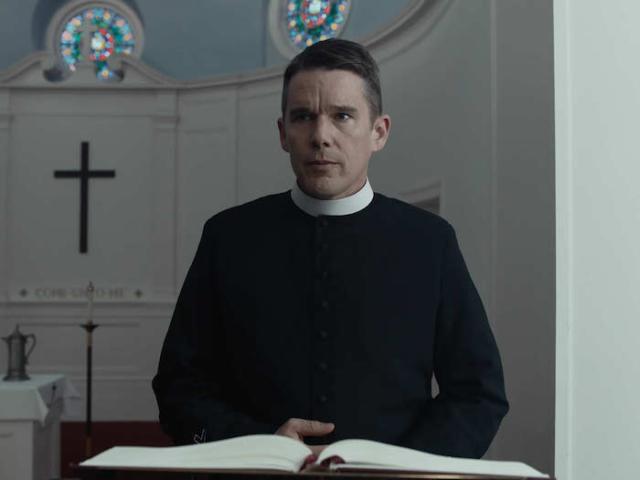 Though I rarely acknowledge such matters, Paul Schrader was royally screwed last February when he failed to receive the Best Original Screenplay Oscar for his latest film. It was bad enough that Ethan Hawke, who won all sorts of awards from critics’ groups for his performance in the lead role, wasn’t even nominated, but Schrader was a screenwriter before he was a director, and First Reformed may be the most cogent realization of his distinct world view and approach to cinematic storytelling. In fact, the most brilliant detail in his screenplay is the provenance of the First Reformed Church that provides the setting for the story. Its main appeal in the 21st century is not its status as a sanctuary from material suffering or the lucid world view of its sympathetic pastor, Reverend Toller (Hawke), but its historical relevance as a main stop in upstate New York on the Underground Railroad during the days of slavery. It’s a tourist attraction, which pretty much sums up the way Schrader has come to rationalize his fundamentalist upbringing and the state of his own faith.
 The comic challenge for Adam McKay, who made his name with Will Ferrell vehicles, in depicting the life of former Vice President Dick Cheney is not that no amount of satire could make the George W. Bush administration seem more ridiculous than it was, but that we already have a near perfect lampoon of the venality of Washington D.C. as represented by the second-in-command: Veep. Granted, McKay, as he did with The Big Short, is attempting to graft semi-serious real life matters onto frat boy stock situations, and there certainly wasn’t a bigger mess of frat boy toxicity than the Bush II White House. The real problem with this kind of approach is that the actors seem to be having much more fun than the audience is.
 The time frame of Paul McGuigan’s slice-of-life biopic of actress Gloria Grahame isn’t specifically stated, though the first scene takes place in a rundown dressing room in Liverpool in 1981 as Grahame (Annette Bening), long washed-up as a film actress, prepares to take the stage for yet another performance of The Glass Menagerie. She has already met and fallen in love with a local aspiring actor, Peter Turner (Jamie Bell), who is much younger than she is, and McGuigan hints throughout the movie that Grahame had a penchant for much younger men, even for boys. However, the film focuses on her relationship with Turner, which is limiting in terms of what it tells us of Grahame’s life as an artist and a human being. It’s also dramatically lazy, since the plot is a series of flashbacks and flash-forwards that seem to cover a long period of time but actually only cover a few years, and the development is just one drunken fight after another, many in Liverpool, where Turner was raised, but also in New York and Los Angeles, all followed by desperate reconciliations and punctuated by the recurrence of the breast cancer that eventually killed her at the age of 57.
 Here’s
 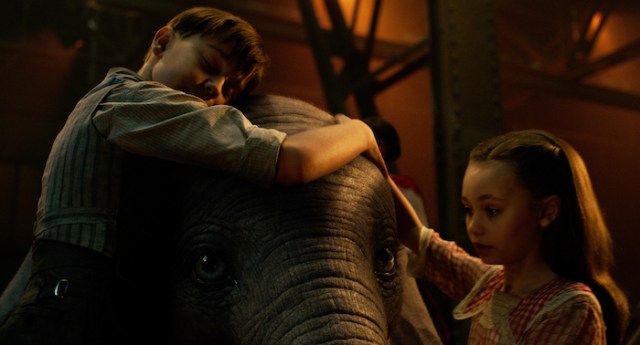 At this writing, the new CGI live-action Dumbo is being slated as a likely box office smash, thus justifying Disney’s faith in director Tim Burton as the kind of edgy filmmaker they can trust with their family fare. Inherent in this proposition is the idea that, of course, there is no intention of supplanting the original animated version of the story, but rather to simply give it more relevance for an audience whose tastes in technology are presumably more sophisticated than they were in 1941, but that’s a load of bull. Disney owns the story and the images and thus controls how those elements are reconfigured for a new generation. The real idea is to exploit a property, and nobody expects Burton, regardless of his reputation for the weird and the wondrous, to make anything other than what Disney approves of. And if you hold Alice in Wonderland up as an example of what Burton can do in the face of corporate control, remember that it was probably the worst reviewed film of his career. Neither Burton nor Disney seems willing to test each other in the same way this time.
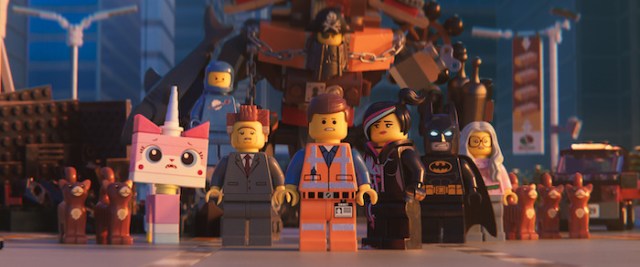 The big reveal at the end of the first LEGO Movie was one of the most brilliant in the history of animated films, since it capped a fairly hilarious mock-dystopian story with a credibly affecting framing device that not only put the mock-dystopian story into proper perspective, but gave it an emotional force that you couldn’t have expected given the overall comic thrust of the movie. Obviously, the sequel isn’t going to be able to deliver the same kind of thrill. As they used to joke in the old Looney Tunes shorts when the guy blows himself up to impress a vaudeville talent agent, yeah, it’s great, but you can only do it once.
 In the wake of the recent Mueller report and the disappointment felt by those who hoped it would hasten the end of Donald Trump’s presidency, Rob Reiner’s earnest paean to the old-fashioned virtues of hard-hitting newspaper journalism may, in fact, only serve to rub salt in those wounds being nursed by liberals like Reiner himself. Shock and Awe chronicles the painstaking research that the Knight Ridder newspaper group carried out to prove that the weapons of mass destruction Bush II posited as the reason for invadeing Iraq in 2003 were essentially made up. Almost every other media outlet in America bought the administration story, so Knight Ridder should have come to represent what’s left of responsible journalism, but for the most part journalism didn’t survive the Bush years, as we can easily tell by the shrill tone used to cover both the Obama and Trump administrations. The lesson the Trump folks want us to take away from Mueller is that the mainstream press can’t be trusted, which is also what Shock and Awe tries to tell us.
 philipbrasor.com