

Daisuke Miyagawa (middle)
Here’s this week’s Media Mix about the Nippon TV variety show Itte Q, which has been accused of fabricating foreign “festivals” for one of its most popular regular segments. One of the points I wanted to make in the column is that “yarase” (faking it) is a function of variety show production and not an anomaly. The cliches that have developed over the years through countless variety show formats dictate what audiences expect from the genre, and so producers work with those cliches, even if they don’t adhere to “reality.” Of course, television is a malleable medium, and anyone with so-called media literacy understands when they are expected to suspend disbelief. The most glaring example that comes to mind is the situation that occurs in many travel variety shows of someone going somewhere to look for a certain person. In every instance the reporter/talent finds the sought individual, and over the years it’s become commonplace for the encounter to be a chance meeting. The viewer probably understands that it’s all a setup if only for practicality’s sake. Why would the producers spend all that money to send talent and a crew all that way, sometimes to a foreign country, without a guarantee that they will have footage to bring back? In the case of Itte Q, as the professor quoted in the Tokyo Shimbun article pointed out, the producers have to work around talent Daisuke Miyagawa’s schedule because he is central to the appeal of the “festival” segment of the show, so they aren’t going to risk wasting resources and time by sending him to a place where he isn’t going to have anything to do. They’re going to make sure everything goes as planned and so will game the system, in this case the “festival” he’s checking out. The point, however, should not be that viewers are being fooled by all this. I’d prefer to think that fans of Itte Q and similar variety shows are wise to the subterfuge and accept it as part of the fun. On the surface, at least, the producers and the network have to make it seem as if it’s all on the up and up, but in the case at hand, the producers definitely misrepresented Laotian culture by inventing something that didn’t exist, which makes the subterfuge unacceptable. Nevertheless, as Donald Trump likes to say, it is what it is.
 Artist biodocs would seem to be easier to pull off than artist biopics, as long as there’s enough available footage. Eric Clapton has been more or less a star since he emerged in mid-60s England as a blues guitar prodigy and purist, and this career review makes ample use of film and photography, not to mention audio recordings of friends and family who offer insight into Clapton’s mindset at specific junctures in his life. There’s a lot to chew on, and in the end we get a very good idea of the kind of person Clapton is but are not much closer to understanding his sensibility as an artist than we were before we watched the movie.
 At first blush, this fairly modest horror movie by upstart Trey Edward Shults feels like a pale reflection of A Quiet Place, which is probably this year’s most successful horror movie. Both films are about families hiding out in the woods from unseen menaces. In the case of It Comes at Night, it’s a kind of plague, while in A Quiet Place it’s some sort of invading species of predator, but the main theme is survival against very bad odds. What eventually gives Shults’ film the edge in this regard is that the central family—Paul (Joel Edgerton), Sarah (Carmen Ejogo), and their 17-year-old son Travis (Kelvin Harrison Jr.)—can’t see the menace clearly, since it can only be transferred via another living being. Their paranoia is practical but not empirically based. In the haunting opening scene, they literally cart Sarah’s father (David Pendleton), covered in lesions and mumbling incoherently, to a ditch where they shoot him and set his body on fire.
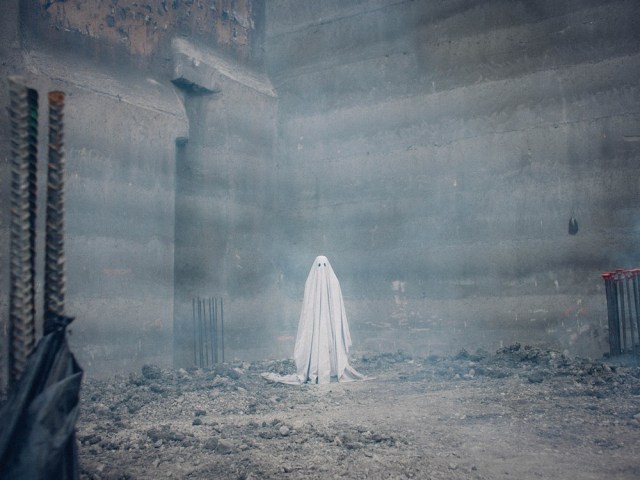 Though not a Hollywood film in the least, David Lowery’s A Ghost Story plays with ideas about the paranormal that are fashionable among the bean counters of tinsel town, except that they’re in service to a story about loss and the persistence of love. And in that regard it’s compelling up to a point. What fails to get through is any real reason for caring about the people on screen.
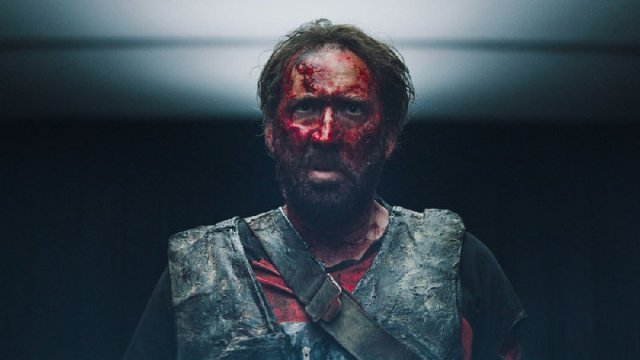 Panos Cosmatos’s violent revenge thriller is like every other violent revenge thriller and yet unique, owing mainly to its stubborn insistence on describing a specific place and time that has no discernible purpose. Set somewhere in the California wilderness in 1983, Mandy could have been set in a suburb of Indianapolis in 2010 with no change in theme or plot, and yet Cosmatos keeps throwing signifiers at us, as if he expects the viewer to pick up allusions that might explain the protagonist’s disturbing behavior. In that regard, the only thing that makes sense is the casting: Nicolas Cage may not have been born to play the grieving lumberjack, Red, but given his recent tendency to take every part offered to him, including terrible ones, he seems preternaturally suited to play this sympathetic monster.
 In it’s own limited way, the biopic of the British band Queen is as narratively compromised as the group’s creative output was musically compromised. Leader Freddie Mercury was always open about how his approach to rock was not doctrinnaire; that while he loved rock music and what it had undergone in the post-Beatles world of English pop, he loved theatricality even more, and so many of Queen’s best-loved songs combine prog-rock technique with Broadway glitz, and the movie honors this legacy by avoiding anything that smacks of subtlety or even verisimilitude. When people say that Rami Malek’s impersonation of Mercury is the best thing about the movie, what they’re saying is that the actor falls for Mercury’s preternatural need to show off. Even in the expository passages, showing how Mercury overcame his immigrant insecurities, his self- esteem problems, and, eventually, his hesitancy to acknowledge his homosexuality, you almost expect him to break into song in a bid to make these scenes even more emotionally fraught. Queen fans will love it, and Queen skeptics still won’t get it for the same reason.
 The “Ten Years” series started in Hong Kong in 2015 with an omnibus of shorts depicting the former British territory ten years into the future, and was notably dystopian in tone, which is to be expected, and not just because of the city’s special circumstances of being stuck halfway between a Western-influenced conclave in Asia and the point-of-the-spear for China in the international economic order. Any movie that attempts to specifically predict what’s going to happen in the future is probably going to have cautionary aspects. In any case, Beijing was quite alarmed at the film, and it may have been that aspect which sparked similar productions using the concept in Taiwan, Thailand, and Japan.
 The pleasures and edifications of Michael Moore’s latest broadside attack on the power elite comprise more of a mixed bag than any of his previous polemics, which tended to focus on a specific, albeit broadly characterized, subject matter. Though Donald Trump is the ostensible target, Moore ranges far and wide to explain the forces that he thinks conspired to get Trump elected, taking in everything from establishment Democrats to the mass media and even Gwen Stefani. And while Moore’s explications don’t always stand up to rigorous scrutiny as journalism, there’s less of his patented working-guy-confrontation shtick, which had been getting old more than a decade ago, and it makes all the difference in the world.
 philipbrasor.com