
 Collaboration is more than just the theme of Agnes Varda’s latest curiosity. Teaming up with the tall-glass-of-water visual artist JR both on camera and behind it, the veteran nouvelle vague director expands her late career discussion of the French polity by engaging it in one of JR’s art projects, thus freeing herself up as more than just an enthusiastic observer of what is mostly rural life.
During the course of the film, the two artists travel the French countryside in pursuit of meaningful encounters with average people. The entry point into these people’s lives is JR’s very large prints of the individuals they encounter, which are then plastered on surfaces in very public places. Sometimes the photos are of faces, sometimes they are of full body shots. Many include more than one person. They are then affixed to buildings and even vehicles. The point is that each work of art is attended by a true story related by the subject, the overall result being a portrait of a people that becomes more indelible with the addition of semi-permanent visual aids.
But that isn’t the real appeal of the movie, which is Varda’s and JR’s interaction with each other. The pair putter around in a large truck listening to pop songs and talking about anything that comes into their heads. There’s a playfulness to these interactions that defies the age difference and informs their conversations with the farmers, factory workers, and village bureaucrats they meet on the road. Their collaboration is mainly with life, and they extend it to everyone they encounter. The goofiness is built into the contrast between the two principals: Varda is short, plump, pixieish, with a drastic two-tone bowl cut, while JR is tall, lanky, insouciant, his head constantly encased in a fedora and dark shades (a running joke throughout the film). Varda is also 88, and she is happy to bring her experiences into the discussion, dropping names like crumbs of bread and plumbing her exceptional memory for anecdotes that apply to any situation she finds herself in.
And there is drama. JR drops his flippant air when they visit his 100-year-old grandmother, and a visit to an ophthamologist reminds us of Varda’s encroaching decrepitude, since it appears she is going blind. But even that sequence is leavened with a joke—he eye-slashing scene from Un Chien Andalou, a movie she apparently had something to do with. For once the purposely shocking image is revealed for what it is: a prank against conformity, which is a stirring rebuke to the idea that the average person is a slave to normalcy. The people we meet are widely varied in their appetites and needs, and as our hosts continually expound, the mission of film and photography is to open us up to that possibility. JR’s project is a willful exaggeration of this premise. His works are intended to crush the notion of the commonplace: How can a dockworker’s face stretched across the side of a building be considered “normal?” How, for that matter, can a goat’s?
In the end, Varda and JR attempt to visit the man who perhaps best represents all they have tried to accomplish in their unique movie: Jean-Luc Godard. They fail to make the connection, though the aborted visit does lead to another wonderful anecdote about a weekend Varda and her late husband, Jacques Demy, spent with Godard and his wife, Anna Karina. Every moment in life is magic. Few movies drive that point home as well as Faces Places does.
In French. Now playing in Tokyo at Cine Swith Ginza (03-3561-0707), Shinjuku Cinema Qualite (03-3352-5645), Uplink Shibuya (03-6825-5503).
Faces Places home page in Japanese.
photo (c) Agnes Varda-JR-Cine Tamaris, Social Animals 2016
 Here’s
  I have yet to see Ryusuke Hamaguchi’s previous film, the internationally lauded 5-hour domestic drama Happy Hour, which, probably due to its length, hasn’t been picked up by WOWOW. But having read about its charms for almost a year I was intrigued to see his latest, which premiered in competition at this year’s Cannes. It’s much shorter and, based on a popular novel, apparently more manageable than Happy Hour. In fact, it’s pretty conventional in terms of plot and characterization. Hamaguchi’s strong point is his attention to personality detail. Despite the hackneyed dialogue and thin motivation that’s built into the story, he manages to make the people on screen seem familiar in a three-dimensional way, though, in the end, it isn’t enough to lift the narrative out of the pedestrian.
 It’s a good thing the second Ant-Man movie is above average, because it’s becoming quite a chore to fit all these Marvel superhero movies into the Marvel universe, at least as it applies to the Avengers movies, which seem to be the focus. Much of the plotting of Ant-Man and the Wasp is dependent on both the last Captain America movie and the last Avengers flick, though temporally they exist in different relative dimensions, and I found myself uselessly trying to recall the details of Avengers: Infinity War, which hasn’t taken place at this point, when I should have been concentrating on Captain America: Civil War, which is the reason our hero, Scott Lang (Paul Rudd), is under house arrest as the movie begins.
 Here’s
  Thanks to Japan’s complicated publicity machine, the sequel to the successful movie version of the very successful ABBA-inspired jukebox musical Mamma Mia! arrives well after most of the rest of the world has decided it’s a better movie than the original. The first thing that strikes me is pity for Meryl Streep, who basically saved the first movie from mawkish amateurism with her native ability as a stage performer and willingness to parlay her appreciation of the songs into a silly nostalgia romp. I don’t think I’m spoiling anything at this point by saying that Streep’s character is deceased in the sequel, a move that may have been production-oriented (Meryl may have simply thought once is enough) but was probably strategic, since the plot is divided into two parallel storylines taking place in different time periods. In the present, we have Donna’s (Streep) daughter, Sophie (Amanda Seyfried), preparing to reopen her mother’s Greek hotel, with or without the aid of her famously three fathers, Sam (Pierce Brosnan), Bill (Stellan Skarsgard), and Harry (Colin Firth). The other storyline depicts the early 20-ish Donna, played by the other young blonde go-to actress of the moment, Lily James, coming to the Greek island in question for the first time and meeting the three men who will seal her fate as not only a single mother of distinction, but a popular travel destination entrepreneur.
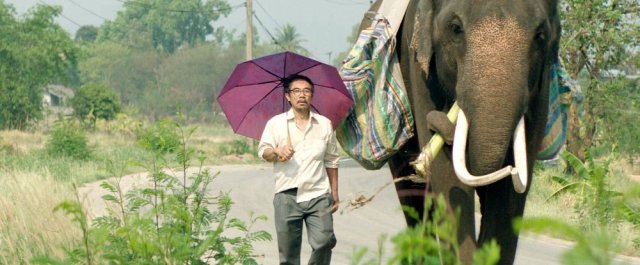 The titular elephant in this Thai film is named after the iconic cartoon sailor, though I can’t really fathom the title’s unconventional spelling. In a way, the linguistic disconnect expands on the movie’s sometimes jarring juxtaposition of universal themes and local particulars. The hero is a successful architect, Thana (Thaneth Warakulnukroh), who is going through the usual mid-life crisis (failing marriage, loss of direction, etc.) and one day happens upon a man trying to move an elephant along a Bangkok street. Convinced the elephant is Popeye, his childhood pet when he lived in the deep countryside, he buys the animal off the man and sets out to “bring the elephant home” on foot. In other words, Pop Aye is a classic road movie of self-discovery except that we have no insight into the mindset of one of the members of the entourage.
 The Brothers Grimm story from which this French animated film has been adapted is not one of their more famous ones, but it has all the non-Disney hallmarks that have made the fairy tale-meisters the darlings of comparative lit majors. It’s fixated on graphic violence and sublimated sex, but it’s also about the human capacity for cruelty that goes beyond the kind of cartoon villainy we’ve come to expect from stories like this. The fundamental reason the story is so powerful and suggestive is the animation itself, which not only eschews CGI, but also the kind of cell-craft that most people are familiar with.
