
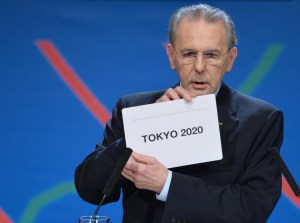
 Here’s this week’s Media Mix, which is about resistance to the solicitation of “volunteers” for the 2020 Tokyo Olympics. As stated at the beginning of the piece, the ostensible reason for the all-volunteer character of the staffing plan is to save money, since the volunteers will not be compensated. The once-in-a-lifetime experience of working for the games is thought to be compensation enough, and, for sure, Tokyo is shaping up to be the most expensive Olympics of all time by a large margin. For the most part, the organizers are trying to save money on infrastructure items–streamlining transportation and shifting construction costs to local governments and other participants. As mentioned, the organizing committee’s own budget has not been scrutinized and likely won’t be, which is why Ryu Honma, the freelance journalist who has been most vocal about the unfairness of the volunteer scheme, wants to look at it and how sponsors contribute to it.
Asahi Shimbun (which, for the record, is one of the sponsors) pointed to another area where savings could be made. In a Dec. 23 article, the newspaper talked about accommodations for the members of the International Olympic Committee during the games. As a matter of course, the IOC has demanded 1,600 rooms and suites for 33 nights, all at “4-star or 5-star hotels in Tokyo.” According to IOC rules, it is obligated to pay up to the equivalent of ¥44,000 a night per room for these accommodations, with any difference being covered by the local organizing committee. Luxury hotel rooms and suites in Tokyo cost upwards of ¥100,000 a night, and you can bet that all hotels in the capital will be charging premium prices while the games are going on. Among the “25 items” that the organizers have proposed to “reduce expenditures,” which the IOC is demanding, is to either “lower the grade of hotels” for the IOC, or have the IOC cover its own accommodation expenses. Of the 25 suggestions offered, this was the only one the IOC completely rejected.
 As there was no one record that monopolized my attention this year—nothing I wanted to hear compulsively, like Heartthrob or The Truth About Love in past years—I found myself shuffling through a lot more new music than I usually do, and with a greater sense of curiosity. Consequently, I discovered acutely how far my tastes ranged from week-to-week, even day-to-day. It’s not unusual that an album I really liked at the beginning of the year faded in my estimation toward the end of it, but in 2017 I found this fluctuating attraction to certain songs and artists to be even more extreme, and while at first I put it down to a kind of middle-aged ADD, now I think of it more as a function of the type of emotional involvement with music I used to take for granted when I was young but no longer have the time to indulge. Of course, one of the reasons you glom onto certain artists or albums is that you instinctively steer toward the safe harbor of familiarity, and I’m not just talking about the stuff you liked when you were a college freshman. When making up lists like this, I always trust my impulses first, and I know that doing so can necessarily push away things I might genuinely love if I gave them enough time; though I also think that music, as opposed to movies, is a more impulsive endeavor, for both the creator and the receiver. And if there’s anything that unites the albums that made my top ten it’s their ability to please me in an ever-intensifying way now that I’ve learned them more or less by heart, and in many cases that didn’t happen until December. That said, the new album I probably listened to most intensely this year was Randy Newman’s, and I can’t rightly say why it didn’t make this list. Maybe I just prefer his older, more concise songs to his late-career theatrical approach, but I guess that’s a safe harbor, too, and when I was honest with myself, I had to admit I liked a lot of other stuff much more.
 Every year my movie-watching regime becomes more rarefied owing to tighter schedules and diminished monetary inducement. Nowadays, however, I can often make up for the films I miss at press screenings by seeing them later at my local multiplex, on streaming services, or on the satellite channel WOWOW (though by then they’ve usually been out of theaters for a year). In actuality, I can only think of one film I saw in any of those situations that might have ended up on this list: Noah Baumbach’s The Meyerowitz Stories. I’ve always liked Baumbach, and this one, which I saw on Netflix, was better than most. I think I might have liked it even more if I had seen it in a setting with no cats or other domestic distractions. These are definitely the pitfalls of home viewing for anyone who takes their movies seriously. So are overly comfortable seats. I can definitely attest that I fell asleep during substantial portions of Ghost in the Shell and Despicable Me 3 because I saw them at night-time big press screenings held in movie palaces with those damn throne-like chairs. I can just as confidently say that regardless of where I saw them, I did not doze off during any of the following fifteen films, all of which I wouldn’t mind seeing again, as a matter of fact. As always, these films were all released in Japanese theaters during the 2017 calendar year. Oh yeah, and I loved Twin Peaks the Return, but I would never qualify it as a movie.
 Beautiful Trauma
 The Age of Shadows
 Here’s

 The Nordic Mellow
 philipbrasor.com