
Here are the movie reviews I wrote for the April issue of EL Magazine, which was distributed in Tokyo last weekend (a little later than normal due to a printing error).
 Black Panther
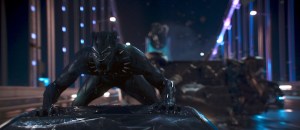
By now it’s difficult to separate the hype surrounding this extraordinary blockbuster from its qualities as a work of art, and while art may not necessarily have been what the filmmakers were after foremost, they certainly endeavored to make this latest entry in the expanding Marvel Comics universe more momentous than other recent superhero movies. But even within the preordained structural conditions that come with Marvel movies, Black Panther stands out, and not just because almost all the characters are black. Director Ryan Coogler has already proven, with Creed, that he can take a popular and beloved predigested film series and make it fresh by rejiggering its focus to appeal to black audiences. What distinguishes Black Panther is its attention not only to the action details all moviegoers demand these days, but to the particulars of the black experience in nuanced and refined ways. The quick, effective opener explains the fictional African country of Wakanda and its development as an advanced nation thanks to the auspicious arrival of a meteor eons ago carrying a vital metal called vibranium. The futuristic city built upon this element is kept mostly shielded from the world, but the tribes that thrive under its dominion continue to practice the ancient traditions, only with more responsibility because of their blessing. Wakanda is a utopia, and Coogler’s genius is in contrasting it with the lot of people of color throughout the world, in particular African-Americans. The requisite conflict, in fact, is precipated by one of Wakanda’s royalty, N’Jobu, exiling himself to California due to his objection to Wakanda’s self-imposed neutrality in the face of his race’s subjugation at the hands of “colonizers.” He is sought out by his brother, T’Chaka, who finds him in Oakland and brands him a traitor, killing him in the process, thus setting the stage for when N’Jobu’s son, Erik Killmonger (Michael B. Jordan), challenges T’Chaka’s son, T’Challa (Chadwick Boseman), for the throne of Wakanda. By this time, T’Challa is king, and thus assumes the identity of Black Panther, whose super powers are derived from vibranium, some of which is stolen by a white arms merchant (Andy Serkis) being chased by the CIA. This plot development makes for the only really uncomfortable bit in the movie, since T’Challa must work with the American government to get back his metal. It also means the CIA is instrumental in helping Wakanda fight off Killmonger’s scheme to bring Wakanda out of the shadows and on to the world stage as a righteous defender of the oppressed, and it’s hard not to argue with that, especially when it’s couched in Jordan’s street smart dialect. In fact, Killmonger’s mission, even as it runs up against the noble heroics of Black Panther, never feels compromised. You almost wish he’d wipe that stupid grin off the CIA’s face. (photo: Marvel Studios) Continue reading
 Here’s
  Here’s
  Here’s
 Beach House 3
 Here’s
  The Beguiled
 Since they don’t tour or make videos, XTC give interviews. Lots of them. Colin Moulding, the group’s soft-spoken bassist reckons he and his partner, guitarist Andy Partridge, have done something like a million since they began promoting their new album, Apple Venus, Vol. 1, last fall.
 In today’s Japan Times there is a
  Here’s
  philipbrasor.com