
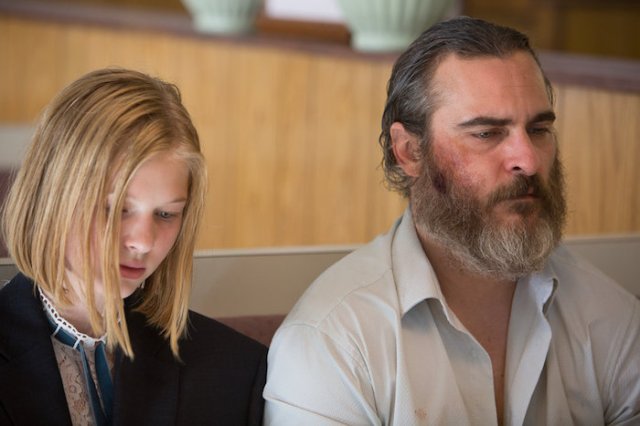
 It’s difficult to grasp what director Lynne Ramsay is trying to accomplish with her new movie. Ostensibly a genre exercise, You Were Never Really Here sketchily outlines the daily grind of a hit man, Joe (Joaquin Phoenix), who specializes in rescuing young girls from the clutches of kidnappers and other bottom feeders. Joe suffers from some form of PTSD that seems to be a combination of battle fatigue and his own early childhood trauma, and Phoenix plays him as a sullen misanthrope who occasionally bursts into uncontrollable tears, but not necessarily because of his bloody work. Ramsay’s style here is similar to that which made her 2001 feature, Morvern Caller, an indie sensation: Smudgy cinematography and random edits that recreate a druggy sensibility. This made sense in Morvern because the protagonist was living a lie that she couldn’t credibly keep up with. With Joe the charged atmospherics are a literal representation of his mindset, and in the end they only work against the trite hit-man arc of the plot.
Though the movie delves into extraneous character development–Joe’s queasy relationship with his damaged mother (Judith Roberts), his bizarre addiction to jelly beans–it eventually has to fulfill its genre obligations, and Ramsay doesn’t seem to be invested enough in the particulars of building a thriller. Joe is dispatched to save a girl (Ekaterina Samsonov) from what seems to be a cabal of pedophile politicians. The implication that such a group exists brings up all sorts of questions that deserve an answer before we can even begin to believe Joe’s reckless methodology in carrying out his contract. For one thing, Joe’s weapon of choice is a simple hammer, and while Ramsay doesn’t really show him using it, she does reveal the aftermath of his violence. It’s hard to see this devisce as being anything other than gratuitous.
The only really effective result of all this careful visual manipulation—some critics have called You Were Never Really Here essentially the final section of Taxi Driver drawn out to feature length—is Phoenix’s portrayal of a naturalistic brute. When he does fly into action, with his bulked-up action moves and hysterical expression, you immediately realize how vacant the assassin genre is normally. There really is no such thing as the cool-as-ice killer, so if Ramsay deserves any credit for giving us one more pointless addition to an already overstuffed film trope it is to show the genre’s bankruptcy as anything other than a form of exploitative entertainment, but I’m not sure if that’s a good enough reason to make this movie.
Now playing in Tokyo at Shinjuku Wald 9 (03-5369-4955), Human Trust Cinema Shibuya (03-5468-5551), Human Trust Cinema Yurakucho (03-6259-8608).
You Were Never Really Here home page in Japanese
photo (c) Why Not Productions, Channel Four Television Corp. and the The British Film Institute 2017. (c) Alison Cohen Rosa/Why Not Productions
 Recently, Christopher Nolan hailed Stanley Kubrick as the greatest director of all time, mainly for his ability to make nitrate film stock mimic the most sublime visual attributes of great paintings. Though he was thinking of 2001, Barry Lyndon is a better example of this attribute, and Barry Lyndon is the most obvious analog when discussing Catalan filmmaker Albert Serra’s The Death of Louis XIV. This is about as close as we’ll ever get to the richness of Rembrandt on film, and there are whole passages where all we have are closeups of faces that are doing nothing in particular but look like people from the 18th century.
 As a long-time resident of Japan whose interaction with the local culture is circumstantial, I don’t believe I have much to add to the conversation that has surrounded Wes Anderson’s latest entertainment and which mostly has to do with whether the director has exploited that culture without really understanding it. At first glance, I was more offended by the anti-cat bias of the storyline, but that, as they say, is just me. Narrative films rarely take the trouble to make whatever milieu they depict accurate in every sense since dramatic considerations usually come first. Generally speaking, if the dramatic elements work for me, I will appreciate, if not necessarily enjoy, the work on hand, and while I’ve had problems with Anderson in the past, I have come to like his movies the more I see them, which means he’s either getting better or I’ve just become used to his purposely quirky presentation.
 In the rarefied setting that informs Paul Thomas Anderson’s latest luxury, the title “fashion designer” seems imprecise when describing the vocation of the protagonist, Reynolds Woodcock (Daniel Day-Lewis). He’s a dressmaker. All he makes is fine dresses for fine ladies. He is not, in fact, interested in fashion as an art form, though he obviously sees himself as something of an artist. More to the point, he’s an aesthete, a trait that Anderson emphasizes in the broadly conceived opening sequence, which shows Woodcock carrying out his morning ritual of dressing himself and then eating breakfast, preparations that are as vital to his vision of life as a series of beautiful choices as are his selection of fabric and filigree for his apparel.
 Here’s
 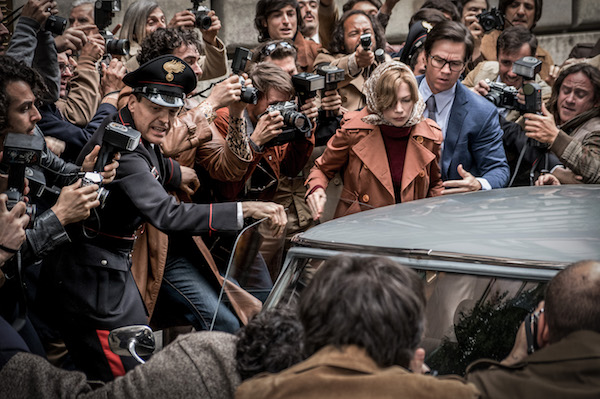 It’s a wonder that the incredible tale of the 1973 kidnapping of oil billionaire J. Paul Getty’s grandson hasn’t been dramatized before (for the record, there is presently a TV series covering the same ground), but as it stands this high-concept, low-ambition rendering by Ridley Scott has become more famous for its casting than for whatever insights it brings to the case, and for what it’s worth it’s difficult to believe that Kevin Spacey, unceremoniously dumped from the film after his scenes had been shot, would have captured the peculiar oily charm of Getty the way Christopher Plummer has.
 Atsuko Hirayanagi explores familiar screwball archetypes in her debut feature, and while most have been well presented by other Japanese directors, they’ve never attempted them in a cross-cultural setting. Setsuko (Shinobu Terajima) is an uptight, lonely single woman working a deadend OL job in Tokyo and living in a frightfully messy apartment. She seems this close to self-annihilating breakdown when her saucy niece (Shioli Kutsuna) talks her into signing up for English lessons with her teacher, an earnest American named John (Josh Hartnett). With a pedagogic style that uses hugs and wigs to fortify the role play endemic to Japanese language learning, John wins Setsuko over, and she becomes enamored of not only her new persona, Lucy, but John himself. When he suddenly leaves Japan with her niece in tow, she is eager to join her annoyed sister (Kaho Minami) on the California journey to find them. There, the movie opens up in startling ways and you appreciate not only Hirayanagi’s astute understanding of American differences, but also Terashima’s empathy with an inherently unlikable character. (95 min.)

 Both Sides of the Sky
 Here’s
  philipbrasor.com