
 Though stuffed to the gills with macho signifiers and the sentimentalized homoerotic comradeship of men in peril, this action film about the job of forest firefighting is notable for the way it incorporates the minutiae of the job into a kickass storyline without making it feel pedantic or dry. In the opening scenes, a fire department supervisor for the city of Prescott, Arizona, Eric Marsh (Josh Brolin), prepares his team for recertification from your normal fire crew to a coveted federally recognized “hotshot” team, which are called on only to battle the most dangerous forest fires. The crew’s grueling physical training regimen is detailed, but also its logistical knowhow in learning how fires spread, which mostly involves preparing a line at the edge of an area where the fire is heading in order to “contain” it. The work looks unexciting—mostly clearing the area of brush and fuel—but is nevertheless fascinating in the way it enlightens the viewer of what they need to know about the drama that will eventually unfold.
Unfortunately, this straightforward methodology is complicated by the usual dramatic flourishes, embodied in the character of Brendan McDonough (Miles Teller), a former drug addict who, now that he’s a father, is walking the straight-and-narrow with a particularly upright backbone. Mistrusted by the rest of the crew he’s trying to join, he has his work cut out for him, but Marsh keeps cutting him slack because he suspects that what he’s been through will make him more conscientious as a fireman—not braver or less risk-aversive, but smarter when things get really tough. Marsh is the big brother figure, which means Marsh himself needs a father figure, which comes in the form of Jeff Bridges as Prescott’s fire chief. Though director Joseph Kosinski doesn’t belabor these relationships, he doesn’t do much to make them anything more than emotional fuel that never quite gets lit. Then, of course, there are the women, notably Marsh’s wife, Amanda (Jennifer Connelly), who hold down the fort and worry excessively about their men whenever they go into the flaming fray. The requisite action finale is scary and bracing and keeps the focus on what’s real at the moment rather than what’s going to happen. The movie builds suspense from what we have learned about the way forest fires “act.” It’s a rare disaster movie that asks you to appreciate the action based on what it’s already taught you about nature, both human and existential.
Now playing in Tokyo at Toho Cinemas Hibiya (050-6868-5068), Toho Cinemas Shinjuku (050-6868-5063), Shinjuku Wald 9 (03-5369-4955), Toho Cinemas Nihonbashi (050-6868-5060), Toho Cinemas Roppongi Hills (050-6868-5024), Toho Cinemas Ueno (050-6868-5060), Cinema Sunshine Ikebukuro (03-3982-6388).
Only the Brave home page in Japanese.
photo (c) 2017 No Exit Film LLC
 Mexican director Michel Franco’s signature is a sensationalistic storyline told in a dry manner. The basic idea of April’s Daughter is made for tabloid TV—teen pregnancy as the natural outcome of a broken home. However, Franco doesn’t present this scenario in a way you’d expect. The young mother, Valeria (Ana Becerril), is 17 and, we are led to believe from the very start, likes sex a lot. She lives with her older sister, Clara (Joanna Larequi), in a nice rustic house on the beach in Puerto Vallarta, a situation that belies their material circumstances. Both are dropouts working part-time jobs. We soon learn that the house is owned by their mother, April (Emma Suarez), who doesn’t live with them and for some reason isn’t aware that Valeria is pregnant, even though she’s already 7 months along when the movie opens. Clara, a moody, lonely girl who resents Valeria’s dissipated lifestyle, tells April of her sister’s condition against Valeria’s wishes, and April shows up promising to help out. At first Valeria is suspicious and resentful, as if she’s seen this scene before and learned not to believe in it, but her fears over the coming delivery prove to be too much and she asks her mother to stay and see her through. Valeria’s boyfriend, the studly but somewhat clueless Mateo (Enrique Arrizon), is all for it, since his own parents want nothing to do with the child.
 Here’s
  As a documentary filmmaker, Kazuhiro Soda goes with what he knows, or, more precisely, who he knows. In most cases his subjects are people he’s close to, and while the relationship makes the filmmaking process easier and more open it also allows Soda to sort of cruise. His latest film is more ambitious in terms of scale, but it still takes the easy way. Apparently, Soda had a teaching gig at the University of Michigan in Ann Arbor, and he recruited some of his students to help him make a documentary about the university’s famous football stadium, which is supposedly the second biggest sports facility in the world. Filming mainly during a home game against UM’s nemesis Michigan State, the group of more than 15 cameramen try to take in everything, from concessions to rich alumni to scalpers and even the locker room.
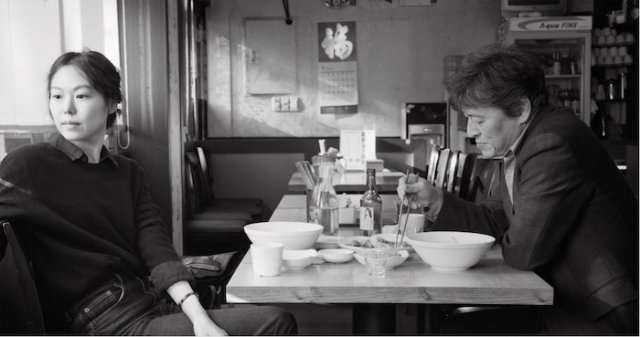 Hong Sang-soo’s antiromantic comedies differ little in terms of narrative themes, and tend to distinguish themselves through formal construction. The Day After is almost unique among his films in that its form is conventional—no “what if” digressions or POV mischief—and for once the comedy is clear-eyed and unfussy. Bong-wan (Kwon Hae-hyo) is a typical Hong stand-in protagonist, a noted critic-cum-small press publisher who is having an extramarital affair with his only employee, Chang-sook (Kim Sae-byuk). In the brilliantly staged opening scene, Bong-wan is having breakfast with his wife, Hae-joo (Jo Yoon-hee), who has somehow gotten wise to the affair and plies him with questions as he plays with his food and laughs at her. The scene is both hilariously on point and witheringly precise about the marriage dynamic, but the viewer has no way of knowing whether Hae-joo’s suspicions are correct. Still, if the viewer has seen a Hong film before they can probably assume them to be.
 Here’s
  It would be difficult to make a better military-themed movie than The Last Detail, the 1973 Hal Ashby adaptation of Darryl Ponicsan’s debut novel about two fun-loving sailors escorting a third to the brig for the ignominiuos crime of pilfering a charity box. With a script by Robert Towne and one of Jack Nicholson’s most indelible performances, it’s a unique feature, better than M.A.S.H. at plumbing the contradictions sane men put up with when following the killing chain of command, and the seminal road movie in an era when the road movie came into its own as a sub-genre. Ponicsan wrote a sequel in 2004 with the same three characters, older, obviously, and going on another road trip, but director Rickard Linklater, for reasons that can only be surmised, decided to change the names of the characters, their branch of service to the Marines (which is odd, since in the original movie the Marines are sworn enemies of the Navy), and the most salient trait of the character who went to jail, namely his innocence. In fact, this character, called Doc (Steve Carrell), seems to have been dishonorably discharged for a more serious offense than stealing.
 It will be interesting to see the reaction in Japan to Hirokazu Kore-eda’s latest film, which won the Palme d’Or at Cannes last month. Though Kore-eda has tackled socially relevant topics in the past, most notably in his 2004 shocker Nobody Knows, Shoplifters seems to have hit a sore spot with certain fellow countrymen who probably have no intention of ever seeing it, thinking it reflects badly on Japan while winning a prestigious award overseas and being sold to 149 countries. These public personalities, including bestselling novelist Naoki Hyakuta and celebrity plastic surgeon Katsuya Takasu, claim to speak for Japan when they say the movie, which is about impoverished people who resort to petty crimes to get by, sends the wrong message about Japan and Japanese people. During a post-screening press conference at the Foreign Correspondents Club of Japan, the director didn’t address these claims directly, but suggested instead that he had no particular reason for choosing this theme except that he found it dramatically interesting. If the movie comes off as being “political,” meaning that it appears to criticize social policies that have resulted in abject poverty, that is more like a function of the viewer’s take on the subject. If anything, Shoplifters is a work of empathy rather than one of outrage or polemics—more Mike Leigh than Ken Loach. In fact, if the naysayers swallowed their bile and sat down and watched it, they’d probably realize that, in its own way, it paints the Japanese family in the kind of colors they would normally approve of. Their problem is that they aren’t going to accept the social unit on display as a “family” in the first place.
 Authenticity is fleeting in American teen comedies, even when they shade over into coming-of-age tales. In her autobiographical directing debut, Greta Gerwig is obviously after authenticity above everything else—it’s mainly there in the subversive dialogue—but she’s too experienced as an actor and indie film fixture not to want to get as many laughs as she can, and the purposely commonplace quality of her setting—early 00s Sacramento, which one person calls the “Midwest of California”—works to emphasize the extraordinary self-possession of the titular character, high school senior Christine (Saoirse Ronan), who prefers to be called Lady Bird. Extraordinary protagonists are, of course, the standard of teen comedies, but mainly in constrast to their peers. Here, what makes Lady Bird special is her relationship with her parents, in particular her mother, Marion (Laurie Metcalf), a hard-working nurse who recognizes what’s extraordinary about her daughter but still has to throw her authoritative weight around because she panics at the idea that Lady Bird is unequipped for the world, despite her intelligence and sensitivity. While driving back from a tour of colleges, the pair listen to an audio book of The Grapes of Wrath and get into a bizarre argument about how to appreciate the novel, which has brought them both to tears. In protest to her mother’s haughtiness, Lady Bird flings herself out of the moving car.
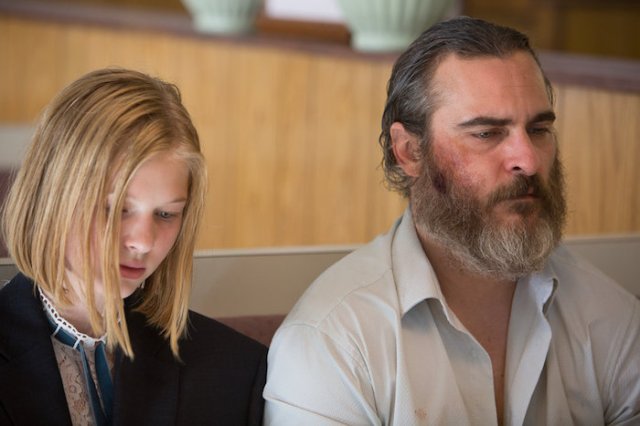 It’s difficult to grasp what director Lynne Ramsay is trying to accomplish with her new movie. Ostensibly a genre exercise, You Were Never Really Here sketchily outlines the daily grind of a hit man, Joe (Joaquin Phoenix), who specializes in rescuing young girls from the clutches of kidnappers and other bottom feeders. Joe suffers from some form of PTSD that seems to be a combination of battle fatigue and his own early childhood trauma, and Phoenix plays him as a sullen misanthrope who occasionally bursts into uncontrollable tears, but not necessarily because of his bloody work. Ramsay’s style here is similar to that which made her 2001 feature, Morvern Caller, an indie sensation: Smudgy cinematography and random edits that recreate a druggy sensibility. This made sense in Morvern because the protagonist was living a lie that she couldn’t credibly keep up with. With Joe the charged atmospherics are a literal representation of his mindset, and in the end they only work against the trite hit-man arc of the plot.
