
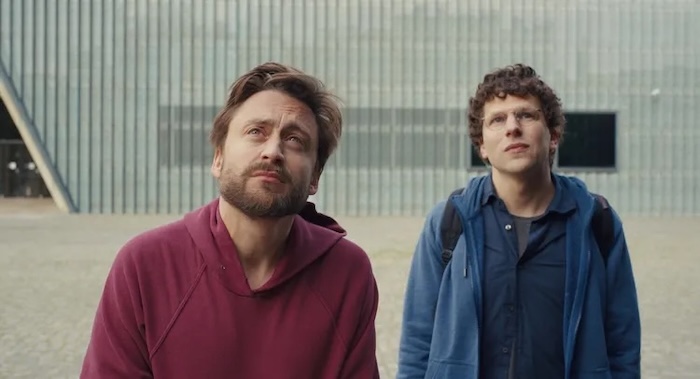
Though Jesse Eisenberg taps every anxiety joke in his second directorial feature and does nothing particularly fresh with them, A Real Pain is quite funny in the way some of Woody Allen’s post-Annie Hall comedies were funny. Characters you’re familiar with act out in ways that highlight life’s essential unfairness, and the ironies hit home via the chuckle reflex. As with much comedy, whether narrative or standup, it seems easier to mine this vein of suffering if you’re Jewish, and Eisenberg’s premise is both a gold mine of comic possibility and inherently tragic. Two cousins who were once very close embark on a Holocaust tour of Poland in the twilight of their youth in order to honor their beloved grandmother, who recently died and was a survivor of the camps. The emotional friction between David (Eisenberg) and Benjy (Kieran Culkin) was abraded by various individual adult choices, David’s being a life as a salaried employee and responsible husband and father and Benjy’s being the kind of dedicated cynic who doesn’t take to gainful employment and conventional civic uprightness. The first joke after the two land in Poland and check into their hotel room sets the stakes: Benjy has airmailed himself a bag of weed, which scandalizes David to no end, though he eventually partakes.
Nevertheless, Benjy is more proactive about the organized tour than David is, meaning that Benjy sees it as a way to discuss the Holocaust in all its dimensions. Eisenberg has concocted a brilliant set of tour mates, including Eloge (Kurt Egyiawan), a survivor of the Rwandan genocide who has converted to Judaism, and Marcia (Jennifer Grey), a single middle-aged American who finds in Benjy the perfect vessel into which she can pour her personal disappointments. The tour guide is a non-Jewish Brit named James (Will Sharpe) whose grasp of tempestuous Jewish temperaments isn’t as impeccable as his understanding of history, and whenever Benji hijacks the itinerary—such as staging an irreverent photo tableau at the Ghetto Uprising Memorial, or refusing to ride in the first class train car in principle on the way to the next stop of the tour—James is forced, on the fly, to readjust his bedside manner in accordance with the members’ various insecurities. No one, of course, is as insecure as David, whose adherence to propriety is checked by Benjy every step of the way, causing more than a few dustups between the cousins, especially once they leave the tour to find their grandmother’s childhood home. The bottom line, however, is that for all of Benjy’s instinctual desire to upset whatever equilibrium David would prefer to maintain, his presence is undeniably stimulating and not just provocative. It surfaces that Benjy attempted suicide not long ago, and this added intelligence, already known by David but not by the viewer, doesn’t dampen the laughs at all, but nevertheless adds the bittersweetest subtext to the cousins’ roiling camaraderie. It’s the greatest joke Woody Allen never had the guts to explore fully.

A brotherly love equally fraught forms the dramatic lynchpin of the biographical Dreamin’ Wild, which attempts to come to grips with a nominally feel-good story that, in fact, is shot through with regret and resentment. Based on the lives of Donnie (Casey Affleck) and Joe Emerson (Walton Goggins), two Oregon brothers who grew up on an orchard and recorded, with the help of their father, Don Sr. (Beau Bridges), an album of pop songs that did nothing when it was released in the late 70s but was rediscovered by the internet in the mid-2010s, the movie, written and directed by Bill Pohlad, does a capable job of showing how late success is not necessarily better than no success at all.
Eschewing the music biopic template of rise-and-fall-and-rise, Dreamin’ Wild (the title of the phantom album) is mostly about the way Donnie’s ambitions as a singer and songwriter outstripped both his brother’s merely passing interest in music and his father’s more potent desire to see Donnie excel at what he loved. What makes the story different is that Don Sr. never discouraged Donnie’s dream of musical fame and, in fact, was so charged by what he rightly understood to be exceptional talent that he mortgaged his farm in order to build a studio to properly record Donnie’s music when no label seemed interested, a decision that placed an incredibly heavy emotional burden on Donnie over the course of his life when the gambit didn’t pan out financially. Joe was the good-time sideman who never felt sufficiently appreciated or acknowledged, and while Donnie remained a demanding taskmaster both in the studio when they were teenagers and later in life after the brothers’ names were being shouted from indie music’s rooftops, their differing sensibilities could never be joined in common cause, thus extending their intramural bitterness into middle age.
As with his biopic about Brian Wilson, Pohlad tells the story through a carefully schematicized script that goes back-and-forth in time, an approach that sometimes works against the tale’s naturalistic drama. Though sad in the final analysis, there’s also a certain ecstatic undercurrent to the brothers’ relationship, which is just as subtle and poignant as that of David and Benjy—the enigma of male bonding through blood.
A Real Pain now playing in Tokyo at Toho Cinemas Chanter Hibiya (050-6868-5001), Toho Cinemas Shinjuku (050-6868-5063), Shibuya Parco White Cine Quinto (03-6712-7225), Toho Cinemas Roppongi Hills (050-6868-5024).
Dreamin’ Wild now playing in Tokyo at Toho Cinemas Chanter Hibiya (050-6868-5001), Toho Cinemas Nihonbashi (050-6868-5060), Kino Cinema Shinjuku (03-5315-0978).
A Real Pain home page in Japanese
Dreamin’ Wild home page in Japanese
A Real Pain photo (c) 2024 Searchlight Pictures
Dreamin’ Wild photo (c) 2022 Fruitland, LLC


 philipbrasor.com