Review: Civil War

Alex Garland’s extrapolation of the current U.S. crisis of cultural division to its most extreme ends is very disturbing not just because of the ultra-violence on display but also due to its purposeful vagueness. The second American civil war is being fought between two sides whose positions are never fully explained. Even the journalists covering the conflict, who are centered as the protagonists of the film, don’t seem to know. It’s why the veteran photojournalist, Lee (Kirsten Dunst), is leading the troupe from New York to Washington, so as to actually find out. We know that the national military is battling something called the Western Forces, the product of an alliance between Texas and California, a combination I would never have come up with myself, but Garland obviously means to put across the notion that chaos rules—there’s also a “Florida alliance” that seems to have its own separate agenda. Also unclear is on which side of the political-cultural divide the current president stands, and as the events of the movie unfold it becomes apparent that much of the killing is more or less an expression of settling scores, meaning the war is an excuse for anyone with a gun to get theirs. And that’s what makes it supremely scary, because, as extrapolations go, it’s easy to see how we get from our present situation to the one in the film. 

But if the movie is “about” anything it’s the way violence is a kind of drug, which is where the media come in. Lee, though seasoned and not at all sentimental, understands how dangerous the appeal of her job is, and you can see the culmination of that sensibility in another veteran along for the ride, Joel (Wagner Moura), who admits to digging the high. The older New York Times reporter, Sammy (Stephen McKinley Henderson), is less enthusiastic and appears vexed by his colleagues’ enthusiasm, which soon infects ambitious rookie, Jesse (Cailee Spaeny), who idolizes Lee until circumstances give her the opportunity to make a name for herself, and at that point all bets are off. The plot takes the form of a road trip through hell, with the quartet using their press credentials to get close to the action and witness atrocities that are carried out so casually that they approach the surreal. Garland, a seasoned director as well as a published novelist, knows that his profession has had something to do with this capacity for cruelty, since the combatants often take cues from action figures in big budget movies. The film’s most frightening scene has Jesse Plemons as a soldier (Which side? I couldn’t tell) who feels his rifle gives him the power to act as judge, jury, and executioner. During the climactic battle in Washington, the gung-ho attitude of the rebels who are closing in on the White House mimic that of the heroes you see in countless war movies, and then you figure out their mission is to assassinate everyone in the executive branch. 

Though Civil War in admirably thorough in its presentation of a nightmare scenario that feels real, in the end its cynicism gets the better of it. As an avid moviegoer I admit to falling for the kind of violence that Garland is offering up for our delectation as a way of interrogating our appreciation of what it’s done to the American consciousness, but there’s a certain “whataboutism” behind the movie’s thematic thrust that’s a turn-off; which isn’t to say it can’t happen this way.

Now playing in Tokyo at Toho Cinemas Nihonbashi (050-6868-5060), Toho Cinemas Hibiya (050-6868-5068), Marunouchi Piccadilly (050-6875-0075), 109 Cinemas Premium Shinjuku (0570-060-109), Shinjuku Wald 9 (03-5369-4955), Shinjuku Piccadilly (050-6861-3011), Toho Cinemas Shinjuku (050-6868-5063), Shibuya Cine Quinto (03-3477-5905), Toho Cinemas Roppongi Hills (050-6868-5024).

Civil War home page in Japanese

photo (c) 2023 Miller Avenue Rights LLC; IPR.VC Fund II KY

Posted in Movies | Tagged , , | Leave a comment

29th Busan International Film Festival, October 3, 2024

My very slight favored status as a reliable press participant at the Busan International Film Festival—I’ve attended every edition since 2001, except for two years during the pandemic—has not been recognized this year. No free accommodations, no advance ticket bookings, no invitation to the Opening Ceremony. Someone in the know suggested it was a budget thing, since the present administration cut government funding for the festival, but I think my name just got dropped somewhere over the course of the year. The people I usually deal with in the press office don’t seem to be working for the festival any more. In any case, I’m staying at a “guest house” whose only merits are that it’s a block from the subway station and serves breakfast, though you have to fix your own eggs. 

Since I didn’t have an invitation to the opening ceremony I watched it via a streaming service, which is actually a better way to appreciate it. When I attended in person I usually had a bad seat and couldn’t really see anything—not that there’s really anything to see. The endless parade of celebrities and film people gets pretty repetitious, and the remarks are scripted, except for Portuguese director Miguel Gomes’, whose entire filmography is being showcased this year. He gave a short, sweet, improvised speech in which he invited anyone who sees him wandering around the festival to come up and chat. “I speak English, French, Portuguese, and a little Spanish.” Good to know. 

The theme this year is “Vision of Asia: Ocean of Cinema,” which adheres to the ongoing marine vibe the festival tries to maintain, since the sea is so close. And while BIFF has always prided itself on being the premiere Asian film festival, this year it seems particularly bound to the continent. There were much fewer guests on the red carpet from Europe this year (the U.S. never really figures at all, thank God), and there was a noted increase in Chinese film people compared to last year. Iran wasn’t represented as much as it usually is, perhaps owing to the fact that BIFF asked director Mohammad Rasoulof to head the New Currents jury. Rasoulof had a warrant issued for his arrest  by the Iranian government when he was out of the country, so, of course, he’s in exile now. He wasn’t there last night, but was “en route” as the emcee said. 

Continue reading
Posted in Uncategorized | Leave a comment

Review: Laapataa Ladies

The Hindi title translates as something like “lost” ladies, though technically speaking the two females in question are misplaced by dint of negligence, a notion that makes this otherwise strained comedy interesting in terms of what it has to say about the status of women and the institution of matrimony in India. Though the plot device of two brides being switched out accidentally has a certain Restoration comedy feel to it, here it manages to make sense within the context of traditional arranged marriages, which still holds sway in certain parts of India. The fact that the story takes place in 2001 lends more creedence to a plot that some will find absurd, but it probably had more to do with the available technology, since early model cell phones and the absence of widespread internet figure into the workings of the story. In a nutshell, two brides from different weddings get on the same train to travel to their respective husbands’ home towns. They are both veiled in very similar outfits (as are quite a few other women on the train—it’s apparently the auspicious season for weddings), the train is crowded, and the journey long, so when one of the husbands yanks his wife off the train to get off at their stop, he pulls the wrong hand. His real bride continues on, unaccompanied, until the end of the line.

Once the husband, Deepak (Sparsh Shrivastava), discovers his mistake, it becomes imperative to find what happened to his real bride, Phool (Nitanshi Goel), who, it turns out, is in a distant village on her own. More to the point, Jaya (Pratubha Ranta), the woman Deepak pulled off the train, provokes suspicion in the village, especially that of the conniving police chief (Ravi Kishan), who wonders why she doesn’t seem all that much bothered by her predicament. Is she the “bandit bride” who’s been swindling innocent men on a crime spree? Given that this is an Indian production and is clearly aimed at a general audience, director Kiran Rao allows the various storylines plenty of time to develop, so as Phool is adopted by the impoverished demimonde of the town she finds herself in, and thus comes to understand the true value of friendship, Jaya insinuates herself into the life of Deepak’s village where her academic knowledge of agriculture is utilized to help save the local rice crop. Meanwhile, the police chief endeavors to get to the bottom of Jaya’s providence in order to extract some sort of monetary gain. 

Though the twists and turns are predictable and the comedy uneven, the feminist undercurrents are effective given the current situation in India. Phool learns about being self-reliant while Jaya’s situation (spoiler!) is such that she is perfectly justified in trying to escape her marital fate, since the man she is betrothed to is a widower whose first wife met a horrible end. And because the better jokes revolve around traditional gender-based beliefs, especially with regard to things like face coverings, the value of “girls’ education,” and whether a wife has to obey a husband who doesn’t have her best interests at heart, the movie maintains its ability to surprise until the end. 

In Hindi. Opens Oct. 4 in Tokyo at Human Trust Cinema Yurakucho (03-6259-8608), Shinjuku Piccadilly (050-6861-3011), Human Trust Cinema Shibuya (03-5468-5551).

Laapataa Ladies home page in Japanese

photo (c) Aamir Khan Films LLP 2024

Posted in Movies | Leave a comment

Review: Late Night with the Devil

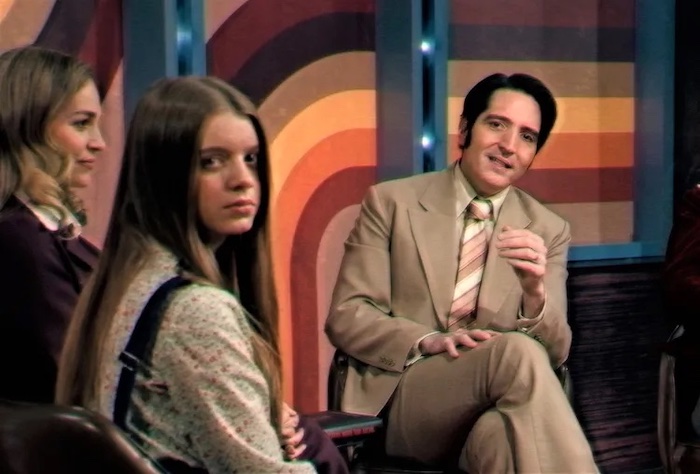
For their first movie set in the U.S., Australian horror maven-brothers Cameron and Colin Cairnes hit on a novel idea that would seem to require a sensibility they weren’t born to. Late Night with the Devil is essentially a real-time rendering of an episode of a fictional American late-night TV talk show from the 70s. The fact that the Cairnes nailed the tone of that particular genre of television in its time makes one wonder just how ubiquitous it was globally, but in any case, they’re helped enormously by actor David Dastmalchian, who plays the troubled, ambitious host, Jack Delroy, a man whose only desire is to knock Johnny Carson off the late-night throne, if even for one ratings cycle. Delroy’s show, “Night Owls with Jack Delroy,” we are told during a well-written preface narrated over a montage of shocking news stories from that era, was once considered edgy, but due to personal tragedy and other unforeseen developments, Delroy was never able to capitalize on the initial buzz, and some five years into the show it has slipped badly and is in danger of being cancelled, so during sweeps week in 1977, which happens to coincide with Halloween, he goes for broke with a live broadcast featuring a girl who is supposedly possessed by the devil. 

Though the conceit of structuring the film as a real TV show occasionally gets away from the Cairnes—Is this a documentary about that particular show, or merely found footage?—the dialogue and visuals recreate the era with stunning verisimilitude, which presents its own problems when supporting what is nominally a horror film. The setup is exacting and thus takes longer than it should, and consequently no horror elements show up until halfway through the movie. The first two guests before the girl comes out for the big finale are meant to provide context to the studio audience: a medium named Christou (Fayssal Bazzi) whose shtick isn’t entirely convincing; that is, until he starts projectile vomiting black goo; and a magician named Carmichael (Ian Bliss) who is now in the business of debunking “charlatans” like Christou, much as the Amazing Randi did with regard to people like Uri Geller. When the possessed girl, Lilly (Ingrid Torelli), is brought out with her handler, the Stanford parapsychologist Dr. June Ross-Mitchell (Laura Gordon), Carmichael tries to explain away the demonic ramblings of the spirit within her, Mr. Wiggles, by performing a neat bit of hypnosis on the audience, and for a moment the movie conveys genuine suspense. But the other shoe has to drop and when it does, all hell literally breaks loose, since Delroy’s constant need to pump the segment for all its visceral power in order to cause a sensation goes against the doctor’s warnings, thus allowing Mr. Wiggles ingress into our world. 

The Cairnes also intensify their critique of media smugness by showing what happens on set during the commercial breaks, as the pushy asshole producer badgers employees and Delroy gets worked up about whether the home audience is properly worked up itself. In a sense, the horror stuff and this comment on the distorting effect of TV work at cross purposes, since neither is sufficiently elaborated upon to make any points beyond the most obvious ones. And the ending, which goes on two beats too long, dampens the effects of the shocks that preceded it. But those shocks are pretty good in that they are as funny as they are gross. 

Opens Oct. 4 in Tokyo at Toho Cinemas Hibiya (050-6868-5068), Toho Cinemas Shinjuku (050-6868-5063), Shibuya Cine Quinto (03-3477-5905), Toho Cinemas Roppongi Hills (050-6868-5024).

Late Night with the Devil home page in Japanese

photo (c) 2023 Future Pictures & Spooky Pictures

Posted in Movies | Tagged , | Leave a comment

Review: Beetlejuice Beetlejuice

Though Tim Burton is an artist in every sense of the word, we tend to approach him as a filmmaker whose work evinces joy because those works are fun to watch. This is the guy whose first feature was a vehicle for Pee Wee Herman. And when we think of those Burton films that were less successful artistically, it was usually the ones where the fun was in shorter supply. The long-overdue sequel to one of his best films, Beetlejuice, has already been touted as a return to form, mainly because it is so purely enjoyable in an adolescent way, which tends to overwhelm the notion stuck in the back of my brain that it’s rather a sloppy movie, more intent on delivering grisly jokes than in presenting an integrated movie experience. But, then again, Beetlejuice the character, as perfectly realized by Michael Keaton with absolutely no loss in comical impact despite the fact (because of the fact?) that he is now closer temporally to the state the character embodies than he was in 1988, is all about chaos anyway, so who should expect a tidy storyline?

Maybe it’s my own memory that’s the problem, but I didn’t brush up on the original until after I saw the sequel, and Burton isn’t particularly concerned about bringing people like me up to speed, so he integrated any backstory obligations into the present tale by reviving the Deetz family with the elimination of the paterfamilias in a comically macabre manner, thus simplifying matters enormously. The remaining members are thus reunited at the home where they were haunted by the ghosts of the previous owners. The teenager of the house, Lydia (Winona Ryder), who was bamboozled into almost marrying the mischievous, decayed Beetlejuice back in the day, is now a middle-aged TV psychic with a history of addiction and a manager-BF, Rory (Justin Theroux), who seems woefully unsuited to keeping her mental health issues at bay. Stepmom Delia (Catherine O’Hara) is some kind of multimedia artist, and the new addition to the household, Lydia’s own teenage daughter, Astrid (Jenna Ortega), by a man who’s already moved off this mortal coil, thinks her mother’s spritual vocation is a crock and her extended family a bunch of weirdos—which, of course, they are. Ironically, it’s Astrid who, by an accident that went over my head, ends up in the afterlife and thus those she left behind invoke Beetlejuice’s return to somehow help her find her way back. However, this time the sly imp has his own crisis to address, a former wife, Delores (Monica Bellucci), he dismembered some centuries ago and who has reassembled herself via staple gun to come and get him, more out of connubial determination than any sense of revenge, which seems to be a more frightening prospect to the inveterate bachelor-for-eternity. The chaos, in other words, is purposely built-in, which is why the plot (or plots, since there are several) runs off the rails at a certain juncture and all you’re bound to remember is the bloody set pieces, of which the extended musical number set to Richard Harris’s unforgettable version of “Macarthur Park” is the topper.

In short, Beetlejuice Beetlejuice is, pardon the cliche, meta in the best way. It continually comments on our familiarity not only with the previous film and the characters, however slight that familiarity may be, but with Burton’s entire gestalt—the actors often seem to be more in on a joke than in playing their characters. Willem Dafoe’s late-in-the-movie cameo as a private dick of the dead is the funniest extended non sequitur I’ve seen all year. There’s absolutely no reason for him to even be here, but…why not? The fact that Dafoe, a relatively minor presence, was the exuberant face of the film during the initial press junket says more than I ever could about how much people enjoy working with Tim Burton. It’s not just the audience who has fun.

Now playing in Tokyo at Toho Cinemas Nihonbashi (050-6868-5060), Toho Cinemas Hibiya (050-6868-5068), Marunouchi Piccadilly (050-6875-0075), 109 Cinemas Premium Shinjuku (0570-060-109), Shinjuku Wald 9 (03-5369-4955), Shinjuku Piccadilly (050-6861-3011), Toho Cinemas Shinjuku (050-6868-5063), Human Trust Cinema Shibuya (03-5468-5551), Toho Cinemas Roppongi Hills (050-6868-5024).

Beetlejuice Beetlejuice home page in Japanese

photo (c) 2024 Warner Bros. Ent.

Posted in Movies | Tagged , , , , | Leave a comment

Review: Kinds of Kindness

Kinds of Cruelty would be a more accurate title for Yorgos Lanthimos’s latest movie, but in line with the director’s often skewed view of human foibles and how those foibles can be dramatized, he frames his uniformly unpleasant characters in ways that accentuate their well-meaningness while at the same time exposing their basest impulses. In that context it’s worth repeating what a number of other critics have pointed out about Lanthimos’s approach. Here, working with Efthimis Filippou, the screenwriter who did his earlier Greek-language work as well as his more outré English-language movies, Lanthimos misses the common narrative appeal of his two best movies, the Oscar winners The Favourite and Poor Things, which were written by someone else. Like Dogtooth and The Lobster, Kinds of Kindness relies on twisted personalities doing weird things that Lanthimos obviously believes will be intriguing to his audience but which are just baffling because they are set in a very familiar, almost banal world (in this case urban and suburban America). Lanthimos is the master of the startling non sequitur, and Kinds of Kindness, at almost three hours, is just one long series of non sequiturs in service to clearly delineated plots that could have just as easily been conceived in a more naturalistic way without losing any of their thematic relevance, for what that’s worth.

There are three distinct stories using the same group of actors playing different characters, the only through-line being an amorphous, mute participant who goes by the initials R.M.F. This character figures into the titles of all three stories, though only in the first does his presence have any meaning. In that story, “The Death of R.M.F.,” he seems to be hired by a powerful CEO named Raymond (Willem Dafoe) to act as the “victim” of an employee, Robert (Jesse Plemons), whom Raymond has cultivated at every step of his adult development. Raymond has bought Robert the nice house he lives in, chosen his wife, Sarah (Hong Chau), tells him when to have sex and what to eat, and generally dictates every detail of his life. When he asks him to purposely get into an car crash with R.M.F. and the result is a fender bender with no serious casualties, Raymond is disappointed and demands Robert do it again with more seriousness and Robert refuses, occasioning a rift between mentor and mentee that leads to terrible, albeit ridiculous outcomes. There are lots of ways to interpret this tale, though none of them have anything to do with how we live our lives realistically. It’s all designed to shock and dismay. In the second story, “R.M.F. is Flying,” Plemons plays Daniel, a police officer whose oceanographer wife, Liz (Emma Stone), has gone missing during a field survey at sea. After she is finally found alive, Daniel’s anxiety does not turn to joy but rather paranoia, as he is convinced Liz is not the woman he married but some kind of imposter. As in the first story, matters become increasingly ludicrous as they also turn violent and distressing. The last, and probably best story, “R.M.F. Eats a Sandwich,” has Plemons and Stone playing acolytes of a new age guru (Dafoe) and his partner (Chau) looking for a chosen individual who has the ability to raise the dead. Stone’s character is a woman who has abandoned her husband and daughter for the guru and is eventually compromised in the guru’s estimation with regard to her faith, and then summarily banished; at which point she endeavors to return to the fold by any means necessary. More pointless violence ensues.

As already suggested, much of this violence, which includes vehicular mayhem, shootings, self-mutilation, and a particularly disturbing rape, is played at least partially for laughs, and while Lanthimos has a certain talent for the transgressive effect, it’s so schematically presented that you feel he’s following some kind of manual. Almost all the decor is sterile and tasteful, the dialogue invariably high-mindedly polite except when it isn’t (thus provoking a predictable reaction), and the story details single-mindedly counter-intuitive. For instance, I couldn’t figure out why Lanthimos and Filippou had Stone’s character in the last story drive a vintage Dodge Charger at exceedingly high speeds, since it didn’t seem to match the character’s sensibility, and the reason only became clear in the last scene, when her reckless driving caps the action in the most blatantly obvious way. It felt like cheating, and then I realized that the whole movie was kind of a scam. 

Opens Sept. 27 in Tokyo at Toho Cinemas Nihonbashi (050-6868-5060), Toho Cinemas Hibiya (050-6868-5068), 109 Cinemas Premium Shinjuku (0570-060-109), Shinjuku Piccadilly (050-6861-3011), Toho Cinemas Shinjuku (050-6868-5063), Shibuya Parco White Cine Quinto (03-6712-7225), Toho Cinemas Roppongi Hills (050-6868-5024).

Kinds of Kindness home page in Japanese

photo (c) 2024 20th Century Studios

Posted in Movies | Tagged , , , , , | Leave a comment

Review: The Roundup: Punishment

The fourth go-round for this ultra-formulaic police thriller series starring Ma Dong-seok is as predictable as the last two sequels, an m.o. justified by its massive box office returns in South Korea. Once again, burly battering ram police detective Ma Dong-seok (Ma) is drawn into the murder of a Korean national overseas, thus securing tourist industry participation in the production. We’ve so far had the opportunity to visit Singapore and Vietnam, so it’s only a hop, skip, and a jump to another popular Korean destination, the Philippines, where a rich tech bro (Lee Dong-hwi) has set up an online casino operation that’s managed by a bloodthirsty, ambitious ex-mercenary, Baek Chang-mi (Kim Mu-yeol), who lures programmers from Korea to the Philippines with lucrative job offers and then imprisons them in front of screens to create software that hooks offshore rubes. When one of these programmers tries to escape, Baek brutally kills him and the body, which has been reported missing back in Seoul, comes to the attention of Ma, who promises the victim’s mother—before she commits suicide from grief—that he will “punish” the person responsible, thus setting up the premise of all the Roundup films: Ma stretching the already flaccid limits of the law to bring a sadistic criminal to justice.

The only alteration to this formula is that Baek isn’t sadistic. He simply kills anyone who is inconvenient or standing in the way of his own material betterment, though in a manner that would be considered extreme by any normal sensibility. The more consistent series trait is the humor, which in this film is mainly a function of Ma’s ignorance of the IT that is central to the criminal enterprise. He can’t quite get his head around the idea of virtual anything and though he tries to cover up his lack of tech savvy with the usual bluster (“Is this a digital fist?”), it doesn’t matter in the end, because he wins all the fights, which, just like sex scenes in the proverbial porno, take place every five minutes or so in order to fulfill the film’s contract with the series’ fans. The other through-theme is how cavalierly Ma and his fellow cops intimidate witnesses and suspects with the threat of beat-downs and even death in order to get the information they need. Does South Korean law enforcement really appreciate their being portrayed in this way, even when it’s a joke? 

Given the money that Ma and his producers have made off the series, I doubt if they’re going to stop, though I have yet to read about a fifth installment. If they do decide to continue they should take a bit of time off first and try to freshen the formula, though the thinking is probably why fix something that isn’t broken, at least in terms of ticket sales? Ma the star is still a great comic actor and while there are about five fights too many in Punishment, the choreography can’t be beat, which is why I hear Ma makes a tidy side business in the U.S. training other action stars on how to use their fists. Nice work if you can get it.

In Korean. Opens Sept. 27 in Tokyo at Marunouchi Toei (03-3535-4741), Shinjuku Piccadilly (050-6861-3011).

The Roundup: Punishment home page in Japanese

photo (c) 2024 ABO Entertainment Co. Ltd. & Bigpunch Pictures & Hong Film & B.A. Entertainment Corporation

Posted in Movies | Tagged , | Leave a comment

Media watch: Social services continue to miss the real reasons behind child abandonment

Various Parent-Child Handbooks (Asahi)

Earlier this month, the Children and Family Agency released statistics about child abuse in Japan. In 2022, 72 children died as the result of “abuse,” two fewer than in 2021. However, in recent years this statistic has remained pretty much the same with only slight fluctuations, and according to an agency official quoted in an Asahi Shimbun report on the statistic, the number 72 “is still a big problem.”

The term “abuse” in this case should be qualified. Of the 72 deaths of persons under the age of 16, 56 perished of “abuse that did not involve group suicide,” meaning 16 children died at the hands of a parent or parents who committed suicide along with their children, and since minors are not considered to have agency under such circumstances, they were effectively murdered. Breaking the number down further, 25 of the children were less than 1 year old when they died of abuse, and 9 “were killed” on the day they were born. All of these nine babies were “abandoned,” though it isn’t clear from the Asahi report if the children died of actual violence or neglect. Five of the babies were “abandoned by the mother,” one by “both parents,” and the circumstances of the remaining three are unknown. As far as the agency can tell, six of the mothers of these abandoned children had never been examined by a physician while they were pregnant, and 7 were not in possession of the Mother and Child Handbooks that are routinely given to expectant mothers by medical institutions. In only one case did the agency determine that the mother consulted some form of authority about her pregnancy. 

The agency’s comment on these statistics acknowledges that some pregnant women and girls need “support” due to poverty or the fact that the pregnancy was unplanned, but doesn’t really offer any solutions. Asahi talked to the head of a psychiatric hospital in Kumamoto Prefecture that works with women who have been convicted of killing and/or abandoning their babies after giving birth alone. The doctor said that such women have a “lower ability to adjust to normal social situations,” a condition known as borderline personality disorder, and tend to have weak or no connections with family and no interaction with authorities, which they don’t tend to trust anyway. A few have been prostitutes, but in any case the “struggles” of these women need to be better understood.

Continue reading
Posted in Media | Tagged , | Leave a comment

Review: High & Low – John Galliano

Several years ago, I read an article in the New York Times that explicated the financial circumstances surrounding the fashion industry. Most designer fashion houses, including quite a few high-end ones, constantly operate in the red, since their product is so expensive to produce and promote and, due to its scarcity nature, doesn’t sell in volumes that can support those expenses. Consequently, the designers rely mainly on sponsors to prop up their lavish lifestyles, because without the image such a lifestyle conveys, the public won’t believe they are high fashion designers. This concept remained forefront in my mind as I watched Kevin Macdonald’s highly accomplished but pointlessly exhausting documentary about the British designer John Galliano, who destroyed his career in 2011 when he drunkenly spewed virulent antisemitic comments in a Paris cafe that were recorded by bystanders. Macdonald, in fact, opens the film with one of the recordings and then proceeds to show how Galliano reached this low point in his career. It’s a standard means of explaining the man and the artist, even if it runs on wicked tabloid energy. 

The rise before the fall is Horatio-Alger-on-meth boilerplate. Born into a working class Catholic family with an abusive father and a Spanish-born mother, Galliano “knew he was very gay” by the time he finished grammar school in London. Cultivating a posh accent while studying art and fashion on his own terms as a teenager, he eventually floored every teacher at the art college he attended and graduated with a fashion show that drew the attention of the relevant press and big houses in the 80s during the so-called new romantic period. Highly influenced by Abel Gance’s silent biopic of Napoleon, he made clothing that channeled the foppery of the 18th century into ambisexual provocations that delighted the cognoscenti. He was suddenly the hottest, youngest designer to ever commandeer a catwalk, but he was also broke because no one would buy his “art,” which is how it was characterized. When he moved to Paris to try to capitalize on his reputation he had to sleep on people’s couches. Meanwhile, he had already cultivated addictions to alcohol and certain drugs that only added to his outré appeal. Eventually, star makers like Anna Wintour and Andre Leon Talley took up his cause, determined to get him a gig that paid, thus bringing him to the attention of billionaire Bernard Arnault, who became his de facto patron and master manipulator. By 1996, he was working for Givenchy, a position that catapulted him to the head designer chair at Dior, at which point his workload was so heavy he couldn’t support it without the chemicals and the punk attitude, which everybody seemed to love. With Alexander McQueen replacing him at Givenchy, it was the age of the “rock and roll designer.” Macdonald carefully shows how Galliano’s self-destructive attitude infected those close to him, including his loyal assistant, who eventually died due to the unending strain.

Macdonald doesn’t skimp on the celebrity talking heads, most of whom sing Galliano’s praises as an artist while acknowledging he was a royal fuckup. On a number of occasions he talked to the man himself, who is now sober but hardly whole and still struggling to work himself back into the good graces of the layer of the industry that makes a difference in these matters as the artistic director of Maison Margiela. From all appearances, he is humbled by his fall but, still convinced that the punk-pirate image that got him to the top will get him there again, seems oblivious to how little stock the public and the press have put into his acts and statements of contrition. To Macdonald’s credit, he doesn’t really buy Galliano’s self-styled resurrection, but that doesn’t mean he isn’t getting off on his mortification. 

In English and French. Now playing in Tokyo at Human Trust Cinema Yurakucho (03-6259-8608), Shinjuku Piccadilly (050-6861-3011).

High & Low – John Galliano home page in Japanese

photo (c) 2023 KGB Films JG Ltd.

Posted in Movies | Tagged , , , | Leave a comment

Review: Songs of Earth

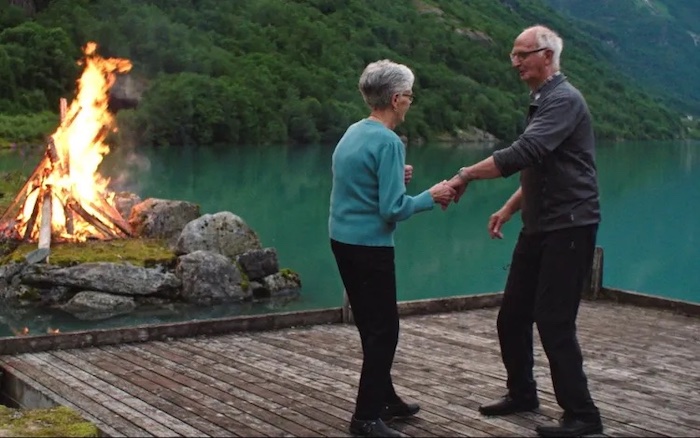
The scenery captured by four expert camera operators—one using a drone—in Margreth Olin’s documentary is undeniably other-wordly, even if the images are meant to convey the magnificence of nature in the raw. The reason has to do with the perceptions of the world that the majority of us live with, perceptions that often diminish nature. Though the film, as Olin plainly puts it, is “an ode to my parents,” it takes place in a remote corner of Norway called Oldedalen that seems to have totally escaped the encroachment of technology that has been visited on the rest of the world. In a sense, Olin sets up a paradox by using supremely high-tech cameras and sound recording to preserve audio-visual renderings of natural beauty that may be more viscerally expressive than the experienced thing itself.

This impression has to do with scale. Olin follows her 82-year-old father as he hikes this formidable land, with its towering mountains, mirrored-surface frozen lakes, serpentine fjords, and astounding diversity of flora and fauna, for the umpteenth time, telling stories about what has happened here and how nature shaped the lives he’s known, including his own. There’s an old tree where he proposed to Olin’s mother (still alive and healthy and fretting that she will die first), a sunken village where 40 people were killed by a landslide that caused a fresh-water tsunami, a vanishing glacier that shows how the distant thunder of civilization has made its impact even here. Intercut with the panoramic photography are old family snapshots from generations ago, impressionistic recreations of local anecdotes, and brief interludes indicating the passing of seasons and well as the hours of the day. A lot of this kind of thing goes a long way, and sometimes the narrative simplicity is overwhelmed by the visual sumptuousness. You tend to forget to listen to what’s being said.

Though only 90 minutes long, the leisurely pace has a numbing effect that feels more like therapy than elucidation, and when it’s finished you look for the complementary photo book that will sit on your coffee table; which isn’t to deride the polished look of the film or its moving tribute to the power of familial love. Olin delivers something we can only receive with awe because we can’t imagine ourselves being surrounded through an entire life with such beauty and circumstance—both happy and tragic—and in the end you could be forgiven for thinking that none of it is as real as it obviously is. 

In Norwegian. Opens Sept. 20 in Tokyo at Toho Cinemas Chanter Hibiya (050-6868-5001), Cinemart Shinjuku (03-5369-2831).

Songs of Earth home page in Japanese

photo (c) 2023 Speranza Film AS

Posted in Movies | Leave a comment