Review: Bonnard, Pierre and Marthe

Director Martin Provost is known for his biopics of French women, both real and (semi-)fictional, and his latest extends the idea by studying the artistic evolution of Marthe de Meligny (Cécile de France), a factory worker who, by chance, meets the budding impressionist painter, Pierre Bonnard, on a Paris street in 1893 and quickly becomes his model, despite having no overt inclination for art or posing. The nudity he insists on, in fact, bothers her at first, but since the couple is having sex before the day is through, you assume she’s not as prudish as she claims. Either that, or Provost is simply exercising his prerogative as a French director to make everything about sex. The ensuing story takes the couple through the rest of their lives, and, despite Pierre’s self-justifying tendency to stray, Provost and his two actors are convincing with regard to the Bonnards’ enduring love, though the director endeavors to cast this love as a function of the pair’s artistic ambitions. Eventually, Marthe, too, becomes a painter, and rather than react with competitive resentment, Pierre encourages her to the extent that he takes on the household chores around their sloppy but large, airy, rural house so that she can concentrate on her art more diligently. Though refreshing in what it says about their relationship, for Pierre, assuming domestic responsibilities has more to do with throwing off bourgeois trappings—at first, he forbids Marthe from getting pregnant—and embracing the modernism he so slavishly admires around him. 

Though there’s not much of a plot on which to hang the movie, Provost contrasts the pleasures of the epicurean oasis Pierre has created with the hypocrisies of male-oriented bohemianism in such a way that you can follow the road that modernism followed in the first half of the 20th century. There’s a lot of naked frolicking and weighty discussions about art and social constructs that imply you had to be there to fully appreciate the epistemological significance. And while Marthe’s chronic infirmities are used to add drama to sequences where there otherwise wouldn’t be any, she remains the strongest character in a film that includes such contemporary luminaries as Claude Monet (Andre Marcon) and Édouard Vuilliard (Grégoire Leprince-Ringuet), thus suggesting that without participants grounded in the reality of day-to-day life, modernism would have died of starvation early on. 

Consequently, it takes a crisis of love to really push Marthe toward her full potential as an artist, and Provost makes a good case that she was the superior painter because of it. I’ll take his word for it because I knew nothing about the Bonnards before I saw his movie, and while your enjoyment of it will greatly depend on your capacity for melodramatic overkill in the service of sex and art, I will admit the movie has historical value. That assumes, however, Provost is being honest and not just exploitative.

In French. Opens Sept. 20 in Tokyo at Cine Switch Ginza (03-3561-0707).

Bonnard, Pierre and Marthe home page in Japanese

photo (c) 2023 Les Films du Kiosque-France 3 Cinema-Umedia-Volapuk

Posted in Movies | Tagged , , | Leave a comment

Review: A Human Position

It says a lot about this quiet, enigmatic Norwegian film that the main character, Asta (Amalie Ibsen Jensen), almost casually secures a job as a reporter at her small coastal town’s newspaper without the viewer registering much in the way of congratulatory feeling. The job, in fact, seems trivial, like something you’d take on for the summer just to make extra money. Much of the reason for this lack of excitement is the fact that nothing of any consequence really happens in Ålesund’s news cycle except sports and PR gambits, and so when Asta starts pursuing a story about an asylum seeker who was working in a local food processing factory before being forcibly deported you many miss the significance until the story has meaning for her. Asta, who seems to be recovering from some kind of trauma, has moments of acute depression that her lover-roommate, Live (Maria Agwumaro), a furniture repairer/upholsterer, tries to sidestep until she can’t. Of course, there’s a cat, too.

If A Human Position sounds like slow going, it is, though there’s a poignancy to the static shots of the beautiful landscape of the town and Asta/Live’s bare, airy, well-lit apartment. The conversations are often blank and go nowhere meaningful but help signify the relationships on view in ways that more meaningful dialogue wouldn’t (though the comments about Norway’s welfare state are interesting), because these are the kinds of things people talk about to create spaces in which they can survive from day to day. So when the asylum-seeker story presents itself to Asta it gives her own existence meaning, even if nobody else seems to care about it. She needs more than a distraction. She needs to believe in her ability to make a difference, something the trauma suggested she couldn’t do, and which obviously preoccupies her. 

Which isn’t to day A Human Position is a downer. There are moments of subtle humor, as when Live discovers an old electric organ left in the attic and attempts to play a popular tune, that illustrate the title more clearly. As is often said, most of life is spent sitting around and waiting for something to happen, and the director, Anders Emblem, seems uniquely tuned into this credo in showing how Asta not only copes with disappointment, but remains open to the possibility of renewal and even reawakening. The fact that we don’t witness these changes because the movie ends before they happen doesn’t take anything away from Emblem’s purpose. If anything, it makes hope more believable. 

In Norwegian and English. Now playing in Tokyo at Theater Image Forum Aoyama (03-5766-0114).

A Human Position home page in Japanese

photo (c) Vesterhavet 2022

Posted in Movies | Leave a comment

Review: Hit Man

Richard Linklater could be cited as one of those world-class directors who alternates idiosyncratic, arty films with mass-marketable, crowd-pleasing entertainments, and most people will probably slot Hit Man in the latter category, but it’s deeper than the description would let on. Titles cards at the beginning and end claim it is based on a true story or, at least, the protagonist is a real person, but the contours of the plot adhere so resolutely to those of a criminal thriller that you know Linklater and his co-scenarist, leading man Glen Powell, have taken the story into fabulist territory. And while the basic premise is by no means meta in execution, the script and direction constantly comment, even directly, on the whole sub-genre of paid assassin movies. After all, the titular character, Gary Johnson (Powell), a philosophy professor at the Univ. of New Orleans who moonlights for the police as a faux assassin to entrap people who solicit hit men, says more than once that “hit men don’t exist,” that the “occupation” was essentially made up by popular culture. It’s a theory I myself have often pondered while watching movies like David Fincher’s The Killer.

Linklater fortifies this idea by showing how Gary’s professional study of human behavior (“The self is a construction,” he tells his students) informs his various impersonations of paid assassins. Powell gets limitless comic mileage with these impersonations, each of which is tailored to the particular person who is endeavoring to hire him. Consequently, when he shows up as “Ron” to a meeting with a woman named Madison (Adria Arjona) who wants him to off her abusive husband, he adjusts his character’s cool, macho manner in such a way as to convince her to leave the guy instead, thus enraging the cops he works with by letting her get away. Later, he embarks on a hot affair with Madison as Ron, who is much more of a stud than Gary is. However, this ongoing impersonation becomes more than a liability, and the way Linklater resolves the various ensuing complications makes for plot development of rare ingenuity. If, like me, you find paid assassin movies redundant and predictable, the unexpected twists and turns that Hit Man follows will have you laughing and shaking your head all the way into next week.

Some viewers will balk at the story’s moral ambivalence, but, again, Hit Man is essentially a comment on popular entertainment while itself being popular entertainment of the most bracing and imaginative kind. And Powell earns his current reputation as the most interesting leading man in Hollywood. We often talk about movies within movies. Powell’s acting here comprises performances within performances, and all are not only convincing, but refreshingly articulate and coherent. It will likely be streaming pretty soon in Japan (it already is overseas), but I urge you to see it in a theater just to bathe in its intelligence. 

Now playing in Tokyo at Kadokawa Cinema Yurakucho (03-6268-0015), Shinjuku Piccadilly (050-6861-3011), Human Trust Cinema Shibuya (03-5468-5551).

Hit Man home page in Japanese

photo (c) 2023 All the Hits LLC

Posted in Movies | Tagged , | Leave a comment

Review: Breaking Point

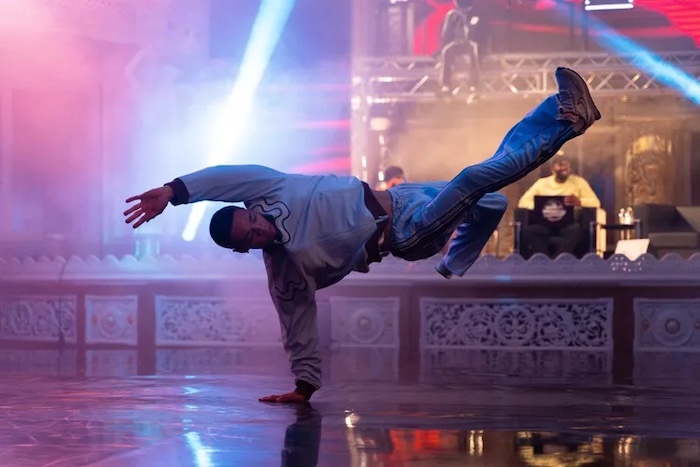
It’s difficult to say if this 2023 British film’s release in Japan was meant to coincide with the 2024 Paris Olympics, which featured breaking (break dancing for you old-timers) as an official event for the first time. Likely not, but the timing provides a certain ironic context given that the most prevalent topic surrounding the breaking competition at the Games was its air of cultural appropriation—which may explain, at least partly, why it isn’t scheduled to be reprised at the next Olympics. For sure, Americans, specifically African-Americans, who invented breaking were under-represented at the Games, and probably for understandable reasons. Serious breakers in the U.S. probably don’t have much use for this kind of organized presentation, with judges and scores and such, so that leaves it to the Europeans and the Japanese, who take such competitions seriously. Breaking Point is conceived as a classic sports movie, wherein the main characters work toward a big tournament, in this case a world team championship. The fact that the final match (spoiler!) comes down to Britain-versus-France shows where the film’s priorities lie.

The drama is provided by brothers Benji (Karam Singh) and Trey (Kelvin Clark), whose relationship has been icy ever since their mother died in a car accident that they survived. Both were gifted street dancers in their youth, but after the accident went separate ways, goal-wise, with Trey abandoning breaking and working toward admission to a good university and Benji sticking with breaking, which he practices usually under less-than-legal circumstances. There are, of course, love interests and family conflicts, and eventually the two brothers bury the hatchet and work toward forming an all-UK team that can go to the world championships. Since the two leads were chosen for their footwork, the acting is, at best, serviceable, but the script is better than the above description might indicate if only because the family dynamics at play are just complicated enough to draw you into the story. 

The hook is and should be the breaking, which is difficult to judge for someone like me, not so much because of the moves themselves but rather the music, which is more hip-hop-adjacent than hip-hop. Consequently, the routines feel over-choreographed, lacking the kind of spontaneity that made old school breaking so exciting when paired with genuine raps. But then the victor of the tournament, per the implications of the filmmakers, is determined mainly by the quality of the coaching. You can’t get more Olympics-oriented than that.

Opens Sept. 13 in Tokyo at Marunouchi Piccadilly (050-6875-0075), Shinjuku Piccadilly (050-6861-3011).

Breaking Point home page in Japanese

photo (c) FAE Films BP Ltd. 2023

Posted in Movies | Tagged , | Leave a comment

Media watch: How sustainable is Japan’s health insurance system?

There are reasons why I, an American, have decided to live the rest of my life in Japan, and though one of them is the current state of political discourse in my native country, that factor entered into the decision late in the game. Certainly, the most pertinent economic advantage of living in Japan as opposed to living in the U.S. is health insurance. I really don’t see the point of the private insurance system in the States, which, besides being expensive, is arbitrary with regard to the kind of treatment that’s available depending on your plan. Japan’s isn’t necessarily cheap, but it is pegged to income, which makes it fair, and everything, including dental care and all major surgery, is covered. There’s just no comparison.

For some years now, Japan’s national health insurance system has become a serious burden on the government, the main reason being the rapidly aging population that demands more care. But another reason is the basic cost of care, which is increasing almost exponentially as new treatments are developed. The reason these increased costs are such a concern was covered in a September 7 Asahi Shimbun article, which considered whether Japan’s medical care system can be maintained at such a high standard into the future. Part of the reason, according to the journalist who wrote the piece, Makoto Hara, has to do with Japanese attitudes, which hold that every single life is precious and thus the best medical care must be available to everyone regardless of social station and income. Hara thinks this attitude is the reason why Japanese lifespans are the highest in the world. Some people may disagree with this assessment, but in practice it seems to be the fundamental philosophy behind the health care system. At the same time that Japanese people live longer than others, Japan’s national debt is also higher than other countries’, owing mainly to its medical insurance system. But there are other countries in the world with universal health care and they don’t have the same level of debt. What’s the difference?

Hara says that it’s the way Japanese doctors are encouraged to utilize the most cutting edge treatments as soon as they are available. At first glance, that statement seems self-justifying. After all, one of the sticking points of America’s health insurance situation is that, depending on your plan, many treatments, especially new ones, may not be available to you, and such limitations could have a serious effect on your level of care. In Japan, there are no such limitations as long as the treatment—be it a drug or a procedure—has been approved by the health ministry. And as Hara reports, there’s a kind of taboo against criticizing the use of such treatments, since anyone should be able to access them. But an increasing number of doctors, especially those who treat cancer, are wondering if the pressure to use state-of-the-art treatments isn’t bankrupting the system at this pace. Many of these doctors believe that not enough research has gone into determining how effective these new treatments are compared to older treatments, which often cost a fraction of what new treatments cost. 

Continue reading
Posted in Media | Tagged , | Leave a comment

Review: My Sunshine

Hiroshi Okuyama’s assured second feature could be slotted as a sports movie, since it adheres to many of the structural requirements of the genre, but eventually the viewer will realize that it only follows the plan in order to upend it. For one thing, there is no make-or-break competition waiting at the end of the tale. Moreover, the coach-athlete dynamic has none of the hackneyed tension that usually forms the dramatic crux of a sports movie. If anything, the instructor here, Arakawa (Sosuke Ikematsu), has the patience of Job and an attitude that seems geared toward making his charges as relaxed as possible. Logic has it that if there is nothing at stake in a sports movie, there’s nothing to look forward to, but the competition here is more about love than glory.

Arakawa is not the main protagonist. That’s Takuya (Keitatsu Koshiyama), a junior high age kid with a slight speech impediment and a constitutional inability to bring anything aggressive to the sports he plays out of a sense of obligation rather than interest. He sucks at baseball, but when winter comes early to his small Hokkaido town, he dons skates and attempts to help out the school hockey team, failing softly but no less miserably. Maybe it’s his penchant for being easily distracted, which is where Sakura (Kiara Nakanishi) comes in. She shares the rink with the hockey team, practicing her figure skating routines, and Takuya falls hard. Sakura’s coach, Arakawa, notices his gaze and has an idea, which leads to him gently urging Takuya to take up figure skating himself so he can develop him and Sakura into an ice dance pair. Understanding his limitations but unable to control his eagerness to be next to the one he adores, Takuya agrees; and while Sakura is keen on the idea it has more to do with her regard for Arakawa than any feelings she has for Takuya. In fact, her behavior toward her new partner and would-be paramour is merely polite, because she only has eyes for coach, but he is already spoken for. It’s hinted more than once that Arakawa, once a promising world-class figure skater himself, has come to this town to be with his male lover, who hails from the region. Okuyama doesn’t make too much of the relationship except to imply that Arakawa’s somewhat baffling refusal to point to his own exceptional talents appears to be a means of protecting himself and his partner from the scrutiny of others, a plan that, in the end, isn’t very successful. It’s difficult to say if he’s channeling his dashed professional ambitions into these two kids, but it explains his aforementioned patience and lack of un-sports-movie-like disciplinary application.

Unlike Okuyama’s first movie, the deceptively wry coming-of-age story, Jesus, My Sunshine is impressionistic. The director does his own camerawork, which conveys Takuya’s mindset, especially as he watches Sakura skate, with over-exposed bursts of ecstatic wonder, and it makes perfect sense. Takuya is your classic incoherent adolescent, straining to make his feelings understood and unable to do so. Okuyama doesn’t make the viewer suffer through the kid’s feelings of helplessness but rather makes us share in them as they dissolve into hope while he assiduously learns his routines and becomes actually good at something he’s growing to enjoy. (For the record, both young actors have studied figure skating since they were 4, but Koshiyama gives the more impressive performance because he has to be inept in the beginning.) If his love remains unrequited, it’s still love, and rather than letting us down by denying us the kind of excitement we expect from a sports movie, My Sunshine revels in the overwhelming trust and affection these three people feel for one another, and that’s enough.

In Japanese. Playing Sept. 6-8 in Tokyo at Toho Cinemas Chanter (050-6868-5001), Theatre Shinjuku (03-3352-1846). Opens wide Sept. 13. 

My Sunshine home page in Japanese

photo (c) 2024 My Sunshine Film Partners/Commes des Cinemas

Posted in Movies | Tagged | Leave a comment

Media watch: Prince Hisahito’s rumored Todai ambitions aren’t getting any encouragement in the press

(Kyodo)

Though the Japanese media is invariably respectful and circumspect when it comes to the Imperial household, I’ve never gotten the impression that the general public, while respectful themselves, really harbors much affection for the royals. It may be simply a matter of proximity: The Japanese person I live with has nothing but scorn for the emperor system and so I tend to look at the matter through her eyes. And recently I read that the famous story about the subjects of Emperor Showa weeping uncontrollably upon hearing him announce live on the radio Japan’s surrender on Aug. 15, 1945, was an exaggeration whipped up by the press at the time and maintained as a received fact. Most people were too busy trying not to starve to death, if they weren’t jumping for joy at the realization that the war was actually over. 

But the way the tabloid press exploits the inevitable Schadenfreude generated in the wake of royal scandal is also a bit heavy-handed, as evidenced by the utterly stupid and cruel treatment of Mako, the daughter of Crown Prince Akishino, and her husband Kei Komuro over the past several years. Because Komuro’s mother was having financial troubles, it was deemed he wasn’t worthy of her hand, but she married him anyway. That should have been the end of it, but apparently there are stringers in New York, where Komuro works as a lawyer, watching the couple’s every move even now. 

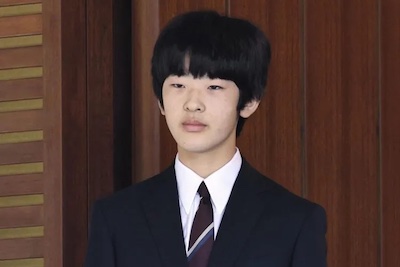
Consequently, the recent tabloid story about Akishino’s youngest son, Prince Hisahito, who is second in line to the throne, comes across as a big deal about nothing. It has to do with the boy’s supposed plans for university, and there’s nothing at all scandalous about those plans. Nevertheless, the circumstances are such that it would probably be impossible for him to realize them without inviting suspicions from the public. The media is already way ahead of the story.

Continue reading
Posted in Media | Tagged , , | Leave a comment

Media watch: NHK’s annual end-of-war anniversary special tackles propaganda

I’m about halfway through the second volume of Gary Giddins’ biography of Bing Crosby, which takes in “The War Years 1940-1946.” Crosby was at the peak of his stardom during this period, earning the highest income in Hollywood except for the studio chiefs. He was 38 when the Japanese attacked Pearl Harbor and while he could have served, the military preferred he remain in the U.S. and do what he did best—entertain—only that he should do it for the sake of the war effort, meaning singing for the troops (remotely or at homeland bases) and selling war bonds through concert tours with other big stars. Giddins makes a persuasive case that these activities did not get in the way of his career, but, in fact, enhanced his standing as the most popular singer of the day. It was during the war years, after all, that his biggest hit—actually, the best selling record of all time—”White Christmas” was released, as well as most of the “Road” movies he made with Bob Hope and his dramatic breakthrough Going My Way. He was certainly the most popular male star among the soldiers, and he did his best to respond to every one of their requests. And while he was tireless in his service to the war effort, Giddins suggests that part of the reason was that it got him out of the house and away from his alcoholic wife.

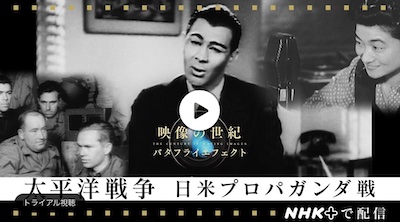
But while the book does an impressive job of describing Crosby’s day-to-day existence at the time, it feels slight in terms of explicating the mood of the country. The general impression I’ve always had about America during the war was that everyone’s attention was fixed on the conflicts in Europe and the Pacific, but, up until the beginning of 1943 at least, the book makes it seem as if most people were living their lives pretty much as they were before the war. As it so happens, I watched the NHK Special broadcast on Aug. 26, Japan-U.S. Propaganda War, and it actually explained that for the first year or so, the American public was not fixated on the war. Prior to Pearl Harbor, most Americans did not want to get involved in the European conflict, and even after the U.S. declared war on Japan and Germany, the public remained somewhat cool toward its involvement. The documentary cites an Oct. 1943 survey that found 54 percent of American respondents “didn’t think about the war very much,” thus leading to a different propaganda strategy on the part of the government. Previously, the Japanese were described in newsreels and media in a fairly straightforward manner, and the president, Franklin Roosevelt, forbade graphic descriptions and depictions of the war, but photographer Norman Hatch changed his mind, saying that the American people needed to see what the soldiers were going through so as to support the war effort more fervently. Thereafter, newsreels showed American corpses and talked about Japanese mistreatment of POWs and their troops’ bloodthirsty battlefield methodology. American hatred of the enemy increased substantially as a result, and thus made it easier to carry out bombing raids on civilians, including the atomic bombings of Hiroshima and Nagasaki.

Continue reading
Posted in Media | Tagged | Leave a comment

Review: From Okinawa With Love

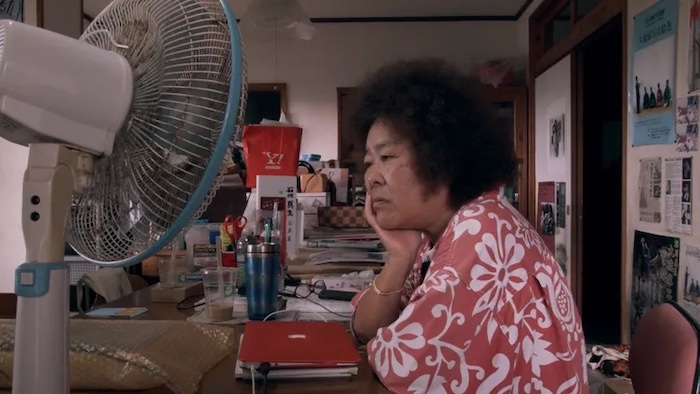
Like her subjects in the real world, Mao Ishikawa is a fringe figure in the world of Japanese photography. Though she’s won a number of major awards for her work, her subject matter is stubbornly circumscribed, concerned not just with the lives of the people of Okinawa, where she was born in 1953 and raised, but that substrate of Okinawan society that comes into direct contact with the U.S. servicemen through the nightlife industry. Having lived through the American occupation of the island before it reverted to Japanese control in 1972, she knows intimately the peculiar relationship that has evolved between America and Okinawa over the decades, and while she doesn’t appreciate the U.S. military’s intrusive presence, she asserts numerous times during director Hiroshi Sunairi’s even more intimate documentary about Ishikawa and her work that she loves the servicemen she’s known over the years, in every permutation of the verb. This identification comes from a feeling of shared oppression. Just as Okinawans have always been looked down upon by “Yamato” (the rest of Japan), a condition evidenced by the fact that the island has more U.S. bases than anywhere else in the country and that these bases keep the native population in thrall to Tokyo, the sailors and Marines she has been closest to over the years are African-American, who understand discrimination as much as she does.

Consequently, her political views, while staunchly anti-military when it comes to the existence and power of the U.S. bases, are leavened by an almost nostalgic affection for the culture of bar hostesses and their American boyfriends whom she photographed so familiarly during the 1970s and 80s. Though this work is evocative and aesthetically rigorous, it scandalized so-called normal society, and much of Sunairi’s purpose is to show how Ishikawa’s provocative attitude evolved over time, though the average viewer, after just listening to a little of what Ishikawa has to say about life, doesn’t need much explanation. She owned a bar herself in Kin Town, and speaks frankly and with great humor about her many sexual affairs with servicemen. Having been married once and then divorced, she repelled the offers of matrimony from some of her American lovers, but still believes that the relationships were deeper than what most people experience when it comes to romance. Nevertheless, she is also well aware of the undercurrents of violence that occasionally erupt in these relationships given the power dynamic that holds sway in the U.S. military, not to mention the one that pulsates within the social order of Okinawa. She is nothing if not clear-eyed about the interpersonal problems that such imbalances create.

Though Sunairi pays close attention to the photography, his main interest is Ishikawa as a raconteur and representative of a certain kind of free artistic sensibility, and the narrative is ripe with redundant observations about Ishikawa’s iconoclasm. But in the end Sunairi’s persistence pays off in a sequence where Ishikawa’s chronic infirmity (she’s had cancer since the early 2000s) and her desire to reveal literally everything about her life and work reach a confluence of explicatory intention that’s truly moving. I think I would have preferred more outside input into Ishikawa’s influence, but she’s a big enough personality on her own to inhabit fully a feature-length documentary.

In Japanese and English. Now playing in Tokyo at Theater Image Forum Aoyama (03-5766-0114).

From Okinawa With Love home page in Japanese

Posted in Movies | Tagged | Leave a comment

Review: Road to Boston

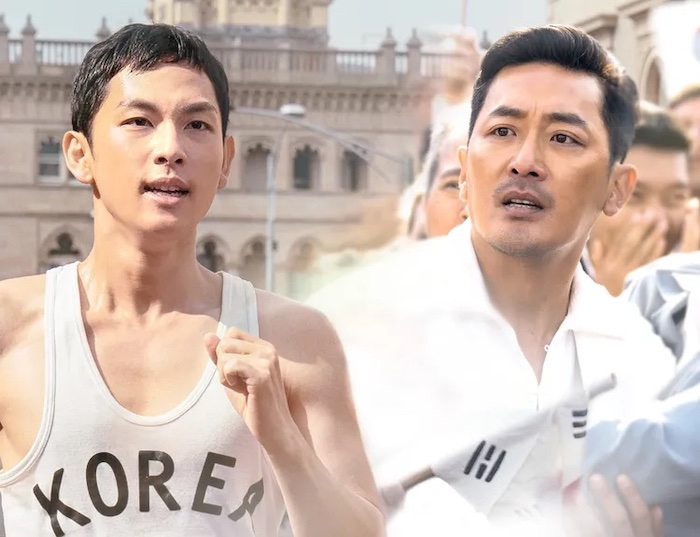
It’s often said that South Korean storytelling in movies and dramas is based on one theme, revenge, which gives the impression that the national self-image is one of eternal victimhood. It’s not an entirely fair evaluation, but the country’s history over the last century easily lends itself to such interpretations. The 35 years under the thumb of the Japanese Imperial military has yielded a bumper crop of great tales in terms of dramatic impact, with the aftermath of abject political self-destruction serving double time as a wellspring of national tragedy. Any other country that had been sitting on a story as compelling as the true one told in Road to Boston would have already exploited it years ago, so I can only assume that no one in Korea had gotten around to it until now because there were so many other compelling true stories to pick from; which isn’t to say it’s a great movie, only that it can’t help but be absorbing. 

Son Kee-jung (Ha Jung-woo) was the gold medalist at the 1936 Berlin Olympics in the marathon, a Korean running under the Japanese flag, which he hid from view when he stood on the Olympic podium. He was consequently punished by his Japanese overlords, but his humiliation didn’t stop there. After the war, with Korean independence regained, Son becomes a national hero, albeit a miserable one, what with Seoul sunk into poverty by the time the action starts in 1947 and now under the thumb of the occupying U.S. forces. To make matters worse, Son’s family is trapped in the north, and he has little recourse to get them out. Unlike Son, the bronze medalist at the 1936 games, another Korean named Nam Seung-Ryong (Bae Sung-woo), has continued with his running and coaches young men who mostly want to emulate Son. One, an arrogant kid named Suh Yun-bok (Im Si-wan) is only in it for the money, since he has to work to take care of his ill mother. He also happens to be the most talented young runner in Seoul, and Nam hopes to bring Korea glory as an independent country in the next Olympics, but according to the rules, Korea cannot participate unless it has already participated in a world-class athletic meet (1936 doesn’t count because they ran as Japanese), and Nam has his sights set on the Boston Marathon of 1947. So he tries to enlist Son’s help in getting his charges whipped into shape.

The bulk of the film chronicles not only the subsequent tortuous mental and physical training, which makes Road to Boston a typical sports drama, but the bureaucratic bullshit that Korea had to endure to make it to New England, the biggest obstacle being the American military, which won’t give them any kind of break financially or logistically, meaning Son and Nam have to do it all on their own, often resorting to means that are just as humiliating as those they endured under the Japanese. The resulting triumphs—and here the triumphs are genuine doozies—that much sweeter. Director Kang Je-kyu steeps these impossibly consequential ingredients in a nationalist stew so over-seasoned with sentimental dross that at times it can be over-bearing, and yet he knows that it’s the only way to deliver this tale without diminishing its power for the people who need to experience it. The rest of us can scoff at the extended marathon sequence, with its shameless tribute to the power of proving something to the world, and the overwrought implications that the world’s (read: America’s) image of Koreans was blatantly racist, but we can’t deny the force of the drama. Some countries would kill for this story. 

In Korean and English. Now playing in Tokyo at Shinjuku Musashinokan (03-3354-5670), Human Trust Cinema Yurakucho (03-6259-8608), Yebisu Garden Cinema (0570-783-715).

Road to Boston home page in Japanese

photo (c) 2023 Lotte Entertainment & Content Zio Inc. & B.A. Entertainment & Big Picture

Posted in Movies | Tagged , | Leave a comment