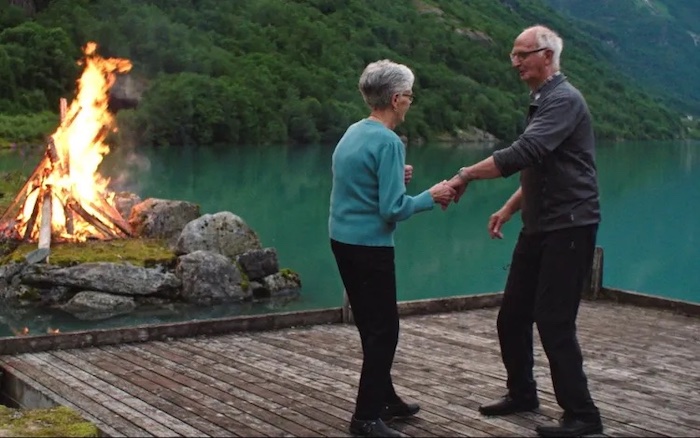
The scenery captured by four expert camera operators—one using a drone—in Margreth Olin’s documentary is undeniably other-wordly, even if the images are meant to convey the magnificence of nature in the raw. The reason has to do with the perceptions of the world that the majority of us live with, perceptions that often diminish nature. Though the film, as Olin plainly puts it, is “an ode to my parents,” it takes place in a remote corner of Norway called Oldedalen that seems to have totally escaped the encroachment of technology that has been visited on the rest of the world. In a sense, Olin sets up a paradox by using supremely high-tech cameras and sound recording to preserve audio-visual renderings of natural beauty that may be more viscerally expressive than the experienced thing itself.
This impression has to do with scale. Olin follows her 82-year-old father as he hikes this formidable land, with its towering mountains, mirrored-surface frozen lakes, serpentine fjords, and astounding diversity of flora and fauna, for the umpteenth time, telling stories about what has happened here and how nature shaped the lives he’s known, including his own. There’s an old tree where he proposed to Olin’s mother (still alive and healthy and fretting that she will die first), a sunken village where 40 people were killed by a landslide that caused a fresh-water tsunami, a vanishing glacier that shows how the distant thunder of civilization has made its impact even here. Intercut with the panoramic photography are old family snapshots from generations ago, impressionistic recreations of local anecdotes, and brief interludes indicating the passing of seasons and well as the hours of the day. A lot of this kind of thing goes a long way, and sometimes the narrative simplicity is overwhelmed by the visual sumptuousness. You tend to forget to listen to what’s being said.
Though only 90 minutes long, the leisurely pace has a numbing effect that feels more like therapy than elucidation, and when it’s finished you look for the complementary photo book that will sit on your coffee table; which isn’t to deride the polished look of the film or its moving tribute to the power of familial love. Olin delivers something we can only receive with awe because we can’t imagine ourselves being surrounded through an entire life with such beauty and circumstance—both happy and tragic—and in the end you could be forgiven for thinking that none of it is as real as it obviously is.
In Norwegian. Opens Sept. 20 in Tokyo at Toho Cinemas Chanter Hibiya (050-6868-5001), Cinemart Shinjuku (03-5369-2831).
Songs of Earth home page in Japanese
photo (c) 2023 Speranza Film AS