Review: One Fine Morning

Hot on the heels of Francois Ozon’s Everything Went Fine (though I acknowledge that in some territories the release order was the reverse) comes another French movie about a woman struggling with her father’s end-of-life arrangements. And while the circumstances are notably different in terms of financial wherewithal and how the arrangements are supposed to be realized, both films make striking attempts to connect with the viewer through credible empathy: This is something you’re going to have to go through yourself, probably more than once. And in that regard, Mia Hansen-Løve’s more contemplative, emotionally fraught film strikes deeper at those nerves that will always be raw due to whatever frictions we experience in our dealings with parents—or families in general, for that matter.

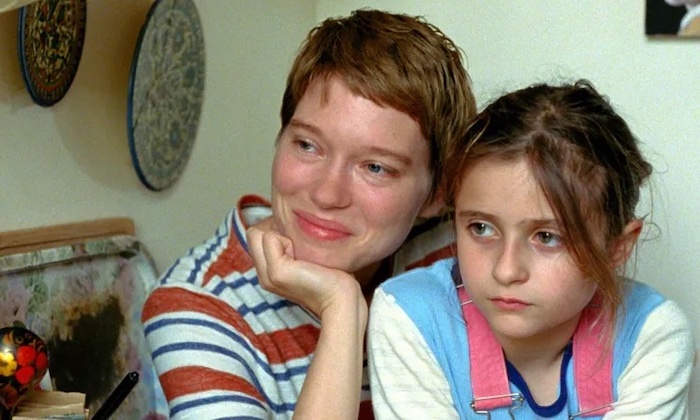
Like Ozon’s female protagonist, Emmanuele, Sandra (Lea Seydoux) is the product of an academic upbringing, but unlike Emmanuele Sandra hasn’t benefited materially from that situation as much. She works in Paris as a freelance German and English interpreter, and is translating a book in her spare time more or less as a means of maintaning her intellectual cred, though once her father’s neuro-degenerative condition worsens, she doesn’t have any time to spare. In addition to taking care of her father, Georg (Pascal Greggory), a retired philosophy professor who grew up in Austria, a chore she shares with several other related women, including her sister (Sarah Le Picard), mother (Nicole Garcia), and Georg’s current partner (Fejria Deliba), Sandra is raising an 8-year-old daughter, Linn (Camille Leban Martins), alone, since her own partner died five years earlier. Seydoux’s performance and Hansen-Løve’s direction create a character who is obviously overwhelmed by her responsibilities and yet seems almost enlivened by them. In an early scene in which she visits her father, who is still living alone in his book-stuffed apartment, she has to talk him through the steps necessary for him to unlock his front door, and the patience she exhibits is heartbreaking. It also sets the tone for not only the movie as a whole, but our way of processing what happens to Sandra. Again, unlike in Ozon’s movie, where addressing the stricken father’s condition was mainly a matter of tolerating his offensive personality, here Georg has no real input into what happens to him, and because of his less privileged financial situation, Sandra and her family are forced to move him from one facility to another until they can secure an affordable permanent residence. In the meantime, Sandra has embarked on a love affair with her late partner’s best friend, Clement (Melvil Poupaud), a self-styled “cosmochemist” whose married status posits the usual tensions such relationships entail, and while initially it’s all about sex (“I had assumed my love life was behind me”), Sandra, at least, finds herself in need of a more grounded emotional experience given the precarity of the rest of her waking existence. 

Hansen-Løve doesn’t have to belabor the various conflicts that afflict Sandra’s life because there is always the certitude that things will change, and the appeal of the film as encapsulated in its title (also the title of Georg’s unfinished memoir) is that change is both inevitable and what impresses us most about the past. If resilience is the movie’s indomitable theme, the everyday redemption that Sandra enjoys for simply doing the right thing—even when doing the right thing means being miserable—is what makes it so affecting. 

In French. Opens May 5 in Tokyo at Shinjuku Musashinokan (03-3354-5670), Cine Switch Ginza (03-3561-0707).

One Fine Morning home page in Japanese

photo (c) 2022 LFP-Les films pelleas/Razor Film Produktion/Arte France Cinema/Dauphin Films/Mubi/CN6 Productions/Bayerische Rundfunk/Zack Films

Posted in Movies | Tagged , | Leave a comment

Media watch: The inevitability of the immigration law revision

Ushiku Immigration Center in Ibaraki Prefecture, where many undocumented foreigners are detained (Tokyo Shimbun)

We’ve written in the past about the Japanese government’s treatment of asylum seekers, and the revision to the Immigration Control and Refugee Recognition Law that the ruling coalition has been working on for years to close inconvenient loopholes was supposed to be passed two years ago, but wasn’t due to issues with timing and public opinion. We wrote about the specific problems with that bill in March 2021, when it wasn’t certain it would fail, but it did. Now it’s back, and the media are saying it will likely be passed this time. 

As we also wrote at the time, the original revision was mostly accepted by the mainstream media because all they did was parrot the government’s talking points. The exception, as is often the case with government policy, was Tokyo Shimbun, which in the meantime has continued to cover the matter without compromising its editorial conscience. After the revised revision was approved by the Lower House Judicial Affairs Committee on April 28 with the votes of four parties—the ruling Liberal Democratic Party and its coalition partner, Komeito; Nippon Ishin no Kai, and Kokumin Minshuto—Tokyo Shimbun explained that the LDP’s next step would be to get the revision passed in the Lower House in “early May.” Summarizing the purport of the bill, the newspaper said it is meant to “solve the problem of people remaining in detention for a long time,” a situation that has led to at least two detainees dying in custody, even if they weren’t necessarily asylum-seekers. The reason for the long detention under current law is that, while a self-identified refugee is in the process of applying for asylum they cannot be forcibly deported, but since they are by government definition “undocumented” they must be detained. Over the years, this sort of detention of foreign nationals has become a huge PR problem for the Japanese government, since it draws the attention of overseas human rights organizations, including some associated with the UN. As has always been obvious since the first revision was proposed in 2021, the government has no intention of giving in to these groups but rather is trying to avoid the whole problem of having refugee applicants sitting in jail for months and even years. The new revision effectively sets a limit for asylum applications at three, meaning after the third rejection, the applicant can be forced to return to their home country, regardless of whether they attempt to reapply. Critics of the revision have said, in Tokyo Shimbun’s words, that if it is passed in its present form it would be like “pressing the button for these refugees’ execution,” meaning that they would be sent back to the countries they escaped from and there would likely face arrest and further persecution, maybe even death. The government has said that the purpose of the three-time application limit is to prevent “abuse” of the system, which, for all intents and purposes, does not really consitute a system at all. As we have written repeatedly, applications for asylum are routinely rejected by immigration authorities (who have the sole authority to detain them—Japan is the only rich country in the world where courts have no say in immigrant detention, meaning they do not receive the due process guaranteed by the Constitution), who essentially say they don’t believe that the applicants are in any danger in their home countries because they do not submit sufficient “documentary proof” of their persecution. In other words, they can say anything they want, which usually comes down to the judgement that self-identified refugees are lying about their situations and coming to Japan for “economic reasons.”

Continue reading
Posted in Media | Tagged , | Leave a comment

Review: I, Olga Hepnarova

Tomas Weinreb’s and Petr Kazda’s fictionalized reimagining of the last woman to be executed in Czechoslovakia, in 1975, maintains a brutal fascination for its subject, played with unstinting sad-sack bravura by Michalina Olszanka, with an almost comical attention to detail. Even in the early scenes, when Olga is sent as a 13-year-old to a psychiatric hospital-cum-juvenile detention center following a suicide attempt and is violently bullied, come across as mockumentary takes on the idea of Eastern European brutalist cinema—long takes in black-and-white and low contrast lighting, with amateurish actors doing their best not to look at the camera. This aesthetic aligns with the filmmakers’ preference for not giving too much away, and while the source of Olga’s suffering is easy to discern, the particulars are never clear. She obsesses over her patrimony, though there’s nothing in the early scenes to indicate which of the men in her nominal household is supposed to be her father, if any. Her mother is a physician who can use the state system to get Olga the care she needs (including medication, which is how she attempts to kill herself), but that’s all the information we have about her—that, and she seems unmoved by Olga’s professed pathology. “You look angry,” one new acquaintance says to her later on. “I always look angry,” Olga replies, as if looking were being.

The middle part of the movie is more interesting in the way it develops Olga’s character both apart from her identification as a social incompetent and within a closed circle of people. Particularly noteworthy is the way her therapists, unlike her mother, actually attempt to empathize with her situation, which appears to be a comment not only on the relatively advanced state of socialized medicine in Czechoslovakia but an acknowledgement of how Olga’s peculiar predicament was something that could be understood by a fairly wide cross-section of people. Having missed out on a large chunk of school while institutionalized, Olga gives up on education and finds work as a driver (of both people and goods), a profession for which she has a talent. Living on her own in a drafty hut that she treats as a pigsty, Olga makes some attempt at a normal life, but her need to feel oppressed and mocked always asserts itself. After she embarks on a series of ravenous lesbian relationships she actually expects the medical establishment to help her get a new girlfriend as part of her treatment, and when her doctor says “finding you a partner isn’t healthcare,” she adds homosexuality to the ever-growing list of attributes that only prove to herself she’s hopelessly damaged. 

As the title implies, much of the movie is told through Olga’s perspective, mostly diary entries in which she keeps warning herself that the only recourse she has is to kill someone so as to prove to society that what they’ve done to her is inexcusable, and yet when she carries out her deadly plan it’s still shocking, probably because the visceral quality of the scene contrasts so starkly with Olga’s enervated behavior. In court, she tries to make a philosophical case for her murderous rampage, and during psychological investigations into her motives, her interrogators, like the doctors before them, seem genuinely perceptive of her reasoning. With her chain-smoking, preternaturally lean physique, and perpetually downcast demeanor, Olga Hepnarova often looks like a bad stereotype of the disaffected teenager, but apparently Czechoslavia was filled with such people. The fact that Olga was hanged might indicate that so many others like her didn’t follow their disaffected attitude to its natural extreme. It’s as if Weinreb and Kazda wanted to question whether her pain was real or just another adolescent pose.

In Czech. Now playing in Tokyo at Theater Image Forum Aoyama (03-5766-0114).

I, Olga Hepnarova home page in Japanese

Posted in Movies | Leave a comment

Review: In Our Prime

Ever since his lead performance in Oldboy, Choi Min-sik has come to represent, at least to international movie fans whose diet of Korean films tend to center on well-known fare, the Korean idea of the antihero: a deeply flawed individual who is made to pay for his sins in extreme ways and, for better or worse, is redeemed by this process—even if Choi’s filmography reveals a wider range of characters. Given the Korean predilection for revenge tales and purple melodrama, Choi took this kind of persona to the bank, but in his twilight years he’s turned into something else, a kind of post-redemption figure who wears his victimhood like a badge. In his latest film he plays a North Korean defector who lays low by working as a night watchman at a prestigious prep school. As it turns out, his desire to cut a modest figure is multivalent, and it’s the viewer’s desire to learn what made him such a hermit that gives the story its potent appeal, because otherwise the movie does nothing new or interesting.

The protagonist is actually a student, Ji-woo (Kim Dong-hwi), who is attending as a “welfare case,” meaning an honors student who can’t afford such a school because of his socioeconomic situation (widowed mother without education). Painfully aware of his circumstances, he’s not so much bullied as given the opportunity, usually against his will, to prove his worth, and one night while smuggling in booze for his dorm mates, he’s caught by the night watchman,  Hak-sung (Choi), who reports him to the school. The punishment is loss of dorm privileges for a few months and, embarrassed to go home, he endeavors to sleep in one of the school’s abandoned classrooms, where, of course, he encounters Hak-sung again. As it turns out, the night watchman was once a storied math prodigy, and Ji-woo can’t afford the kind of math tutors his classmates patronize. Once he understands Ji-woo’s special status, Hak-sung agrees to teach him advanced calculus under certain conditions, which mostly boil down to not giving a fig about tests and scores and applying oneself to the study of math as if it were a sacred calling.

Aside from Hak-sung’s philosophical diatribes about the real meaning of numbers, most of the development in the first half of the movie adheres to the kind of action prerogatives you see in sports films, but once his true motivations come out, the story takes on multiple meanings and deepens its critical interrogation of not only Korea’s warped education system, but also the fraught, unknowable emotional and logistical difficulties that communist defectors have to navigate in order to just survive in South Korea. The screenplay is clever even if it relies too heavily on big, obvious reveals and changes in tone that feel phony—the scene where Hak-sung and a female student play what sounds like a K-pop tune on a piano that is supposedly based on a numerical extrapolation of pi is sublimely ludicrous. What saves it is Choi’s indelible projection of a grizzled survivor of moral misadventure. 

In Korean. Now playing in Tokyo at Cinemart Shinjuku (03-5369-2831).

In Our Prime home page in Japanese

photo (c) 2022 showbox and Joyrabbit Inc.

Posted in Movies | Tagged | Leave a comment

Review: The Highway Family

Character actors, especially those who specialize in villains, are by definition cast within a fairly narrow range, while marquee stars prefer to work in their wheelhouses because that’s what makes them and their movies money. Jung Il-woo is one of Korea’s most bankable leading men whose career has mostly been in TV historical dramas and fairly light romantic stuff. In Lee Sang-moon’s feature debut, he plays the paternal head of a homeless family of four whose mental capacities seem to be at a diminished level. The kind of subtlety the part demands would be a challenge for any actor, and while Jung can often be affecting in ensemble scenes, he inadvertently overwhelms the movie with a pathos that burns a little too brightly. 

Jung plays Ki-woo, who, along with his pregnant wife Ji-sook (Kim Seul-ki) and two young children camp out at highway rest stops in the Korean countryside. For food, Ki-woo cadges cash from motorists, saying he lost his wallet and will pay them back later. Most people are good, though a few demand more answers than Ki-woo is willing to give, so he keeps the kids nearby for sympathetic reinforcement. Lee develops the story slowly so as to provide some idea of how this family gets by as a family, and for the first 45 minutes Ki-woo’s motivations remain a mystery. If anything, he comes across as the storied hippie subjecting his family to some sort of whim about free will and independence. But then he’s arrested after a middle aged Good Samaritan, Young-sun (Ra Mi-ran), gives him a large amount of money and then spies him begging again at a different rest stop and calls the police. The authorities detain him but not his family, and, feeling responsible, Young-sun puts the three up in her used furniture store. Having herself lost a son recently, Young-sun and her husband informally adopt Ji-sook and the two kids, who, it turns out, cannot read or write. As they warm to their new surroundings, Ki-woo simmers in jail and his nascent mental illness manifests as violent paranoia. He escapes to reclaim his family.

As with many Korean debut dramas that attempt to tackle a social issue, The Highway Family has a tough time maintaining an even tone. Though Ki-woo’s escape is meant to highlight the fragile state of his mind, it’s played almost as slapstick. More problematically, Lee gradually unspools the back story that got this family into the situation they now find them in, and it’s rich and affecting enough to make the melodrama and thriller aspects feel unnecessary and distracting. Ki-woo, as it turns out, has had a tough time of it, as has Ji-sook, but the frantic climax seems imported from another movie, and Jung’s determination to do it proud only makes matters worse.

In Korean. Now playing in Tokyo at Cinemart Shinjuku (03-5369-2831).

The Highway Family home page in Japanese

photo (c) 2022 Seollem film, kt alpha Co., Ltd.

Posted in Movies | Leave a comment

Review: Red Rocket

It was obviously going to be a tall order for director Sean Baker to top or even equal his last film, The Florida Project, an epic exploration of 21st century survivalist poverty in the capitalist milieu represented by the titular state’s reliance on Disney Enterprises, and Red Rocket certainly maintains his cred as the most compelling chronicler of the American socioeconomic underbelly in that he evokes true empathy with his characters, regardless of their shortcomings. Our protagonist, the former L.A. porn star Mikey Saber (Simon Rex), is from the get-go a morally compromised individual, showing up shirtless and bloodied at the broken-down mid-Texas bungalow home of his estranged wife and former AV partner Lexi (Bree Elrod) and meth-head mother, Lil (Brenda Deiss), begging for succor. Neither woman wants to accommodate him, but he’s a charmer in his own snakelike fashion and eventually gets a shower, and then some clothes, and then food and a place to sleep.

Mikey is in almost every scene of Red Rocket, which passes itself off as a comedy in much the same way that Baker’s earlier film, Tangerine, did, which is to say it looks squarely at the ridiculousness of the situations that Mikey, a preternaturally unsympathetic hero, repeatedly places himself in. Though it’s not entirely clear why Mikey had to leave L.A. in such a state, he reacclimatizes to his old home town quickly, using his native smarts and bullshit talents to ingratiate himself into the lives of other folks who, given time to think matters out clearly, wouldn’t normally give Mikey the time of day. After failing to secure a legitimate job, he drops in an old acquaintance, Leondria (Judy Hill), who deals marijuana, and starts selling her wares to guys at the local oil refinery despite Leondria’s warnings to stay away from “big oil.” Quickly reestablishing himself as a player with money to burn, he starts paying rent at Lexi’s, treats his shy, ne’er-do-well neighbor Lonnie (Ethan Darbone) to strip club sojourns, and plans his return to Hollywood in various nefarious ways, the most serious of which is to sponsor a teenage donut shop employee, Strawberry (Suzanna Son), as a porn ingenue once she turns 18. 

Except for Lonnie, who worships Mikey and hangs breathlessly on all of his tall tales of swordsmanship, everyone sees through his veneer of scalliwaggery, including Strawberry, whose willingness to have regular sex with someone more than twice her age has less to do with exploiting her own seductive powers than with what appears to be a real desire to remake Mikey into her own ideal. In the scheme of things, we endure much of Mikey’s hot air in anticipation of his comeuppance, and it’s something of a slog, not because Baker’s direction is slow—it’s some of the most assured work he’s ever done—but because the character just isn’t that interesting. He’s a type we’re too familiar with, and while Rex does imbue him with a distinct personality, Mikey’s shtick is essentially something you’re asked to put up with. When the just deserts are served—on a platter of cliche, no less—you wonder why it took so long. 

Opens April 21 in Tokyo at Human Trust Cinema Shibuya (03-5468-5551), Cinemart Shinjuku (03-5369-2831).

Red Rocket home page in Japanese

photo (c) 2021 Red Rocket Productions LLC

Posted in Movies | Tagged | Leave a comment

Review: Mariupolis 2

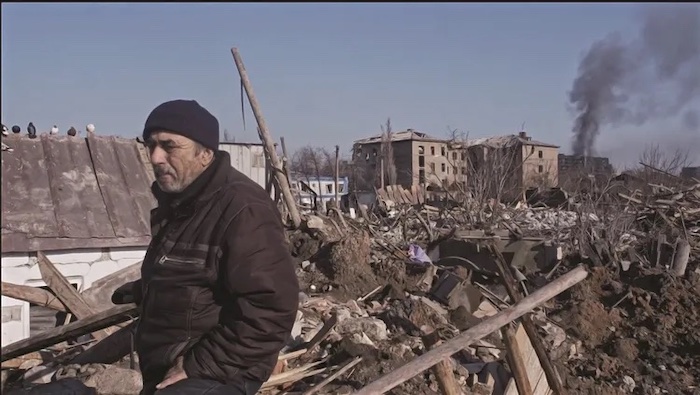
Because of their nature as recordings of real events, documentaries often come with their own dramatic context, and in the case of Lithuanian filmmaker Mantas Kvedaravicius’s sequel to his 2016 film about the titular Ukrainian port city, much has been made about his return to Mariupol shortly after the Russian invasion in February 2022. Mariupol 2, which chronicles only 7 days in an area about the size of a few city blocks, doesn’t provide any background or incisive commentary about the reason for the invasion. It simply records how one group of people cope with the constant bombardment. But once you understand that Kvedaravicius was captured by Russian troops right after this footage was shot and then summarily executed, the movie becomes something else. As it happened, Kvedaravicius’s partner, Hanna Bilobrova, and his editor quickly cut the footage and had it ready to be shown at Cannes less than two months later. Whether such a film, hastily thrown together without narration or contextual information, constitutes a valuable document is up for debate, but at the time it premiered it stood outside any critical consideration.

Mariupolis was a love song to a city. Mariupolis 2 complements it by showing how the city is gradually being destroyed, and for the most part Kvedaravicius keeps shooting from the same vantage points to show how buildings and skylines are changing in the course of his week there. The center of the action is a Baptist church where neighbors have fled for sanctuary, sleeping in close quarters in the basement and cooking large pots of soup using whatever materials they can scrounge up. Smoke is pervasive and the sound of artillery, both distant and close-range, is constant. The only violence is suggested. Two men enter a bombed out residence to retrieve a generator, stepping over two dead bodies in the process. Conversations are necessarily incomplete, and while some do address the politics of the war—one man insists that things were better when the Soviets ruled the city, though he says it out of earshot of others—there’s never a feeling of taking sides. Mariupol has a sizable ethnic Russian population.

As the director carefully moves away from the church, he catches more scenes of destruction. This particular area contains a lot of small industry, and the resignation of the factory managers and employees who sift through the rubble is particularly chilling, because the war, after all, has just begun. Watching these men try and make sense of what is happening around them becomes all the more disconcerting at one year’s remove. How many are dead? How many were captured? We know Kvedaravicius is gone. Though Mariupolis 2 has little meaning without a more elaborate explanation of the war, until the war actually ends its power to affect will remain potent. 

In Russian. Now playing in Tokyo at Theater Image Forum Aoyama (03-5766-0114).

Mariupolis 2 home page in Japanese

photo (c) 2022 Extimacy Films, Easy Riders Films, Twenty Twenty Vision

Posted in Movies | Tagged | Leave a comment

Review: Lost Illusions

That Balzac guy sure was prescient. His 1843 novel Illusions perdues depicted a media world centered on fake news, in which the profits to be had by printing what the highest bidder had to offer for specific journalistic favors was just too tempting to pass up. Though Balzac is often described as a “realist,” he wasn’t averse to using broad dramatic license and inflating the worst qualities of French society in order to highlight the cynicism of the age. His method here is to contrast naive idealism with abject opportunism.

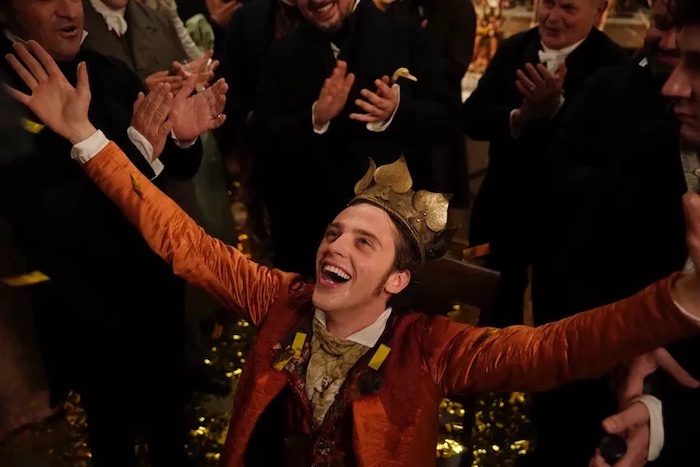
Xavier Giannolli has adapted Lost Illusions to the screen without much interpretation: Its main mode of exposition is voiceover narration that sounds as if it were lifted directly from the novel. The instrument is young poet Lucien Chardon (Benjamin Voisin), who lives in the sticks and conducts an affair with an older noblewoman, Louise de Bargeton (Cecile de France), who quickly tires of him as her social inferior after she repairs to Paris and he follows closely behind. While in the capital, Lucien tries to sell his creative writing to a publisher, Dauriat (Gerard Depardieu), at the insistence of his new mentor, Lousteau (Vincent Lacoste), who works for Dauriat writing reviews of books and plays on spec, meaning he is assigned what to say depending on who needs good—or, more importantly, bad—publicity. Dauriat is the film’s most potent caricature, a functionally illiterate “editor” who knows that only money talks (and writes). Lucien thus adopts a pen name and starts producing debilitating diatribes about, among others, a work by a royalist (read: conservative) named Nathan (Canadian film director Xavier Dolan), who is now positioned as his sworn enemy. 

Lucien eventually becomes a notorious critic whose pronouncements can sink or float a play. Balzac’s view of show business is particularly acid as even theater managers take big payoffs to make sure audiences boo or cheer according to who has more financial pull, regardless of the quality of the work on display. Carried away by his own deluded power to influence, Lucien falls in love with a young actress, Coralie (Salome Dawaels), and embarks on a mission to make her a star, grossly overestimating his ability to do so in such a toxic environment. As a result, his former flame, Louise, overcome with jealousy, connives with Nathan to realize Lucien’s downfall. Giannolli achieves a narrative completeness through carefully cultivated details that aptly explains how this sort of rank capitalism could thrive in such a milieu, but often the schematic nature of the production drains the story of whatever emotional resonance Balzac was so good at incorporating into his social studies. We know from the start, because Balzac and Giannolli tell us, that this is a tragedy, but by the end it comes across as more of an elaborate anecdote. 

In French. Now playing in Tokyo at Human Trust Cinema Yurakucho (03-6259-8608), Shinjuku Piccadilly (050-6861-3011), Yebisu Garden Cinema (0570-783-715).

Lost Illusions home page in Japanese

photo (c) 2021 Curiosa Films-Gaumont-France 3 Cinema-Gabriel Inc.-Umedia

Posted in Movies | Tagged | Leave a comment

Review: Moneyboys

The title of Chinese filmmaker C.B. Yi’s debut feature refers to male hustlers in the industrial south of China who cater to male customers. From the first scene when we’re introduced to the protagonist, Fei (Kai Ko), going to his first gig as one third of a threesome, it’s clear that these moneyboys are gay men who otherwise can’t reveal their sexual preferences, and as the movie develops we see the tight-knit community that forms underground among these men (and their female comrades), thus shining a light not only on gay life in China, but the circumstances surrounding migrant labor from the countryside to the cities. As it turns out, Yi, who studied film in Austria, shot Moneyboys in Taiwan, supposedly for budgetary reasons, though it may also have had something to do with the movie’s theme. 

Like many migrant workers, Fei sends money back to his family in the countryside, though in his case he hides from them the nature of his work. The story is framed by his relationships with two other men, first Xiaolai (JC Lin), a fellow moneyboy who falls in love with Fei and exacts retribution on a john who subjects Fei to a beating during a paid tryst. After Xiaolai is himself subjected to a beating in return, Fei escapes to another city and Yi jumps ahead five years, by which time Fei has become a successful moneyboy with a nice apartment and steady work with high-income clients. Nevertheless, his life isn’t stable, and he’s set up by local police who bust him for prostitution, a charge that somehow is communicated back to his home village. The next time he visits, to see his ailing grandfather, he is practically banished by his extended family, but a childhood friend, Long (Bai Yufan), follows him back to the city, eager to become a moneyboy himself since, as he so pointedly explains, every job he’s ever had involves “selling my body,” so he might as well get paid as much as possible for it.

Yi brings the narrative full circle in a way that’s dramatically satisfying. Fei’s life has rendered his psyche vulnerable to any kind of disapproval, and when he reconnects with Xiaolai while trying to make a home with Long, he loses his equilibrium—or, whatever equilibrium he has managed to manifest under such circumstances. The conflicting emotions of all three men is palpable, and the overall mood and motivations of the characters feel credible to the point of documentary realism. Kai, apparently, was once a popular film star who is making a comeback after some years in the show biz wilderness, and his unsettling portrayal of Fei keeps the viewer off balance, because you never know how he will react to the next obstacle on his carefully navigated road to happiness, developing a through-line of personality that’s recognizable regardless of whether he presents with ecstasy or despair. And though Yi demonstrates a familiar European sensibility in his choices—very little camera movement, with long static shots of inventively blocked tableaux—Moneyboys feels alien enough to convince you it’s honestly depicting a world you know nothing about.

In Mandarin. Opens April 14 in Tokyo at Cinemart Shinjuku (03-5369-2831).

Moneyboys home page in Japanese

photo (c) KGP Filmproduktion, Zorba, Arte France Cinema, Flash Forward Entertainment, La Compagnier Cinematographique & Panache Productions 2021

Posted in Movies | Tagged , | 1 Comment

Review: Holy Spider

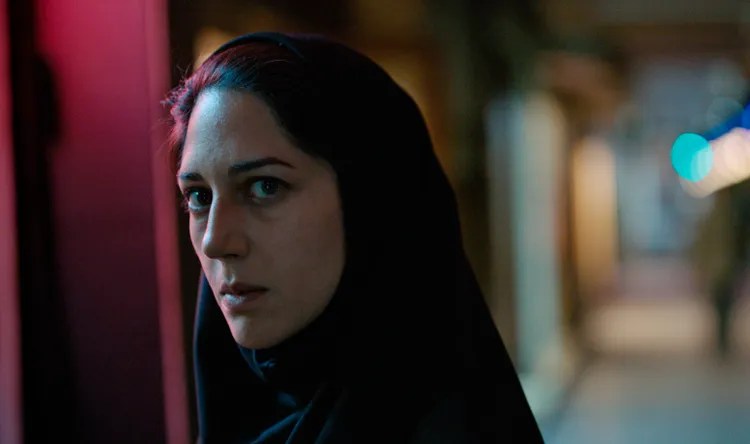
More serendipitous timing: This film about a man who murders female prostitutes in Iran’s holy city of Mashhad is being released internationally as Iranian women ramp up their resistance to the fundamentalist regime that has long kept them down. Not surprisingly, the movie was not shot in Iran but in Jordan. Director Ali Abbasi, a native Iranian who now lives and works in Denmark (he is responsible for the curious Danish language body-horror fantasy Border), applied for permission to film in Iran but was refused. It’s easy to understand why, and not just because of the serial killer theme and the attendant sex and violence. The movie takes a sharply negative view of Iran’s treatment of women in general, and never neglects the opportunity to play up the magnitude of misogyny that’s embedded in the country’s laws and cultural attitudes. In that regard, Abbasi gets invaluable help from his lead, Zar Amir-Ebrahimi, who won the Best Actress prize at Cannes for her performance as the headstrong journalist, Arezoo Rahimi, though in some ways her dominant presence makes you wonder if the character she plays is more of a didactic device than a fully inhabited person.

Though Holy Spider, based on a true story, is a credible thriller, it isn’t a mystery, since we know who the killer is right from the first scene, when the middle aged construction worker Saeed (Mehdi Bajestani) stalks an already battered prostitute and then brings her back to his apartment posing as a potential john. He strangles her in the stairway when she starts to get cold feet and then drives out of town with the body and dumps it on the side of a hill. As the movie develops and the murders pile up, we learn that Saeed is married with two children as well as a veteran of the Iran-Iraq War (the movie takes place around 2000-01). The fact that he didn’t die a martyr, as many of his comrades did, has left him guilt-ridden and determined to make his holy mark, and thus he embarks on a crusade to “cleanse the streets” of sinful women who sell their bodies, often to support drug habits. Though Abbasi addresses the origins of these women’s problems, he does it collectively, the result being that the viewer only sees them as victims. Rahimi provides contrast without much depth. She stands up to patronizing officials, including a police officer who demands sex in exchange for intelligence about the murders, and commiserates with the prostitutes, who are afraid to trust her. But between these two extremes of feminine constructs there is only Saeed’s wife, who is positioned to represent the requisite figure of complacency—the nurturer. 

Abbasi falls back on thriller cliches that undermine his aims, and often the audience has to take the motivations depicted at face value. But the final third of the film is bracingly effective in showing the base hypocrisy of the judicial and penal systems, as well as the dogma that props them up. It’s obvious to Rahimi from the beginning that the authorities aren’t so interested in catching the Spider Killer, as he’s referred to in the press, because they think he really is cleaning up the streets, but after she forces their hand they find new ways of covering their asses while making the appropriate noises about justice and purity of purpose. 

In Farsi. Opens April 14 in Tokyo at Shinjuku Cinema Qualite (03-3352-5645), Human Trust Cinema Shibuya (03-5468-5551), Toho Cinemas Chanter Hibiya (050-6868-5001).

Holy Spider home page in Japanese

photo (c) Profile Pictures/One Two Films

Posted in Movies | Tagged , | Leave a comment