Media watch: Are school-based sports clubs on the way out?

photo: Asahi

As the debate heats up on the government’s desire to increase Japan’s defense budget, some people on social media have been posting a quote by ruling Liberal Democratic Party lawmaker Tomomi Inada from 2016 when she was the defense minister. Inada proposed transferring funds used for the children’s allowance (kodomo teate) to defense, which she reasoned would solve the problem of perceived shortfalls. The children’s allowance is a form of welfare that is available to any household with children that makes up to a certain amount of money, and obviously Inada thought it could be sacrificed on the altar of national security. The people who have posted the meme say that Inada thinks children are less important than Japan’s ability to purchase expensive military hardware from the U.S., and, as a matter of fact, of all the G7 governments, Japan’s spends the least on children and their education. Meanwhile, if the defense budget is increased to 2 percent of GDP, Japan will then be number 3 in the world of all countries in terms of defense spending.

Even when the government addresses issues that directly affect children their priorities can seem skewed. A June 6 article in the financial magazine Toyo Keizai talked about a symposium carried out by a group of scholars and former athletes at the behest of the Japan Sports Agency about the future of junior high school sports. As everyone knows, the birth rate continues to drop year after year, which means school enrollment in most places is also dropping. Dwindling enrollment has already started to affect extra-curricular activities, of which sports is the most prominent. Already, some junior high schools cannot muster enough students to field teams, and so the agency has been trying to come up with solutions. On May 27, the symposium proposed that school sports be moved from schools themselves to regional sports associations. The idea is that individual junior high schools with insufficient enrollment to form sports teams pool their sports-minded students together in regional sporting associations to form regional sports clubs rather than school-based sports clubs. One scholar said that by 2048, on average a boys junior high school baseball team will only have 3.5 members, thus making baseball as a school sport unviable.

According to Toyo Keizai, there are already some 3,600 regional sports associations throughout Japan that have been cultivated by the JSA, as well as other regional clubs operated by private companies. The agency has asked the symposium participants to further discuss the matter of transferring sports clubs from junior high schools over the next three years. The first phase of their work would be a summary of the transfer proposal. The second phase will presumably be coming up with concrete ideas to carry out the transfers. The group admits that such a move will fundamentally change the whole concept of how to develop athletes in Japan, an endeavor that has centered on the school system. Consequently, the third phase, which would be the actual transfer, can only be carried out after problems already facing school sports, mostly of a financial nature, are addressed.

Continue reading

Posted in Media | Tagged , , | Leave a comment

Review: Soup and Ideology

Filmmaker Yang Yonghi’s career has been in the service of explaining why her family is what it is, and as with many such endeavors the family itself hasn’t always seemed happy with the attention. Most of this work has been in the documentary field, but she did do one narrative feature, 2012’s Our Homeland, that used actors and a dramatic script to tell the story of her family, perhaps in a bid to make the explanation more accessible to average viewers, who may be less intrigued by the documentary form. Actually, Our Homeland was less intriguing than her documentaries, mainly because it dramatized a situation that had built-in drama, especially for Japanese viewers. Yang and her family are Japan-resident Koreans. Moreover, they identify with North Korea, thus making them pariahs, not only to Japanese people but to other Japan-resident Koreans who identify with South Korea. The story that Yang tells in all her films is played against this background. Her father, born in South Korea, came to Japan during the colonial era and, disillusioned with his lot and that of other Koreans after the war, offered his loyatlies to North Korea with its claims of being a paradise on earth. Moreover, he worked for Chongryon, the conduit association between Japan and North Korea, while his wife ran a restaurant in Osaka. In the early 1970s he even sent all three of his sons to North Korea to live. Yonghi is the much younger daughter who didn’t go to North Korea and in the meantime became a filmmaker. Two of her docs take place principally in North Korea where she filmed her relatives’ lives there. Though her father, who has since died, never abandoned his faith in North Korea, Yonghi herself has always taken a more pragmatic, if not skeptical, view of her family’s path. At the same time, as the member of an ethnic minority in Japan, the country of her birth, she maintains a true outsider’s view of her situation and that of her family.

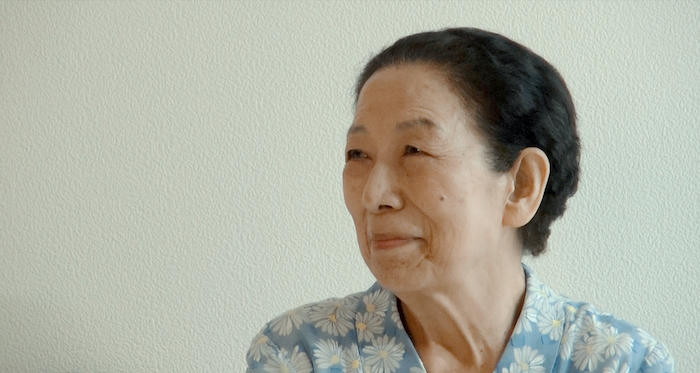
Soup and Ideology is meant to be a kind of concluding chapter, though she has said there may be room for further exploration. It is about Yang’s mother, Kang Jung-hee, who survived her husband with her loyalty to Pyongyang intact. She continues to send most of the money she makes to her children in North Korea, as if it is not only a necessity but her mission. Yang’s film is rangier than her earlier works, built with footage shot over the course of a decade or so. But in another sense it is her most concise film since it involves a discovery placing her family’s dilemma in a context that is more immediate for the viewer, not to mention more dramatic. In the opening scene, Kang, hospitalized, starts talking about the time she spent on South Korea’s Jeju Island between 1945, when she fled Osaka as a teenager to escape the US firebombing, and 1948. While on Jeju she became engaged to a Korean doctor who was also a member of the local resistance, which objected to the eventual partition of the peninsula. The Americans and the provisional South Korean government brutally repressed the resistance, killing 30,000 people in the process, and Kang had to escape the island under cover of darkness to return to Osaka, where she eventually met the man who would become her husband.

Yang knew nothing of this story until her mother told her in 2015, and most of the movie involves how she comes to grips with it. Using her mother’s first-person recollections, narrative explications by South Korean historical activists, and animated sequences illustrating parts of the tragedy, Yang finds a means of putting into perspective the confusion she has always felt regarding her family’s politics, which she recognized as being impelled by anger and frustration rather than by ideology. Having always wondered why her family had to suffer for their beliefs—a situation that she blames as much on her father’s intransigence as she does on the anti-Korean sentiments held by Japanese society—the over-arching horror of the Jeju Uprising gives her not only a convenient back story to that suffering, but a narrative frame over which to stretch the canvas of her mother’s final days as she sinks slowly into a fog of dementia (she died in January, after filming of the movie was completed).

Which isn’t to say Soup and Ideology is a dark experience. During the time when she was lucid, Kang is a much more convivial film subject than Yang’s father was, a fountain of folk wisdom and cynical, off-color humor who is charming and approachable. Yang also gets valuable support from her new, much younger husband, a Japanese man whose close relationship to Kang is the jumping off point for many of the scenes that reveal more about Yang’s relationship with her mother than anything else she filmed. The results transcend the ostensible journey of self-discovery that culminates in Kang returning to Jeju to face her demons, painting a picture of life for Japan-resident Koreans that was not as raw and vivid in Yang’s previous movies, whether documentary or feature. During a post-screening press conference at the Foreign Correspondents’ Club of Japan, Yang mentioned Pachinko, the bestselling novel by Korean-American writer Min Jin Lee that is currently creating millions of new fans worldwide as a TV series. Much of the novel covers the exact same milieu that Yang’s work does and she expressed frustration that such a multi-generational epic has never been tackled by a Japanese director, since it represents a foundational story of postwar Japan that most Japanese probably know nothing about. It was difficult not to sense behind the remark the feeling that Yang herself thinks she should have been given the opportunity to make such an epic, which says more about Japan’s squeamishness toward its own modern history (not to mention the parochial nature of Japan’s film industry) than Yang’s obvious talents as a director. 

In Japanese and Korean. Now playing in Tokyo at Eurospace Shibuya (03-3461-0211), Polepole Higashi Nagano (03-3371-0088).

Soup and Ideology home page in Japanese

photo (c) PLACE TO BE, Yang Yonghi

Posted in Movies | Tagged , , | Leave a comment

Review: The Story of Film: A New Generation

British film scholar and filmmaker Mark Cousins takes the notion of fan service to its most obvious ends in that, as a fan himself, he only seems intent on satisfying his own needs, which turn out to be quite specific. Best known for his 2011 15-hour history of movies, The Story of Film: An Odyssey, Cousins expands on his personal idiosyncrasies while addressing film as both an art form and a commercial imperative, and yet the series is reportedly as ecumenical a study of movies as you’re likely to ever encounter (I’ve only seen a handful of individual episodes over the years), which isn’t to say he doesn’t offer opinions, but rather that he can both honor and transcend his tastes in order to make points that may have greater meaning to his perceived audience.

Clocking in at two-hours-and-forty-five minutes, his latest study, A New Generation, takes into consideration the state of international cinema in the years since his opus opened, and, unfashionably perhaps, he is optimistic about the future of the medium and approves resoundingly of all the technical advancements that the movies have acquired in that time. For sure, Cousins’ means of explaining how movies have developed in the last decade—he opens by comparing two blockbusters, Joker and Frozen, for their depiction of outsiders—takes some time to get used to, not to mention his narrative habit of describing in detail exactly what you’re seeing. But the point of this discursive methodology is to show how filmic forms have changed in the 21st century in adapting to these new technologies as well as to deeper engagement with themes that were once either forbidden or simply out-of-mind. In Cousins’ purview every shot is deliberate and revelatory, but not necessarily of something story-related. The first half of the doc is titled “Extending the Language of Film,” which presents movies as a type of communication with its own grammar, and like all languages film is constantly evolving. The movie he cites as the one that pushed this language further than others is Sean Baker’s Tangerine, because it not only highlighted the onset of affordable high-quality visuals through the use of iPhones, but did it by focusing on trans women, who were never the center of attention before: A new technology for a new kind of protagonist.

Cousins’ liberal use of superlatives can be annoying but they point up his investment in the films he’s exhibiting, many of which are almost too familiar, but he’s equally enamored of international titles that you probably have never heard of. He’s especially taken with Indian and Southeast Asian films, but seems less versed in Korean works except for Parasite. And while he has nothing pointed to say about the emergence of streaming, he includes films that are now mostly known through their exposure on smaller screens. He’s also very good at outlining the way genre has become a tool of expression rather than just a stylistic choice—the sections on horror and comedy are particularly fascinating since they delineate in plain terms how different cultures exploit these genres for their own purposes. “Horror is always new,” he says in a hushed tone, marveling at how much good will you can engender out of promising viewers a proper scare. 

But to assume that Cousins likes everything short-changes the documentary’s accomplishments. In the second half, titled “What Have We Been Digging For?”, he makes the case that film is still the most immediate art form for artists who want to convey their own sensibility directly, even if they are discovering how to do it along the way. Of course, this capability is transferred to the audience, which both incorporates the viewed experiences into their consciousness while projecting themselves onto the screen. I was almost shocked that I had seen most of the 111 films he discusses, including Aleksey German’s Hard to Be a God, which he claims is the most striking movie made in the last 10 years while being one of the least viewed. However, I wasn’t surprised that he taught me a brand new way of looking at them, which means I should probably see them again. If I came away with one incontrovertible truth after sitting through A New Generation is that there will never be enough time for you to see all the films you want. 

Opens June 10 in Tokyo at Shinjuku Cinema Qualite (03-3352-5645).

The Story of Film: A New Generation home page in Japanese

photo (c) Story of Film Ltd 2020

Posted in Movies | Leave a comment

Review: Nomad: In the Footsteps of Bruce Chatwin

In many ways every film is about its filmmaker, even when the ostensible subject is a different person. A viewer who approaches Werner Herzog’s documentary about the British travel writer Bruce Chatwin expecting a biography will likely be disappointed since the clearest purpose of the film is to explore Herzog’s relationship with Chatwin, which started in the early 1980s. Consequently, the aspect of Chatwin’s career that I myself find most interesting is mostly ignored. Chatwin is often credited with reviving the art of travel writing with his bestseller In Patagonia, but that wasn’t his aim, which was to make himself useful as a citizen of the world. An office worker whose first few attempts at being published failed due to lack of focus, he became the nomad of Herzog’s title because he was always in search of something he couldn’t grasp until he actually found it. His travel writing is different because it isn’t really about travel. It’s about going to a place and discovering everything there is to know about it, right down to the geology and the natural history. 

It’s this latter facet of Chatwin’s work that overlaps with Herzog’s, whose own movies are often anthropological in conception. However, he doesn’t examine Chatwin’s work itself, and, for that matter, rarely even quotes from his books. He essentially reminisces about the times he spent with Chatwin and then tries to build parallels between Chatwin’s thoughts and his own movies, which are referenced at least as much as Chatwin’s words. Herzog is straightforward about how Chatwin directly influenced his own movies, but we learn nothing about the writer’s frustration as a young corporate factotum, or, for that matter, much about his sexual conflicts (Chatwin died of AIDS in 1989 at the age of 48, still in the closet though his wife of many years was aware and tolerant of his relationships with men). Instead, we get a lot of ruminative narration about Chatwin’s “obsession with prehistory” and his conclusion that “all history is myth.” Though these ideas are interesting in and of themselves, it is up to the viewer to forge the proper connections in order to make some kind of linear sense out of Chatwin’s life. Herzog’s patented English voiceover, at once clipped in tone but grandiose in style, can often sound like a parody of itself, especially when expanding on such abstract matters. 

The movie, which itself travels all over the world, is beautiful, but because it is essentially a compilation of footage shot over many years for other projects, it’s easy to get the impression that Herzog was simply looking for a means of putting that disparate footage to use, and Chatwin, the ultimate peripatetic writer, became the ideal subject. At one point, Herzog tells an interlocutor that Chatwin is the subject of their conversation and the movie we are now watching, as if to remind himself what he should be doing. As erudite and probing as Nomad is, a more honest title would have been Bruce and Me

Now playing in Tokyo at Iwanami Hall Suidobashi (03-3262-5252).

Nomad home page in Japanese

Posted in Movies | Tagged | Leave a comment

Review: Crock of Gold: A Few Rounds With Shane MacGowan

The centrality of “authenticity” comes and goes in the annals of music criticism. In its most common usage it represents an artist’s commitment to music as craft, which is why hip-hop and techno were originally dismissed by self-serious, trad-oriented types. But in the sense of being authentic to one’s beliefs, the term really came into its own during the punk revolution of the late 70s and 80s, when artists themselves dismissed music that felt unrepresentative of the human condition. As a rock documentarist, Julien Temple has made this notion his metier, and his two-hour-plus study of the music and career of Pogues frontman Shane MacGowan is more successful in this regard than his docs about the Sex Pistols and Joe Strummer, if mainly because MacGowan himself sets both the pace and the tone of the film by being front and center for most of the movie.

MacGowan was authentic in an unusual way: An Irishman who celebrated his Irishness as a native Londoner. Already a drunk and hellion as a teen, he appeared to his family and friends to be on the short road to oblivion until he saw the Sex Pistols and adapted the punk image for his own purposes. What’s interesting is this image should have rightly put him on the even shorter road to self-destruction, as MacGowan, speaking from a wheelchair and with an often difficult-to-understand slur in the present to Temple, as well as to friends such as Johnny Depp (one of the film’s producers) and Sinn Fein leader Gerry Adams, recalls how punk helped him find what can only be termed a constructive outlet for his self-destruction. And while he did start out as a rocker he quickly transmogrified the punk attitude to celebrate and expand on Irish traditional music forms with the Pogues. 

“I was put here by God to save Irish music,” he says without irony. More essentially, he used Irish music to talk about those things that have always been explicit in Irish literature, such as the Irish diaspora and the idea of exile. Though he claims Brendan Behan as his poetic soulmate, he sees James Joyce, who lived his life abroad and was, he points out, a great singer, as his true model for how to live as an artist. Though Temple makes much of MacGowan’s oft-repeated line that he purposely acted the drunken Irish stereotype in order to throw it back in the face of British racists, MacGowan’s romantic streak, as illustrated by songs like “A Pair of Brown Eyes” and his classic Christmas song “Fairytale of New York,” is fully explicated as a means of putting his bad-boy reputation and demolished physical form into proper perspective. 

What’s most remarkable about the film, aside from the staggering array of source material that Temple got his hands on, is how MacGowan, who has railed not only against the establishment over the years but also against his bandmates (whom he’s “divorced” twice) and mentors like Elvis Costello (whom he fired once), now finds himself rock royalty and one of the giants of 20th literature, as Strummer (his replacement in the Pogues, don’t forget) once called him. The movie ends with a 60th birthday party on stage where he’s feted as an original for the ages, and while the movie emphasizes his physical deterioration it also celebrates the sharpness of his mind in the witty and cutting comments that seem so effortless for him. Crock of Gold is hagiography as a presentation of stark contrasts, which is why you can’t accuse it of being inauthentic. 

Now playing in Tokyo at Shibuya Cine Quinto (03-3477-5905).

Crock of Gold home page in Japanese

photo (c) The Gift Film Limited 2020

Posted in Movies | Tagged , | Leave a comment

Review: An Officer and a Spy

Roman Polanski is old and probably doesn’t have many more films left in him. Though he’s considered one of the most important directors of the last 60 years, his output since the turn of the millennium has been riddled with asterisks due to his status as a fugitive from justice, which, based on the spotty distribution of his last several movies, would seem to have rendered him persona non grata in the Anglophone cinematic universe at least. Depending on how you feel about confessed statutory rapists, this informal blackballing could be deemed unfortunate given the quality of his latest feature, a very involving retelling of the infamous Dreyfus Affair that rocked French society at the end of the 19th century and which, reportedly, is a subject Polanski had been keen to tackle for some time. From what I can gather, the only public screenings of An Officer and a Spy (J’accuse is the original French title) with English subtitles have been at festivals. 

Japanese distributors are less squeamish about Polanski’s notoriety, and here the movie is being promoted as a kind of detective thriller, which is about right, though viewers shouldn’t expect anything as delightfully tawdry as Chinatown. Alfred Dreyfus (Louis Garrel) was a captain in the French army who, despite an excellent record and undiminished loyalty, was convicted of selling secret weapons technology to the Germans and exiled to Devil’s Island. What made the trial and subsequent sentencing scandalous is that Dreyfus was scapegoated because he was a Jew during a period when anti-semitism was ascendant in France. Eventually, the writer Emile Zola published an open letter accusing certain officers by name of using dodgy evidence to railroad Dreyfus as a means of covering up army corruption, knowing that it would be easy to stigmatize a Jew. The fallout exposed the institutional anti-semitism of the age and became a basic text for future scholars of institutional discrimination. 

Polanski, working with the writer Robert Harris, who published a novel about the Dreyfus Affair as preparation for the movie, doesn’t center his film on Dreyfus or Zola, but rather on Col. Georges Picquart (Jean Dujardin), an officer who served above Dreyfus and, following the latter’s conviction, was promoted to the head of military intelligence, where in the course of investigating a suspected double agent realized that the man he was following was the person who actually traded secrets with the Germans, not Dreyfus. Though Picquart himself admits to being an anti-semite, he is also a soldier of honorable disposition and cannot countenance the idea that an earnest and upright officer like Dreyfus was cynically framed in order to cover up the incompetence of the upper ranks. After painstakingly collecting evidence with the help of a detective, he confronts his superiors and they immediately and resentfully not only reject his findings, but banish him to Africa where he will not cause any problems.

But Picquart will not leave the matter alone. He returns to Paris some time later and takes up where he left off, recruiting a sympathetic lawyer to help him rehabilitate Dreyfus along with a group of politicians and Zola, who eventually publishes his essay. This leads to Picquart’s arrest for insubordination and a defamation suit against Zola. Because a good portion of the public also hates Jews, it is easy for both men to be convicted, but a fellow officer who previously gave testimony against Dreyfus succumbs to guilt and confesses his perjury, thus resulting in Picquart’s release and a second trial for Dreyfus.

The real object of Polanski’s attention is the toxic privilege of the French military. The men occupying the highest ranks are no different in temperament and prejudices than their counterparts in Stanley Kubrick’s Paths of Glory, who blithely sentence men to death for empty principles. To a 21st century viewer these proud men are not just ethically compromised. They embody a class-derived evil that will become a leitmotif for the 20th century. But Polanski plays by their game by focusing on their foil, Picquart, who while opposing them also personifies the noble qualities they claim as their stock in trade. Harris’s suspenseful script and Polanski’s zig-zagging direction—his use of flashbacks and flash-forwards is masterful—make for a police procedural with uncommon depth. More essentially, An Officer and a Spy feels like living history, though I suspect Harris expanded a lot on the record. In any case, if you’re the kind of moviegoer who likes detective stories and detailed historical reenactments, this movie is right up your alley. 

In French. Opens June 3 in Tokyo at Toho Cinemas Nihonbashi (050-6868-5060), Toho Cinemas Chanter Hibiya (050-6868-5001), Toho Cinemas Shinjuku (050-6868-5063), Toho Cinemas Roppongi Hills (050-6868-5024).

An Officer and a Spy home page in Japanese

photo (c) 2019 Legendaire, R.P. Productions, Gaumont, France 2 Cinema, France 3 Cinema, Elise O Cinema, Raicinema (c) Guy Fernandis-Tous droits reserves

Posted in Movies | Tagged | Leave a comment

Media watch: LDP heavyweights scramble to kill own redistricting plan

Hiroyuki Hosoda (Asahi)

For years, concerned citizens have asked Japanese courts to address the vote disparities that have plagued national elections since the electoral system was revamped nearly 30 years ago. In almost all the cases, judges have found that such disparities are provisionally unconstitutional but nevertheless refuse to order new elections to be held in accordance with plaintiffs’ desires, saying that it is up to the Japanese legislature to remedy the situation, presumably by redistributing Diet seats in accordance with changing demographics. Now, the Diet has a plan that will pretty much do that and, what’s more, it was formulated by the ruling Liberal Democratic Party, which implies it should be easy to implement. However, in recent months, several high-powered lawmakers in the party have finally come to understand what carrying out the plan would mean and that if it is they could actually lose their constituencies and thus are now trying to undermine it.

An April 15 article in Toyo Keizai Online summarized the plan, which has been dubbed the “add 10, take away 10” formula, because it would remove ten Lower House seats from rural districts that have been losing population for several decades and add ten seats to predominantly urban districts where populations have risen. The plan was prompted by demographic calculations made following the 2020 census and released last June. As a result, Diet Affairs Committee chairpersons from all the political parties have agreed to establish a joint deliberative council to lay out the 10-10 plan for the prime minister’s approval, but there have been delays because a substantial portion of the LDP has voiced objection. And while Prime Minister Fumio Kishida has indicated he supports the revision, those with reservations have a lot of pull within the party. Kishida is supposed to submit the revision by June 25, or just before the Upper House poll, and while the revision would not effect that election it might cause strife within the party that could be a distraction from campaigning activities. 

The calculus for the plan was first submitted in April 2016 by the ruling coalition and was subsequently passed by both houses. The concept follows what is called the “Adams method,” which, in Japan’s case, means that the number of Lower House seats assigned to each prefecture is determined by the prefecture’s population. According to the census, which is carried out by the interior ministry, the Lower House represents a total of 289 constituencies, ranging from Tottori #2 District, with 274,160 people, to Tokyo #22 district with 573,969 people. These extremes represent the largest gap in terms of voting disparity—a factor of 2.049—meaning that votes in Tottori #2 are worth 2.049 times the votes in Tokyo #22. In fact, there are 20 constituencies where the vote value is more than twice as much as as what it is in Tokyo. The object of the 10-10 plan is to reduce this disparity at least to less than 2.0 times. Specifically, the plan will increase the number of seats for all of Tokyo Prefecture by 5, Kanagawa Prefecture by 2, and Chiba, Aichi, and Saitama Prefectures by one each, because these areas have seen substantial increases in population over the years. At the same time, Miyagi, Fukushima, Niigata, Shiga, Wakayama, Okayama, Hiroshima, Yamaguchi, Ehime, and Nagasaki Prefectures will each lose one seat, because they have lost population.

Continue reading
Posted in Media | Tagged , | Leave a comment

Review: Mothering Sunday

Adapted from a Graham Swift novel published in 2016, Eva Husson’s debut feature feels like an attempt to inject oxygen into the stuffy atmosphere that usually surrounds the so-called British prestige picture. Comprising three different time periods but centered on the titular holiday in 1924, the movie is a blend of highbrow dialogue and overly impressionistic direction that aims to penetrate the genteel surfaces of English aristocracy and show how, deep down, the rich are just as capable of suffering as the poor. The main difference is that the poor, thanks to a closer proximity to reality, have a readier capacity to probe their suffering for meaning.

This latter idea is personified by the protagonist, Jane Fairchild (Odessa Yound), an orphan employed as a maid at the country estate of Lord and Lady Niven (Colin Firth, Olivia Colman), who lost their two sons in the trenches of France. In fact, the town has lost most of its generation of high-born men to World War I, a circumstance that unites the local gentry under a pall of open-ended mourning. Their only sense of hope is invested in the impending nuptials between the sole surviving youth, Paul Sheringham (Josh O’Connor), and the bitterly resistent Emma (Emma D’Arcy), who was once informally betrothed to one of the Nivens’ sons. As it happens, Jane has been pursuing a passionate, secret love affair with Paul for some time, and on this particular Sunday that affair will come to an end since the wedding, to which Paul has willingly assented out of class obligation, is scheduled to take place in less than a fortnight. 

Husson capably interweaves Paul’s and Jane’s lovemaking, their postcoital discussions about fate and literature, a strained riverside lunch attended by the three manor families of the town, and Jane’s future some years down the road as she embarks on a writing career using this pivotal afternoon to explore her traumatized psyche. This blending of two versions of the past (later there will be a second flash-forward, so to speak) and how they speak to each other highlights the inventiveness of the plotting and the sharpness of the characterizations, but the effort exerted to pull it all together into a thematic whole comes across as even more pretentious than what you get in the worst kind of Merchant-Ivory project. All this existential drama is siphoned into Jane’s life as a writer, as if it were all set up by the gods with that end game in sight. Though I’m tempted to blame Swift, it’s mostly due to the heavy lifting on the part of Husson, whose reliance on closeups and hazy rays of sunlight borders on the obsessive, not to mention Morgan Kibby’s derivative chamber music score, which repeatedly calls attention to itself. Fans of Downton Abbey may find the sexual candor and interclass dynamics shocking and thrilling, but for those of us who approach this milieu with less fawning regard, the movie offers nothing provocative except a clever story. 

Opens May 27 in Tokyo at Human Trust Cinema Yurakucho (03-6259-8608), Shinjuku Piccadilly (050-6861-3011).

Mothering Sunday home page in Japanese

photo (c) Channel Four Television Corporation, The British Film Institute and Number 9 Films Sunday Limited 2021

Posted in Movies | Leave a comment

Review: One Second

At one point the most celebrated and revered member of the so-called Fifth Generation of Chinese filmmakers, Zhang Yimou has since turned into an equally notorious example of submitting to a repressive system for the sake of survival as an artist, if necessarily a diminished one. Younger film aficionados mainly identify him as a maker of large-scale entertainments in the wuxia style, though older movie fans probably mark his turning point as accepting the role of the artistic director of the Beijing Olympics, both the 2008 and 2022 versions. As such, these jobs supposedly revealed his latent nationalism, an opinion that was bolstered by movies like Hero or, more critically, his Hollywood co-production The Great Wall

In his latest offering, One Second, Zhang returns to the theme that first made him internationally famous—a stubborn will to live in the face of hardship. It’s a theme that’s inherently sentimental, and as such the movie’s most direct cognate is his 1999 feature The Road Home, which not only sealed his reputation on the festival circuit, but made a superstar out of Zhang Ziyi. More to the point, Zhang places the narrative at the center of the Cultural Revolution in such a way as to show that the resilience on display is in reaction to pressures brought to bear by the government’s brutal social engineering plans. Reading several reviews of the film I noted that, while Zhang still seems to enjoy the authorities’ favor, One Second was pulled from festivals before it could be screened. 

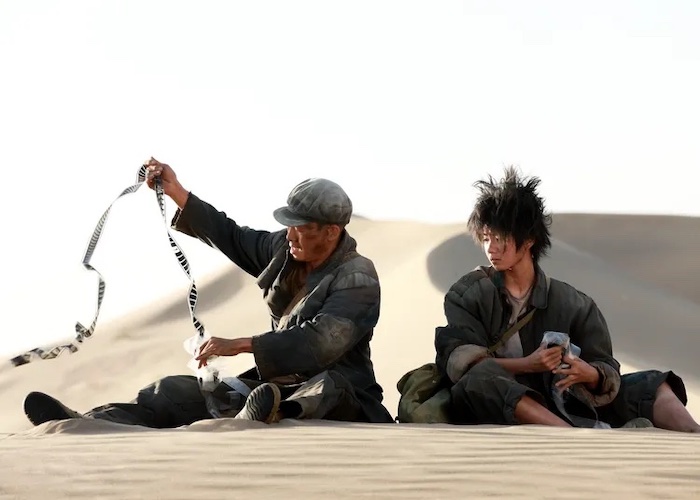
The movie is also about movies in the most elemental way. An escapee from a farm prison, Zhang (Zhang Li), crosses the desert on foot to watch a movie in a backwater town. When he arrives, however, he learns that he is too late. The screening, which is carried out by a local workers unit, has already concluded, the film reels packed up and ready to go to the next town. While trying to learn more, Zhang notices an unkempt waif, Liu (Liu Haocun), steal one of the film cans from the delivery motorcycle and pursues her. What ensues for the next half hour is an almost slapstick level cat-and-mouse game, as the film cannister changes hands between Zhang and Liu as they make their way to the next town, where, as it happens, Liu lives in abject destitution with her younger brother. 

Certainly the story’s most striking impression is how central movie-going is to the people who live in this place (Hebei Province in the middle of nowhere) at this particular time (the 70s, I would guess). When the film that is in the can falls out and ends up being dragged through the dirt for many kilometers, it arrives in the town scratched and grimy, but the dedicated, resourceful projectionist, Fan (Fan Wei), afraid that he has a potential riot on his hands, enlists the entire town to restore the film to at least a screenable state. As it turns out, Zhang the fugitive’s self-imposed mission is to see this particular segment, a boilerplate newsreel in which his estranged daughter supposedly appears as an ideal student. The upshot is that because of his “crime” (the preternaturally hotheaded Zhang assaulted a Red Army soldier) his wife was compelled to divorce him and his daughter forced to denounce and disown him. The “one second” of his daughter on the reel is the only chance he may ever have to see her again.

Zhang’s script skillfully taps this theme of parental despair as a contrasting motif to Liu’s story of parental abandonment. Not yet an adolescent, she cares for her younger brother by stealing and scheming. Though Zhang the director does not overtly try to make the claim that both Zhang the protagonist and Liu are victims of a “system,” it’s clear as the movie develops and becomes at once more melodramatic and viscerally exciting they are dealing with their situations, emotionally and practically, the only way they can. Zhang stages the action with an economical efficiency that proves he still sees himself as a technician first, but the movie’s power as pure cinema also shows that his artistic vision is undiminished, regardless of what uses it serves. 

In Mandarin. Now playing in Tokyo at Toho Cinemas Chanter Hibiya (050-6868-5001), Toho Cinemas Roppongi Hills (050-6868—5024).

One Second home page in Japanese

photo (c) Huanxi Media Group Limited

Posted in Movies | Tagged | Leave a comment

Media watch: Trial of Utoro arson suspect receives scant coverage

Utoro after the fire (Yahoo)

May 16 was the first day of the criminal trial of Shogo Arimoto, the 22-year-old man arrested for starting a fire in the Utoro district of Uji, Kyoto Prefecture, last August. Arimoto admitted to all the charges, though he denies the prosecutors’ characterization of his motives for starting the fire, which is that Arimoto has deep feelings of enmity toward Koreans. Utoro is famous as a community of Japan-resident Koreans who are descendants of workers brought from the Korean peninsula during World War II to help build an airport. In April, a memorial hall containing items related to and explanations of the history of the Utoro district opened, and the fire that Arimoto allegedly set destroyed not only seven buildings, but about 40 items that were destined to be part of the memorial hall’s archives. In December, we reported on the incident and its background here

Though the Asahi Shimbun covered Arimoto’s first day in court, for the most part the significance of the arson as a possible hate crime has been ignored by the media. In their opening statement, the prosecution explained that the defendant quit his job last July and expressed his frustration by setting fire to buildings associated with Koreans. At first he set fire to a South Korean school and the Aichi Prefecture headquarters of the Korean Residents Union in Japan, but neither received any press coverage, so he planned the Utoro arson with more care, targeting the memorial hall artifacts because he thought “society” would pay more attention. He was arrested in October for the July arson attack, and the arrested again in December for the Utoro fire. 

Continue reading
Posted in Media | Tagged , , | Leave a comment