Given what’s going on in Ukraine right now, many people may feel disinclined to take in a Russian movie, but the release in Japan of Dear Comrades!, a 2020 film by Andrei Konchalovsky, is timely in a chilling way. Based on a 1962 incident where factory workers in the small town of Novocherkassk peacefully demonstrated for higher wages when food prices spiked and were then killed by soldiers, the movie seems to take for granted the notion that Soviet authorities had no compunction about using deadly force just for convenience’s sake, even against their own people. As more than one person says during the course of the movie, life is pretty cheap under communism.
Of course, what’s going on now in Ukraine is not the work of the Communist Party, but a subtheme of Dear Comrades! is a kind of passive belief that Russia has alway been in thrall to authoritarianism. The protagonist, Lyudmilla (Yuliya Vysotskaya), is a Soviet functionary who blithely cuts the ubiquitous lines at retailers to collect her rations before anyone else can get theirs, but from the first scene it’s clear that just acquiring daily necessities is a full-time job that uses up everyone’s surplus energy. Lyudmilla carries her privilege with confidence and whenever someone even suggests that the food shortages are the doings of the party she puts them in their place with assurance. She even defends Stalin, who has already been in the grave for 9 years, replaced by a man who understood the destruction he caused even if he doesn’t say so out loud. To Lyudmilla, the state would be in better shape if Stalin were still running things.
The protest happens during a committee meeting that descends into chaos after the Kremlin calls them demanding they put an end to it by any means necessary. What follows is necessarily confusing because as orders make their way trough the byzantine Soviet bureaucracy anything that can go wrong likely does. The consequence is that lower officials quickly supplant their superiors and take out their grievances on them, thus multiplying the deadly toll initiated by the strike. At first, Konchalovsky seems to be aiming for some kind of dark satire, but once Lyudmilla realizes that her own daughter may have been involved in the demonstration, the movie’s whole mood turns deadly serious, with Lyudmilla doing double duty finding out the fate of her daughter and preventing her own arrest—or worse. Shot in black-and-white and framed with an eye for the austere beauty of Soviet brutalist architecture, the movie often feels calculated to the point of preciousness, and much of the drama of the second half doesn’t have as much power as the bleak comedy of the first. Dear Comrades! is sobering but it would have achieved more of its intended effect if it wasn’t telling us something we already knew.
In Russian. Now playing in Tokyo at Human Trust Cinema Yurakucho (03-6259-8608).
Nice bit of timing on the part of the involved local distributors to arrange for Edgar Wright’s documentary about the veteran pop group Sparks to open one week after the Japan release of Leos Carax’s musical (operetta?) Annette, for which Sparks provided the songs (by my measure, the best thing about the movie). If the timing was serendipity, so much the better, since, as Wright’s movie so ably points out, at many points in the band’s five-decade career they’ve seemed to teeter on the verge of irrelevance only to come roaring back as potent as ever. And yet, as the movie also attests, they’ve never been properly understood, even by their loyalest fans.
Fortunately, Wright doesn’t try to recreate Sparks’ shape-shifting aesthetic for the movie. It’s pretty conventional as far as music bios go, opening with a litany of raves from recognizable celebrities (Beck, Mike Meyers, New Order), before actually introducing Ron and Russell Mael, the brothers who have always been Sparks. It then follows with a brief but incisive explanation of their 1950s-60s childhood in California and how it shaped their approach to not only music but the life of the mind. It helps that Wright, a comedian at heart, appreciates the brothers’ knack for lampooning everything they believe in, including their own native talents, and never presents the Maels as something they could never be, i.e., geniuses or the progenitor-saviors of SoCal art rock. You would never mistake Sparks’ artistry for the self-indulgent earnestness of the so-called Laurel Canyon sound or, for that matter, Frank Zappa.
But Wright does add his own unique visual shorthand for describing Sparks’ development, using animation, both hand-drawn and stop-action, to supplement the brothers’ own unique conception of themselves as entertainers, and it’s easy to see how, as both Russell and Ron point out so often, they were as influenced by movies as they were by music. In that regard, the malleability of their sound mirrored the fluid character of postwar art, whether popular, middle-brow, or lofty. In the 70s alone, Sparks went from proto-glam to prog to disco in such a way that they seemed to forecast these trends even though they were often riding coattails. The difference is that they absorbed what made these forms interesting for them, which is also why they never achieved ringing commercial success in any of their endeavors. However, they endured and prospered. This tendency would persist through the 80s and 90s and on into the new millennium, but one facet would remain unchanged: the aural and visual imagery of the brothers themselves, specifically Russell’s fey, operatic vocal style and Ron’s purposefully bizarre stage appearance and mannerisms. As many of the talking heads here testify, Ron may possess the most iconic mustache of any figure in pop culture since Salvador Dali. Less noted until Wright makes an issue of it is Ron’s musical inventiveness, which is really the source of the duo’s longevity. Though the remarks by musicians, producers, and other industry people about Sparks’ integrity as song creators is the least compelling part of the movie, it accurately points up how their technical chops kept them in the money. That’s why Annette, though not really covered in the film, is so significant: they’d tried putting together narrative performance pieces before but couldn’t quite square their weird idiosyncratic music with the communal function of theater and film production. It took a Leos Carax, meaning someone who could raise money for ambitious, totally personal art, to let them fulfill their artistic vision in their own way. Wright’s movie honors that vision just as ably.
Opens April 8 in Tokyo at Toho Cinemas Chanter Hibiya (050-6868-5001), Shibuya Cine Quinto (03-3477-5905), Toho Cinemas Roppongi Hills (050-6868-5024).
This award-winning film, the debut feature of Cassio Pereira dos Santos, addresses the predicament of trans teens in a country like Brazil, which has certain built-in cultural mores that are at once accepting of sexual minorities and mistrustful of them. The unassailable premise of the story is that everyone should be able to live the life they want as long as it doesn’t hurt anyone else or otherwise impinge on their right to live their own life. The title character (Thiessa Woinbackk), a lower middle class 17-year-old whose mother has her back but is denied the normal adolescent experiences her peers enjoy, sees her problem as one of exposure. After she is assaulted at a nightclub where a young man comes on to her only to be told she is trans, she urges her mother to quit their home town and move to a new town where no one knows anything about her. The logic of this strategy is both understandable as a plot point and slightly suspicious in terms of how real life works. Conveniently, Valentina’s mother, Marcia (Guta Stresser), has just been certified as a nurse, so the decision to move is made that much easier.
However, after finding a place to rent in the home of an elderly woman, Valentina attempts to enroll at the local high school and while the administrator has no problem with her trans status, in order for her to enroll with her preferred name rather than the one she was given at birth, Raul, she needs the assent of both parents, which means she has to hunt down her estranged father, who, Valentina believes, left because she transitioned. As she searches for him, she becomes more acclimatized to her new environment, making friends at school (which has allowed her a grace period to acquire her father’s signature) and excelling in algebra and chemistry. Tellingly, perhaps, her best friends, who initially do not know she is trans, are the gay stringbean Julio (Ronaldo Bonafro) and the blithely pregnant hacker Amanda (Leticia Franco). Pereira dos Santos follows a fairly formulaic development, alternating normal teen shenanigans with the inevitable creeping public disclosure of Valentina’s situation. However, he keeps the viewer off balance by constantly shifting expectations. When Valentina’s father, Renato (Romulo Braga), finally shows up and does the right thing, he’s not the aggrieved paterfamilias we were expecting, but instead a shy, awkward man whose reasons for leaving turn out to be more complicated than anyone might want to admit. Similarly, once the town bigots start to circulate gossip about Valentina, she finds that not only do her peers come to her aid, but so do most of the adults in her orbit. Which isn’t to say the bigotry isn’t real or destructive (a card at the end informs us that more than 80 percent of trans teens don’t graduate and the life expectancy of a trans person in Brazil is 35), only that it’s owned by a minority. The moral of Valentina may be not be very original, but it’s worth pondering: Most people are kind. They’re just not strong.
In Portuguese. Now playing in Tokyo at Shinjuku Musashinokan (03-3354-5670), Human Trust Cinema Shibuya (03-5468-5551).
Soliciting for Sapporo 2030 survey (Hokkaido News)
In case you weren’t aware, Sapporo, the capital of Hokkaido, is gunning for the 2030 Winter Olympics, a goal that has been met with mixed feelings by not only many Japanese but, seemingly, many residents of Sapporo. Given the trauma exacted on the citizenry by the Tokyo 2020 Olympics, what with its postponement and huge financial overruns, the hesitation to go through all that again is understandable, but often the people behind such campaigns work as if they were an irresistible force. This time, the media is ready if not necessarily able.
A March 30 article in Toyo Keizai outlined in detail doubts provoked in the press by a survey whose results were announced by the Sapporo municipal government on March 16. One of the requirements for selection by the International Olympic Committee to host the games is the support of residents, so the city government is trying to get at least that part of the effort out of the way. Toyo Keizai hints that the bitter memory of Tokyo may be too fresh in people’s minds. Consequently, the media had questions when the results showed a majority of Sapporo citizens said they wanted to bring the Winter Olympics to their city in 2030.
A day before the announcement, Sapporo Mayor Katsuhiro Akimoto went to Tokyo to promote the bid in cooperation with ruling Liberal Democratic Party lawmakers from Hokkaido, saying that “by working with bureaucrats and citizens to develop the local area, we can look forward to business opportunities for the prefecture, so we hope to host the games with your cooperation.” Meaningfully, he received the support of Seiko Hashimoto, the former chairman of the Tokyo 2020 organizing committee, who pointed out that this year marks the 50th anniversary of the last time Sapporo hosted the Winter Olympics, though, somewhat ominously, she also pledged to help Akimoto by “using the experience we gained from Tokyo 2020.” Two days later, Hashimoto met with Prime Minister Fumio Kishida and Japan Olympic Committee President Yasuhiro Yamashita, eliciting their support for 2030 as well.
Toyo Keizei interpreted these developments as suggesting that the people working on the bid think it’s a done deal, but a close look at the survey results would seem to indicate that they may be getting ahead of themselves. The survey involved 17,500 respondents who were asked their feelings about hosting the Olympics. The survey was carried out by snail mail, through the internet, and on the street. Responses through all three methods showed a positive response, with between 52 and 57 percent of respondents saying they support the bid process. However, when this contingent was broken down further, the results seem slightly less positive, with half saying they definitely support the bid and the other half saying they “might” support the bid. More significantly, Hokkaido residents seem more inclined to support the bid than do Sapporo residents exclusively, and the share of Sapporans who said they definitely don’t want the Olympics was higher than the share of negative responses from residents of the rest of the prefecture. This reaction is easy to understand, says Toyo Keizai, since the people of Sapporo think they are going to have to pay for the preparations.
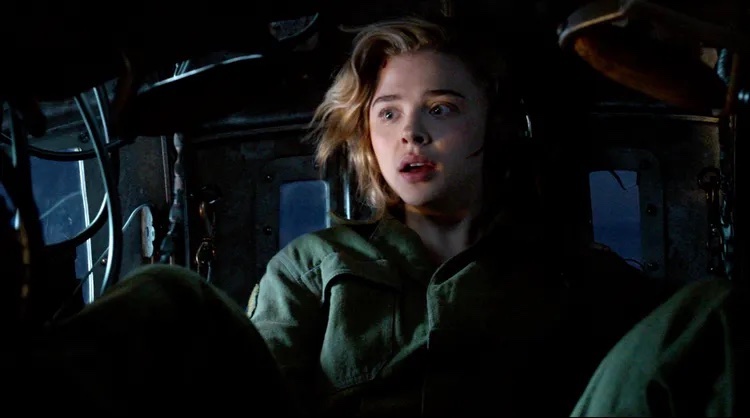
Though she’s done some nominally serious movies, Chloe Grace Moretz seems to be gunning for Milla Jovovich’s position as the premier female sci-fi-action hero of our age. Shadow in the Cloud has all the trappings of a project whipped up in an afternoon, but Moretz’s earnest performance and director Roseanne Liang’s willingness to tap any absurd narrative impulse make for a strangely thrilling piece of nonsense. The skinny is that the original script was reworked extensively after the writer, Max Landis, was accused of sexual abuse, and certain ideas clash obtrusively. If the movie succeeds on its own odd merits it’s because the people involved seem to believe to their souls that it works.
Moretz plays a flight officer during World War II who boards an allied bomber-supply plane in New Zealand with a box that she claims has to be delivered to the Philippines. Armed with papers that verify the package is “classified,” she gets on the flight at the last minute but the all-male crew doesn’t appreciate this extra body and play out their resentments with blatantly sexist banter, despite the fact that she outranks several of them. In any case, there’s no room for her in the hold, due to equipment they’re delivering, and she’s stuck in the lower gun turret, where most of the first half of the movie takes place as she listens to the guys’ offensive conversation through headphones. Though this setup necessarily limits the visual component, it manages to make for a lot of dramatic give-and-take thanks to Moretz’s command of her character, Maude, who is obviously hiding some kind of secret regarding the package and has to cover up her unease with a bluff assertiveness that doesn’t always convince her comrades.
But as this conceit plays out in an increasingly ridiculous manner the action prerogatives take over, first with an unexpected attack by Japanese zeros and then a totally batshit monster mash that was probably the original concept Landis was selling. I’m not certain how Liang changed the script, but, given the charge against Landis, I have a pretty good idea what it was and though it doesn’t work intellectually, much less logically, the resulting action is tightly packed and extremely well choreographed. By the mid-point, the sexual tensions that built up during the first half erupt into the most elemental expression of the survival instinct.
Now playing in Tokyo at Shinjuku Piccadilly (050-6861-3011), Shibuya Cine Quinto (03-3477-5905).
As everyone knows, movies are a collaborative art form, and while critics tend to judge their quality based on reductionist criteria concerning direction, writing, and acting, more often than not our opinions are shaped by more prosaic choices. As Martin Scorsese says near the beginning of this fascinating documentary, 90 percent of any film comes down to casting, a job we tend to think of as being purely administrative, though, as a parade of famous directors and actors attest in dozens of in-person interviews here, matching the right talent to a role is an art form in and of itself.
The doc’s director, Tom Donahue, centers his story on the woman who many believe invented the job, Marion Dougherty, who started out in the 1950s as an assistant to the person who basically found actors for Kraft Television Theater, one of the live dramatic TV shows that proliferated during the early days of the medium. At the time, TV was still mainly in New York, and thus the people who found actors had a whole city of them, thanks to the New York theater scene. When her boss quit, the job fell to Dougherty, who made a point of reading the scripts and then finding actors who she thought were right for the parts, rather than simply bodies to fill space. Though her creativity was not acknowledged by the larger artistic community, it was appreciated by those in the TV business, and eventually she went freelance and worked on pioneering shows like Naked City and Route 66, in the process discovering the likes of James Dean, Robert Duvall, Al Pacino, Dustin Hoffman, Gene Hackman, Jean Stapleton, Christopher Walken, and, most notoriously, Jon Voight, who so badly screwed up his debut chance on Naked City that he couldn’t find a job for years until Dougherty rediscovered him and suggested him for Joe Buck in Midnight Cowboy, a part for which the producers wanted Michael Sarazzin. But perhaps the most illustrative anecdote about the importance of Dougherty’s instinct was her advising Warren Beatty to lose his Brando affectations. And while it was west coast casting director (a professional term that had yet to be invented) Lyn Stalmaster who bucked the system by pushing the short, Jewish Hoffman for Benjamin Braddock, who in the novel of The Graduate was Waspy and athletic, it was Dougherty who got him the part of Ratso Rizzo, which may have been even more visionary given that Hoffman’s own manager thought the role would destroy his client’s momentum.
Donahue makes a convincing case that the advent of the New Hollywood of the late 60s and 70s was the result of creative casting choices, with Dougherty and her brownstone full of female acolytes handling the New York school and Stalmaster holding down Los Angeles. The common wisdom holds that during the Hollywood studio era, casting was pre-determined by acting types, but once the studios collapsed it became a free-for-all, and casting directors were extremely valuable, despite the somewhat pompous protestations of directors guild head Taylor Hackford, who has always lobbied against the term “casting director,” since, to him, only the person designated a film’s “director” deserves such a moniker because all decisions about a movie come down to that person. Almost every other director Donahue interviews disagrees, including Woody Allen, who confesses he is so intimidated by meeting new people that he couldn’t do the work he does without a casting director. Even Clint Eastwood admits that he finds casting the most confounding process in filmmaking since there is just so much talent out there and sifting through it all is impossible. The directors also despair that casting doesn’t have its own Oscar category given its importance in the process, but apparently the prejudice is stubborn. Despite a campaign to give Dougherty a special Oscar in the 90s that was endorsed by dozens of superstar directors she didn’t receive one.
Still, once the doc enters the 80s and the age of the blockbuster, the movie loses a certain amount of credibility and the important casting decisions that stand out, such as Dougherty pushing Danny Glover for the Lethal Weapon franchise despite the fact that the part wasn’t necessarily written with a Black man in mind, seem more like one-offs than trends that were maintained. Dougherty died in 2011 and the doc was first released the following year, so many of these interviews sound and look dated. Donahue doesn’t cover much in the way of post-millennial casting decisions, which seem to have reverted to a system where big names are the norm even if they don’t match the roles. Another topic missing from the story is how sex figured in casting decisions in the past. The #metoo movement wasn’t at large in 2012, and has since brought to light a problem that was always snickered about but relegated to the shadows. Donahue doesn’t address it at all, but so many of the younger casting directors (almost all women) he interviewed certainly must have worked with Harvey Weinstein at one time, and we now know what he thought about the casting process.
Now playing in Tokyo at Theater Image Forum, Aoyama (03-5766-0114).
Here is a link to our April media column for the Number 1 Shimbun, which is about the push in Japan for “nuclear sharing” and reopening nuclear power plants in the wake of Russia’s invasion of Ukraine.
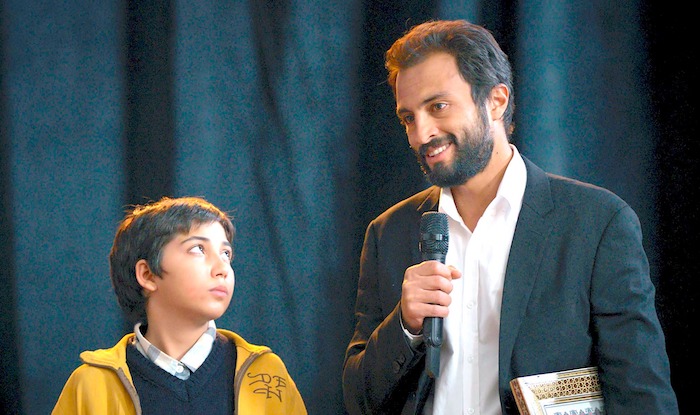
It’s interesting that Asghar Farhadi’s movies are appreciated by so many people from so many different countries since they address legal and cultural matters so specific to Iran. In fact, I’ve often had problems navigating his plots because I’ve missed the meaning of social niceties that Iranians likely take for granted, but in a way that’s also what makes his films so compelling. As you learn how these matters play out in Iranian society the dramatic contours of his stories make more sense. His latest work also focuses on a peculiarity of Iranian law, debtors prisons (which exists in other countries but probably in different ways), but for once the paradox is immediately understood. A creditor can demand that the person who owes them money be thrown in jail until they pay up, but, of course, how can the debtor come up with the cash while they’re locked up?
That’s exactly Rahim’s (Amir Jadidi) problem. He owes his ex-brother-in-law, Bahram (Mohsen Tanabandeh), a large sum, which he borrowed to pay off some loan sharks. For some reason, Bahram holds a grudge against Rahim and seems to prefer he stay in jail indefinitely. When Rahim is given a two-day provisional release to pay off at least some of the debt, Bahram is not happy. Rahim’s girlfriend, Farkhondeh (Sahar Goldust), has found a bag on the street with some gold coins in it, and she and Rahim think they can use the money for a down payment, but when they try to hock the coins they find they’re not worth as much as they thought, so Rahim endeavors to find the owner of the bag. His jailers, informed of this act of seeming selflessness, see some PR benefits and declare Rahim a hero on social media, but Bahram is suspicious. In any case, he rejects Rahim’s payback plan and demands he go back to prison.
As usual, Farhadi’s plotting sometimes gets away from him, but the subtle ways that Rahim’s reputation rises and then inevitably falls is carefully engineered so that his character flaws stand out. It’s not saying much that Rahim is not hero material to begin with, but his main problem is his lack of a forceful personality, and for much of the movie you wonder what Farkhondeh, who seems much more resourceful, sees in him. Similarly, though Bahram’s intransigence pegs him as the villain of this tale, his reasons eventually emerge. Like other Farhadi stories this one hinges on inter- and intra-family tensions, especially those brought about through marriage. I still don’t get a lot of the motivation that propels the plot, but I think I’m getting the hang of Iran’s social dynamics.
In Farsi. Now playing in Tokyo at Cine Switch Ginza (03-3561-0707), Bunkamura Le Cinema Shibuya (03-3477-9264), Shinjuku Cine Qualite (03-3352-5645).
If Cannes is, as its organizers claim, the greatest film festival in the world, it’s probably because the French film industry dutifully treats it as such. In fact, it’s impossible to distinguish the French film industry from the Cannes sensibility—just observe how the relationship is simultaneously honored and skewered throughout the French Netflix comedy Call My Agent. Consequently, you can get a good idea of the business’s self-importance by observing which French films qualify for prime exhibition. Last year’s partial return to normalcy, i.e., in-person audiences, was marked with an opening film by a director, Leos Carax, who puts out only one film a decade, an output that automatically attracts attention, especially given Carax’s reputation as being a creator of sui generis, confounding works. As it happened, he walked away with the director’s prize, even though the movie itself mostly perplexed people who were, by dint of where it was being shown, pre-disposed to appreciate it, if not necessarily like it.
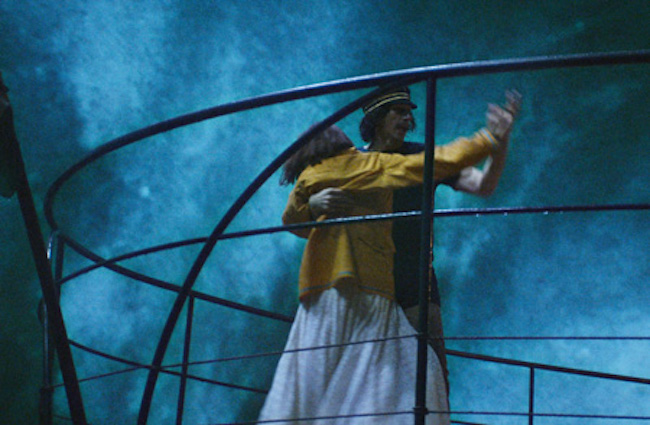
The fact that Annette is Carax’s first movie in English is less momentous than that it is a musical whose book and songs were written by the American brothers Russell and Ron Mael, better known as the rock band Sparks, who have been around screwing with people’s predilections since the early 1970s. Annette is a meta-film in that the music is often used as a comment on itself and the audience is constantly reminded that everyone on screen knows they’re out there. Genre-wise, it’s a romantic tragedy focusing on the marriage of two people who have similar vocations but are otherwise completely wrong for each other. Henry McHenry (Adam Driver) is a confrontational stand-up comedian, though technically he’s more of a monologuist with a chip on his shoulder: he struts the stage in his underwear and a hooded, open bathrobe as if looking for someone to box, insulting his audience or, at least, the idea of an audience that would deign pay money to see him. Naturally, he is a success, at least for a while. His better half is an opera singer, Ann Defrasnoux (Marion Cotillard), who sees her artistic mission as “saving” her listeners. Together, they have a child, the titular girl, who mocks her parents, especially her father, by simply existing. How could two people so obviously unsuited to connubial cohabitation produce and raise an offspring, which is probably why Annette is depicted as a literal puppet.
The above precis, however, is misleading in that the story as envisioned by the Maels and realized by Carax rarely follows anything like a line of development, and most of what’s afffecting about the film is invested in stylized tableaux and production numbers. In that sense the songs work exceptionally well because we can enjoy them as songs rather than as devices to advance the plot or feed into a theme. As the setting is Los Angeles, the Maels’ home town, and not Paris, this feeling of displacement is acute. It’s definitely a Carax film, and he seems to have no proper affinity for the city. It could be taking place anywhere and, thus, nowhere. So as the tragedy takes hold it fails to make an impression, and the only thing that lingers in the memory is Henry’s forceful personality, which is alternately terrifying and endearing. Annette is a hodgepodge of fascinating ideas that don’t add up to anything coherent. I wish I wanted to see it again, but I don’t.
Equally frustrating is the movie that won the Palme D’or at Cannes, Titane. Purposely provocative whereas Annette was pointlessly challenging, the movie was written and directed by Julia Ducournau, whose previous feature, Raw, was a slyly comic take on the vampire genre set in an impossibly competitive veterinary college. Though Titane doesn’t lack for humor, its shocks are all there on the surface, exerting much less power over the viewer’s imagination than Raw did.
Certainly, the plot is just plain pulp nonsense. Alexia (Agathe Rousselle), who has a metal plate in her head due to a horrible car accident she survived as a child, is a model-dancer in an automobile showroom who likes to get it on, literally, with the merchandise after hours. Ducournau doesn’t bother explaining the biology or, for that matter, the mechanics behind this interaction, but in any case Alexia’s sexual penchant for chrome results in her becoming pregnant with…something. In any case, the nature of her work, which is creating sexual tensions between potential customers and the motorized wares she pleasures, often stimulates those customers in more conventional ways, and one evening she murders a man who stalks her after she leaves work. As in Raw, once this kind of blood lust is activated it becomes uncontrollable, and Alexia embarks on an indiscriminate killing spree that’s as bloody as it is impossible to fathom. Sought by the police, she goes through an equally repulsive physical self-transformation and tries to pass herself off as a young man who has been missing for a number of years in order to reinvent herself. Ridiculously, Vincent (Vincent Lindon), the father of this boy, believes the impersonation and takes Alexia under his wing as his own flesh and blood and whatever. At that point, the story enters the realm of family melodrama, and, thanks almost entirely to Lindon’s performance, often works by the standards of family melodrama. By the time Alexia is about to deliver her baby, Vincent is there for her, and the child.
The entire appeal of Titane is its hallucinogenic persistence. Ducournau just keeps throwing weird ideas at the screen, hoping that some of them will stick, but as with Annette, what remains in the mind is isolated grotesqueries: Alexia leaking motor oil from various orifices, her brain peaking out from an opening above her ear, Vincent’s obsessive injections of steroids, which create their own kind of mechanized physique. The violence, though exceedingly gory, is so stylized as to be unreal, except for the scene where Alexia transforms her face by propelling the irresistible force of her nose toward the immovable object of a rest room sink. In moments like that, body horror doesn’t get any more tactile.
Annette opens April 1 in Tokyo at Shibuya Euro Space (03-3461-0211), Kadokawa Cinema Yurakucho (03-6268-0015), Shinjuku Piccadilly (050-6861-3011).
Annette photo (c) 2020CG Cinema Internationale/Theo Films/Tribus P Films International/Arte France Cinema/UGC Images/Detailfilm/Eurospace/Scope Pictures/Wrong Men/RTBF/Piano
Titane, in French, opens April 1 in Tokyo at Shinjuku Wald 9 (03-5369-4955), Human Trust Cinema Yurakucho (03-6259-8608), Shibuya Cine Quinto (03-3477-5905).
The Hollywood melodramas of the late 40s and early 50s had a discomfiting story-telling quality that seems exclusive to that particular era, meaning right after a war that many deemed “good” but which nevertheless haunted those who had seen it up close. Though we tend to associate this quality with the genre dubbed “noir,” it really permeated almost every script at the time that wasn’t a comedy. As a child I would watch these movies on TV and often became truly disgusted with the human behavior on display. It was much different than my reaction to prewar melodramas, which tended to sympathize with marginalized characters regardless of any extralegal activities they carried out, probably because of the Depression, which turned almost everyone into a victim of some kind.
Gullermo del Toro is obviously looking to recreate this disgust with Nightmare Alley, a remake of a 1947 melodrama that I haven’t seen but which I imagine delivered the queasiness very effectively. If del Toro’s version doesn’t make the same kind of impression, I suppose you could chalk it up to our 21st century jaded sensibility, not to mention a heightened degree of media literacy that allows us to evaluate texts as we absorb their stories. In any case, the main feeling I got while watching his version of Nightmare Alley wasn’t disgust at the antics on the screen but an impatience with the plot and characters, none of which were credible, and while we don’t demand movies to be realistic—for noirs, in particular, we demand the opposite—capable craft and attention to dramatic detail are necessary to make a fictional universe compelling, and the craft on display, while admirable, is only in the service of surfaces.
The story is a corker. Sometime in the 40s, a drifter named Stanton Carlisle (Bradley Cooper) gets hired as a laborer for a traveling carnival, and over time ingratiates himself with the troupe’s resident mentalist, Zeena (Toni Collette), learning the tricks of the trade through her retired, alcoholic husband, Pete (David Strathairn), plainly showing how Carlisle masters the psychological sleight-of-hand that’s vital to the illusion of claivoyance—more specifically, talking to dead people. After Pete dies under suspicious circumstances, Carlisle leaves the carnival with another, younger performer, Molly (Rooney Mara), who eventually becomes his assistant as he embarks on a successful career as a solo mentalist. However, being an in-demand entertainer isn’t enough, and when a glamorous psychologist, Dr. Ritter (Cate Blanchett), tries to expose his act and is foiled by Carlisle’s ingenuity, she offers to help him scam a millionaire (Richard Jenkins), whom Carlisle helps to communicate with his dead son, the aim being to make a killing off the millionaire. When this scheme is successful, the millionaire offers to introduce Carlisle to another rich individual who might require his services, and, working with Dr. Ritter again, the pair start a romantic relationship that seals Carlisle’s doom.
Since tragedy is built into these kinds of melodramas, the shock precipitated by the action has to be leveraged by the viewer’s identification with the protagonist, and Carlisle isn’t flamboyant enough in his expressiveness to find a purchase on our sympathies. The movie, in fact, has too many characters competing for the viewer’s emotional attention. Zeena and Molly essentially cancel each other out as love foils for Carlisle, and Dr. Ritter, as portrayed by Blanchett, is a stylized femme fatale whose personality is only as deep as her flawless complexion and immaculate coiffure. Most egregiously, the film’s thematic lynchpin, carnival owner Clem (Willem Dafoe), is such a cartoonish distillation of opportunistic evil that the movie’s implied moral lessons never have a chance to engage our understanding. In the end, I was neither disgusted by the behavior on the screen nor particularly moved by it. Just puzzled.
Now playing in Tokyo at Toho Cinemas Hibiya (050-6868-5068), Toho Cinemas Nihonbashi (050-6868-5060), Toho Cinemas Roppongi Hills (050-6868-5024), Toho Cinemas Shinjuku (050-6868-5063), Shinjuku Wald 9 (03-5369-4955), Shinjuku Piccadilly (050-6861-3011), Toho Cinemas Shibuya (050-6868-5002).






 philipbrasor.com