Media Mix, May 22, 2021

Here’s this week’s Media Mix about how the national newspapers are talking about the scheduled discharge of irradiated ground water from the stricken Fukushima No. 1 reactor into the surrounding sea. One of the purposes of editorials is to put the news into some kind perspective that will have meaning to readers, and in the case of the discharge many people don’t know if it’s a good idea or a bad idea. For the most part, the media has taken the government line, which is that the discharge will not harm the environment, but it’s not really certain that the public is convinced, which is why the general tenor of the editorial content of all five national newspapers is that the government has to explain more, though, realistically speaking, it’s difficult to imagine what exactly the government could do to bring everyone over to their way of thinking. Obviously, someone like Hiroaki Koide, the physicist mentioned at the end of the column, is going to be against the discharge because he is fundamentally opposed to commercial nuclear energy, but his main beef is with Tepco rather than the government, since he believes the utility approaches the whole matter from an economic standpoint, which means safety and other concerns are secondary. 

With climate change an ever-increasing threat to everyone on the planet, nuclear energy has become a focus of attention because it doesn’t produce CO2, so Japan, which has spent decades building up its nuclear capacity, has an obligation to see how viable nuclear power is as a means of mitigating its contributions to global warming, but it can’t ignore the public’s anxieties about nuclear power, not after what happened in Fukushima ten years ago. Tepco and the government have had a decade to put into place credible safety guidelines that take into account the proximity of power stations to residential areas and Japan’s geological situation, and they haven’t done enough. Various courts have blocked power station restarts because evacuation plans have been found to be insufficient, and in the past several months violations of security arrangements at two of Tepco’s power plants were discovered. It’s as if Tepco and the government don’t really care, so they can’t complain about “damaging rumors” if they themselves are party to creating them. 

Posted in Uncategorized | Leave a comment

Milva in Tokyo, 1998

The great Italian singer Milva died on April 23. For a while in the 90s and 00s she was an annual visitor to Japan, kind of like the Ventures of canzone, and I caught several of her concerts because Masako at the time did a lot of work for the promoter who brought her to Japan. The following is a review of her joint concert with the bandoneonist Daniel Binelli that I wrote for the Japan Times.

It’s not unusual for an artist’s reputation to soar after his death, but in the case of Astor Piazzolla, the Argentine bandoneonist and tango music composer who died in 1992, the legacy has taken on a separate life of its own. Though successful while he was alive, Piazzolla has in the past several years entered the classical canon as one of the late 20th century’s most significant composers, thanks not only to the current “tango boom,” but also to superstars like cellist Yo-Yo Ma and violinist Gidon Kremer, both of whom recently released best-selling albums of Piazzolla compositions.

As Kremer said in an interview on TBS’s “News 23” last year while he was in Japan for a concert tour, Piazzolla’s newfound popularity as a composer among the classical elite can be attributed to a sudden fin de siecle realization: For better or worse, most of the “serious” music composed in this century has been aimed at other composers. Piazzolla, on the other hand, wrote music for people — music that was not only challenging to play but enjoyable to listen to.

The Italian singer Milva, never one to pass up a chance to exploit a cultural trend, has dedicated her latest “Dramatic Recital” to the music of Piazzolla. Former Dramatic Recitals included programs dedicated to Brecht and Weill, songs that were popular in Europe between the wars, and the music of Edith Piaf. But while some people may raise their eyebrows at the canzone diva’s blatant opportunism, she has more of a right to take advantage of Piazzolla than, say, Ma or Kremer does since she actually toured with the great man back in the 80s.

What’s more, on her current Japan tour, entitled “El Tango de Astor Piazzolla,” she is being accompanied by bandoneonist Daniel Binelli, a musician who, since he spent three years playing alongside and studying with Piazzolla, can lay justifiable claim to the master’s musical legacy, not only as a musician but as a composer.

Though Milva’s name was at the top of the bill, Binelli and his excellent quintet were equal creative partners when they performed at the Tokyo International Forum on June 11. Alternating between Piazzolla compositions (including two written expressly for Milva) and Binelli compositions (including one written expressly for Milva), the recital was as much a tutorial on the musical life of Buenos Aires as it was a showcase for the oversized theatrical expressionism of the saucy, red-haired chanteuse.

In fact, Binelli and his group held forth by themselves on half the numbers. The peculiar genius of Piazzolla’s work is the way it extrapolates the rhythmic fundamentals of the tango into a new kind of formalism that is as compelling to listeners as it is to dancers. Binelli has taken this idea further. His compositions are more angular, more self-consciously “modern” than his teacher’s were. If in concert these works do not sound particularly danceable, that may only be because there were no dancers around to prove otherwise, but my guess is that tangoers would have had a tough time with the time signature changes in a work like Binelli’s “Fugue & Resurrection.”

Milva dances, in a fashion, but what she really does is sing, very loudly and very broadly, in a rich contralto complemented by a thick, juicy slice of Mediterranean ham. There’s some debate as to whether Piazzolla’s music, as melodic as it is, really lends itself to lyrics (his second wife was a singer and he wrote a number of songs for her), but don’t tell that to Milva, who threw herself into the material with the abandon of a Holy Roller.

Dressed in a series of daringly strapless gowns that clashed rather obviously with director Filippo Crivelli’s purposely impoverished-looking set (an unpainted wooden fence meant to represent…what? Some Buenos Aires back alley?) as well as with the musicians’ customary black shirts and slacks, Milva is such a gone showwoman that you can’t help but admire her total disregard for theatrical congruity, even when she kicks off her high heels (as she does at every performance) in a fit of planned impetuousness.

She can even be forgiven for putting lyrics (English, no less) to Piazzolla’s brief gem-perfect instrumental “Libertango” for an encore. After all, this was not a classical concert; it was essentially a cabaret show. And despite his clear acknowledgment of Piazzolla’s highbrow legacy, Binelli was more than happy to match Milva’s campy excesses with some wonderfully ostentatious accompaniment. As the saying goes, it takes two.


Posted in Music | Tagged , | Leave a comment

Media Mix, May 15, 2021

Yuki Kitazumi

Here’s this week’s Media Mix, which is about the Japanese government’s “channels” to the Myanmar military that staged a coup earlier this year. The point of the column is to ask whether the government has the wherewithal to confront the Myanmar military and persuade it to negotiate in good faith with the civilian government it removed from power under the charge that the civilians’ overwhelming victory in last November’s general election was fraudulent, though third party observers said it was free and fair. The fact that the military has freed Japanese freelance journalist Yuki Kitazumi after arresting and indicting him for allegedly spreading “fake news” about the protest movement against the military proves that the Japanese government does have some sway over the generals because of all the aid it gives the country—much of which likely goes directly into the generals’ pockets—but so far there has been no indication that the Japanese government will use this influence to help the people of Myanmar and its shaky democracy, which has now collapsed. Though the Japanese mass media hasn’t said so overtly, the mood on social media leans toward an acknowledgement that there seems to be little will in the government to try and broker some kind of agreement between the military and the civilian government. The President Online article cited in the column goes into detail about the financial stakes involved, and though these stakes definitely come into play (many Japanese companies are heavily invested in Myanmar), as time stretches on and the military seems determined to just wait things out in a bid to wear down the protesters, the relative inaction on the part of the Japanese government seems to show that it doesn’t have the stomach to take on the generals in this regard. In other words, maybe money has less to do with it than we think it does. It may simply be a matter of the government telling itself that this is an issue that only the people of Myanmar can solve, and you can make of that what you will. 

Posted in Media | Tagged | Leave a comment

Review: The Father

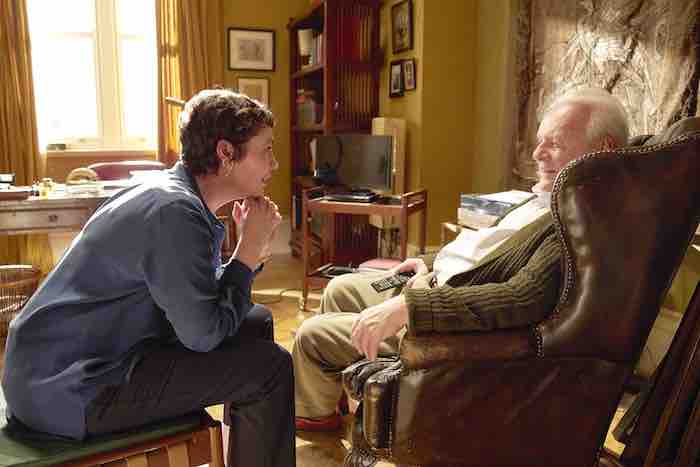
I had no problem with Anthony Hopkins winning the Best Actor Oscar for his performance in Florian Zeller’s screen adaptation of his own play. I saw all the other nominated performances, and only Hopkins’ stood out. Everyone else, including odds-on favorite Chadwick Boseman, did exactly what they were supposed to do in their respective movies. Hopkins, however, not only transcended Zeller’s occasionally gimmicky dramatization of a man confronting dementia, but he brought out his character’s true personality, something the script didn’t necessarily support. If the point of Zeller’s realization was to place the viewer in the main character’s mind, there was always going to be the danger of feeling doubly estranged from the character, but Hopkins’ careful focus on the kernel of the role’s humanity gave the viewer something to grasp, and once you were in his grip, it was difficult to avoid the horror of the situation.

Hopkins plays Anthony, so named because Zeller wrote the screenplay with Hopkins in mind. Unfamiliar with the original French play or the subsequent French movie version that, according to various reviews, seems very, very different from this English version (co-adapted by Christopher Hampton, himself an acclaimed playwright), I have no idea what kind of adjustments Zeller made in order to accommodate Sir Anthony, but the character is firmly within the actor’s wheelhouse: a retired engineer-cum-civil-servant who lives in a lovely London flat surrounded by objects of good taste and doted upon by a daughter, Anne (Olivia Colman), who clearly adores him and only wants him to be happy. In the opening scenes, she tries to set him up with a new home helper (Imogen Poots) in the hopes that he will be easier with her than he was with past helpers. Though this premise is fairly standard for stories that address the indignities of growing old, the various tensions at play—the hushed anxiety beneath Anne’s polite veneer, Anthony’s overbearing flirtatiousness, and the new recruit’s difficulty in navigating between them—is handled so adroitly that you leave the sequence in a state of acute unease that Zeller and Hopkins then exploit to the fullest.

Borrowing from the horror-suspense playbook, Zeller’s direction forces the viewer to question what’s reality and what isn’t, though even that fairly trite approximation doesn’t quite get a handle on the emotional complexities at play. At almost every step, we have to wonder not only whether the people Anthony encounters are really who they say they are, but if this place that seemed so comfortably his really is his. It’s not so much that Zeller masters the art of meaningful contradictions, but that he understands how the human mind naturally reacts to them. He and Hopkins evoke terror and sadness by denying us the comfort of continuity. What’s really horrifying is how inevitable it all seems.

Now playing in Tokyo at Toho Cinemas Chanter Hibiya (050-6868-5001), Toho Cinemas Shinjuku (050-6868-5063), Bunkamura Le Cinema Shibuya (03-3477-9264).

The Father home page in Japanese

photo (c) New Zealand Trust Corporation as Trustee for Elarof Channel Four Television Corporation Trademark Father Limited F Comme Film Cine-@ Orange Studio 2020

Posted in Movies | Tagged , | Leave a comment

Media Mix, May 9, 2021

Ban’ei race

Here’s this week’s Media Mix about a viral video showing a jockey kicking a horse. The point of the piece is that the media tends to be passive about anything that might be perceived as animal abuse, and that pertains to livestock as much as it does to race horses and other animals bred and raised for entertainment purposes. As mentioned in the column, after the video drew criticism, some people involved in the racing business defended the jockey and the sport by saying that it isn’t as bad as it looks, and that line of argument has continued, with the media picking it up but never getting to the other aspect of horse racing that I brought up later in the column—that as soon as a horse becomes unproductive it is killed, because they aren’t bred for anything other than racing or creating other race horses. Granted, ban’ei race horses are draft horses, so they could presumably be put to work, but I really wonder how many farmers, even in Hokkaido, still use horses to pull plows and transport crops. The same thing goes for cockfighting. In one old article I read about Kyoko Honda, the woman who rescues maimed and discarded roosters, one man was interviewed who stages “safe” cockfights in that the birds’ claws are trimmed and the fights do not end in injury or death. Needless, to say, however, this man’s example is the rare exception and it didn’t sway Honda away from her mission to get the sport banned in Okinawa.

Though the Japanese media seems to go out of its way to avoid the obvious about animals raised for sport or food, generally speaking media all over the world do the same thing, even if it’s only a matter of degree. That, in fact, is the moral of the story, so to speak, of two similar documentaries now available on Netflix, Cowspiracy and Seaspiracy, which happen to be from the same production house. Ostensibly, both films address mass food production from the standpoint of the environment and sustainability—the former about livestock farming and the latter about industrial fishing. Both are incredibly destructive to the environment. However, both also end up in the same place where the narrator-directors conclude that eating flesh, whether it be that of mammals, birds, or fish, is morally indefensible for all the suffering it causes. This is, of course, a highly personal determination, but it is a truth that anyone who lives in the world today has to confront on their own terms, and while the media does talk about inhumane conditions for livestock, it usually comes down to the idea that we leave the dirty work to people at the bottom of the economic pyramid or those lingering at the margins of society. One could make the argument that catching and killing your own meat is defensible from a primal standpoint, but like the humane cockfighting presenter mentioned above, it’s the exception that essentially proves the rule, which is that we make other species suffer needlessly for our own sustenance. In that light, making them suffer for our own entertainment seems beyond the pale. 

Posted in Media | Tagged , | Leave a comment

Media Mix, May 2, 2021

Yoshiaki Yoshida

Here’s this week’s Media Mix about bigoted comments made by Yoshiaki Yoshida, the chairman and founder of the cosmetics/health supplement company DHC, and the media reaction. Some marginal matters that didn’t make it into the column but are nevertheless relevant: Originally, I had written the anti-Korean slur in the article because it has appeared in other English-language coverage of the matter but was told by an editor that the word is considered extremely derogatory, on par with the N-word. This would seem to indicate that recognition of anti-Korean hate speech has yet to permeate the culture at large, since even the BBC used the word. Also, last year the magazine Shukan Bunshun reported that Yoshida, reacting badly to the news that his company was no longer the sales leader in the industry, urged employees to blanket fake-post on consumer bulletin boards using pseudonyms to boost the image of DHC’s products while at the same time blasting his own advertising department’s work, saying the ads were “childish.” As pointed out in the column, his beef with Suntory was prompted by his losing market share to the liquor giant, which also sells health supplements, and this brought out his bigoted side more prominently. Bunshun, which seems to have a grudge against the company, also interviewed an employee in January who was fired for having openly criticized Yoshida for his anti-Korean rants and gave Bunshun a recording of a human resources person asking him to quit, which he refused to do, thus forcing the company to dismiss him. In the recording, the human resources person said that hate speech “is not a problem” in the company. The fired employee is suing DHC, seemingly to get his job back. 

One more side note: DHC started out as a translation company that also offered lessons in translating. When Masako and I were first starting out as translators we entered a contest that DHC was running as a means of drumming up students. The winner would receive ¥50,000 and a chance to work for the company as a freelancer. The winning translations (there were two — one for Japanese to English, another for English to Japanese) would also be published. As it happens we won the J to E prize, and while we did receive the money they never asked us to do any work after that. Also they never published our translation, which was of an interview in Japanese with scholar Douglas Lummis, an American who is famous for defending the rights of native Okinawans, which seems ironic now given Yoshida’s reactionary proclivities, including his bigoted feelings toward Okinawans. Less pertinent but still interesting and slightly ironic, Masako’s late father was a Korean immigrant, though there was no way that DHC would have known this because Masako doesn’t bear his name. In any case, a company that deals in translation as a business should be expected to be more tolerant of other cultures, I would think. So maybe Yoshida’s bigotry was something that developed over time; or just became more apparent as he got older and richer.

Posted in Media | Tagged , | Leave a comment

Review: Along the Sea

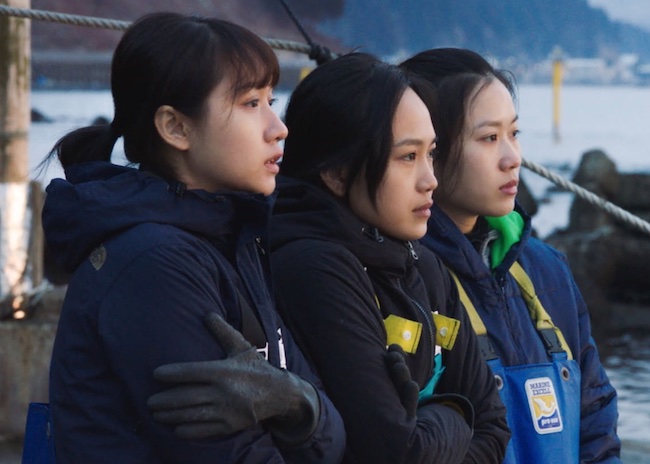
Akio Fujimoto’s Along the Sea does a good job of describing Japan’s arcane technical intern training program without actually explicating its rules and procedures. As such, it also goes a considerable distance in providing an idea of Japan’s attitude toward immigration in general, though for those of us non-Japanese who live here it may feel insufficient given the rank hypocrisy at the heart of the country’s immigration policies. By now, everyone who has ever read about the technical trainee program knows that it is basically a cover for the provision of cheap overseas labor to Japanese businesses without any reciprocal protections for the laborers themselves. Cloaked by the meaningless and anodyne concept of development assistance, the program can’t help but create a kind of parallel universe of brokers and criminal agents who exploit the system for themselves, thus making its supposed beneficiares double victims.

Along the Sea focuses on three trainees, all young Vietnamese women (Vietnam provides approximately half the trainees) who came to Japan with the express aim of making money rather than “learning a skill,” which is the ostensible purpose of the program. When we first meet the women, Phuong (Hoang Phuong), Nhu (Quynh Nhu), and An (Huynh Tuyet Anh), they are already escaping from their assigned positions, where they work 15-hour days in a factory under horrible living conditions, including unpaid overtime. The underground nature of their escape, however, means they leave behind their documentation, which their “employers” withhold in order to keep them hostage, and are thus not only illegally resident in Japan, but unable to return properly to Vietnam.

Their escape is assisted by a broker who has already secured  employment for the women at a fish-packing factory in Aomori Prefecture. For a while the women are happy with their decision, mainly because the pay is better and more secure, which means they can easily send money back to their families in Vietnam; and they have more freedom of movement and actually seem less conspicuous in this sleepy seaside town. However, Phuong eventually falls ill and believes she may be pregnant, a development that puts all three women at risk. Because they have no documentation they cannot access public health care and Phuong turns to a Vietnamese fixer who exploits her situation more brutally than the Japanese authority, which can mostly hide behind bureaucratic layers of cyncism. Eventually, the general paranoia festers, destroying the women’s relationship. 

Fujimoto treats the story with  documentary precision, and thus the viewer may want more information, such as the availability of abortions in Japan (Phuong thinks the father is her boyfriend back home, and pregnant trainees are forbidden from entering Japan) and the distinction between brokers and fixers in terms of what kinds of underground networks they belong to. Such unanswered questions do not detract from the dramatic impetus of the movie, and while the overall production is purposely drab and as contrast-free at the overcast pallor of Aomori, the movie is thought-provoking in an immediate way, which is unusual for a recent Japanese narrative film.

In Vietnamese and Japanese. Now playing in Tokyo at Polepole Higashi Nakano (03-3371-0088).

Along the Sea home page in Japanese

photo (c) 2020 E.x.N K.K./ever rolling films

Posted in Movies | Leave a comment

Media Mix, April 24, 2021

Nagoya torch relay (Chunichi Shimbun)

Here’s this week’s Media Mix about coverage related to the Olympics that doesn’t sit right with the organizers, whether they be local officials or the IOC. I should say more about the Tokyo Shimbun article and video that covered the start of the torch relay in Fukushima. Though I use it in the column as an illustration of how IOC rules vis-a-vis the media sidestep local laws and practices in order to privilege those outlets that have entered into exclusive deals with the Olympics, to the newspaper’s reporters the restrictions in place could have real negative consequences. When locals in Fukushima complained about the “festival atmosphere” during the torch relay event, they weren’t just talking about the “bad taste” aspect, but also the health risks, which has been the main focus of Tokyo Shimbun’s coverage. On April 7, the paper ran another feature about the torch relay as it passed through Nagoya and Aichi Prefecture, reporting on how crowds of spectators were dangerously dense. In this case, a video would have made a particularly strong impact in line with the reporting, but since Tokyo Shimbun couldn’t keep any visuals on its home page for more than 72 hours per IOC rules they had to make do with verbal descriptions about crowds standing “shoulder-to-shoulder” along public roads “3-persons deep,” and how local security teams were having trouble maintaining social distancing guidelines. Needless to say, no TV stations covered the torch relay in this way since most of the networks have some kind of stake in the Olympics, and even if a station doesn’t have a sponsorship deal they still are hesitant to get on the wrong side of the organizers lest they get shut out of future coverage. 

But even if that weren’t the case, would TV stations cover the torch relay and other Olympics promotional events with a critical eye? When NHK broadcast a livestream of the torch relay as it passed through Nagano city on April 1, some viewers noticed that the sound was cut out for about 30 seconds after it was apparent that protesters in the background were chanting anti-Olympics slogans. A wave of indignation swept through social media, accusing NHK of shutting out dissident voices and distorting its news coverage. One explanation is that security stopped the demonstration due to the loud chanting, which goes against COVID-prevention protocols, but it’s obvious from the resulting footage that somebody muted the sound itself. Organizers responded by saying that the presentation of the video was NHK’s concern and the organizers had nothing to do with it. When Mainichi Shimbun, which, as pointed out in the column, has been the most conscientious of the sponsoring daily newspapers in its coverage of the Olympics in general (Asahi has, too, but mostly in its editorials), asked NHK why it cut out the sound, the publicity person referred to “various circumstances” without elaborating, though they didn’t deny that the sound had been altered. NHK, of course, will be one of the main broadcasters of the Games, but, given their history of avoiding certain controversies for the sake of decorum, it seems just as likely that NHK’s decision to cut the mic mid-protest was more reflexive than cautionary. 

Posted in Media | Tagged | Leave a comment

Review: Caught in the Net

The clever, almost flippant title of this Czech documentary betrays its slightly self-congratulatory tone. Though the topic is a very serious one—pederasts stalking children online—the focus on superior production values and the game-like execution counteracts the seriousness to a certain extent. For all the disgust certain scenes will surely provoke in viewers, the movie seems almost beside the point, and I can’t help but feel that a more effective documentary about the sexual victimization of children could have been made without the reality show trappings.

Granted, the enterprise concocted and recorded by filmmakers Vit Klusak and Barbora Chalupova is presented as an “experiment” that mostly investigates the permeability of social media and how those without proper defenses due to lack of maturity can be taken advantage of. Right at the start of the film we are shown statistics stating that 41 percent of Czech children have received unsolicited pornographic images online from other people. The parameters of the experiment are explained clinically and also in a slightly conspiratorial fashion. The directors put out a casting call for young female actors over the age of 18 to arrive wearing children’s clothing. Twenty-three show up and each is told her task if selected: she will impersonate a 12-year-old girl who joins a number of social networks with the purpose of attracting men who stalk pre-teen girls for sexual gratification. Those auditioning for the part explain, often in lurid detail, some of their own experiences with sexual abuse. Three are selected, and then an elaborate set is constructed on a soundstage consisting of three bedrooms that simulate the individual actors’ respective spaces when they themselves were 12 years old, complete with actual artifacts from their childhoods. Computers are set up and connected to video recording equipment that will be monitored by a large staff, including psychologists, lawyers, social workers, and sexologists, who are on hand to make sure things don’t get too intense for the actors, which, of course, they do.

The experiment lasts for ten days, during which the three women are contacted by a total of 2,548 men, who mostly interact with the women through Skype. Their faces are creepily masked, and they often freely admit that they are masturbating as they talk to the women, who are clearly distressed by the fact though they’ve been warned this will happen. In almost all the cases recorded, the men not only show the women their penises, but request that they remove articles of clothing themselves or demand they send nude photos of themselves. In fact, in order to extend the experiment, the producers hire outside models to act as body doubles for the women so that they can send the nude photos requested. In at least one case, an interlocutor uses the photo for blackmail purposes. (As a kind of antidote to the queasy mood, they include one young man who goes online just to talk and then commiserates so honestly with one of the women about the horridness of most men that the interaction brings tears to the eyes of everyone listening.) The whole endeavor is capped by in-person meetings in a cafe with 21 of the men and then a contentious encounter with one outside his home where the filmmakers reveal their project and accuse him of illegal acts. 

The film does explicate how shockingly widespread child stalking is on the internet, and many of the encounters reveal the mindset behind such actions, which often come down to simple misogyny (in his defense, the man confronted at the end of the movie blames the girls for coming on to him); and a final title card mentions that the data collected during the experiment was eventually handed over to the police, who are now “investigating” the men depicted. But the overall impression is of a very sophisticated stunt that produced interesting results that probably could have been produced in a way that was less sensational. 

In Czech. Now playing in Tokyo at Human Trust Cinema Shibuya (03-5468-5551), Shinjuku Musashinokan (03-3354-5670). 

Caught in the Net home page in Japanese

photo (c) Milan Jaros, 2020 Hypermarket Film, Czech Television, Peter Kerekes, Radio and Television of Slovakia, Helium Film

Posted in Movies | Leave a comment

Review: The Booksellers

D.W. Young’s engrossing documentary attempts to make a case for the physically printed word as the most viable means of extending culture into the future, but  because it focuses on rare booksellers it invariably makes that case as a construct of capitalism, and I don’t think that was Young’s intention. At one point near the end of the movie an expert comes out and says that young people, or, at least, young New Yorkers, are rejecting digital reading platforms for paper and theorizes that technology like Kindle was developed and used mainly by boomers whose eyesight was starting to go. It’s a quaint but rather difficult idea to defend empirically (he seems to base this theory on observations he made on the subway), and, in any event, contrasted with the narrative that Young presented prior to this assertion, simply sounds like the conclusion of someone with a vested interest in trade paperbacks.

The main subject of the movie is books as artifacts–as works of art distinct but not separate from the art of the writing they contain. Revived New York essayist/iconoclast Fran Lebowitz puts it best when she says saltily that she would kill anyone who dared place their drink on a book, any book. Books are living things, she says, which is why she can’t countenance anyone “throwing them away,” no matter what kind of literature they deliver. In that regard, Young might have gained a lot of traction by reporting on regular book stores that are going out of business (or coming back, as some media have reported) due to or despite digital pressure, but instead he hangs out with the fringe of the business, those who collect books obsessively and then trade the rarest of them for ever-increasing amounts of money. As such, the movie has the kind of musty, low-lit atmosphere that antique book stores give off. The sellers themselves are, for the most part, quiet and serious, though Young makes a point of interviewing members who don’t fit the stereotyped majority, meaning middle aged men in tweedy outfits with bad haircuts. There are women and people of color, who point out how hard a time they have doing business with the leaders in the field. There’s also a brief shout-out to rare magazine fans, which at least brings the business into the 20th century.

Unfortunately, Young seems to assume that the viewer cares more about the state of books than the state of literature, and consequently it feels like it’s aimed at a niche audience that already has its mind made up. For one thing, he often neglects to identify the person on screen or the place where the interview is taking place, which is odd for a documentary about documentation. In a sense, he’s more interested in conveying the excitement of the physical world of books than he is in the act of reading, and, in my mind, at least, the two are inseparable. 

Now playing in Tokyo at Human Trust Cinema Yurakucho (03-6259-8608), Shinjuku Cinema Qualite (03-3352-5645). 

The Booksellers home page in Japanese

photo (c) 2019 Blackletter Films LLC

Posted in Movies | Leave a comment