
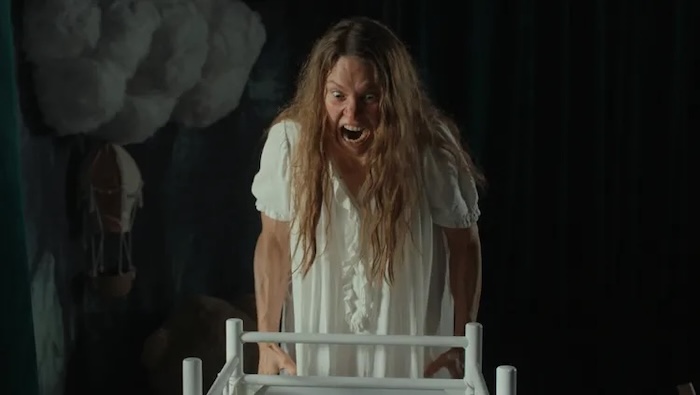
Though I’m sure there were cinematic treatments of the horrors of new motherhood before Rosemary’s Baby, it was Roman Polanski’s adaptation of Ira Levin’s bestseller that first interpreted the phenomenon as a literal horror story, and we’ve have many variations on the theme since then. Nightborn takes a folk horror approach to the subject of post partum depression, a theme that’s been ripe for the picking lately by woman directors like Lynne Ramsay and Mary Bronstein. The movie’s director, Hanna Bergholm, is Finnish, and sets her story in a creepy, dark Finnish forest that the protagonist, a newlywed named Saga (Seiki Haarla), knew as a child because her grandmother lived in a big old house there surrounded by junk that, she was told, kept the forest’s malevolence at bay. So when Saga’s new British husband, Jon (Rupert Grint), endeavors to remove the junk from the property so they can fix up the delapidated house as their own home, you already know they’re in for it.
It’s clear that whatever subtexts Bergholm wants to impart about the psychological pitfalls of giving birth, she’s more intent on telling a straightforward Tale from the Crypt, and Nightborn essentially takes Rosemary’s Baby to its natural end. Nine months after Saga and Jon make love in the squishy moss under a forbidding looking tree in the forest, Saga goes through a very difficult labor and immediately feels that there’s something wrong with her new son, whom she impulsively names Kuura. What’s weird is that no one else seems to think Kuura is strange, despite that fact that the child has a distressingly shrill crying voice and draws blood when he suckles. Bergholm emphasizes this disconnect by never showing Kuura’s face, always having it turned away from the camera or hidden in shadow. As the baby starts to grow it develops a taste not only for blood but meat that Saga has no choice but to satisfy, a decision that Jon finds repugnant without even trying to understand, even as the forest itself starts encroaching more aggressively on the house. Family from both sides of the marriage come and go and tend to take Jon’s incurious side, thus driving Saga deeper into depression and frustration. Though she hates the baby, she also feels protective of it.
As a horror film, Nightborn is long on gore and short on scares, which may be the point. Even if Bergholm is avoiding metaphors, it’s obvious that her sympathies for Saga’s situation are at the expense of everyone else, especially Jon who, despite his genuine fear for Saga’s wellbeing, refuses to admit to what’s happening right before his eyes. In the end, Saga is forced to face her demon baby by herself, meaning she’s alone in her despair, and that’s a pretty chilling take on the so-called maternal instinct.
In English and Finnish. Now playing in Tokyo at Human Trust Cinema Shibuya (03-5468-5551), Toho Cinemas Changer Hibiya (050-6868-5001), Kino Cinema Shinjuku (03-5315-0978).
Nightborn home page in Japanese
photo (c) 2025 Elokuvayh/o Komee4a Oy, Filmai LT, Bluelight, Getaway

