
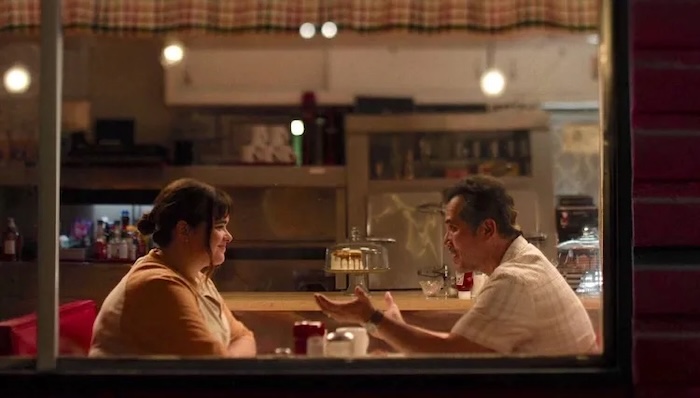
One of the nicer touches in Tracie Laymon’s reportedly semi-autobiographical movie, Bob Trevino Likes It, is the perpetually cracked screen on the cell phone used by the protagonist, Lily Trevino (Barbara Ferreira). As the title suggests, Lily spends an awful lot of time checking her social media feeds and messages, and the condition of the screen, which is never explained nor repaired, becomes a constant reminder of how damaged Lily’s life is. A private care worker living in a nameless American Midwest suburb, the twenty-something Lily walks around with a huge chip on her shoulder thanks to her emotionally abusive father, Bob (French Stewart), who still hasn’t gotten over Lily’s drug-addicted mother walking out on them many years ago and takes his frustrations with the world out on his daughter. Lily internalizes his insults and complaints, seething at his selfishness but afraid that any pushback on her part will just drive him further away, but with each passing encounter her self-hatred and fear of abandonment only increases, to the point that when she finally seeks help from a therapist (Ashlyn Moore), the therapist breaks down in tears after Lily tells her story. Did I say that Bob Trevino Likes It is a comedy?
Well, it is for most of its first half, during which we get the lay of the land of Lily’s psyche, her tendency to seek help by any means necessary on the internet, and the relationships that keep her going—or not. Following a particularly disastrous dinner outing with her father and a middle aged woman he hopes to get jiggy with (“You gotta make me look good,” is her father’s demand), Lily is banished from his life (it’s implied this isn’t the first time he’s done so) and she goes into a depressive tailspin, desperately trying to figure out how to get back into his relatively good graces. While searching Facebook she comes across what she believes is her father’s page, which is doubly perplexing because she didn’t know he had one, but when she tries to friend him she discovers the page belongs to a different Bob Trevino. He accepts her request, thus opening a door to a new relationship. As it turns out, this other Bob (John Leguizamo) is not only her father’s age, but also someone going through his own family-oriented turmoil: He lost a child, a tragedy his wife, like Lily’s father, can’t get past. They eventually meet, and while acquaintances and strangers find their budding friendship unsavory, they turn out to be exactly what each other needs.
Though at first Lily seems desperate for a father figure who acts the way she believes a father should act, eventually she sees how Bob needs her not as a substitute offspring but as someone who proves to him just by listening that he has value as a human being. It goes without saying that Lily really only wants the same thing, and their give-and-take is heartfelt and grounded in the redemptive power of unselfish love. However, all the other characters are written as stereotypes: the haplessly cruel parent, the ineffective social worker, the deluded spouse, the fair weather friend, and countless minor players who might as well have no faces to go with their respective single defining traits that merely add ballast to the plot. Warning: You will cry your eyes out in the end, but you may wonder if the movie deserves your tears.

A difficult father-daughter relationship also centers the drama in Linka Linka, the debut feature of Tibetan writer-director Kangdrun, whose take on the Tibet Autonomous Region of China eschews most of the cultural peculiarites and sweeping mountain vistas and steppes characteristic of films from the area, instead concentrating on the social milieu of the capital city of Lhasa, which is much more cosmopolitan than you might expect, especially for young people, who are shown dancing in nightclubs and engaging with one another mostly online. Like Kangdrun, the protagonist of the film, Samgyi (Tsering Yangkyi), is sent to Shanghai at an early age to receive her education, and when she returns years later she is a budding filmmaker who intends to make her first fiction feature about a formative event in her girlhood that, at the time, traumatized her and her best friend. However, more than dredging up some bitter feelings in the process, Samgyi’s return also preciptates a reckoning with her musician father, who disapproves of her choice of profession, an attitude that renders what was once a loving relationship into a prickly one.
Linka Linka (the title refers to a kind of traditional picnic) has a dual structure, alternating between Samgyi struggling to make her movie on location in Lhasa and flashbacks to her adolescence when the formative incident the movie is about took place. Kangdrun often complicates this structure by further bifurcating the flashback tale between what supposedly happened in her mind and how she describes it in the movie-within-the-movie. At issue is a lost wallet whose provenance figures prominently in the fates of Samgyi and her best friend, Lhamo. Each friend remembered the incident differently, which is why they never spoke afterwards. This disconnect carries over to the viewer, who automatically wonders how reliable a narrator Samgyi is.
The resolution of the central mystery turns out to be less consequential than the idea that you can go home again and take up where you left off, at least emotionally. Due to Kangdrun’s ambitious approach to storytelling, the movie sometimes gets away from its premise, and the sideshows are so enchanting that the viewer can be forgiven for losing the thread of the plot. I wanted to know a lot more about Suoso (Ze Ren Dun Zhu), Samgyi’s fashion-conscious influencer pen pal, who essentially represents contemporary Tibetan youth in their desire to embrace the wider world. His presence is conceived as comic relief, but he’s got more soul than anyone else in the movie.
Bob Trevino Likes It opens Sept. 11 in Tokyo at Human Trust Cinema Yurakucho (03-6259-8608), Human Trust Cinema Shibuya (03-5468-5551), Shinjuku Musahinokan (03-3354-5670).
Linka Linka, in Tibetan and Mandarin, opens Sept. 11 in Tokyo at Human Trust Cinema Yurakucho (03-6259-8608).
Bob Trevino Likes It home page in Japanese
Linka Linka home page in Japanese
Bob Trevino Likes It photo (c) 2024 Chosen Family, LLC
Linka Linka photo (c) Tibetan Antelope Films Co., Ltd.

