
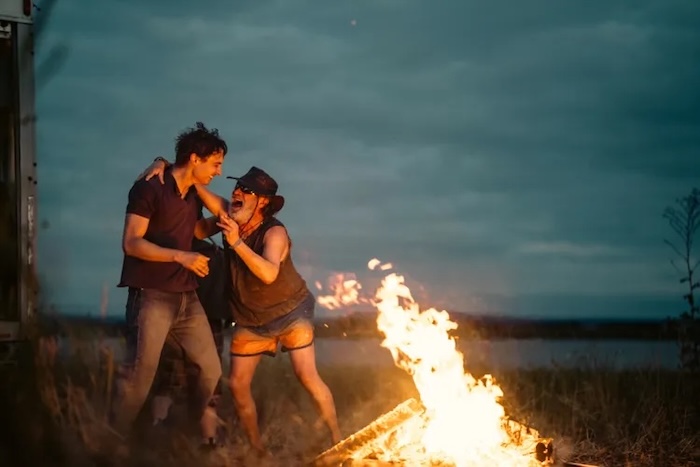
European filmmakers do addiction and homelessness better than their North American or Asian counterparts, mainly because they avoid the sentimentality and presumably requisite pathos often associated with depictions of both conditions. In terms of British representation, I’d like to think this quality has something to do with Ken Loach, who has made explorations of the indignities of living on the margins his metier, but it probably has more to do with British naturalism, a staple of UK cinematic style that stretches back before Kes. The UK actor Harris Dickinson has chosen to look squarely at both conditions in his debut directorial feature, Urchin, which focuses on one individual, Mike (Frank Dillane), who is already at the bottom when we see him, sleeping rough on a London sidewalk within earshot of a Christian street preacher who seems oblivious to his plight.
Dickinson, who also wrote the script, doesn’t provide any background on the twenty-something Mike except a tossed-aside comment that he was adopted, and we aren’t given any clue as to how he ended up in his situation. His panhandling method is totally ineffectual, thus lending creedence to the old saying that homelessness is hard work. Moreover, maintaining his habit, which seems to encompass both alcohol and any illicit drug, feels random and sloppy. He essentially hits up other junkies for scores, including a skinny guy named Nathan (Dickinson himself) who looks worse off than him. Eventually, he does the unspeakable and mugs a man who is trying to help him get a meal. He gets caught and sent to prison for 8 months, where he kicks his habit and seems ready to lead a straight life. Dickinson includes a rather lengthy scene in which a social worker explains to Mike his new digs in a halfway house and his mandatory counseling sessions, a scene that recalls the best kind of expository work by Loach. After Mike starts working at a cheap hotel in the kitchen, he seems on the road to recovery. He even manages to make friends with a pair of female co-workers who take him out for a night of karaoke that Dickinson stages for ultimate empathetic value.
But if you’ve seen this kind of story before, whether by Loach or anyone else, you know the routine: Mike will fall down and get back up and fall down again. His flaw is a total lack of courage when he has to confront his true nature, so when his counselor suggests he meet with the man he mugged, he disintegrates. Later, the same thing happens when he falls in love with a fellow worker named Andrea (Megan Northam), who is attracted to his wounded candor but soon realizes how immature he is. He flinches and that’s that. The movie’s rock is Frank Dillane, who subtly shows us Mike’s insecurities in ways that feel not only natural, but insightful. And then Dickinson compromises these choices with occasional cutaways to Mike’s fantasy world, which explain really nothing and, in the end, just makes it hard to decide if Mike has any future at all. Probably not.
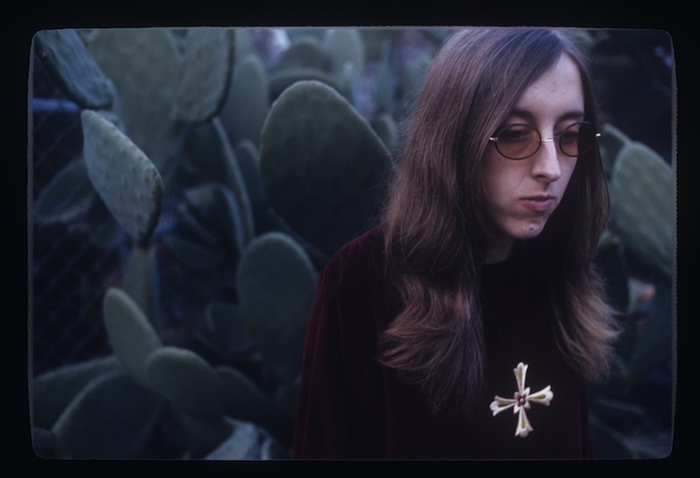
The singer-songwriter Judee Sill was herself homeless for a time and a junkie for most of her adult existence. She died from drug-related causes at the age of 35 in 1979. These aspects of her life were not hidden. If anything, she talked about them openly, even enthusiastically (she also admitted to being a prostitute, though some people who knew her felt she often resorted to hyperbole). The documentary Lost Angel: The Genius of Judee Sill does a good job of connecting Sill’s personal problems to the uniqueness of her songs, even if it’s a bit pokey in execution.
A native Californian whose father owned a tavern with a piano, Sill was mostly self-taught as a musician, but after her father died when she was only 6 her mother remarried a man who reportedly abused her, so she ran away and fell in with a bunch of street thieves. In a juvenile reformatory she got into gospel music, which not only juiced her piano-playing skills but gave her religion that she never shook. However, after getting out her mother died of alcoholism and, unwilling to live with her stepfather, ran away again, this time shacking up with jazz musicians—she supposedly turned into a wicked bass player—who used big time. After quickly developing a $150-a-day habit she was busted repeatedly. It was at this point, around 1968, that she became a singer-songwriter and started hanging out at the clubs on the Sunset Strip, where a young David Geffen found her odd songs fusing spiritual ecstasy with romantic longing, classical-style melodies, and exaggerated vowels compelling enough to help her get an agent. Some years later when Geffen launched Asylum Records, the premiere Laurel Canyon folk-rock sanctuary, Sill was the first artist he signed.
Plenty of famous contemporary talking heads, including Jackson Browne, Graham Nash, and J.D. Souther, a former lover, attest to Sill’s musical genius. Her journals, which are reproduced graphically, contain reams of self-lacerating prose that reveal she knew just how great she was but would never be able to break through in a commercial way. It takes someone like Linda Ronstadt (interviewed over the phone) to point out that Sill, who was not “conventionally beautiful” by the standards of early 70s rock-related show biz, was difficult to promote by Geffen or anybody else, and so while her more successful peers were in awe of her gifts, the public could not care less. For sure, her defeated nature fed her addictions, but it was the character of the business that denied her the living she deserved. Ironically or not, she is now revered as a foundational influence by many present-day indie folk artists, some of whom are also interviewed, including Natalie Mering (Weyes Blood) and Adrianne Lenker and Buck Meek of Big Thief, who sing her praises to high heaven. The movie isn’t likely to draw a lot of people, but those who see it will certainly want to check out her music, which is where its real value lies.
Urchin now playing in Tokyo at Human Trust Cinema Shibuya (03-5468-5551), Shinjuku Musashinokan (03-3354-5670).
Lost Angel: The Genius of Judee Sill now playing in Tokyo at Yebisu Garden Cinema (0570-783-715).
Urchin home page in Japanese
Lost Angel: The Genius of Judee Sill home page in Japanese
Urchin photo (c) Dream Space Films Ltd/British Broadcasting Corporation/The British Film Institute 2025
Lost Angel: The Genius of Judee Sill photo (c) 2023 Onwards & Upwards LLC. Exclusively licensed to TAMT Co., Ltd. in Japan

